Financial Accounting > SOLUTIONS MANUAL > CHAPTER 21 CAPITAL BUDGETING AND COST ANALYSIS: ANSWERS. (All)
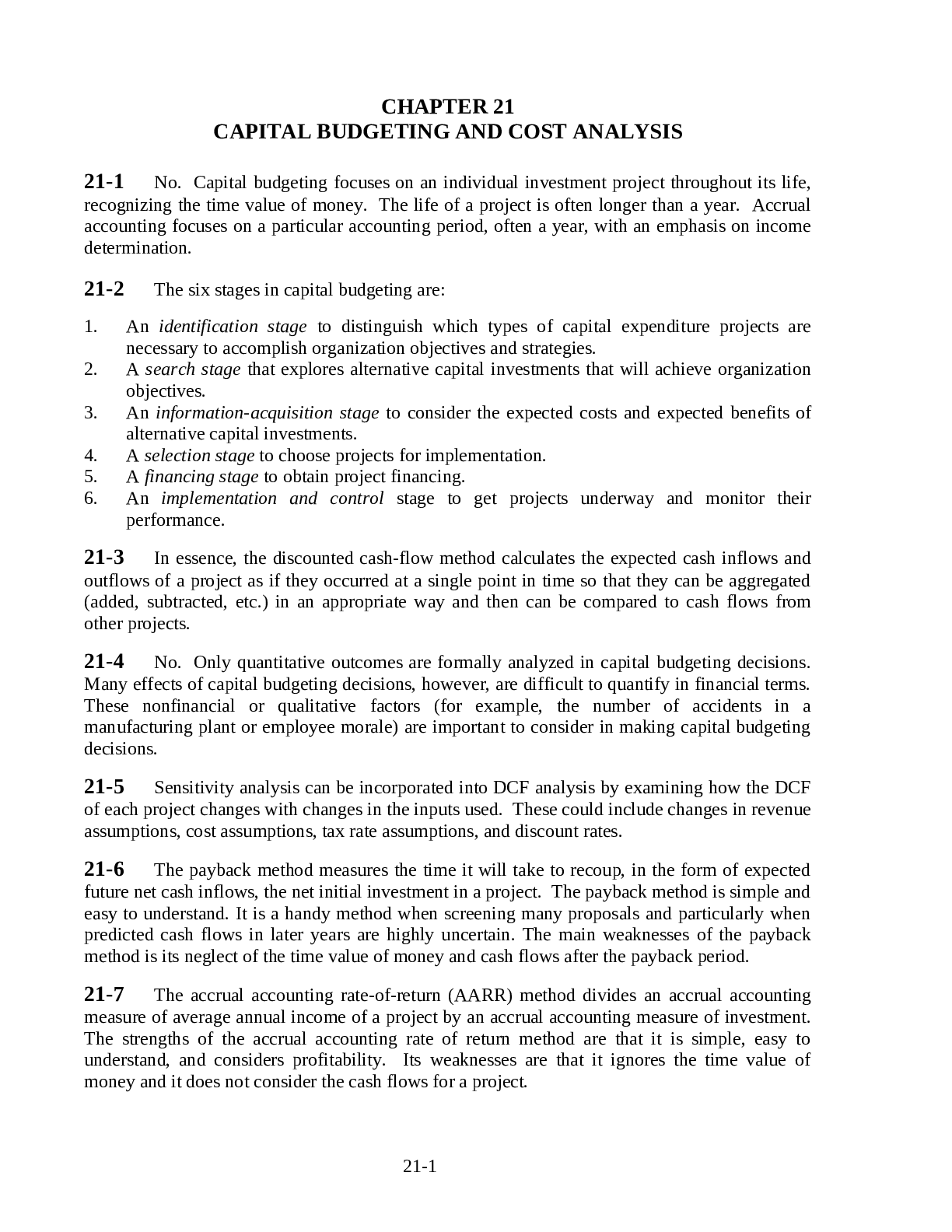
21-1 No. Capital budgeting focuses on an individual investment project throughout its life, recognizing the time value of money. The life of a project is often longer than a year. Accrual accounting ... focuses on a particular accounting period, often a year, with an emphasis on income determination. 21-2 The six stages in capital budgeting are: 1. An identification stage to distinguish which types of capital expenditure projects are necessary to accomplish organization objectives and strategies. 2. A search stage that explores alternative capital investments that will achieve organization objectives. 3. An information-acquisition stage to consider the expected costs and expected benefits of alternative capital investments. 4. A selection stage to choose projects for implementation. 5. A financing stage to obtain project financing. 6. An implementation and control stage to get projects underway and monitor their performance. 21-3 In essence, the discounted cash-flow method calculates the expected cash inflows and outflows of a project as if they occurred at a single point in time so that they can be aggregated (added, subtracted, etc.) in an appropriate way and then can be compared to cash flows from other projects. 21-4 No. Only quantitative outcomes are formally analyzed in capital budgeting decisions. Many effects of capital budgeting decisions, however, are difficult to quantify in financial terms. These nonfinancial or qualitative factors (for example, the number of accidents in a manufacturing plant or employee morale) are important to consider in making capital budgeting decisions. 21-5 Sensitivity analysis can be incorporated into DCF analysis by examining how the DCF of each project changes with changes in the inputs used. These could include changes in revenue assumptions, cost assumptions, tax rate assumptions, and discount rates. 21-6 The payback method measures the time it will take to recoup, in the form of expected future net cash inflows, the net initial investment in a project. The payback method is simple and easy to understand. It is a handy method when screening many proposals and particularly when predicted cash flows in later years are highly uncertain. The main weaknesses of the payback method is its neglect of the time value of money and cash flows after the payback period. 21-7 The accrual accounting rate-of-return (AARR) method divides an accrual accounting measure of average annual income of a project by an accrual accounting measure of investment. The strengths of the accrual accounting rate of return method are that it is simple, easy to understand, and considers profitability. Its weaknesses are that it ignores the time value of money and it does not consider the cash flows for a project. [Show More]
Last updated: 2 years ago
Preview 1 out of 49 pages
Buy this document to get the full access instantly
Instant Download Access after purchase
Buy NowInstant download
We Accept:
Can't find what you want? Try our AI powered Search
Connected school, study & course
About the document
Uploaded On
Jun 25, 2021
Number of pages
49
Written in
All
This document has been written for:
Uploaded
Jun 25, 2021
Downloads
0
Views
93
Scholarfriends.com Online Platform by Browsegrades Inc. 651N South Broad St, Middletown DE. United States.
We're available through e-mail, Twitter, Facebook, and live chat.
FAQ
Questions? Leave a message!
Copyright © Scholarfriends · High quality services·