Guided Reading & Analysis: The Rise of Industrial America, 1865-11900
Chapter 16- The Second Industrial Revolution pp 318-332
Reading Assignment:
Ch. 16 AMSCO or other source for Period 6
Purpose:
This guide is not
...
Guided Reading & Analysis: The Rise of Industrial America, 1865-11900
Chapter 16- The Second Industrial Revolution pp 318-332
Reading Assignment:
Ch. 16 AMSCO or other source for Period 6
Purpose:
This guide is not only a place to record notes as you read, but also to provide a place and
structure for reflections and analysis using your noggin (thinking skills) with new knowledge
gained from the reading. This guide, if THOUGHFULLY completed in its entirety
BOP (Beginning of Period) by the due date, can be used on the corresponding quiz as
well as earn up to 10 bonus points. In addition, completed guides provide the student with
the ability to correct a quiz for ½ points back! The benefits of such activities, however, go far
beyond quiz help and bonus points.
Mastery of the course and AP exam await all who choose to process the information
as they read/receive. This is an optional assignment.
So… young Jedi… what is your choice? Do? Or do not? There is no try.
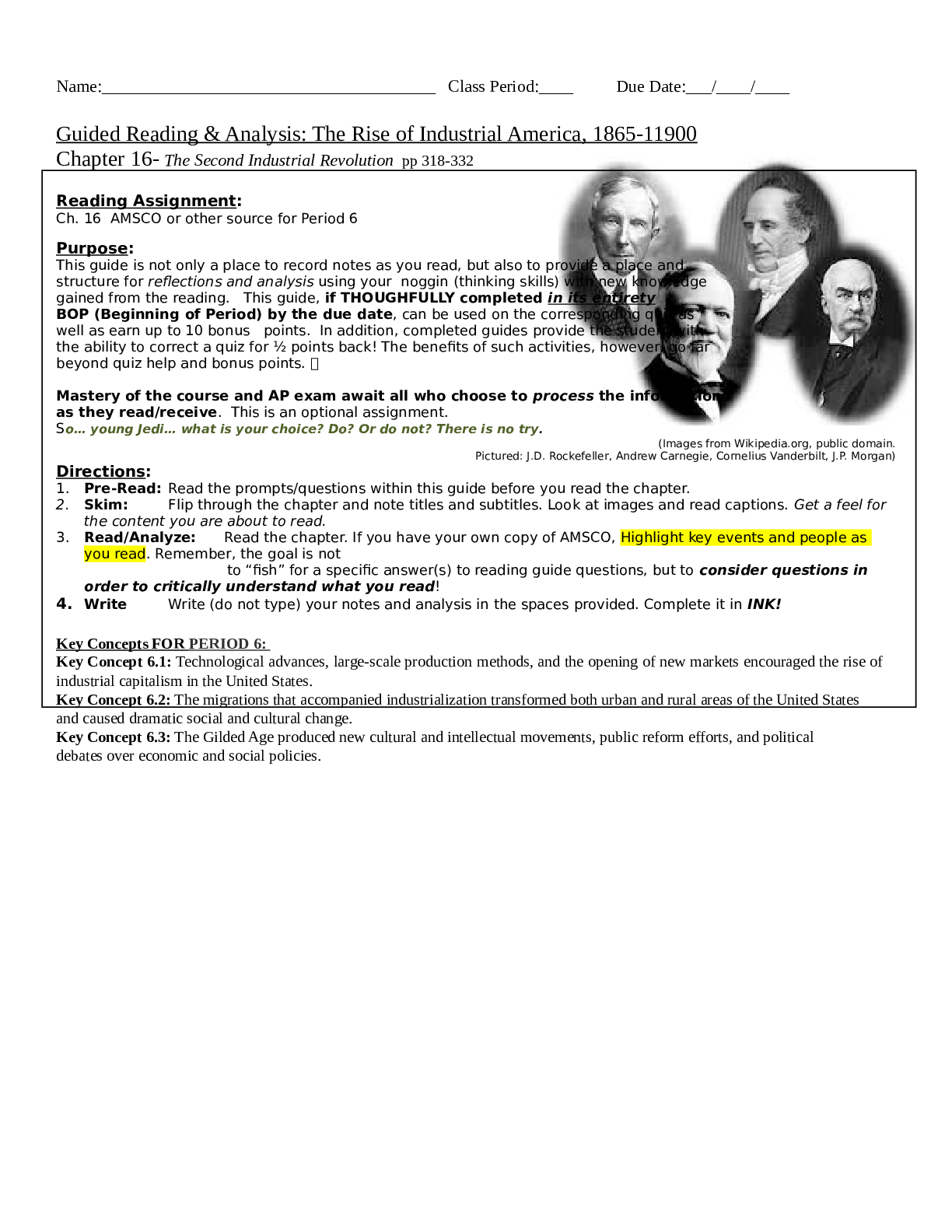
(Images from Wikipedia.org, public domain.
Pictured: J.D. Rockefeller, Andrew Carnegie, Cornelius Vanderbilt, J.P. Morgan)
Directions:
1. Pre-Read: Read the prompts/questions within this guide before you read the chapter.
2. Skim: Flip through the chapter and note titles and subtitles. Look at images and read captions. Get a feel for
the content you are about to read.
3. Read/Analyze: Read the chapter. If you have your own copy of AMSCO, Highlight key events and people as
you read. Remember, the goal is not
to “fish” for a specific answer(s) to reading guide questions, but to consider questions in
order to critically understand what you read!
4. Write Write (do not type) your notes and analysis in the spaces provided. Complete it in INK!
Key Concepts FOR PERIOD 6:
Key Concept 6.1: Technological advances, large-scale production methods, and the opening of new markets encouraged the rise of
industrial capitalism in the United States.
Key Concept 6.2: The migrations that accompanied industrialization transformed both urban and rural areas of the United States
and caused dramatic social and cultural change.
Key Concept 6.3: The Gilded Age produced new cultural and intellectual movements, public reform efforts, and political
debates over economic and social policies.Section 1 Introduction to Period 6, page 318
Key Concepts
and Main Ideas Notes Analysis
The
transformati
on of the
United
States from
an
agricultural
to an
increasingly
industrialize
d and
urbanized
society
brought
about
significant
economic,
political,
diplomatic,
social,
environment
al, and
cultural
changes.
Overview…
Options for Labeling This Era
a. Second industrial revolution
b. Railroad Era
c. Last Frontier
d. Gilded Age
e. End of the Indian Wars
Alternate View…
Ending the period in cuts off the early reformation
movements.
Define the parameters of this unit, and
explain how the era is bookmarked by
major turning points.
The unit talks about improvements in the
industry, economics and the politics in
America. Some of which were railroads and
the success of the steel industry.
In addition to industrialization, other
forces that impacted the growth of the
nation were:
a. New waves of immigration
b. Reformers
c. Labor Unions
d. Farmer organizations
e. Growing middle class
Section 2 Guided Reading
1. Introduction to the Industrial Revolution, page 319
Key Concepts
&
Main Ideas
Notes
The
transformation
of the United
States from an
agricultural to
an increasingly
industrialized
and urbanized
society brought
about significant
economic,
political,
diplomatic,
social,
environmental,
and cultural
changes.
According to President Grover Cleveland, what was the main problem created by
industrialization in the late 19th century?
The lack of concern for the treatment of the workers and increase in monopoly.
The factors that enabled the rapid growth of the American economy
included…
1) The country had many raw materials that were essential to industrialization
2) Abundant labor supply
3) Growing population and an advanced transportation network
4) Wealthy Europeans invested in the economic expansion
5) Development of labor-saving technologies
6) Businesses were benefitting from government policies that protected certain
things.7) Talented entrepreneurs emerged
Of these seven factors, which one had the greatest impact on rapid economic
growth?
Which one had the smallest impact? Explain your reasoning.
The labor saving technologies had the greatest impact because it made work faster
and more efficient with less workers.
The abundant labor supply had the least as industrialization became more advanced,
less workers were actually needed.
REMEMBER…As you read the chapter, jot down your notes in the middle column. Consider your notes to
be elaborations on the Objectives and Main Ideas presented in the left column and in the subtitles of the
text. INCLUDE IN YOUR NOTES ALL SIGNIFICANT VOCABULARY AND PEOPLE. After read and take notes,
thoughtfully, analyze what you read by answering the questions in the right column. Remember this step
is essential to your processing of information. Completing this guide thoughtfully will increase your
retention as well as your comprehension!
2. The Business of Railroads, pp 320-322
Key Concepts
and Main Ideas Notes Analysis
Following the
Civil War,
government
subsidies for
transportation
and
communication
systems
opened new
markets in
North
America…
The Business of Railroads…
The railroads created a national market, this
encouraged mass production, mass
consumption, and economic specialization. It
promoted the growth of the steel and coal
industries.
Which Act created the first federally
funded railroad?
The Pacific Railroad Act
Why were time zones needed?
They allowed for the proper arrival and
departure time across the country for the
railroads.
The Business of Railroads Continued…
Key
Concepts
& Main
Ideas
Notes AnalysisLarge-scale
production
—
accompani
ed by
massive
technologic
al change,
expanding
internation
al
communica
tion
networks,
and progrowth
governmen
t policies —
fueled the
developme
nt of a
“Gilded
Age”
marked by
an
emphasis
on
consumptio
n,
marketing,
and
business
consolidati
on.
Farmers
adapted to
the new
realities of
mechaniz
ed
agricultur
e and
dependenc
e on the
evolving
railroad
system by
creating
local and
regional
organizati
ons that
sought to
resist
corporate
control of
agricultural
markets.
Business
leaders
consolidate
Eastern Trunk Lines…
A major route between two cities with smaller branch
lines that connect the trunk line with outlying towns.
Commodore Cornelius Vanderbilt…
Used profits from steamboats to merge local railroads
into the New York
Central Railroad
Western Railroads…
The railroad building coincided with the settlement of
the last frontier.
Federal Land Grants…
The government gave 80 railroad companies land. The
land grants promoted poor construction and government
corruption.
Transcontinental Railroads…
2 companies divided the task of connecting railroads
from California to the rest of the Union. The two
railroads came together in Utah.
Competition and Consolidation…
The over building of railroads between the 1870’s and
1880’s. The railroads suffered from mismanagement and
fraud.
Jay Gould…
Sold assets and water stock.
Railroads tried to recover by offering rebates and
kickbacks to favored
shippers
J.P. Morgan…
Stabilized rates and reduced railroad debt during the
panic of 1893.
Granger Laws…
Laws passed by Midwestern states that were overturned
in courts, tried
to regulate railroads.
Explain the negative impact of
government subsidies for
railroads.
It encouraged poor quality
building of the railroads.
Compare and contrast Irish and
Chinese railroad workers.
Similarities:
Immigrant groups hired for
cheap labor
Differences:
The conditions that each grou
[Show More]


.png)