PN2 Exam 1 Study Guide (updated) – Rasmussen College
EXAM 1
• Discuss communication practices necessary for patient-centered care and teamwork (Knowledge, skills and attitudes)
o Communication is an integral compo
...
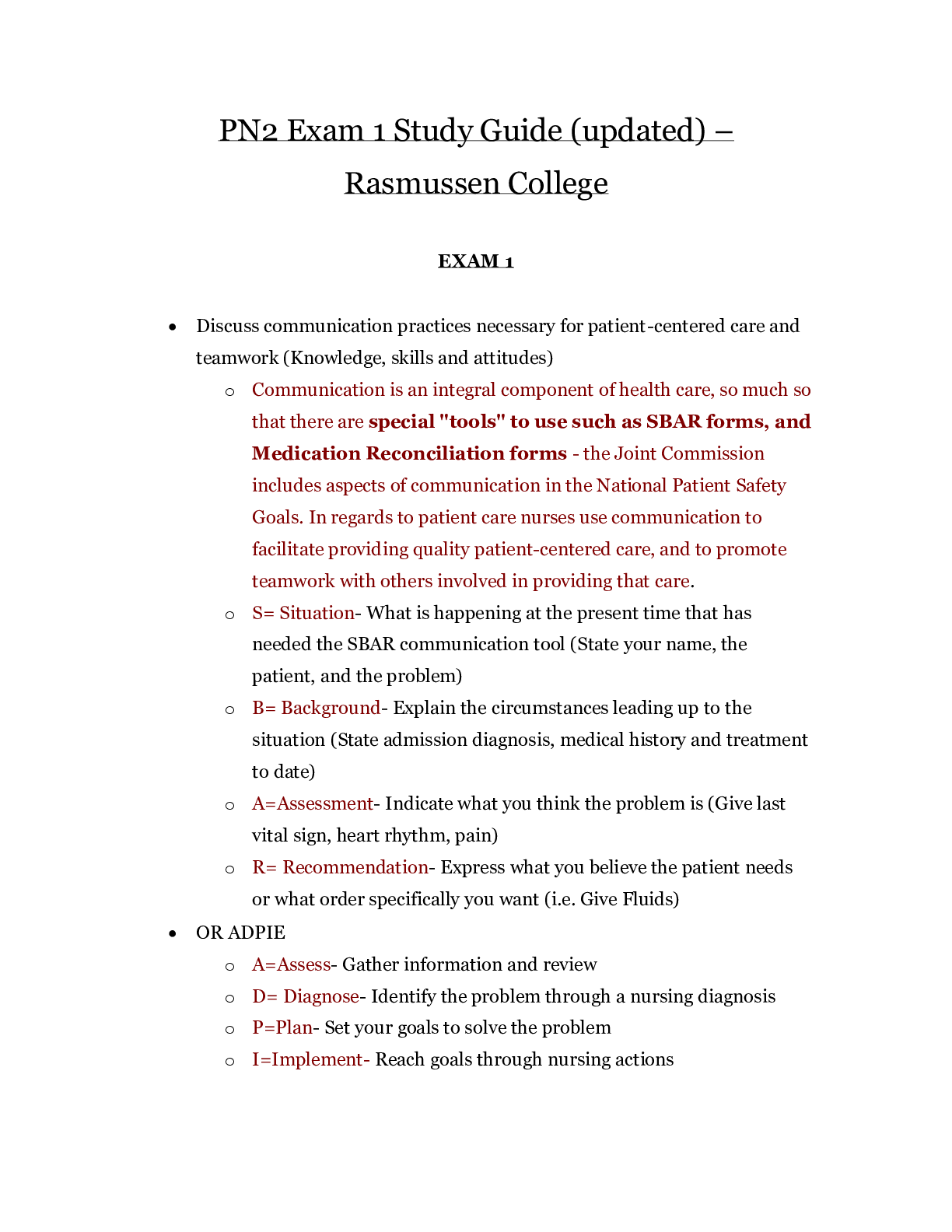
PN2 Exam 1 Study Guide (updated) – Rasmussen College
EXAM 1
• Discuss communication practices necessary for patient-centered care and teamwork (Knowledge, skills and attitudes)
o Communication is an integral component of health care, so much so that there are special "tools" to use such as SBAR forms, and Medication Reconciliation forms - the Joint Commission includes aspects of communication in the National Patient Safety Goals. In regards to patient care nurses use communication to facilitate providing quality patient-centered care, and to promote teamwork with others involved in providing that care.
o S= Situation- What is happening at the present time that has needed the SBAR communication tool (State your name, the patient, and the problem)
o B= Background- Explain the circumstances leading up to the situation (State admission diagnosis, medical history and treatment to date)
o A=Assessment- Indicate what you think the problem is (Give last vital sign, heart rhythm, pain)
o R= Recommendation- Express what you believe the patient needs or what order specifically you want (i.e. Give Fluids)
• OR ADPIE
o A=Assess- Gather information and review
o D= Diagnose- Identify the problem through a nursing diagnosis
o P=Plan- Set your goals to solve the problem
o I=Implement- Reach goals through nursing actions
o E= Evaluate- Determine outcome of goals and what if anything needs changed
• Review concept of cultural competence as it relates to care of diverse clients across life span
o Developing awareness of one’s own existence, sensations, thoughts and environment without letting them have an undue influence on those from other backgrounds
o Demonstrate knowledge and understanding of patient’s culture, health-related needs, and culturally specific meanings of health and illness
o Continuing to learn about cultures of patients whom one provides care
o Recognizing that the variant cultural characteristics determine the degree to which patients adhere to the beliefs, values and practices of their dominant culture
o Accepting and respecting cultural differences in a matter that facilitates the patient’s and family’s abilities to make decisions to meet their needs and beliefs
o Not assuming that the health-care providers beliefs and values are the same as the patients
o Resisting judgmental attitudes such as “different is not as good”
o Being open to cultural encounters
o Being comfortable with cultural encounters
o Adapting care to be congruent with patient’s culture
o Engaging in cultural competence is a conscious process and not necessarily a linear one
Accepting responsibility for one’s own education in cultural competence by attending conferences, reading professional literature and observing cultural practices.
-
-
-
-
-
-
-
-
-
-
-
-
-
-
-
-
-
-
-
-
-
-
-
-
-
-
-
-
-
-
♣ 3rd Family
♣ 4th Person
ϖ Inside
o Communication (Dominant language, Volume/Tone, Eye content, Touch)
o Family roles & Organization (Head of household, Gender roles, Lifestyles)
o Workforce Issues (Autonomy, Language barriers)
o Biocultural ecology (Skin color, Heredity, Genetics, Drug metabolism)
o High-Risk Behaviors (Tobacco, Alcohol, Recreational Drugs, Physical activity, Safety)
o Nutrition (Common foods, rituals, limitations, health promotion)
o Pregnancy (Fertility practices, birthing, postpartum)
o Death rituals (Death rituals, bereavement)
o Spirituality (Religious practices, use of prayer, meaning of life, spirituality & health
o Health-care practices (Focus on health care, traditional practices, self-medication, mental health barriers)
o Health-care practitioners (Perception, Folk practices, Gender & health care)
o Overview/ Heritage (Origins, Residence, Economics, Politics, Education, Occupation)
ϖ MODULE 2
o One key quality and Safety Education for Nurses (QSEN competencies is based on ATTITUDE
[Show More]