The aim of the module "Community Psychology: Building Foundations" (PYC2614) is NOT to …
(1) introduce you to the sub-discipline of psychology, community psychology.
(2) introduce you to how you fit in the community in
...
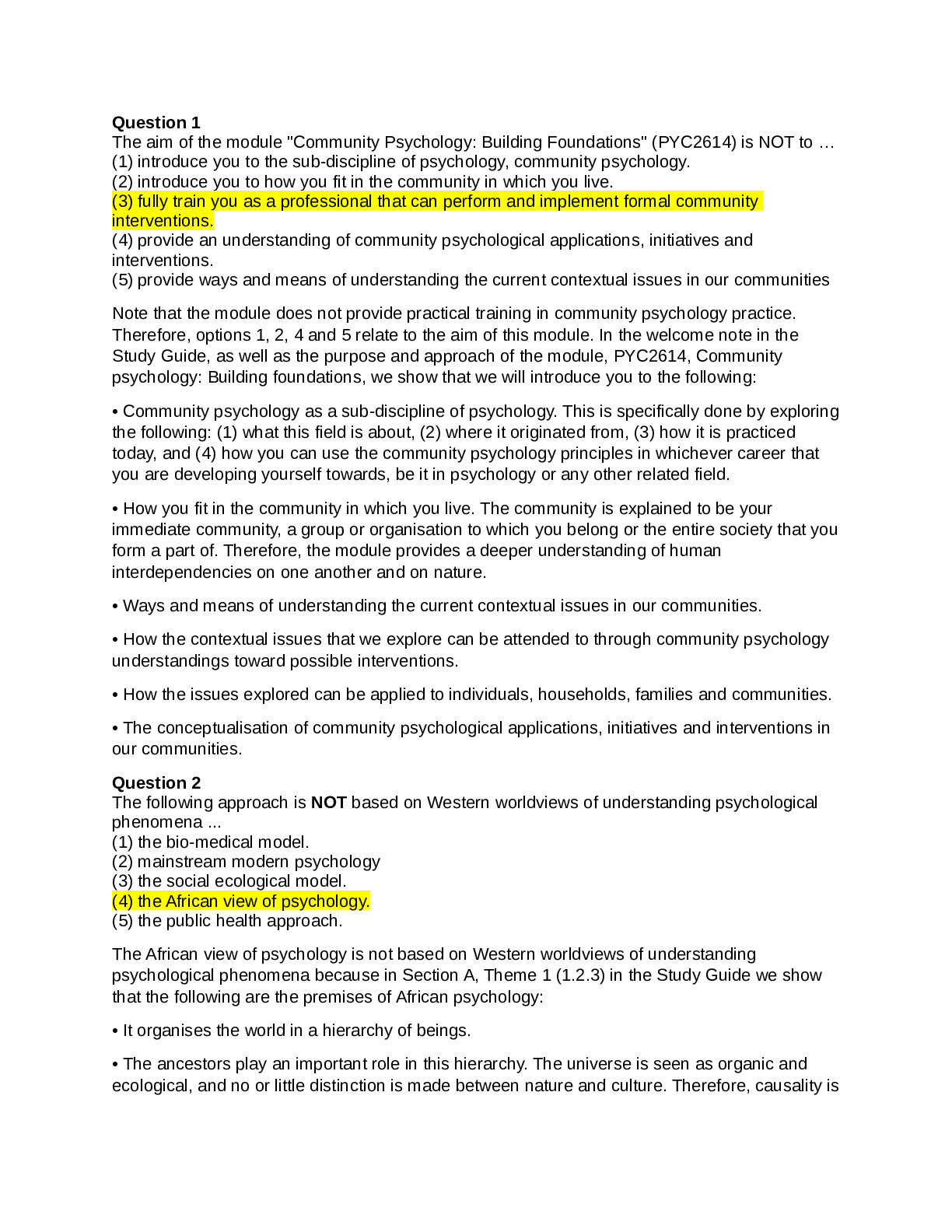
The aim of the module "Community Psychology: Building Foundations" (PYC2614) is NOT to …
(1) introduce you to the sub-discipline of psychology, community psychology.
(2) introduce you to how you fit in the community in which you live.
(3) fully train you as a professional that can perform and implement formal community
interventions.
(4) provide an understanding of community psychological applications, initiatives and
interventions.
(5) provide ways and means of understanding the current contextual issues in our communities
Note that the module does not provide practical training in community psychology practice.
Therefore, options 1, 2, 4 and 5 relate to the aim of this module. In the welcome note in the
Study Guide, as well as the purpose and approach of the module, PYC2614, Community
psychology: Building foundations, we show that we will introduce you to the following:
• Community psychology as a sub-discipline of psychology. This is specifically done by exploring
the following: (1) what this field is about, (2) where it originated from, (3) how it is practiced
today, and (4) how you can use the community psychology principles in whichever career that
you are developing yourself towards, be it in psychology or any other related field.
• How you fit in the community in which you live. The community is explained to be your
immediate community, a group or organisation to which you belong or the entire society that you
form a part of. Therefore, the module provides a deeper understanding of human
interdependencies on one another and on nature.
• Ways and means of understanding the current contextual issues in our communities.
• How the contextual issues that we explore can be attended to through community psychology
understandings toward possible interventions.
• How the issues explored can be applied to individuals, households, families and communities.
• The conceptualisation of community psychological applications, initiatives and interventions in
our communities.
Question 2
The following approach is NOT based on Western worldviews of understanding psychological
phenomena ...
(1) the bio-medical model.
(2) mainstream modern psychology
(3) the social ecological model.
(4) the African view of psychology.
(5) the public health approach.
The African view of psychology is not based on Western worldviews of understanding
psychological phenomena because in Section A, Theme 1 (1.2.3) in the Study Guide we show
that the following are the premises of African psychology:
• It organises the world in a hierarchy of beings.
• The ancestors play an important role in this hierarchy. The universe is seen as organic and
ecological, and no or little distinction is made between nature and culture. Therefore, causality is
understood to be linked to the interaction of life forces. This leads to a holistic view of life as a
cosmic unity.
• Knowledge is gained through participation and connecting, not so much through
separation and abstraction. Therefore, the observer (researcher or psychology
practitioner) is part of the system that is observed and influences it profoundly.
• Life is viewed as communal and personhood (who a person is) is defined in relation to
the community, not the self. Parental responsibilities also reside not just with the father
and mother, but also the extended family and the community. Therefore, it can be said
that personhood is relationally defined (in terms of Ubuntu, that is humanity).
Individuals and communities are seen as interdependent.
• Therefore, options 1, 2, 3 and 5 are not relevant to African psychology based on the
following:
• The bio-medical model - this model is closely aligned with Western medicine. It places
focus on the individual as the unit of analysis and emphasises the role of biological
factors (particularly the brain) in influencing and affecting human behaviour (See Section
A, Theme 1 - 1.2.2).
• Mainstream modern psychology - emanates from the Western way of viewing reality,
assumes that psychology is an objective and universal science, and places the wellbeing
and progress of individual people above that of groups and communities (See Section A,
Theme 1 - 1.2.1).
• The social ecological model – even though this model moves beyond focusing on the
individual to viewing community interaction as a whole, it is a derivative of the medical
model, which emphasises Western medicine (See Section A, Theme 2 - 2.4.4).
• The public health approach – even though the public health approach promotes
individual and social wellbeing, which operates at a level beyond clinical medical ideas
of health, it is aligned with the mental health model. The mental health model has its
roots in mainstream medical discourse and regards mental illness as a disease and
emphasises that the mental health practitioner, who is seen as the expert, is responsible
for the treatment or prevention of the disease (See Section A, Theme 2 - 2.4.3).
Therefore, all these 4 models/approaches have their roots in the Western worldviews of
understanding psychological phenomena.
Question 3
Mainstream, modern and Western psychology is based on a view that …
(1) science is value-laden and should acknowledge social and political undertones.
(2) understands individuals' particular identities in terms of sex, race, culture, and other uni
[Show More]