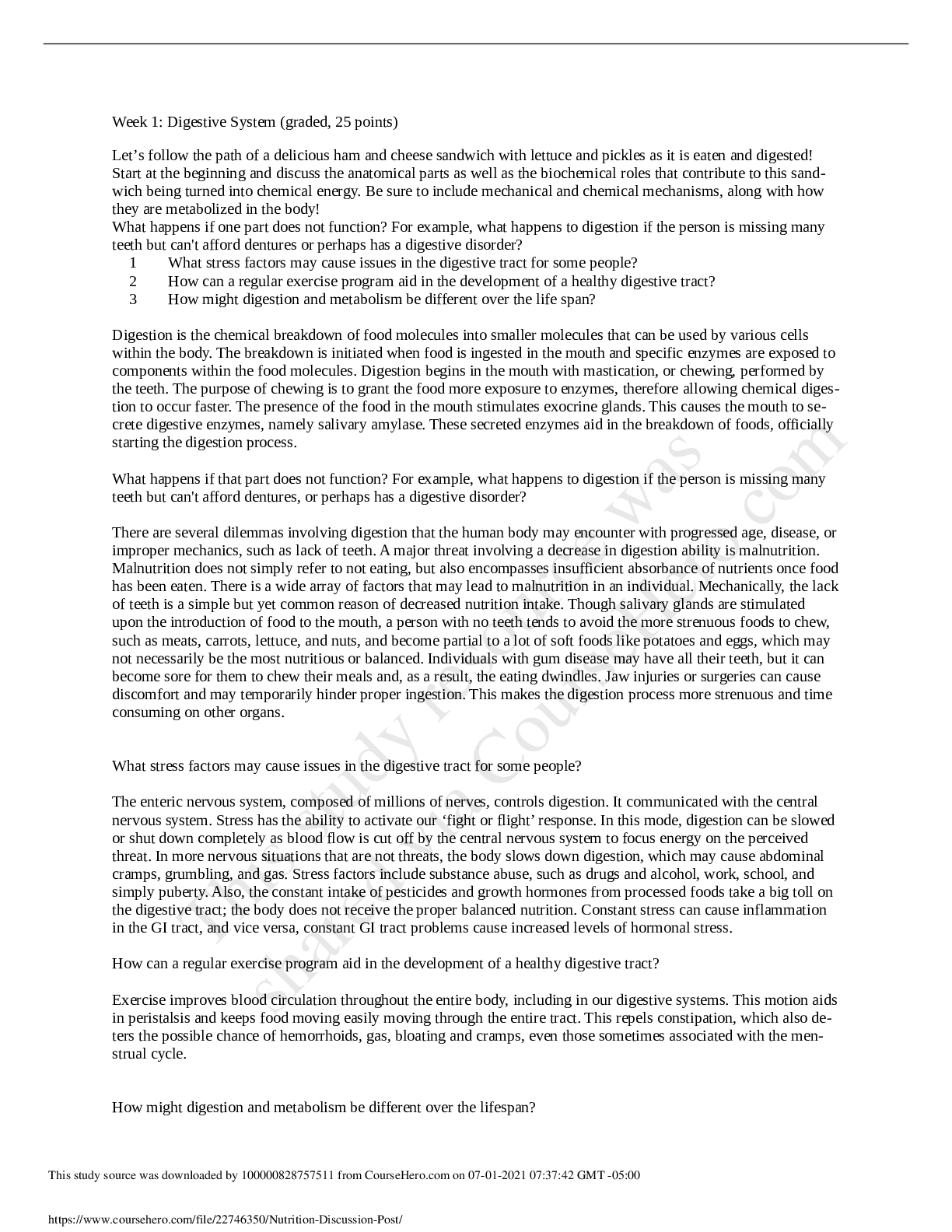
Week 1: Digestive System (graded, 25 points)
Let’s follow the path of a delicious ham and cheese sandwich with lettuce and pickles as it is eaten and digested!
Start at the beginning and discuss the anatomical parts a
...
Week 1: Digestive System (graded, 25 points)
Let’s follow the path of a delicious ham and cheese sandwich with lettuce and pickles as it is eaten and digested!
Start at the beginning and discuss the anatomical parts as well as the biochemical roles that contribute to this sandwich being turned into chemical energy. Be sure to include mechanical and chemical mechanisms, along with how
they are metabolized in the body!
What happens if one part does not function? For example, what happens to digestion if the person is missing many
teeth but can't afford dentures or perhaps has a digestive disorder?
1 What stress factors may cause issues in the digestive tract for some people?
2 How can a regular exercise program aid in the development of a healthy digestive tract?
3 How might digestion and metabolism be different over the life span?
Digestion is the chemical breakdown of food molecules into smaller molecules that can be used by various cells
within the body. The breakdown is initiated when food is ingested in the mouth and specific enzymes are exposed to
components within the food molecules. Digestion begins in the mouth with mastication, or chewing, performed by
the teeth. The purpose of chewing is to grant the food more exposure to enzymes, therefore allowing chemical digestion to occur faster. The presence of the food in the mouth stimulates exocrine glands. This causes the mouth to secrete digestive enzymes, namely salivary amylase. These secreted enzymes aid in the breakdown of foods, officially
starting the digestion process.
What happens if that part does not function? For example, what happens to digestion if the person is missing many
teeth but can't afford dentures, or perhaps has a digestive disorder?
There are several dilemmas involving digestion that the human body may encounter with progressed age, disease, or
improper mechanics, such as lack of teeth. A major threat involving a decrease in digestion ability is malnutrition.
Malnutrition does not simply refer to not eating, but also encompasses insufficient absorbance of nutrients once food
has been eaten. There is a wide array of factors that may lead to malnutrition in an individual. Mechanically, the lack
of teeth is a simple but yet common reason of decreased nutrition intake. Though salivary glands are stimulated
upon the introduction of food to the mouth, a person with no teeth tends to avoid the more strenuous foods to chew,
such as meats, carrots, lettuce, and nuts, and become partial to a lot of soft foods like potatoes and eggs, which may
not necessarily be the most nutritious or balanced. Individuals with gum disease may have all their teeth, but it can
become sore for them to chew their meals and, as a result, the eating dwindles. Jaw injuries or surgeries can cause
discomfort and may temporarily hinder proper ingestion. This makes the digestion process more strenuous and time
consuming on other organs.
What stress factors may cause issues in the digestive tract for some people?
The enteric nervous system, composed of millions of nerves, controls digestion. It communicated with the central
nervous system. Stress has the ability to activate our ‘fight or flight’ response. In this mode, digestion can be slowed
or shut down completely as blood flow is cut off by the central nervous system to focus energy on the perceived
threat. In more nervous situations that are not threats, the body slows down digestion, which may cause abdominal
cramps, grumbling, and gas. Stress factors include substance abuse, such as drugs and alcohol, work, school, and
simply puberty. Also, the constant intake of pesticides and growth hormones from processed foods take a big toll on
the digestive tract; the body does not receive the proper balanced nutrition. Constant stress can cause inflammation
in the GI tract, and vice versa, constant GI tract problems cause increased levels of hormonal stress.
How can a regular exercise program aid in the development of a healthy digestive tract?
Exercise improves blood circulation throughout the entire body, including in our digestive systems. This motion aids
in peristalsis and keeps food moving easily moving through the entire tract. This repels constipation, which also deters the possible chance of hemorrhoids, gas, bloating and cramps, even those sometimes associated with the menstrual cycle.
How might digestion and metabolism be different over the lifespan?
This study source was downloaded by 100000828757511 from CourseHero.com on 07-01-2021 07:37:42 GMT -05:00
https://www.coursehero.com/file/22746350/Nutrition-Discussion-Post
[Show More]





 A21.png)
![Preview of eBook [PDF] Barash, Cullen, and Stoelting's Clinical Anesthesia 9th Edition By Bruce F. Cu](https://browseimages.nyc3.digitaloceanspaces.com/paper-images/2024/Aug/29/8DF2QRTq2024-08-29-10-3966d0259b7c4b5.png)
![Preview of eBook [PDF] Fundamentals of Nursing 3rd Edition By Joanne Tollefson, Sue C. DeLaune, Patri](https://browseimages.nyc3.digitaloceanspaces.com/paper-images/2024/Aug/26/U6SQ8mmq2024-08-26-01-4766cc5d40d7385.png)
![Preview of eBook [PDF] Burns' Pediatric Primary Care 7th Edition BY Dawn Lee Garzon Maaks,, Nancy Bar](https://browseimages.nyc3.digitaloceanspaces.com/paper-images/2024/Aug/26/WR2rowXX2024-08-26-02-0966cc625bea839.png)




.png)
.png)