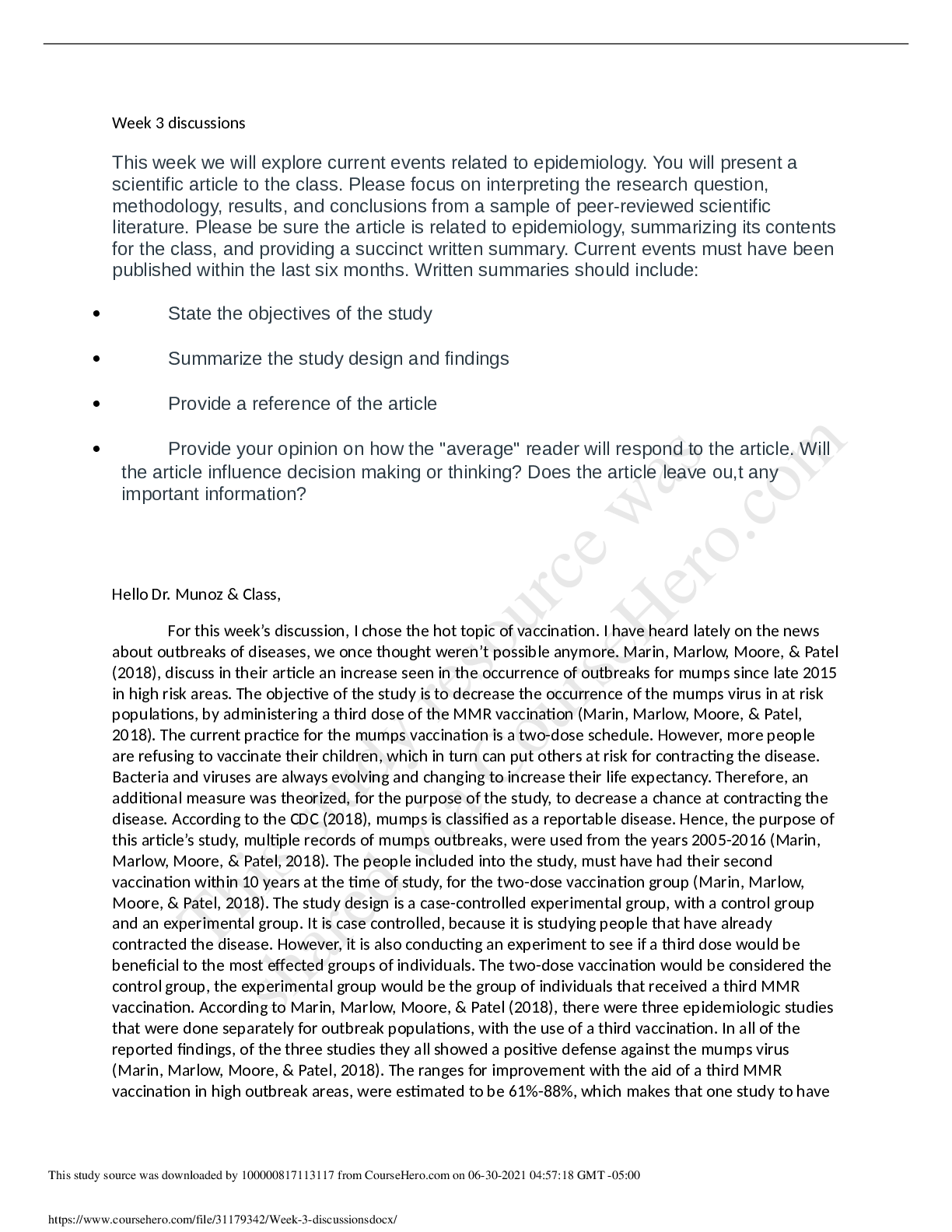
This week we will explore current events related to epidemiology. You will present a
scientific article to the class. Please focus on interpreting the research question,
methodology, results, and conclusions from a sam
...
This week we will explore current events related to epidemiology. You will present a
scientific article to the class. Please focus on interpreting the research question,
methodology, results, and conclusions from a sample of peer-reviewed scientific
literature. Please be sure the article is related to epidemiology, summarizing its contents
for the class, and providing a succinct written summary. Current events must have been
published within the last six months. Written summaries should include:
State the objectives of the study
Summarize the study design and findings
Provide a reference of the article
Provide your opinion on how the "average" reader will respond to the article. Will
the article influence decision making or thinking? Does the article leave ou,t any
important information?
Hello Dr. Munoz & Class,
For this week’s discussion, I chose the hot topic of vaccination. I have heard lately on the news
about outbreaks of diseases, we once thought weren’t possible anymore. Marin, Marlow, Moore, & Patel
(2018), discuss in their article an increase seen in the occurrence of outbreaks for mumps since late 2015
in high risk areas. The objective of the study is to decrease the occurrence of the mumps virus in at risk
populations, by administering a third dose of the MMR vaccination (Marin, Marlow, Moore, & Patel,
2018). The current practice for the mumps vaccination is a two-dose schedule. However, more people
are refusing to vaccinate their children, which in turn can put others at risk for contracting the disease.
Bacteria and viruses are always evolving and changing to increase their life expectancy. Therefore, an
additional measure was theorized, for the purpose of the study, to decrease a chance at contracting the
disease. According to the CDC (2018), mumps is classified as a reportable disease. Hence, the purpose of
this article’s study, multiple records of mumps outbreaks, were used from the years 2005-2016 (Marin,
Marlow, Moore, & Patel, 2018). The people included into the study, must have had their second
vaccination within 10 years at the time of study, for the two-dose vaccination group (Marin, Marlow,
Moore, & Patel, 2018). The study design is a case-controlled experimental group, with a control group
and an experimental group. It is case controlled, because it is studying people that have already
contracted the disease. However, it is also conducting an experiment to see if a third dose would be
beneficial to the most effected groups of individuals. The two-dose vaccination would be considered the
control group, the experimental group would be the group of individuals that received a third MMR
vaccination. According to Marin, Marlow, Moore, & Patel (2018), there were three epidemiologic studies
that were done separately for outbreak populations, with the use of a third vaccination. In all of the
reported findings, of the three studies they all showed a positive defense against the mumps virus
(Marin, Marlow, Moore, & Patel, 2018). The ranges for improvement with the aid of a third MMR
vaccination in high outbreak areas, were estimated to be 61%-88%, which makes that one study to have
[Show More]