1. The male client in a healthcare provider’s office tells the nurse that he has been
experiencing “heartburn” at night that awakens him. Which assessment question should
the nurse ask?
1.“How much weight have you g
...
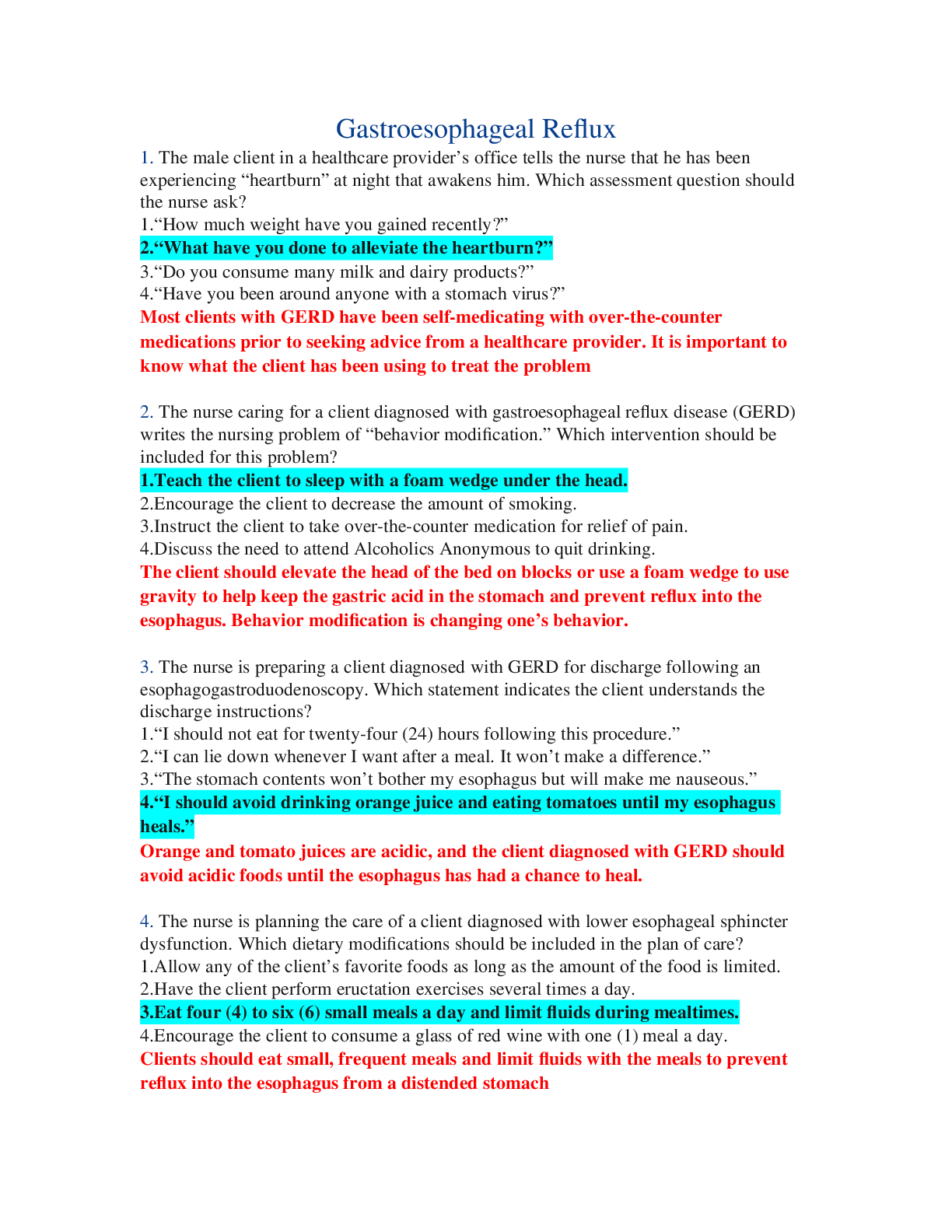
1. The male client in a healthcare provider’s office tells the nurse that he has been
experiencing “heartburn” at night that awakens him. Which assessment question should
the nurse ask?
1.“How much weight have you gained recently?”
2.“What have you done to alleviate the heartburn?”
3.“Do you consume many milk and dairy products?”
4.“Have you been around anyone with a stomach virus?”
Most clients with GERD have been selfmedicating with overthecounter
medications prior to seeking advice from a healthcare provider. It is important to
know what the client has been using to treat the problem
2. The nurse caring for a client diagnosed with gastroesophageal reflux disease (GERD)
writes the nursing problem of “behavior modification.” Which intervention should be
included for this problem?
1.Teach the client to sleep with a foam wedge under the head.
2.Encourage the client to decrease the amount of smoking.
3.Instruct the client to take overthecounter medication for relief of pain.
4.Discuss the need to attend Alcoholics Anonymous to quit drinking.
The client should elevate the head of the bed on blocks or use a foam wedge to use
gravity to help keep the gastric acid in the stomach and prevent reflux into the
esophagus. Behavior modification is changing one’s behavior.
3. The nurse is preparing a client diagnosed with GERD for discharge following an
esophagogastroduodenoscopy. Which statement indicates the client understands the
discharge instructions?
1.“I should not eat for twentyfour (24) hours following this procedure.”
2.“I can lie down whenever I want after a meal. It won’t make a difference.”
3.“The stomach contents won’t bother my esophagus but will make me nauseous.”
4.“I should avoid drinking orange juice and eating tomatoes until my esophagus
heals.”
Orange and tomato juices are acidic, and the client diagnosed with GERD should
avoid acidic foods until the esophagus has had a chance to heal.
4. The nurse is planning the care of a client diagnosed with lower esophageal sphincter
dysfunction. Which dietary modifications should be included in the plan of care?
1.Allow any of the client’s favorite foods as long as the amount of the food is limited.
2.Have the client perform eructation exercises several times a day.
3.Eat four (4) to six (6) small meals a day and limit fluids during mealtimes.
4.Encourage the client to consume a glass of red wine with one (1) meal a day.
Clients should eat small, frequent meals and limit fluids with the meals to prevent
reflux into the esophagus from a distended stomach
5. The nurse is caring for a client diagnosed with gastroesophageal reflux disease
(GERD).Which nursing interventions should be implemented?
1.Place the client prone in bed and administer nonsteroidal antiinflammatory medicaions.
2.Have the client remain upright at all times and walk for 30 minutes three (3) times a
week.
3.Instruct the client to maintain a right lateral sidelying position and take antacids before
meals.
4.Elevate the head of the bed 30 degrees and discuss lifestyle modifications with the
client.
The head of the bed should be elevated to allow gravity to help in preventing reflux.
Lifestyle modifications of losing weight, making dietary modifications, attempting
smoking cessation, discontinuing the use of alcohol, and not stooping or bending at
the waist all help to decrease reflux
6. The nurse is caring for an adult client diagnosed with gastroesophageal reflux disease
(GERD). Which condition is the most common comorbid disease associated with
GERD?
1.Adultonset asthma.
2.Pancreatitis.
3.Peptic ulcer disease.
4.Increased gastric emptying.
Of adultonset asthma cases, 80%–90% are caused by gastroesophageal reflux
disease (GERD). Peptic ulcer disease is related to H. pylori bacterial infections and
can lead to increased levels of gastric acid, but it is not related to reflux
7. The nurse is administering morning medications at 0730. Which medication would
have priority?
1.A proton pump inhibitor.
2.A nonnarcotic analgesic.
3.A histamine receptor antagonist.
4.A mucosal barrier agent.
A mucosal barrier agent must be administered on an empty stomach for the
medication to coat the stomach.
8. The nurse is preparing a client diagnosed with gastroesophageal reflux disease
(GERD) for surgery. Which information should be brought to the attention of the
healthcare provider?
1.The client’s Bernstein esophageal test was positive.
2.The client’s abdominal xray shows a hiatal hernia.
3.The client’s WBC count is 14,000 mg/dL.
4.The client’s hemoglobin is 13.8 mg/dL.
The client’s WBC is elevated, indicating a possible infection, which warrants
notifying the HCP
9. The charge nurse is making assignments. Staffing includes a registered nurse with five
(5) years of medicalsurgical experience, a newly graduated registered nurse, and two
(2) unlicensed nursing assistants. Which client should be assigned to the most
experienced nurse?
1.The 39yearold client diagnosed with lower esophageal dysfunction who is
complaining of pyrosis.
2.The 54yearold client diagnosed with Barrett’s esophagitis who is scheduled to have
an endoscopy this morning.
3.The 46yearold client diagnosed with gastroesophageal reflux disease who has
wheezes in all five (5) lobes.
4.The 68yearold client who is three (3) days postop hiatal hernia and needs to be
ambulated four (4) times today.
This client is exhibiting symptoms of asthma, a complication of GERD; therefore,
the client should be assigned to the most experienced nurse
10. Which statement made by the client would alert the nurse that the client may be
experiencing GERD?
1.“My chest hurts when I walk up the stairs in my home.”
2.“I take antacid tablets with me wherever I go.”
3.“My spouse tells me I snore very loudly at night.”
4.“I drink six (6) to seven (7) soft drinks every day.”
Frequent use of antacids indicates an acidreflux problem
11.The nurse is performing an admission assessment on a client diagnosed with
gastroesophageal reflux disease (GERD). Which signs and symptoms would indicate
GERD?
1.Pyrosis, water brash, and flatulence.
2.Weight loss, dysarthria, and diarrhea.
3.Decreased abdominal fat, proteinuria, and constipation.
4.Midepigastric pain, positive H. pylori test, and melena.
Pyrosis is heartburn, water brash is the feeling of saliva secretion as a result of
reflux, and flatulence is gas—all symptoms of GERD
12. The client diagnosed with gastroesophageal reflux disease (GERD) is at greater risk
for which disease?
1.Hiatal hernia.
2.Gastroenteritis.
3.Esophageal cancer.
4.Gastric cancer.
Barrett’s esophagitis results from longterm erosion of the esophagus as a result of
reflux of stomach contents secondary to GERD. This is a precursor to
esophagealcancer.
Inflammatory Bowel Disease
13. The client is diagnosed with ulcerative colitis. When assessing this client, which sign/
symptom would the nurse expect to find?
1.Twenty bloody stools a day.
2.Oral temperature of 102 F.
3.Hard, rigid abdomen.
4.Urinary stress incontinence.
The colon is ulcerated and unable to absorb water, resulting in bloody diarrhea. Ten
(10) to twenty bloody diarrhea stools is the most common symptom of ulcerative
colitis.
14. The client is prescribed prednisone, a steroid, for an acute episode of
inflammatory bowel disease. Which intervention should the nurse discuss with the client?
1.Take this medication on an empty stomach.
2.Notify the HCP if you experience a moon face.
3.Be sure to take this medication as prescribed.
4.Take the medication in the morning only
This medication must be tapered off to prevent adrenal insufficiency; therefore, the
client must take this medication as prescribed
15. The client diagnosed with inflammatory bowel disease has a serum potassium level
of 3.4 mEq/L. Which action should the nurse implement first?
1.Notify the healthcare provider.
2.Assess the client for leg cramps.
3.Request telemetry for the client.
4.Prepare to administer potassium IV.
Leg cramps are a sign of hypokalemia; hypokalemia can lead to cardiac
dysrhythmias and can be life threatening. Assessment is priority for a potassium
level that is just below normal level, which is 3.5 to 5.5mEq/L.
16. The client is diagnosed with an acute exacerbation of ulcerative colitis. Which
intervention should the nurse implement?
1.Provide a lowresidue diet.
2.Monitor intravenous fluids.
3.Assess vital signs daily.
4.Administer antacids orally.
The client requires fluids to help prevent dehydration from diarrhea and to replace
the fluid lost through normal body functioning.
17. The client diagnosed with IBD is prescribed total parental nutrition (TPN). Which
intervention should the nurse implement?
1.Check the client’s glucose level.
2.Administer an oral hypoglycemic.
[Show More]