A-level PHYSICS Paper 1 May 2019
Document Content and Description Below
Two isotopes of iodine are 125
53 I and 131
53 I.
Determine, for these two isotopes, the difference between the constituents of the
nuclei.
[1 mark]
0 1 . 2 A 131
53 I nuclide undergoes beta (β–
) decay to form a
...
[Show More]
Last updated: 3 years ago
Preview 1 out of 40 pages
Instant download

Buy this Document to get the Full Access Instantly
Provided by Students Who Aced it
We Verify Document Content to Gurantee Accuracy
Reviews( 0 )
Document information
Connected school, study & course
About the document
Uploaded On
Jul 05, 2021
Number of pages
40
Written in
All

Additional information
This document has been written for:
Uploaded
Jul 05, 2021
Downloads
0
Views
109
Topic Tags
Related Subjects & Courses
Explore similar study resources and related concepts.
Recommended For You
Get more on EXAM »
$13.5
26 Pages
MATHEMATICS Paper 2 Wednesday 22 May 2019 QUESTIONS ONLY
$14
17 Pages
AT Q1 Pre-week_MAY 2019.doc | Download for quality grades

$9
48 Pages
Introduction to Law (ILW1501): EXAM 13 May 2019, Questions and...

$12
20 Pages
GCSE COMBINED SCIENCE: TRILOGY Higher Tier Chemistry Paper 1H...

 (1).png)
$10.5
28 Pages
AS CHEMISTRY Paper 2 Organic and Physical Chemistry Thursday 2...

$8
44 Pages
AQA AS BIOLOGY Paper 2. 7401/2. May 2019 and MARK SCHEME – AS...

$6.5
4 Pages
NR 507 Week 8 Final Exam Practice Questions (May 2019-2021) ST...
$22
713 Pages
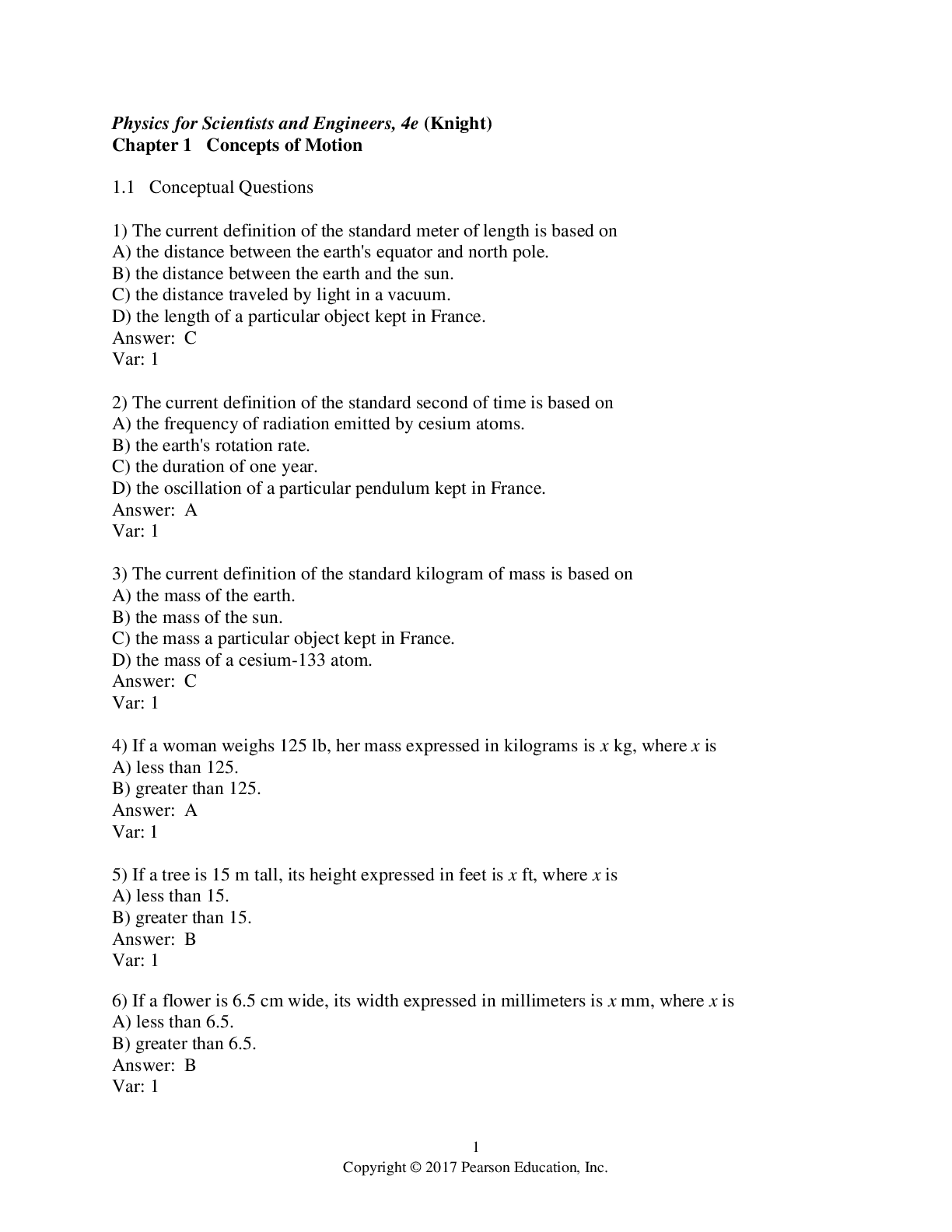
Test Bank for Physics for Scientists and Engineers A Strategic...

$25
100 Pages
Plasma Physics, 2e by Richard Fitzpatrick (Solutions Manual)

$25
37 Pages
College Physics, 3e Roger Freedman, Todd Ruskell, Philip Keste...

$25
79 Pages
A Concise Introduction to Thermodynamics for Physicists, 1e by...
$22
1305 Pages
SOLUTIONS MANUAL for Physics for Scientists and Engineers by R...
More related documents below


