English 216 Quiz 2
• Question 1
Childe’ refers to:
• Question 2
Women in the Romantic period were provided only limited schooling, were subjected to a rigid code of sexual behavior, an
...
English 216 Quiz 2
• Question 1
Childe’ refers to:
• Question 2
Women in the Romantic period were provided only limited schooling, were subjected to a rigid code of sexual behavior, and were bereft of legal rights.
• Question 3
Wollstonecraft argues that women are encouraged to live in a state of perpetual:
• Question 4
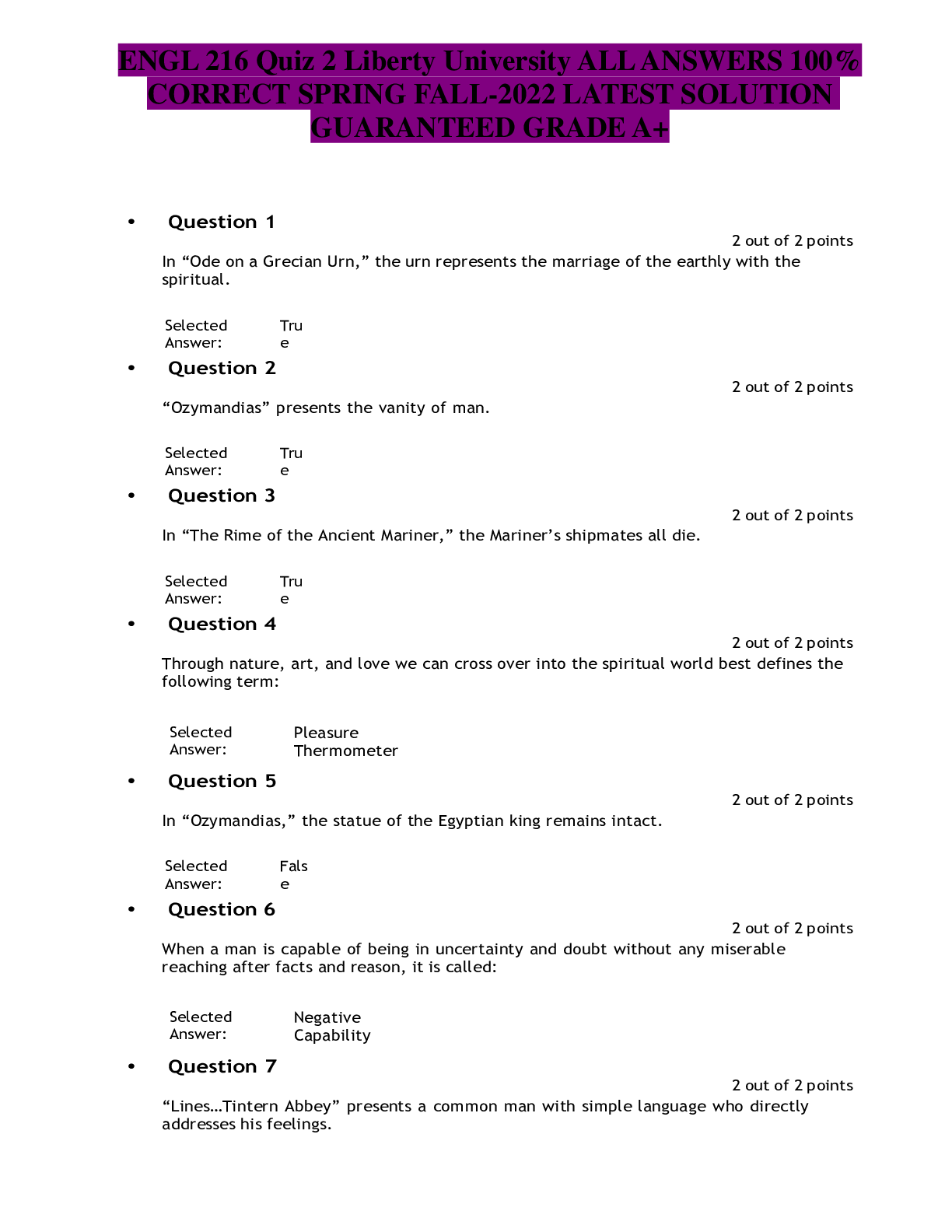
In “Ode on a Grecian Urn,” the sacrifice represents people who are trying to find some way to God.
• Question 5
According to Wordsworth, poetry should not bring pleasure.
• Question 6
In “The Eve of St. Agnes,” this character dies at the end:
• Question 7
In “The Rime of the Ancient Mariner,” the Mariner’s spiritual rebirth begins when he:
• Question 8
St. Agnes is the patron saint of:
• Question 9
In “La Belle Dame sans Merci,” nature commiserates with the knight.
• Question 10
Romanticism adheres to order, science, rational, aristocracy, society, and the preferences of classics.
• Question 11
In “The Rime of the Ancient Mariner,” who plays for the lives of the crew?
• Question 12
The following is not a Romantic author:
• Question 13
Who is considered the ‘Father of Romanticism’?
• Question 14
This poem describes day as being “gaudy”:
• Question 15
The three images presented in “Ode on a Grecian Urn” are:
• Question 16
In “La Belle Dame sans Merci,” the lady is mortal and belongs in the world with the knight.
• Question 17
Wordsworth visited the ruins of Tintern Abbey.
• Question 18
The dominant view of women during this time was that they were inferior, irrational, and flawed.
• Question 19
“Ozymandias” presents the vanity of man.
• Question 20
Romanticism is a worldview.
• Question 21
This poem contains images of tents, clouds, the sun, and contrasts of black and white:
• Question 22
Through nature, art, and love we can cross over into the spiritual world best defines the following term:
• Question 23
The narrator in “The Chimney Sweeper” from Songs of Innocence holds parents, God, Priest, and King accountable for present misery.
• Question 24
In “The Rime of the Ancient Mariner,” the Mariner’s shipmates all die.
• Question 25
Wollstonecraft argues that women’s minds are in a healthy state.
• Question 26
The third canto of Childe Harold’s Pilgrimage ends with a curse on Byron’s daughter.
• Question 27
In “La Belle Dame sans Merci,” the knight has had a brush with mortality.
• Question 28
The Mariner in “The Rime of the Ancient Mariner” tells his story to someone at a:
• Question 29
Wollstonecraft argues that women’s supposed inferiority is used to subordinate them without the power to think or act.
• Question 30
This work focuses on a thunderstorm in the Alps:
• Question 31
“Lines…Tintern Abbey” presents a common man with simple language who directly addresses his feelings.
• Question 32
“When the stars threw down their spears / And water’d heaven with their tears, / Did he smile his work to see? Did he who made the Lamb make thee?” comes from which Romantic poem?
• Question 33
In “The Rime of the Ancient Mariner,” the Mariner shoots and kills a(n):
• Question 34
“She walks in beauty like the night / of cloudless climes and starry skies” was written by this author:
• Question 35
In the first scene of “Ode on a Grecian Urn,” two lovers are about to kiss.
• Question 36
In “The Eve of St. Agnes,” a strong contrast occurs between the following:
• Question 37
“Can tyrants but by tyrants conquered be” is from which poem:
• Question 38
When a man is capable of being in uncertainty and doubt without any miserable reaching after facts and reason, it is called:
• Question 39
Wollstonecraft argues that women are rewarded for being useless and beautiful with a husband.
• Question 40
In this poem by Byron, the protagonist is weary of empty pleasures.
• Question 41
Wollstonecraft evaluates the current attitudes of other authors, including:
• Question 42
This work by Keats ends with the following lines: “’Beauty is truth, truth beauty,’ – that is all / Ye know on earth, and all ye need to know.”
• Question 43
In “The Rime of the Ancient Mariner,” the man to whom the Mariner tells his story is not afraid of the Mariner.
• Question 44
This poet was an abolitionist and illustrator:
• Question 45
In the beginning of “Ode to a Nightingale,” the speaker longs for:
• Question 46
This poet said that poetry is the “spontaneous overflow” of feelings:
• Question 47
In “The Rime of the Ancient Mariner,” a cross is hung around the Mariner’s neck.
• Question 48
“Ode to the West Wind” has how many cantos?
• Question 49
In “Ode on a Grecian Urn,” the urn represents the marriage of the earthly with the spiritual.
• Question 50
Pantheists worship the creator and not creation.
[Show More]