Foundations of Nursing - Assignment #1- Summary and Study Guide
Chapter 1: The Evolution of Nursing
Q1: Florence Nightingale was an English social reformer considered to be the founder of modern nursing.
- She use
...
Foundations of Nursing - Assignment #1- Summary and Study Guide
Chapter 1: The Evolution of Nursing
Q1: Florence Nightingale was an English social reformer considered to be the founder of modern nursing.
- She used basic principles of improved sanitation and hygiene practices to reduce the rate of infections
- She started a nursing school at St. Thomas Hospital in London in which she offered
formal and practical experience training.
- The school was focused on sanitation, patient observation and nutritional improvements
- The school kept records of students’ progress
- The school also retained a registry of all graduates
- There were strict procedures for admission, and hence not all applicants were enrolled.
Q2.
Q3
Q4.
Q5.
- complete practical nursing training
- Take the NCLEX-PN exams
- The State Board of Nursing is responsible for licensing
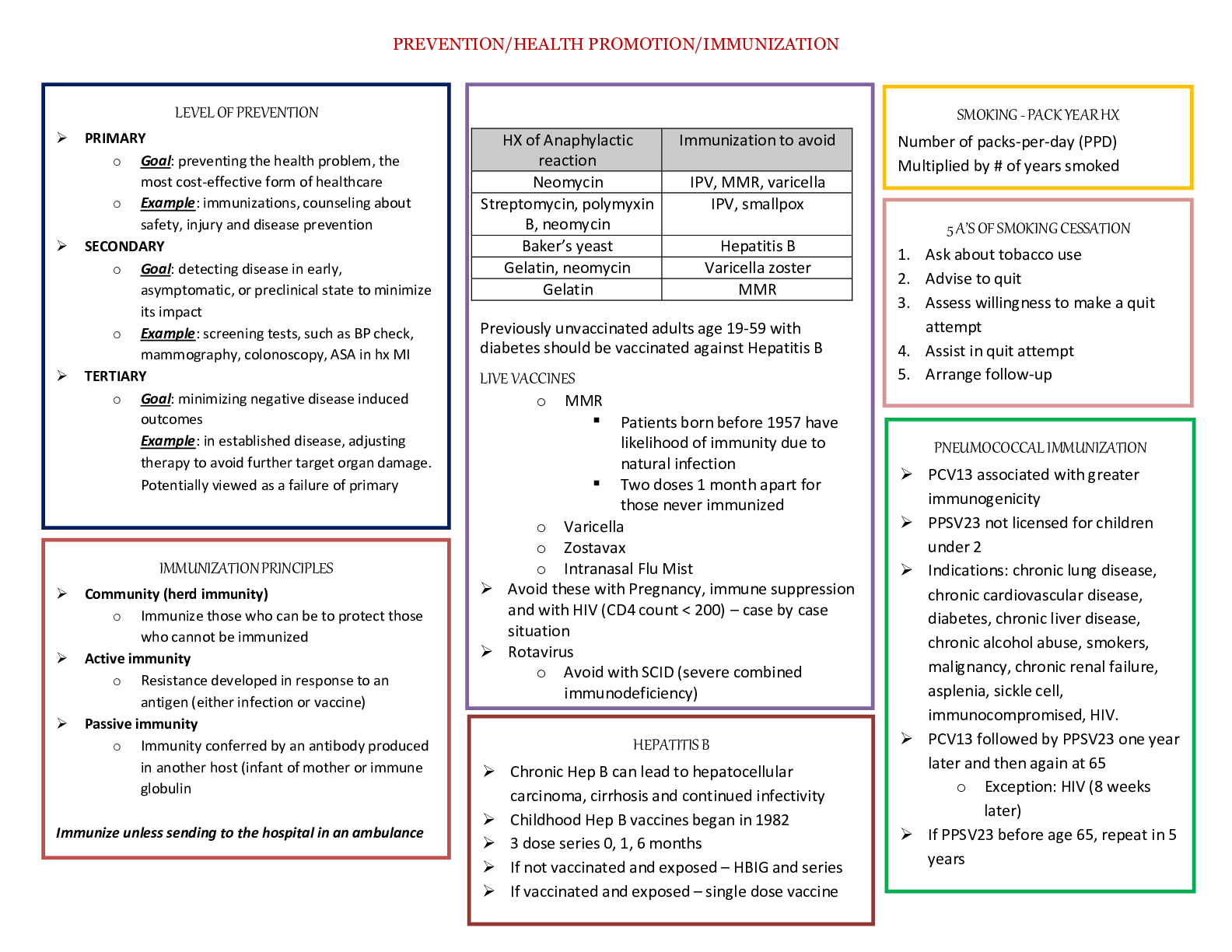
- Health promotion may be defined as the process of engaging and empowering individuals and communities to engage in healthy behaviors. The purpose is to promote health through:
• maintaining wellness
• preventing disease-related complications
• reducing the infirmity associated with diseases states
Example: Providing education on smoking, drug or alcohol abuse, mental health, etc.
- Health prevention is undertaken at primary, secondary and tertiary levels of prevention.
- Holistic Health care requires that professionals from differing areas come together to provide comprehensive care. It is caring for body, mind and spirit. Thus the holistic approach is used to denote caring for the physical, psychological, emotional, and spiritual wellbeing of a patient.
- Maslow Needs Theory attempted to prioritize human needs at five levels, on the premise that needs at the bottom should be met first before those at the top. According to Maslow, human needs can be hierarchically arranged from bottom upward starting with
• Physiological or basic needs,
• Safety and security needs,
• Love and social needs,
• Esteem needs, and
• Self actualization as the top level need.
This theory is relevant in helping nurses prioritizing patients’ problems
Chapter 2: Legal and Ethical Aspects
QA.
- Legal: Relates to respect for laws and established regulations
- Ethical: Relates to Morally right or wrong
QB.
1. Abandonment: wrongful termination of providing care. Example include walking out on a job without assigning it to someone
2. Assault: Verbally threatening a patient to cause bodily harm. In this case there is no
contact. For example, telling the patient that “if you do not listen I would not feed you”
3. Battery: Unwarranted or unlawful touching without consent. Examples include lifting, punching or restraining a patient without a doctor’s order.
4. Defamation: spoken or written statement intended to ruin someone’s reputation
5. Libel: Writing false statements to ruin someone’s reputation
6. Malpractice: Failure to meet legal duty, which results in harm to a patient.
7. Negligence: Failure to take proper care in doing something which a reasonable person would do in same circumstances that result in injury. for example, giving overdose of insulin
8. Slander: speaking untrue statements about someone with the intention of hurting or
ruining his reputation.
9. False Imprisonment: Holding a person against their will
10. Invasion of Privacy: Failure to observe the patient’s right to privacy. for example failure to close the curtains or door when providing care.
QC.
- Criminal Law: Addresses issues with direct impact on society
- Civil Law: Addresses issues relating to individuals
QD.
1. Plaintiff: The complaining party
2. Complaint: A statement of alleged breach of duty written by the plaintiff
3. Defendant: The person alleged to be liable
4. Damages: compensation that the plaintiff is seeking
5. Summons: A court order that notifies the defendant of the legal action
6. Discovery: Process of review of documents and facts
7. Deposition: Interrogating witnesses under oath
8. Verdict: Decision of the court.
9. Appeal: Request for a review of court decision due to disagreement with the decision of the court
10. Liability: Legal responsibility
11. Accountable: Being responsible for one’s own actions
QE.
- Good Nurse-Patient relationship
- Provide compassionate, and competent nursing care.
- Maintaining a positive attitude
QF.
1. Competency: Knowledge and scope of duty
2. Liability: Legal responsibility
3. Advocate: One who defends or pleads a cause or issue on behalf of another.
QG.
1. Standard of Care defines acts whose performance is required, permitted or prohibited. It includes legal guidelines for care provision.
2. Nurse Practice Act are set of laws that formally define the scope of practice for nurses,
limits the scope, and makes it mandatory for nurses to know the Act.
3. Informed Consent means disclosure of facts regarding an invasive procedure and seeking the patient’s approval.
4. Euthanasia means letting a person die
5. Ethical Dilemma occurs when a particular problem involves more than one choice and stems from the different values and beliefs of the decision maker
6. DNR means no CPR be conducted on patient. The nurses’ role is to witness and
document the order
7. Advance Directives are prewritten instructions for end of life care.
QH.
1. Respect for people entails giving same respect to all
2. Autonomy means the right to make one’s own personal decision.
3. Beneficence is a positive action aimed at helping others
4. Non-Maleficence means avoidance of harm or injury
5. Justice means fairness in care delivery and use of resources
QI
- Code of ethics is Principles that govern professional practice. It regulates and gives guidelines for ethical behavior.
QJ
- The nurse’s first duty is to the patients’ health, safety and well-being. Hence when reporting unethical behavior, the nurse should follow the proper chain of command and explain the facts as clearly as possible.
QK
Ensure that any suspected case of abuse is reported to the supervisor QL
HIPAA establishes rules for keeping patients’ health information confidential and private. In this sense, the nurse make sure that:
- information is given only on a “need-to-know” basis
- only persons directly responsible for taking care of the patient have access to information concerning the patient.
- Patients’ information is not unnecessarily exposed
Chapter 4: Communication
1. verbal and non-verbal communication
2. Assertive, Unassertive, aggression.
3. purpose of therapeutic
4. Listening, silence, touch, crying
5. Conveying acceptance, restating, paraphrasing, clarifying, reflection.
Study Guide Assignment #1
Chapter 1: The Evolution of Nursing
11. The National League of Nursing is an accrediting body that observes, regulates and standardize the training of nurses in the USA.
12. The NAPNES enhances and promotes the development of practical nursing education, while NFLPN is the official membership organization for the LPN. These two organizations sets standards for practical and vocational nursing practice, promote and protect the interests of LPN, as well as educate and inform the general public about practical and vocational nursing.
13. – Demonstrate professional behaviors of accountability and professionalism according to
legal and ethical standards
- effectively communicate with patients
- collect holistic assessment data from multiple sources, communicate the data to appropriate health care providers
- collaborate with the registered nurse to organize and incorporate assessment data to plan
- demonstrate caring and empathic approach to the safe, therapeutic and individualized care.
14. NAPNES
16 Bill of Rights 19. (2)
22. (2)
28. (1)
Chapter 2 Matching
1. E
2. D
3. B
4. H
5. F
6. A
7. C
8. J
9. G
10. I True or False 14 False
15. True 17 . (4) 18. (1) 22. (6) 23. (3) 24. (3) 25. (1) 32. (2) 35. (3)
Critical Thinking
36. a) the nurse is expected to serve as witness to the informed consent and ensure that the procedure and consequences of the surgery has been explained to the patient.
b) Report to the charge nurse and respect her decision.
39. The nurse is the patients’ advocate and serves the wellbeing of the patient. However, the nurses and facility may face charges of negligence if the situation continue like this.
Chapter 4: Communication
Fill in the Blank
1. Caring, sincerity, empathy, and trustworthiness
2. Trust Multiple Choice
6. (4)
7. (3)
9. (1)
10. (4)
11 (1)
12 (4)
15 (2)
16 (4)
18 (3)
19 (3)
20 (2)
22 (3)
Foundations of Nursing - Assignment #2- Summary and Study Guide Summary Assignment #2
Chapter 5: Nursing Process and Critical Thinking
Q1. The nursing process is a systematic method by which nurses plan and provide care for patients
Q2. Stages/phases of the nursing process include:
- Assessment
- Diagnosis
- Planning
- Outcome identification/Goal
- Implementation
- Evaluation
Q3. Objective and subjective data Example of objective data: vital signs
Example of subjective data: Patient complain of chest pain
Q4. Primary source and secondary source
Example of Primary Source: Patient complain of loss of appetite Example of secondary source: Nurse observed dry lips
Q5. Data clustering is a method of data organization which involves putting together related data obtained from the health history, physical examination and related diagnostic procedures.
Q6. Medical diagnosis is related to changes in the body system or function. Once resolved, it stays in the medical record and becomes history.
On the other hand, nursing diagnosis can either be resolved with care or it may change and become something else. it does not go into the medical history of the patient.
Q7. There are four main types of nursing diagnosis:
- Actual nursing diagnosis: A clinical judgement about responses to health condition /life processes that exist in an individual.
- Risk nursing diagnosis: clinical judgement of problems that may develop
- Syndrome nursing diagnosis: Describes a specific cluster of nursing diagnosis that occur together and are best addressed together and through similar interventions
- health promotion nursing diagnosis: this describes a wellness nursing diagnosis as a
clinical judgement about a person’s motivation and desire to increase wellbeing and actualize human health potential.
Chapter 3: Documentation
Q8. The main types of charting/documentation include:
- Traditional Charting: This include classifying information into different sections such as admission information, physician orders, and progress note.
- SOAPE Charting: This describes a charting process consisting of indicating subjective data, objective data, analysis of the cause of the problem, plan of action and evaluation.
- Focus Charting: This focuses on a particular problem or nursing diagnosis
- Charting by Exception: A method by which the nurse charts complete physical assessments, observations, vital signs, IV site and rate, and other petinent data at the beginning of each shift. During the shift, the only notes the nurse makes are for additional treatments done.
Q9. The nurse’s responsibility in relation to documentation is to indicate all assessments, interventions, patient responses, instructions, and referrals in the medical record.
Chapter 6: Cultural and Ethnic Consideration
Q10. The nurse can integrate culture in providing care by:
- Taking a little extra time to establish a level of comfort between you and the patient
- Talking to patients in an unhurried manner that considers social and cultural amenities
- Listen actively.
- Being aware of religious and cultural preferences such as helping patients and families prepare for death
- Allowing patients and families the ability to participate in planning which rituals will be
done at the patient’s bed side
- Being sensitive to cultural perceptions regarding organ donations, viewing the body and preparing for burial
Study Guide Assignment #2
Chapter 5: Nursing Process and Critical Thinking
True or False:
2) True
3) False
4) False
5) True
6) True
Short Answers 7)
8)
12)
Multiple Choice
14) 1
15) 4
18) 2 19) 2,5,6
20) 3
21) 2
23) 1
Chapter 3: Documentation
Multiple Choice
19) 2
23) 3
26) 3
30) 2
Chapter 6: Cultural and Ethnic Considerations
Fill in the Blank:
2) Cultural Competence
3) Stereotype
5) Biomedical health belief systems
6) Health care, provide the care and discipline the children Multiple Choice:
7) 2
8) 2, 3, 5
9) 2
10) 1
12) 2
13) 3
14) 3
16) 3
17) 1
19) 3
20) 4
Critical Thinking Activities:
22 (a): The nurse should get a professional translator or interpreter. The nurse should face the patient when talking and not the interpreter.
22(b): Advantages may include
- saves time
- a means of involving the family in planning care and building good rapport with the nurse
- Presence of family members may also reassures the patient
Disadvantages include:
- Family members may not be accurate
- Family members may unintentionally or intentionally conceal information from nurse or patient
Foundations of Nursing - Assignment #3- Summary and Study Guide Summary Assignment #3
Chapter 7 -Asepsis and Infection Control
Q1. Asepsis means the absence of pathogenic microorganisms
Q2. Medical and sterile asepsis: Medical asepsis consists of techniques that inhibit the growth and transmission of pathogenic microorganisms. Sterile or surgical asepsis consist of techniques designed to destroy all microorganisms and their spores.
Q3. Chain of Infection consist of:
- Causative agents: a pathogen such as a bacteria or virus
- Reservoir: where the virus lives or thrives
- Portal of exit: Exit route from the reservoir
- Route of transmission
- Portal of entry
Q4. Spore is a round body that is formed by a bacterium when conditions are unfavourable for its growth
Q5. Pathogens are infectious microorganisms
Q6. Factors affecting immunologic defense mechanisms are:
- increasing age and extreme youth
- stress
- fatigue
- Nutritional status
- hereditary factors
- Disease processes
- environmental factors
- medical therapy
- chemotherapy
- radiation
- lifestyle
- occupation
- trauma
Q7.
- Localized Infection means affecting particular or single organ. Examples may include a superficial wound, Appendicitis, UTI and Arthritis. In this case, the patient usually experiences localized symptoms such as pain and tenderness
- Systemic infection is an infection which affects the entire body instead of just an organ or
part. Examples would be AIDS, Influenza, Sepsis
Q8. The stages of an infectious process include:
- incubation period: This relates to the interval between the entry of the pathogen into the body and appearance of first symptoms
- Prodromal Stage: interval from non-specific signs and symptoms to more specific signs
and symptoms.
- Acute Stage: Interval when patient manifest signs and symptoms specific to type of infection
- Convalescence: Interval when acute symptoms of infection disappear.
Q9. Inflammatory response relates to the body’s response to injury or infection at the cellular level. Inflammation is a protective vascular reaction that delivers fluid, blood products, and nutrients to interstitial tissues in the area of an injury. The process neutralizes and eliminates pathogens.
Q10. Hospital Acquired or Nosocomial infections are infections acquired by a patient in the hospital.
Q11. Standard precautions are universal guidelines for prevention of the spread of infections. these relates to blood, all body fluids, secretions, and excretions, non intact skin, and mucous membrane.
Q12. Personal Protective Equipment (PPE) equipment used to prevent spread of infections. These may include:
- Gloves: Wear gloves when the potential for touching blood, body fluids, secretions, excretions and contaminated items
- Mask, Eye Protection, Face Shield: Wear mask and eye protection or a face shield to
protect mucous membranes of the eyes, the nose and mouth during procedures and patient care activities.
- Gowns: Wear a fluid-resistant gown to protect skin and prevent soiling of clothing during
procedures and patients care activities that are likely to generate splashes or sprays of body fluids, blood or secretions causing soiling.
Q13.
- Gown
- Mask or respirator
- Goggles or Face shield
- Gloves
Q14. Types of Transmission Based Precautions:
- Airborne Precautions: these are precautions against air borne infections such as measles, varicella zoster virus and tuberculosis.
- Droplet precautions: These are precautions against serious illness that may be transmitted
by large particles of droplets such as invasive haemophilus influenza including meningitis, pneumonia, epiglottis and sepsis.
Q15. Principles of Sterile Technique are:
1) A sterile object remains sterile only when touched by other sterile objects
a. sterile touching sterile remains sterile
b. sterile touching clean becomes contaminated
c. sterile touching contaminated becomes contaminated
d. sterile touching questionable is contaminated
2) Place only sterile objects on a sterile field
3) A sterile field out of the range of vision or an object held below a person’s waist is contaminated
4) A sterile object or field becomes contaminated by prolonged exposure to air.
5) when a sterile surface comes in contact with a wet, contaminated surface, the sterile object or field, the sterile object or field becomes contaminated.
6) Fluid flows in the direction of gravity. A sterile object becomes contaminated if gravity
causes a contaminated liquid to flow over the object’s surface.
7) Consider the edges of a sterile field or container to be contaminated. Study Guide Assignment #3
Chapter 7: Asepsis and Infection Control True or False
1. False
2. True
3. True
4. False
5. False
6. False
7. True
8. False
9. False
10. False Short Answers
11. Bacteria, viruses, fungi, and protozoa
12. Disinfection is used to destroy microorganisms. It does not destroy spores
13. Standard precautions include techniques for hand hygiene, disposal of equipment/sharps, handling of specimens, supplies, and equipment.
14. Everyone is responsible for disposing of sharps immediately after using them
16) Medical asepsis includes techniques that inhibit the growth and spread of pathogens. Surgical asepsis destroy all microorganisms. Sterile technique is required to prevent introduction of organisms
a) MA
b) MA
c) SA
d) SA
e) SA
f) MA
g) MA
h) SA
i) MA
j) SA
k) SA
l) MA
17) 17)
- perform hand hygiene
- place the wrapped sterile package in the center of the work surface
- remove the tape or seal indicating the sterilization date
- grasp the outer surface of the tip of the outermost flap
Multiple Choice
18. 4
19. 3
20. 4
21. 2
22. 4
24. 2
25. 3
26. 3
27. 2
28. 4
29. 1
30. 3, 4, 6
31. 2
32. 3
33. 4
34. 2
35. 2
36. 4
37. 2
38. 1
39. 3
Foundations of Nursing - Assignment #4- Summary and Study Guide Summary Assignment #4
Chapter 23 Life Span Development
Q1. Erikson’s theory is based on the assumption that human development occurs in a series of stages including:
Stages Description Nursing Interventions
Infancy (birth – 1yr) At this stage the child learns to trust or distrust. meeting physiological
needs help restore trust Ensure basic needs of the child are provided
Toddler (1-3yrs) Child develops self control and seek autonomy in
common ADL Allow some independence
Preschool (4-6yrs) Child begins to undertake
adult activities Provide support and
encouragement
School age (7-11yrs) Here the individual learns to be competent and productive or feel inferior
when unable to excel Encouragement
Adolescence (12-19yrs) The individual attempts to figure out his future role in
society. Allow independence with guidance
Young Adulthood (20-44) Establishing relationships Demonstrate love in care
Middle Adulthood (45-65) Productive, raising family
Late Adulthood (65+) Individual either sees life as meaningful or despair if life
goals were never met. Ensure individuals self esteem is preserved
Chapter 32- Health Promotion and Care of the Older Adult Q2. Age-Related changes to body systems:
a) Integumentary System: key changes include:
- Dry and thin skin
- loss of fat leading to wrinkles
- nail abnormality
- pressure ulcers
Key nursing interventions include:
- Inspect skin with emphasis on bony prominence
- Turn patient every 2hours
- Prevent shearing and friction by lifting patients instead of dragging
b) Gastrointestinal System: Major changes include:
- obesity
- oral hygiene
- dysphagia
- loss of appetite
- gastric reflex
- lactose intolerance
- constipation
- GI bleeding
important nursing interventions may include:
- providing small meals
- ensure the patient sit upright, slightly forward with chin down when eating
- provide thickened liquid for dysphagia patient
- increase fibre and fluids for constipated patients and encourage exercise
c) Genito-Urinary System: Main age-related changes include:
- prostrate enlargement for men
- Scrotum of men becomes more pendulous
- Estrogen declines for women
- Vagina shortens
- Urinary incontinence is a major problem Nursing interventions include:
- bladder training
- encouraging kegel exercise
- restrict caffeine intake
d) Cardiovascular System: Key Age-related changes include:
- decrease cardiac output
- dysrhythmia
- increase blood pressure
- coronary artery
- peripheral vascular diseases
Nursing interventions: Teach patients to:
- reduce salt intake
- reduce smoking
- reduce fat
e) Respiratory System: Main changes include:
- lungs become less elastic
- decrease cilia
- shortness of breath
- diminished cough reflex
Key nursing interventions may include:
- checking lung sounds
- encourage patient to stop smoking
- encourage exercise
- increase fluid intake
- check pulse oximetry
- check for cyanosis
f) Musculoskeletal System: Main age-related changes include
- decrease calcium level
- decreased fluid in intervertebral disks
- decreased joint mobility
- decreased muscle mass
- key concerns include arthritis, hip fractures, and osteoporosis Nursing interventions include:
- proper assessment of joint mobility
- provide warm bath or shower in the morning
- NSAIDs medications
- Use of assistive devises such as splint, walkers, etc
- monitor vital signs for hip fractures
- frequent turning and deep breathing.
g) Endocrine System: Important age-related changes include:
- changes in hormone secretion
- thyroid disturbance
- hypothyroidism and diabetes mellitus are the most common endocrine disorders
h) Reproductive System: Main changes are:
- decreased estrogen levels for women
- increased vaginal alkalinity
- decreased testosterone for men
- decreased circulation
i) Sensory Perception: Important changes include:
- decreased number of eyelashes
- decreased tear production
- increased discoloration of lens
- decreased tissue elasticity
- decreased muscle tone
- decreased number of hair cells in inner ear
- decreased number of papillae on tongue
j) Nervous System: Key changes include:
- decreased number of brain cells
- decreased number of nerve fibers
- decreased number of neuroreceptors
- Key concerns include insomnia, delirium, reality orientation, dementia and alzheimer’s Q3. Safety concerns for older adults relating to fall
- decreased circulation to the brain
- diminished coordination
- space
- position perception
- decreased ability to balance
- decreased muscle strength
- slow nervous system response
- limited activity
- side effects of medication
Q4. Fall Prevention Guidelines for older adults
- wear low-healed shoes
- wear leather or rubber-soled shoes
- leave night lights on at night
- keep items within reach to prevent overreaching
- avoid use of alcohol
- avoid rushing
- avoid slippery floors and frayed carpets Chapter 24 Loss, Grief, Dying, and Death
Q5. Stages of grief: there are a number of theories describing the stages of growth. The most common among these is Kubler Ross’s five stages of dying:
1) Denial
2) Anger
3) Bargaining
4) Depression
5) Acceptance
Q6. Post mortem care is care provided to a dead person. The nurse’s role here include:
- gather equipment
- remove all tubings and other devices
- close patient’s eyes and mouth if needed
- place patient in supine position
- replace soiled dressings with clean ones
- bath patient as necessary
Chapter 37- Settings for Long-Term Care Q7. Settings for long term care include:
1) The Home: most older adults live in home settings with family members. Care for older adults at home involves a great deal of participation from loved ones. Here the nurse may be required to carryout home visits to gather data and evaluate care.
2) Hospice: provides end of life care
3) Community resources such as:
- adult daycare
- transportation services
- respite care
4) Residential care settings such as:
- Assisted living
- continuing care retirement communities
5) Institutional settings such as:
- subacute units
- long term care facility Study Guide Assignment #4 Chapter 23:
Multiple Choice
21) 2,3,4,6
22) 2
23) 2
24) 2
25) 27
26) 1
27) 2
28) 2
29) 2
30) 1 31) 3,4,5
32) 3
34) 3
35) 4
36) 2
37) 2
38) 3 39) 1,2,4
40) 2
41) 4 42) 1,2,3
43) 4
44) 3
45) 1,2,3,4
46) 3
47) 2
48) 2
49) 3
50) 1
[Show More]