Professional Nursing Practice
Lewis: Medical-Surgical Nursing, 10th Edition
MULTIPLE CHOICE
1. The nurse completes an admission database and explains that the plan of care and discharge
goals will be developed with t
...
Professional Nursing Practice
Lewis: Medical-Surgical Nursing, 10th Edition
MULTIPLE CHOICE
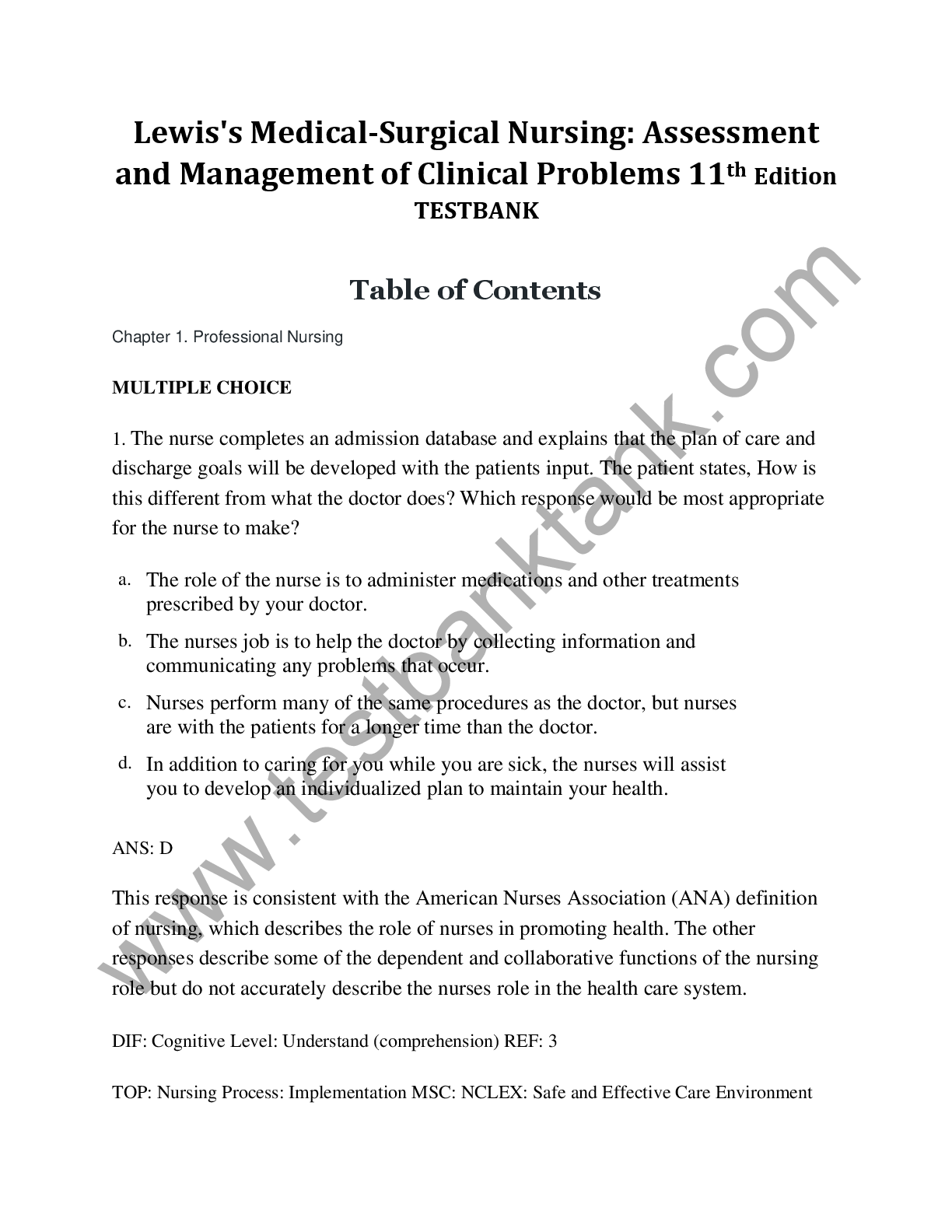
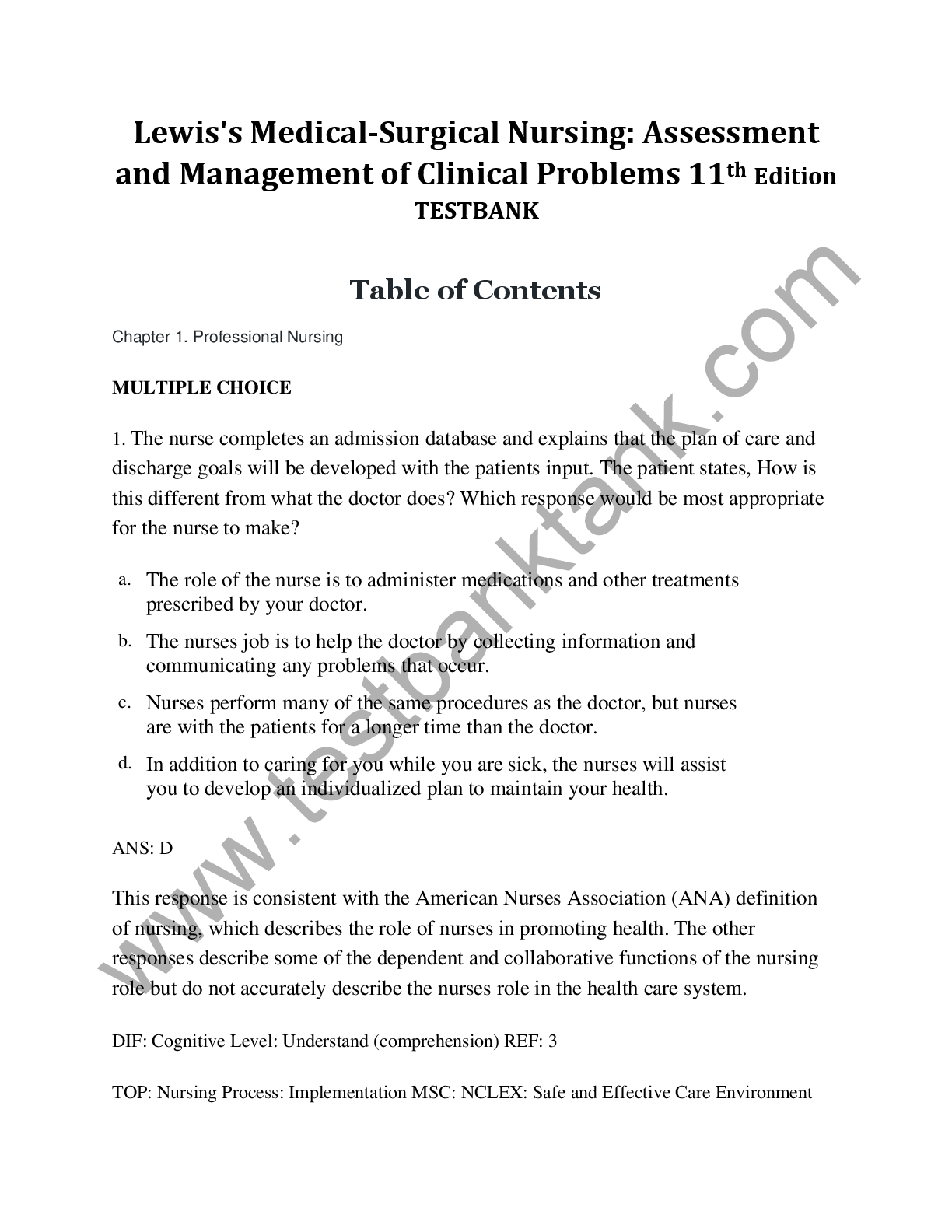
1. The nurse completes an admission database and explains that the plan of care and discharge
goals will be developed with the patient’s input. The patient states, “How is this different from
what the doctor does?” Which response would be most appropriate for the nurse to make?
a. “The role of the nurse is to administer medications and other treatments prescribed
by your doctor.”
b. “The nurse’s job is to help the doctor by collecting information and
communicating any problems that occur.”
c. “Nurses perform many of the same procedures as the doctor, but nurses are with
the patients for a longer time than the doctor.”
d. “In addition to caring for you while you are sick, the nurses will assist you to
develop an individualized plan to maintain your health.”
ANS: D
This response is consistent with the American Nurses Association (ANA) definition of
nursing, which describes the role of nurses in promoting health. The other responses describe
some of the dependent and collaborative functions of the nursing role but do not accurately
describe the nurse’s role in the health care system.
DIF: Cognitive Level: Understand (comprehension) REF: 3
TOP: Nursing Process: Implementation MSC: NCLEX: Safe and Effective Care Environment
2. The nurse describes to a student nurse how to use evidence-based practice guidelines when
caring for patients. Which statement, if made by the nurse, would be the most accurate?
a. “Inferences from clinical research studies are used as a guide.”
b. “Patient care is based on clinical judgment, experience, and traditions.”
c. “Data are evaluated to show that the patient outcomes are consistently met.”
d. “Recommendations are based on research, clinical expertise, and patient
preferences.”
ANS: D
Evidence-based practice (EBP) is the use of the best research-based evidence combined with
clinician expertise. Clinical judgment based on the nurse’s clinical experience is part of EBP,
but clinical decision making should also incorporate current research and research-based
guidelines. Evaluation of patient outcomes is important, but interventions should be based on
research from randomized control studies with a large number of subjects.
DIF: Cognitive Level: Remember (knowledge) REF: 15
TOP: Nursing Process: Planning MSC: NCLEX: Safe and Effective Care Environment
3. The nurse teaches a student nurse about how to apply the nursing process when providing
patient care. Which statement, if made by the student nurse, indicates that teaching was
successful?
a. “The nursing process is a scientific-based method of diagnosing the patient’s
health care problems.”
b. “The nursing process is a problem-solving tool used to identify and treat patients’health care needs.”
c. “The nursing process is used primarily to explain nursing interventions to other
health care professionals.”
d. “The nursing process is based on nursing theory that incorporates the
biopsychosocial nature of humans.”
ANS: B
The nursing process is a problem-solving approach to the identification and treatment of
patients’ problems. Diagnosis is only one phase of the nursing process. The primary use of the
nursing process is in patient care, not to establish nursing theory or explain nursing
interventions to other health care professionals.
DIF: Cognitive Level: Understand (comprehension) REF: 5
TOP: Nursing Process: Implementation MSC: NCLEX: Safe and Effective Care Environment
4. A patient has been admitted to the hospital for surgery and tells the nurse, “I do not feel
comfortable leaving my children with my parents.” Which action should the nurse take next?
a. Reassure the patient that these feelings are common for parents.
b. Have the patient call the children to ensure that they are doing well.
c. Gather more data about the patient’s feelings about the child-care arrangements.
d. Call the patient’s parents to determine whether adequate child care is being
provided.
ANS: C
Because a complete assessment is necessary in order to identify a problem and choose an
appropriate intervention, the nurse’s first action should be to obtain more information. The
other actions may be appropriate, but more assessment is needed before the best intervention
can be chosen.
DIF: Cognitive Level: Apply (application) REF: 6
OBJ: Special Questions: Prioritization TOP: Nursing Process: Assessment
MSC: NCLEX: Psychosocial Integrity
5. A patient who is paralyzed on the left side of the body after a stroke develops a pressure ulcer
on the left hip. Which nursing diagnosis is most appropriate?
a. Impaired physical mobility related to left-sided paralysis
b. Risk for impaired tissue integrity related to left-sided weakness
c. Impaired skin integrity related to altered circulation and pressure
d. Ineffective tissue perfusion related to inability to move independently
ANS: C
The patient’s major problem is the impaired skin integrity as demonstrated by the presence of
a pressure ulcer. The nurse is able to treat the cause of altered circulation and pressure by
frequently repositioning the patient. Although left-sided weakness is a problem for the patient,
the nurse cannot treat the weakness. The “risk for” diagnosis is not appropriate for this patient,
who already has impaired tissue integrity. The patient does have ineffective tissue perfusion,
but the impaired skin integrity diagnosis indicates more clearly what the health problem is.
DIF: Cognitive Level: Apply (application) REF: 7
TOP: Nursing Process: Diagnosis MSC: NCLEX: Physiological Integrity6. A patient with a bacterial infection has a nursing diagnosis of deficient fluid volume related to
excessive diaphoresis. Which outcome would the nurse recognize as appropriate for this
patient?
a. Patient has a balanced intake and output.
b. Patient’s bedding is changed when it becomes damp.
c. Patient understands the need for increased fluid intake.
d. Patient’s skin remains cool and dry throughout hospitalization.
ANS: A
This statement gives measurable data showing resolution of the problem of deficient fluid
volume that was identified in the nursing diagnosis statement. The other statements would not
indicate that the problem of deficient fluid volume was resolved.
DIF: Cognitive Level: Apply (application) REF: 7
TOP: Nursing Process: Planning MSC: NCLEX: Physiological Integrity
7. A nurse asks the patient if pain was relieved after receiving medication. What is the purpose
of the evaluation phase of the nursing process?
a. To determine if interventions have been effective in meeting patient outcomes
b. To document the nursing care plan in the progress notes of the medical record
c. To decide whether the patient’s health problems have been completely resolved
d. To establish if the patient agrees that the nursing care provided was satisfactory
ANS: A
Evaluation consists of determining whether the desired patient outcomes have been met and
whether the nursing interventions were appropriate. The other responses do not describe the
evaluation phase.
DIF: Cognitive Level: Understand (comprehension) REF: 5
TOP: Nursing Process: Evaluation MSC: NCLEX: Safe and Effective Care Environment
8. The nurse interviews a patient while completing the health history and physical examination.
What is the purpose of the assessment phase of the nursing process?
a. To teach interventions that relieve health problems
b. To use patient data to evaluate patient care outcomes
c. To obtain data with which to diagnose patient problems
d. To help the patient identify realistic outcomes for health problems
ANS: C
During the assessment phase, the nurse gathers information about the patient to diagnose
patient problems. The other responses are examples of the planning, intervention, and
evaluation phases of the nursing process.
DIF: Cognitive Level: Understand (comprehension) REF: 5
TOP: Nursing Process: Assessment MSC: NCLEX: Safe and Effective Care Environment
9. Which nursing diagnosis statement is written correctly?
a. Altered tissue perfusion related to heart failure
b. Risk for impaired tissue integrity related to sacral redness
c. Ineffective coping related to response to biopsy test results
d. Altered urinary elimination related to urinary tract infectionANS: C
This diagnosis statement includes a NANDA nursing diagnosis and an etiology that describes
a patient’s response to a health problem that can be treated by nursing. The use of a medical
diagnosis as an etiology (as in the responses beginning “Altered tissue perfusion” and
“Altered urinary elimination”) is not appropriate. The response beginning “Risk for impaired
tissue integrity” uses the defining characteristic as the etiology.
DIF: Cognitive Level: Understand (comprehension) REF: 7
TOP: Nursing Process: Diagnosis MSC: NCLEX: Safe and Effective Care Environment
10. The nurse admits a patient to the hospital and develops a plan of care. What components
should the nurse include in the nursing diagnosis statement?
a. The problem and the suggested patient goals or outcomes
b. The problem with possible causes and the planned interventions
c. The problem, its cause, and objective data that support the problem
d. The problem with an etiology and the signs and symptoms of the problem
ANS: D
When writing nursing diagnoses, this format should be used: problem, etiology, and signs and
symptoms. The subjective, as well as objective, data should be included in the defining
characteristics. Interventions and outcomes are not included in the nursing diagnosis
statement.
DIF: Cognitive Level: Remember (knowledge) REF: 7
TOP: Nursing Process: Diagnosis MSC: NCLEX: Safe and Effective Care Environment
11. A nurse is caring for a patient with heart failure. Which task is appropriate for the nurse to
delegate to experienced unlicensed assistive personnel (UAP)?
a. Monitor for shortness of breath or fatigue after ambulation.
b. Instruct the patient about the need to alternate activity and rest.
c. Obtain the patient’s blood pressure and pulse rate after ambulation.
d. Determine whether the patient is ready to increase the activity level.
ANS: C
UAP education includes accurate vital sign measurement. Assessment and patient teaching
require registered nurse education and scope of practice and cannot be delegated.
DIF: Cognitive Level: Apply (application) REF: 11
OBJ: Special Questions: Delegation TOP: Nursing Process: Planning
MSC: NCLEX: Safe and Effective Care Environment
12. A nurse is caring for a group of patients on the medical-surgical unit with the help of one float
registered nurse (RN), one unlicensed assistive personnel (UAP), and one licensed
practical/vocational nurse (LPN/LVN). Which assignment, if delegated by the nurse, would
be inappropriate?
a. Measurement of a patient’s urine output by UAP
b. Administration of oral medications by LPN/LVN
c. Check for the presence of bowel sounds and flatulence by UAP
d. Care of a patient with diabetes by RN who usually works on the pediatric unit
ANS: CAssessment requires RN education and scope of practice and cannot be delegated to an
LPN/LVN or UAP. The other assignments made by the RN are appropriate.
DIF: Cognitive Level: Apply (application) REF: 11
OBJ: Special Questions: Delegation TOP: Nursing Process: Planning
MSC: NCLEX: Safe and Effective Care Environment
13. Which task is appropriate for the nurse to delegate to a licensed practical/vocational nurse
(LPN/LVN)?
a. Complete the initial admission assessment and plan of care.
b. Document teaching completed before a diagnostic procedure.
c. Instruct a patient about low-fat, reduced sodium dietary restrictions.
d. Obtain bedside blood glucose on a patient before insulin administration.
ANS: D
The education and scope of practice of the LPN/LVN include activities such as obtaining
glucose testing using a finger stick. Patient teaching and the initial assessment and
development of the plan of care are nursing actions that require registered nurse education and
scope of practice.
DIF: Cognitive Level: Apply (application) REF: 11
OBJ: Special Questions: Delegation TOP: Nursing Process: Planning
MSC: NCLEX: Safe and Effective Care Environment
14. A nurse is assigned as a case manager for a hospitalized patient with a spinal cord injury. The
patient can expect the nurse functioning in this role to perform which activity?
a. Care for the patient during hospitalization for the injuries.
b. Assist the patient with home care activities during recovery.
c. Determine what medical care the patient needs for optimal rehabilitation.
d. Coordinate the services that the patient receives in the hospital and at home.
ANS: D
The role of the case manager is to coordinate the patient’s care through multiple settings and
levels of care to allow the maximal patient benefit at the least cost. The case manager does not
provide direct care in either the acute or home setting. The case manager coordinates and
advocates for care but does not determine what medical care is needed; that would be
completed by the health care provider or other provider.
DIF: Cognitive Level: Apply (application) REF: 9
TOP: Nursing Process: Implementation MSC: NCLEX: Safe and Effective Care Environment
15. The nurse is caring for an older adult patient who had surgery to repair a fractured hip. The
patient needs continued nursing care and physical therapy to improve mobility before
returning home. The nurse will help to arrange for transfer of this patient to which facility?
a. A skilled care facility c. A transitional care facility
b. A residential care facility d. An intermediate care facility
ANS: CTransitional care settings are appropriate for patients who need continued rehabilitation before
discharge to home or to long-term care settings. The patient is no longer in need of the more
continuous assessment and care given in acute care settings. There is no indication that the
patient will need the permanent and ongoing medical and nursing services available in
intermediate or skilled care. The patient is not yet independent enough to transfer to a
residential care facility.
DIF: Cognitive Level: Apply (application) REF: 8
TOP: Nursing Process: Planning MSC: NCLEX: Safe and Effective Care Environment
16. A home care nurse is planning care for a patient who has just been diagnosed with type 2
diabetes mellitus. Which task is appropriate for the nurse to delegate to the home health aide?
a. Assist the patient to choose appropriate foods.
b. Help the patient with a daily bath and oral care.
c. Check the patient’s feet for signs of breakdown.
d. Teach the patient how to monitor blood glucose.
ANS: B
Assisting with patient hygiene is included in home health-aide education and scope of
practice. Assessment of the patient and instructing the patient in new skills, such as diet and
blood glucose monitoring, are complex skills that are included in registered nurse education
and scope of practice.
DIF: Cognitive Level: Apply (application) REF: 11
OBJ: Special Questions: Delegation TOP: Nursing Process: Implementation
MSC: NCLEX: Safe and Effective Care Environment
17. The nurse is providing education to nursing staff on quality care initiatives. Which statement
is an accurate description of the impact of health care financing on quality care?
a. “If a patient develops a catheter-related infection, the hospital receives additional
funding.”
b. “Payment for patient care is primarily based on clinical outcomes and patient
satisfaction.”
c. “Hospitals are reimbursed for all costs incurred if care is documented
electronically.”
d. “Because hospitals are accountable for overall care, it is not nursing’s
responsibility to monitor care delivered by others.”
ANS: B
Payment for health care services programs reimburses hospitals for their performance on
overall quality-of-care measures. These measures include clinical outcomes and patient
satisfaction. Nurses are responsible for coordinating complex aspects of patient care,
including the care delivered by others, and identifying issues that are associated with poor
quality care. Payment for care can be withheld if something happens to the patient that is
considered preventable (e.g., acquiring a catheter-related urinary tract infection).
DIF: Cognitive Level: Apply (application) REF: 4
TOP: Nursing Process: Implementation MSC: NCLEX: Safe and Effective Care Environment18. The nurse documenting the patient’s progress in the care plan in the electronic health record
before an interprofessional discharge conference is demonstrating competency in which
QSEN category?
a. Patient-centered care c. Evidence-based practice
b. Quality improvement d. Informatics and technology
ANS: D
The nurse is displaying competency in the QSEN area of informatics and technology. Using a
computerized information system to document patient needs and progress and communicate
vital information regarding the patient with the interprofessional care team members provides
evidence that nursing practice standards related to the nursing process have been maintained
during the care of the patient.
DIF: Cognitive Level: Apply (application) REF: 13
TOP: Nursing Process: Implementation MSC: NCLEX: Safe and Effective Care Environment
MULTIPLE RESPONSE
1. Which information will the nurse consider when deciding what nursing actions to delegate to
a licensed practical/vocational nurse (LPN/LVN) who is working on a medical-surgical unit
(select all that apply)?
a. Institutional policies
b. Stability of the patient
c. State nurse practice act
d. LPN/LVN teaching abilities
e. Experience of the LPN/LVN
ANS: A, B, C, E
The nurse should assess the experience of LPN/LVNs when delegating. In addition, state
nurse practice acts and institutional policies must be considered. In general, whereas the
LPN/LVN scope of practice includes caring for patients who are stable, registered nurses
should provide most of the care for unstable patients. Because the LPN/LVN scope of practice
does not include patient education, this will not be part of the delegation process.
DIF: Cognitive Level: Apply (application) REF: 11
OBJ: Special Questions: Delegation TOP: Nursing Process: Planning
MSC: NCLEX: Safe and Effective Care Environment
2. The nurse is administering medications to a patient. Which actions by the nurse during this
process are consistent with promoting safe delivery of care (select all that apply)?
a. Throws away a medication that is not labeled
b. Uses a hand sanitizer before preparing a medication
c. Identifies the patient by the room number on the door
d. Checks laboratory test results before administering a diuretic
e. Gives the patient a list of current medications upon discharge
ANS: A, B, D, ENational Patient Safety Goals have been established to promote safe delivery of care. The
nurse should use at least two reliable ways to identify the patient such as asking the patient’s
full name and date of birth before medication administration. Other actions that improve
patient safety include performing hand hygiene, disposing of unlabeled medications,
completing appropriate assessments before administering medications, and giving a list of the
current medicines to the patient and caregiver before discharge.
DIF: Cognitive Level: Apply (application) REF: 12
TOP: Nursing Process: Implementation MSC: NCLEX: Safe and Effective Care Environment
OTHER
1. The nurse uses the Situation-Background-Assessment-Recommendation (SBAR) format to
communicate a change in patient status to a health care provider. In which order should the
nurse make the following statements? (Put a comma and a space between each answer choice
[A, B, C, D].)
a. “The patient needs to be evaluated immediately and may need intubation and mechanical
ventilation.”
b. “The patient was admitted yesterday with heart failure and has been receiving furosemide
(Lasix) for diuresis, but urine output has been low.”
c. “The patient has crackles audible throughout the posterior chest, and the most recent
oxygen saturation is 89%. Her condition is very unstable.”
d. “This is the nurse on the surgical unit. After assessing the patient, I am very concerned
about increased shortness of breath over the past hour.”
ANS:
D, B, C, A
The order of the nurse’s statements follows the SBAR format.
DIF: Cognitive Level: Apply (application) REF: 11
OBJ: Special Questions: Prioritization TOP: Nursing Process: Implementation
MSC: NCLEX: Safe and Effective Care EnvironmentChapter 02: Health Disparities and Culturally Competent Care
Lewis: Medical-Surgical Nursing, 10th Edition
MULTIPLE CHOICE
1. The nurse is obtaining a health history from a new patient. Which data will be the focus of
patient teaching?
a. Age and gender c. Hispanic/Latino ethnicity
b. Saturated fat intake d. Family history of diabetes
ANS: B
Behaviors are strongly linked to many health care problems. The patient’s saturated fat intake
is a behavior that the patient can change. The other information will be useful as the nurse
develops an individualized plan for improving the patient’s health, but will not be the focus of
patient teaching.
DIF: Cognitive Level: Apply (application) REF: 18
TOP: Nursing Process: Planning MSC: NCLEX: Health Promotion and Maintenance
2. The nurse works in a clinic located in a community with many Hispanics. Which strategy, if
implemented by the nurse, would decrease health care disparities for the Hispanic patients?
a. Improve public transportation to the clinic.
b. Update equipment and supplies at the clinic.
c. Obtain low-cost medications for clinic patients.
d. Teach clinic staff about Hispanic health beliefs.
ANS: D
Health care disparities are caused by stereotyping, biases, and prejudice of health care
providers. The nurse can decrease these through staff education. The other strategies may also
be addressed by the nurse but will not directly impact health disparities.
DIF: Cognitive Level: Apply (application) REF: 19
TOP: Nursing Process: Planning MSC: NCLEX: Health Promotion and Maintenance
3. What information should the nurse collect when assessing the health status of a community?
a. Air pollution levels c. Most common causes of death
b. Number of health food stores d. Education level of the individuals
ANS: C
Health status measures of a community include birth and death rates, life expectancy, access
to care, and morbidity and mortality rates related to disease and injury. Although air pollution,
access to health food stores, and education level are factors that affect a community’s health
status, they are not health measures.
DIF: Cognitive Level: Understand (comprehension) REF: 18
TOP: Nursing Process: Assessment MSC: NCLEX: Health Promotion and Maintenance
4. The nurse is caring for a Native American patient who has traditional beliefs about health and
illness. Which action by nurse is most appropriate?
a. Avoid asking questions unless the patient initiates the conversation.
b. Ask the patient whether it is important that cultural healers are contacted.c. Explain the usual hospital routines for meal times, care, and family visits.
d. Obtain further information about the patient’s cultural beliefs from a family
member.
ANS: B
Because the patient has traditional health care beliefs, it is appropriate for the nurse to ask
whether the patient would like a visit by a shaman or other cultural healer. There is no cultural
reason for the nurse to avoid asking the patient questions because these questions are
necessary to obtain health information. The patient (rather than the family) should be
consulted about personal cultural beliefs. The hospital routines for meals, care, and visits
should be adapted to the patient’s preferences rather than expecting the patient to adapt to the
hospital schedule.
DIF: Cognitive Level: Apply (application) REF: 24
TOP: Nursing Process: Implementation MSC: NCLEX: Psychosocial Integrity
5. The nurse is caring for an Asian patient who is being admitted to the hospital. Which action
would be most appropriate for the nurse to take when interviewing this patient?
a. Avoid eye contact with the patient.
b. Observe the patient’s use of eye contact.
c. Look directly at the patient when interacting.
d. Ask a family member about the patient’s cultural beliefs.
ANS: B
Observation of the patient’s use of eye contact will be most useful in determining the best way
to communicate effectively with the patient. Looking directly at the patient or avoiding eye
contact may be appropriate, depending on the patient’s individual cultural beliefs. The nurse
should assess the patient, rather than asking family members about the patient’s beliefs.
DIF: Cognitive Level: Apply (application) REF: 25
TOP: Nursing Process: Implementation MSC: NCLEX: Psychosocial Integrity
6. A female staff nurse is assessing a male patient of Arab descent who is admitted with
complaints of severe headaches. It is most important for the charge nurse to intervene if the
nurse takes which action?
a. The nurse explains the 0 to 10 intensity pain scale.
b. The nurse asks the patient when the headaches started.
c. The nurse sits down at the bedside and closes the privacy curtain.
d. The nurse calls for a male nurse to bring a hospital gown to the room.
ANS: C
Many men of Arab ethnicity do not believe it is appropriate to be alone with any female
except for their spouse. The other actions are appropriate.
DIF: Cognitive Level: Apply (application) REF: 25
TOP: Nursing Process: Implementation MSC: NCLEX: Psychosocial Integrity
7. The nurse is caring for a patient who speaks a different language. If an interpreter is not
available, which action by the nurse is most appropriate?
a. Talk slowly so that each word is clearly heard.
b. Speak loudly in close proximity to the patient’s ears.
c. Repeat important words so that the patient recognizes their significance.d. Use simple gestures to demonstrate meaning while talking to the patient.
ANS: D
The use of gestures will enable some information to be communicated to the patient. The
other actions will not improve communication with the patient.
DIF: Cognitive Level: Understand (comprehension) REF: 31
TOP: Nursing Process: Implementation MSC: NCLEX: Psychosocial Integrity
8. The nurse plans care for a hospitalized patient who uses culturally based treatments. Which
action by the nurse is best?
a. Encourage the use of diagnostic procedures.
b. Coordinate the use of folk treatments with ordered medical therapies.
c. Ask the patient to discontinue the cultural treatments during hospitalization.
d. Teach the patient that folk remedies will interfere with orders by the health care
provider.
ANS: B
Many culturally based therapies can be accommodated along with the use of Western
treatments and medications. The nurse should attempt to use both traditional folk treatments
and the ordered Western therapies as much as possible. Some culturally based treatments can
be effective in treating “Western” diseases. Not all folk remedies interfere with Western
therapies. It may be appropriate for the patient to continue some culturally based treatments
while he or she is hospitalized.
DIF: Cognitive Level: Apply (application) REF: 22
TOP: Nursing Process: Planning MSC: NCLEX: Psychosocial Integrity
9. The nurse is caring for a newly admitted patient. Which intervention is the best example of a
culturally appropriate nursing intervention?
a. Insist family members provide most of the patient’s personal care.
b. Maintain a personal space of at least 2 feet when assessing the patient.
c. Ask permission before touching a patient during the physical assessment.
d. Consider the patient’s ethnicity as the most important factor in planning care.
ANS: C
Many cultures consider it disrespectful to touch a patient without asking permission, so asking
a patient for permission is always culturally appropriate. The other actions may be appropriate
for some patients but are not appropriate across all cultural groups or for all individual
patients. Ethnicity may not be the most important factor in planning care, especially if the
patient has urgent physiologic problems.
DIF: Cognitive Level: Understand (comprehension) REF: 28
TOP: Nursing Process: Implementation MSC: NCLEX: Psychosocial Integrity
10. A staff nurse expresses frustration that a Native American patient always has several family
members at the bedside. Which action by the charge nurse is most appropriate?
a. Remind the nurse that family support is important to this family and patient.
b. Have the nurse explain to the family that too many visitors will tire the patient.
c. Suggest that the nurse ask family members to leave the room during patient care.
d. Ask about the nurse’s personal beliefs about family support during hospitalization.ANS: D
The first step in providing culturally competent care is to understand one’s own beliefs and
values related to health and health care. Asking the nurse about personal beliefs will help
achieve this step. Reminding the nurse that this cultural practice is important to the family and
patient will not decrease the nurse’s frustration. The remaining responses (suggest that the
nurse ask family members to leave the room and have the nurse explain to family that too
many visitors will tire the patient) are not culturally appropriate for this patient.
DIF: Cognitive Level: Apply (application) REF: 23
TOP: Nursing Process: Implementation MSC: NCLEX: Psychosocial Integrity
11. An older Asian American patient tells the nurse that she has lived in the United States for 50
years. The patient speaks English and lives in a predominantly Asian neighborhood. Which
action by the nurse is most appropriate?
a. Include a shaman when planning the patient’s care.
b. Avoid direct eye contact with the patient during care.
c. Ask the patient about any special cultural beliefs or practices.
d. Involve the patient’s oldest son to assist with health care decisions.
ANS: C
Further assessment of the patient’s health care preferences is needed before making further
plans for culturally appropriate care. The other responses indicate stereotyping of the patient
based on ethnicity and would not be appropriate initial actions.
DIF: Cognitive Level: Apply (application) REF: 23
TOP: Nursing Process: Planning MSC: NCLEX: Psychosocial Integrity
12. The nurse plans health care for a community with a large number of recent immigrants from
Vietnam. Which intervention is the most important for the nurse to implement?
a. Hepatitis testing c. Contraceptive teaching
b. Tuberculosis screening d. Colonoscopy information
ANS: B
Tuberculosis (TB) is endemic in many parts of Asia, and the incidence of TB is much higher
in immigrants from Vietnam than in the general U.S. population. Teaching about
contraceptive use, colonoscopy, and testing for hepatitis may also be appropriate for some
patients but is not generally indicated for all members of this community.
DIF: Cognitive Level: Apply (application) REF: 28
TOP: Nursing Process: Planning MSC: NCLEX: Physiological Integrity
13. When doing an admission assessment for a patient, the nurse notices that the patient pauses
before answering questions about the health history. Which action by the nurse is most
appropriate?
a. Interview a family member instead.
b. Wait for the patient to answer the questions.
c. Remind the patient that you have other patients who need care.
d. Give the patient an assessment form listing the questions and a pen.
ANS: BPatients from some cultures take time to consider a question carefully before answering. The
nurse will show respect for the patient and help develop a trusting relationship by allowing the
patient time to give a thoughtful answer. Asking the patient why the answers are taking so
much time, stopping the assessment, and handing the patient a form indicate that the nurse
does not have time for the patient.
DIF: Cognitive Level: Apply (application) REF: 30
TOP: Nursing Process: Assessment MSC: NCLEX: Psychosocial Integrity
14. Which strategy should be a priority when the nurse is planning care for a diabetic patient who
is uninsured?
a. Obtain less expensive medications.
b. Follow evidence-based practice guidelines.
c. Assist with dietary changes as the first action.
d. Teach about the impact of exercise on diabetes.
ANS: B
The use of standardized evidence-based guidelines will reduce the incidence of health care
disparities among various socioeconomic groups. The other strategies may also be
appropriate, but the priority concern should be that the patient receives care that meets the
accepted standard.
DIF: Cognitive Level: Apply (application) REF: 28
OBJ: Special Questions: Prioritization TOP: Nursing Process: Planning
MSC: NCLEX: Health Promotion and Maintenance
15. A Hispanic patient complains of abdominal cramping caused by empacho. Which action
should the nurse take first?
a. Ask the patient what treatments are likely to help.
b. Massage the patient’s abdomen until the pain is gone.
c. Administer prescribed medications to decrease the cramping.
d. Offer to contact a curandero(a) to make a visit to the patient.
ANS: A
Further assessment of the patient’s cultural beliefs is appropriate before implementing any
interventions for a culture-bound syndrome such as empacho. Although medication, a visit by
a curandero(a), or massage may be helpful, more information about the patient’s beliefs is
needed to determine which intervention(s) will be most helpful.
DIF: Cognitive Level: Apply (application) REF: 29
OBJ: Special Questions: Prioritization TOP: Nursing Process: Assessment
MSC: NCLEX: Psychosocial Integrity
16. The nurse performs a cultural assessment with a patient from a different culture. Which action
by the nurse should be taken first?
a. Request an interpreter before interviewing the patient.
b. Wait until a family member is available to help with the assessment.
c. Ask the patient about any affiliation with a particular cultural group.
d. Tell the patient what the nurse already knows about the patient’s culture.
ANS: CAn early step in performing a cultural assessment is to determine whether the patient feels an
affiliation with any cultural group. The other actions may be appropriate if the patient does
identify with a particular culture.
DIF: Cognitive Level: Apply (application) REF: 30
OBJ: Special Questions: Prioritization TOP: Nursing Process: Assessment
MSC: NCLEX: Psychosocial Integrity
17. The nurse working in a clinic in a primarily African American community notes a higher
incidence of uncontrolled hypertension in the patients. To correct this health disparity, which
action should the nurse take first?
a. Initiate a regular home-visit program by nurses working at the clinic.
b. Schedule teaching sessions about low-salt diets at community events.
c. Assess the perceptions of community members about the care at the clinic.
d. Obtain low-cost antihypertensive drugs using funding from government grants.
ANS: C
Before other actions are taken, additional assessment data are needed to determine the reason
for the disparity. The other actions also may be appropriate, but additional assessment is
needed before the next action is selected.
DIF: Cognitive Level: Apply (application) REF: 29
OBJ: Special Questions: Prioritization TOP: Nursing Process: Assessment
MSC: NCLEX: Health Promotion and Maintenance
MULTIPLE RESPONSE
1. The nurse is performing an admission assessment for a non–English-speaking patient who is
from China. Which actions could the nurse take to enhance communication (select all that
apply)?
a. Use an electronic translation application.
b. Use a telephone-based medical interpreter.
c. Wait until an agency interpreter is available.
d. Ask the patient’s teenage daughter to interpret.
e. Use exaggerated gestures to convey information.
ANS: A, B, C
Electronic translation applications, telephone-based interpreters, and agency interpreters are
all appropriate to use to communicate with non–English-speaking patients. When no
interpreter is available, family members may be considered, but some information that will be
needed in an admission assessment may be misunderstood or not shared if a child is used as
the interpreter. Gestures are appropriate to use, but exaggeration of the gestures is not needed.
DIF: Cognitive Level: Apply (application) REF: 31
TOP: Nursing Process: Assessment MSC: NCLEX: Psychosocial IntegrityChapter 03: Health History and Physical Examination
Lewis: Medical-Surgical Nursing, 10th Edition
MULTIPLE CHOICE
1. A patient who is actively bleeding is admitted to the emergency department. Which approach
is best for the nurse to use to obtain a health history?
a. Briefly interview the patient while obtaining vital signs.
b. Obtain subjective data about the patient from family members.
c. Omit subjective data collection and obtain the physical examination.
d. Use the health care provider’s medical history to obtain subjective data.
ANS: A
In an emergency situation, the nurse may need to ask only the most pertinent questions for a
specific problem and obtain more information later. A complete health history will include
subjective information that is not available in the health care provider’s medical history.
Family members may be able to provide some subjective data, but only the patient will be
able to give subjective information about the bleeding. Because the subjective data about the
cause of the patient’s bleeding will be essential, obtaining the physical examination alone will
not provide sufficient information.
DIF: Cognitive Level: Apply (application) REF: 40
TOP: Nursing Process: Assessment MSC: NCLEX: Health Promotion and Maintenance
2. Immediate surgery is planned for a patient with acute abdominal pain. Which question by the
nurse will elicit the most complete information about the patient’s coping-stress tolerance
pattern?
a. “Can you rate your pain on a 0 to 10 scale?”
b. “What do you think caused this abdominal pain?”
c. “How do you feel about yourself and your hospitalization?”
d. “Are there other major problems that are a concern right now?”
ANS: D
The coping–stress tolerance pattern includes information about other major stressors
confronting the patient. The health perception–health management pattern includes
information about the patient’s ideas about risk factors. Feelings about self and the
hospitalization are assessed in the self-perception–self-concept pattern. Intensity of pain is
part of the cognitive–perceptual pattern.
DIF: Cognitive Level: Apply (application) REF: 37
TOP: Nursing Process: Assessment MSC: NCLEX: Psychosocial Integrity
3. During the health history interview, a patient tells the nurse about periodic fainting spells.
Which question by the nurse will best elicit any associated clinical manifestations?
a. “How frequently do you have the fainting spells?”
b. “Where are you when you have the fainting spells?”
c. “Do the spells tend to occur at any special time of day?”
d. “Do you have any other symptoms along with the spells?”
ANS: DAsking about other associated symptoms will provide the nurse more information about all the
clinical manifestations related to the fainting spells. Information about the setting is obtained
by asking where the patient was and what the patient was doing when the symptom occurred.
The other questions from the nurse are appropriate for obtaining information about
chronology and frequency.
DIF: Cognitive Level: Apply (application) REF: 35
TOP: Nursing Process: Assessment MSC: NCLEX: Health Promotion and Maintenance
4. The nurse records the following general survey of a patient: “The patient is a 50-yr-old Asian
female attended by her husband and two daughters. Alert and oriented. Does not make eye
contact with the nurse and responds slowly, but appropriately, to questions. No apparent
disabilities or distinguishing features.” What additional information should the nurse add to
this general survey?
a. Nutritional status
b. Intake and output
c. Reasons for contact with the health care system
d. Comments of family members about his condition
ANS: A
The general survey also describes the patient’s general nutritional status. The other
information will be obtained when doing the complete nursing history and examination but is
not obtained through the initial scanning of a patient.
DIF: Cognitive Level: Understand (comprehension) REF: 39
TOP: Nursing Process: Assessment MSC: NCLEX: Health Promotion and Maintenance
5. A nurse performs a health history and physical examination with a patient who has a right leg
fracture. Which assessment would be a pertinent negative finding?
a. Patient has several bruised and swollen areas on the right leg.
b. Patient states that there have been no other recent health problems.
c. Patient refuses to bend the right knee because of the associated pain.
d. Patient denies having pain when the area over the fracture is palpated.
ANS: D
The nurse expects that a patient with a leg fracture will have pain over the fractured area. The
bruising and swelling and pain with bending are positive findings. Having no other recent
health problems is neither a positive nor a negative finding with regard to a leg fracture.
DIF: Cognitive Level: Apply (application) REF: 39
TOP: Nursing Process: Assessment MSC: NCLEX: Health Promotion and Maintenance
6. The nurse who is assessing an older adult with rectal bleeding asks, “Have you ever had a
colonoscopy?” The nurse is performing what type of assessment?
a. Focused assessment c. Detailed health assessment
b. Emergency assessment d. Comprehensive assessment
ANS: AA focused assessment is an abbreviated assessment used to evaluate the status of previously
identified problems and monitor for signs of new problems. It can be done when a specific
problem is identified. An emergency assessment is done when the nurse needs to obtain
information about life-threatening problems quickly while simultaneously taking action to
maintain vital function. A comprehensive assessment includes a detailed health history and
physical examination of one body system or many body systems. It is typically done on
admission to the hospital or onset of care in a primary care setting.
DIF: Cognitive Level: Understand (comprehension) REF: 40
TOP: Nursing Process: Assessment MSC: NCLEX: Health Promotion and Maintenance
7. The nurse is preparing to perform a focused assessment for a patient complaining of shortness
of breath. Which equipment will be needed?
a. Flashlight c. Tongue blades
b. Stethoscope d. Percussion hammer
ANS: B
A stethoscope is used to auscultate breath sounds. The other equipment may be used for a
comprehensive assessment but will not be needed for a focused respiratory assessment.
DIF: Cognitive Level: Understand (comprehension) REF: 40
TOP: Nursing Process: Assessment MSC: NCLEX: Health Promotion and Maintenance
8. The nurse plans to complete a physical examination of an alert, older patient. Which
adaptations to the examination technique should the nurse include?
a. Avoid the use of touch as much as possible.
b. Use slightly more pressure for palpation of the liver.
c. Speak softly and slowly when talking with the patient.
d. Organize the sequence to minimize the position changes.
ANS: D
Older patients may have age-related changes in mobility that make it more difficult to change
position. There is no need to avoid the use of touch when examining older patients. Less
pressure should be used over the liver. Because the patient is alert, there is no indication that
there is any age-related difficulty in understanding directions from the nurse.
DIF: Cognitive Level: Apply (application) REF: 40
TOP: Nursing Process: Assessment MSC: NCLEX: Health Promotion and Maintenance
9. While the nurse is taking the health history, a patient states, “My mother and sister both had
double mastectomies and were unable to be very active for weeks.” Which functional health
pattern is represented by this patient’s statement?
a. Activity–exercise
b. Cognitive–perceptual
c. Coping–stress tolerance
d. Health perception–health management
ANS: D
The information in the patient statement relates to risk factors and important information
about the family history. Identification of risk factors falls into the health perception–health
maintenance pattern.DIF: Cognitive Level: Understand (comprehension) REF: 37
TOP: Nursing Process: Assessment MSC: NCLEX: Health Promotion and Maintenance
10. A patient is seen in the emergency department with severe abdominal pain and hypotension.
Which type of assessment should the nurse do at this time?
a. Focused assessment c. Emergency assessment
b. Subjective assessment d. Comprehensive assessment
ANS: C
Because the patient is hemodynamically unstable, an emergency assessment is needed.
Comprehensive and focused assessments may be needed after the patient is stabilized.
Subjective information is needed, but objective data such as vital signs are essential for the
unstable patient.
DIF: Cognitive Level: Understand (comprehension) REF: 40
TOP: Nursing Process: Assessment MSC: NCLEX: Health Promotion and Maintenance
11. The registered nurse (RN) cares for a patient who was admitted a few hours previously with
back pain after falling. Which action can the RN delegate to unlicensed assistive personnel
(UAP)?
a. Finish documenting the admission assessment.
b. Determine the patient’s priority nursing diagnoses.
c. Obtain the health history from the patient’s caregiver.
d. Take the patient’s temperature, pulse, and blood pressure.
ANS: D
The RN may delegate vital signs to the UAP. Obtaining the health history, documentation of
the admission assessment, and determining nursing diagnoses require the education and scope
of practice of the RN.
DIF: Cognitive Level: Apply (application) REF: 36
OBJ: Special Questions: Delegation TOP: Nursing Process: Planning
MSC: NCLEX: Safe and Effective Care Environment
12. When assessing for formation of a possible blood clot in the lower leg of a patient, which
action should the nurse take first?
a. Visually inspect the leg.
b. Feel for the temperature of the leg.
c. Check the patient’s pedal pulses using the fingertips.
d. Compress the nail beds to determine capillary refill time.
ANS: A
Inspection is the first of the major techniques used in the physical examination. Palpation and
auscultation are then used later in the examination.
DIF: Cognitive Level: Apply (application) REF: 39
OBJ: Special Questions: Prioritization TOP: Nursing Process: Assessment
MSC: NCLEX: Health Promotion and Maintenance
13. When assessing a patient’s abdomen during the admission assessment, which action should
the nurse take first?
a. Feel for any masses. c. Listen for bowel sounds.b. Palpate the abdomen. d. Percuss the liver borders.
ANS: C
When assessing the abdomen, auscultation is done before palpation or percussion because
palpation and percussion can cause changes in bowel sounds and alter the findings. All of the
techniques are appropriate, but auscultation should be done first.
DIF: Cognitive Level: Understand (comprehension) REF: 39
OBJ: Special Questions: Prioritization TOP: Nursing Process: Assessment
MSC: NCLEX: Health Promotion and Maintenance
14. When admitting a patient who has just arrived on the unit with a severe headache, what should
the nurse do first?
a. Complete only basic demographic data before addressing the patient’s pain.
b. Inform the patient that the headache will be treated as soon as the health history is
completed.
c. Medicate the patient for the headache before doing the health history and
examination.
d. Take the initial vital signs and then address the headache before completing the
health history.
ANS: C
The patient priority in this situation will be to decrease the pain level because the patient will
be unlikely to cooperate in providing demographic data or the health history until the nurse
addresses the pain. However, obtaining information about vital signs is essential before using
either pharmacologic or nonpharmacologic therapies for pain control. The vital signs may
indicate hemodynamic instability that would need to be addressed immediately.
DIF: Cognitive Level: Apply (application) REF: 35
OBJ: Special Questions: Prioritization TOP: Nursing Process: Assessment
MSC: NCLEX: Physiological Integrity
OTHER
1. In what order will the nurse perform these actions when doing a physical assessment for a
patient admitted with abdominal pain? (Put a comma and a space between each answer
choice [A, B, C, D].)
a. Percuss the abdomen to locate any areas of dullness.
b. Palpate the abdomen to check for tenderness or masses.
c. Inspect the abdomen for distention or other abnormalities.
d. Auscultate the abdomen for the presence of bowel sounds.
ANS:
C, D, A, B
When assessing the abdomen, the initial action is to inspect the abdomen. Auscultation is
done next because percussion and palpation can alter bowel sounds and produce misleading
findings.
DIF: Cognitive Level: Understand (comprehension) REF: 39
TOP: Nursing Process: Assessment MSC: NCLEX: Physiological IntegrityChapter 04: Patient and Caregiver Teaching
Lewis: Medical-Surgical Nursing, 10th Edition
MULTIPLE CHOICE
1. A patient with newly diagnosed colon cancer has a nursing diagnosis of deficient knowledge
about colon cancer. The nurse should initially focus on which learning goal for this patient?
a. The patient will state ways of preventing the recurrence of the cancer.
b. The patient will explore and select an appropriate colon cancer therapy.
c. The patient will demonstrate coping skills needed to manage the disease.
d. The patient will choose methods to minimize adverse effects of treatment.
ANS: B
Adults learn best when given information that can be used immediately. The first action the
patient will need to take after a cancer diagnosis is to explore and choose a treatment option.
The other goals may be appropriate as treatment progresses.
DIF: Cognitive Level: Apply (application) REF: 47
TOP: Nursing Process: Planning MSC: NCLEX: Health Promotion and Maintenance
2. After the nurse provides diet instructions for a patient with diabetes, the patient can restate the
information but fails to make the recommended diet changes. How would the nurse best
evaluate the patient’s situation?
a. Learning did not occur because the patient’s behavior did not change.
b. Choosing not to follow the diet is the behavior that resulted from learning.
c. The nurse’s responsibility for helping the patient make diet changes has been
fulfilled.
d. The teaching methods were ineffective in helping the patient learn about the
necessary diet changes.
ANS: B
Although the patient behavior has not changed, the patient’s ability to restate the information
indicates that learning has occurred, and the patient is choosing at this time not to change the
diet. The patient may be in the contemplation or preparation stage in the transtheoretical
model. The nurse should reinforce the need for change and continue to provide information
and assistance with planning for change.
DIF: Cognitive Level: Apply (application) REF: 47
TOP: Nursing Process: Evaluation MSC: NCLEX: Health Promotion and Maintenance
3. A patient is diagnosed with heart failure after being admitted to the hospital for shortness of
breath and fatigue. Which teaching strategy, if implemented by the nurse, is most likely to be
effective?
a. Assure the patient that the nurse is an expert on management of heart failure.
b. Teach the patient at each meal about the amounts of sodium in various foods.
c. Discuss the importance of medication control in maintenance of long-term health.
d. Refer the patient to a home health nurse for instructions on diet and fluid
restrictions.
ANS: BPrinciples of adult education indicate that readiness and motivation to learn are high when
facing new tasks (e.g., learning about the sodium amounts in various food items) and when
demonstration and practice of skills are available. Although a home health referral may be
needed for this patient, teaching should not be postponed until discharge. Adult learners are
independent. The nurse should act as a facilitator for learning, rather than as the expert. Adults
learn best when the topic is of immediate usefulness. Long-term goals may not be very
motivating.
DIF: Cognitive Level: Apply (application) REF: 47
TOP: Nursing Process: Planning MSC: NCLEX: Health Promotion and Maintenance
4. A patient who was admitted to the hospital with hyperglycemia and newly diagnosed diabetes
mellitus is scheduled for discharge the second day after admission. When implementing
patient teaching, what is the priority action for the nurse?
a. Instruct about the increased risk for cardiovascular disease.
b. Provide detailed information about dietary control of glucose.
c. Teach glucose self-monitoring and medication administration.
d. Give information about the effects of exercise on glucose control.
ANS: C
When time is limited, the nurse should focus on the priorities of teaching. In this situation, the
patient should know how to test blood glucose and administer medications to control glucose
levels. The patient will need further teaching about the role of diet, exercise, various
medications, and the many potential complications of diabetes, but these topics can be
addressed through planning for appropriate referrals.
DIF: Cognitive Level: Apply (application) REF: 49
TOP: Nursing Process: Implementation MSC: NCLEX: Health Promotion and Maintenance
5. A patient states, “I told my husband I wouldn’t buy as much prepared food snacks, so I will
go the grocery store to buy fresh fruit, vegetables, and whole grains.” When using the
Transtheoretical Model of Health Behavior Change, the nurse identifies that this patient is in
which stage of change?
a. Preparation c. Maintenance
b. Termination d. Contemplation
ANS: A
The patient’s statement indicating that the plan for change is being shared with someone else
indicates that the preparation stage has been achieved. Contemplation of a change would be
indicated by a statement like “I know I should exercise.” Maintenance of a change occurs
when the patient practices the behavior regularly. Termination would be indicated when the
change is a permanent part of the lifestyle.
DIF: Cognitive Level: Understand (comprehension) REF: 48
TOP: Nursing Process: Assessment MSC: NCLEX: Health Promotion and Maintenance
6. While admitting a patient to the medical unit, the nurse determines that the patient has a
hearing impairment. How should the nurse use this information to plan teaching and learning
strategies?
a. Motivation and readiness to learn will be affected.
b. The family must be included in the teaching process.c. The patient will have problems understanding information.
d. Written materials should be provided with verbal instructions.
ANS: D
The information that the patient has a hearing impairment indicates that the nurse should use
written and verbal materials in teaching along with other strategies. The patient does not
indicate a lack of motivation or an inability to understand new information. The patient’s
decreased hearing does not necessarily imply that the family must be included in the teaching
process.
DIF: Cognitive Level: Understand (comprehension) REF: 51
TOP: Nursing Process: Planning MSC: NCLEX: Health Promotion and Maintenance
7. A patient who is morbidly obese states, “I’ve recently made some changes in my life. I’ve
decreased my fat intake, and I’ve stopped smoking.” Which statement, if made by the nurse, is
the best initial response?
a. “Although those are important, it is essential that you make other changes, too.”
b. “Are you having any difficulty in maintaining the changes you have already
made?”
c. “Which additional changes in your lifestyle would you like to implement at this
time?”
d. “You have already accomplished changes that are important for the health of your
heart.”
ANS: D
Positive reinforcement of the learner’s achievements is critical in making lifestyle changes.
This patient is in the action stage of the Transtheoretical Model when reinforcement of the
changes being made is an important nursing intervention. The other responses are also
appropriate but are not the best initial response.
DIF: Cognitive Level: Apply (application) REF: 53
TOP: Nursing Process: Implementation MSC: NCLEX: Health Promotion and Maintenance
8. The nurse is planning a teaching session with a patient newly diagnosed with migraine
headaches. To assess a patient’s readiness to learn, which question should the nurse ask first?
a. “What kind of work and leisure activities do you do?”
b. “What information do you think you need right now?”
c. “Can you describe the types of activities that help you learn new information?”
d. “Do you have any religious beliefs that are inconsistent with the planned
treatment?”
ANS: B
Motivation and readiness to learn depend on what the patient values and perceives as
important. The other questions are also important in developing the teaching plan, but do not
address what information most interests the patient at present.
DIF: Cognitive Level: Apply (application) REF: 53
TOP: Nursing Process: Assessment MSC: NCLEX: Health Promotion and Maintenance
9. The nurse considers a nursing diagnosis of ineffective health maintenance related to low
motivation for a patient with diabetes. Which finding would the nurse most likely use to
support this nursing diagnosis?a. The patient does not perform capillary blood glucose tests as directed.
b. The patient occasionally forgets to take the daily prescribed medication.
c. The patient states that dietary changes have not made any difference at all.
d. The patient cannot identify signs or symptoms of high and low blood glucose.
ANS: C
The patient’s motivation to follow a diabetic diet will be decreased if the patient believes that
dietary changes do not affect symptoms. The other responses do not indicate that the
ineffective health maintenance is caused by lack of motivation.
DIF: Cognitive Level: Apply (application) REF: 48
TOP: Nursing Process: Diagnosis MSC: NCLEX: Health Promotion and Maintenance
10. A patient with diabetic neuropathy requires teaching about foot care. Which learning goal
should the nurse include in the teaching plan?
a. The nurse will demonstrate the proper technique for trimming toenails.
b. The patient will list three ways to protect the feet from injury by discharge.
c. The nurse will instruct the patient on appropriate foot care before discharge.
d. The patient will understand the rationale for proper foot care after instruction.
ANS: B
Learning goals should state clear, measurable outcomes of the learning process.
Demonstrating technique for trimming toenails and providing instructions on foot care are
actions that the nurse will take rather than behaviors that indicate that patient learning has
occurred. A learning goal that states that the patient will understand the rationale for proper
foot care is too vague and nonspecific to measure whether learning has occurred.
DIF: Cognitive Level: Apply (application) REF: 54
TOP: Nursing Process: Planning MSC: NCLEX: Health Promotion and Maintenance
11. A patient needs to learn how to instill eye drops. Which teaching strategy, if implemented by
the nurse, would be most effective?
a. Peer teaching
b. Lecture-discussion
c. Printed instructions
d. Demonstration and return demonstration
ANS: D
Demonstration with return demonstration (show back) is best used to teach a patient how to
learn to perform a skill. Lecture-discussion, peer teaching, and printed materials are more
useful for other learning needs.
DIF: Cognitive Level: Understand (comprehension) REF: 56
TOP: Nursing Process: Planning MSC: NCLEX: Health Promotion and Maintenance
12. The nurse and the patient who is diagnosed with hypertension develop this goal: “The patient
will select a 2-gram sodium diet from the hospital menu for the next 3 days.” Which
evaluation method will be best for the nurse to use when determining whether teaching was
effective?
a. Have the patient list substitutes for favorite foods that are high in sodium.
b. Check the sodium content of the patient’s menu choices over the next 3 days.c. Ask the patient to identify which foods on the hospital menus are high in sodium.
d. Compare the patient’s sodium intake before and after the teaching was
implemented.
ANS: B
All of the answers address the patient’s sodium intake, but the desired patient behaviors in the
learning objective are most clearly addressed by evaluating the sodium content of the patient’s
menu choices.
DIF: Cognitive Level: Apply (application) REF: 57
TOP: Nursing Process: Evaluation MSC: NCLEX: Health Promotion and Maintenance
13. The nurse prepares written handouts to be used as part of the standardized teaching plan for
patients who have been recently diagnosed with diabetes. What statement would be most
appropriate to include in the handouts?
a. Eating the right foods can help in keeping blood glucose at a near-normal level.
b. Polyphagia, polydipsia, and polyuria are common symptoms of diabetes mellitus.
c. Some patients with diabetes control blood glucose with oral medications,
injections, or dietary interventions.
d. Diabetes mellitus is characterized by chronic hyperglycemia and the associated
symptoms than can lead to long-term complications.
ANS: A
The reading level for patient teaching materials should be at the fifth grade level. The other
responses have words with three or more syllables, use many medical terms, or are too long.
DIF: Cognitive Level: Apply (application) REF: 52
TOP: Nursing Process: Planning MSC: NCLEX: Health Promotion and Maintenance
14. The hospital nurse implements a teaching plan to assist an older patient who lives alone to
independently accomplish daily activities. How would the nurse best evaluate the patient’s
long-term response to the teaching?
a. Make a referral to the home health nursing agency for home visits.
b. Have the patient demonstrate the learned skills at the end of the teaching session.
c. Arrange a physical therapy visit before the patient is discharged from the hospital.
d. Check the patient’s ability to bathe and get dressed without any assistance the next
day.
ANS: A
A home health referral would allow for the assessment of the patient’s long-term response
after discharge. The other actions allow evaluation of the patient’s short-term response to
teaching.
DIF: Cognitive Level: Apply (application) REF: 57
TOP: Nursing Process: Evaluation MSC: NCLEX: Health Promotion and Maintenance
15. A patient who smokes a pack of cigarettes per day tells the nurse, “I enjoy smoking and have
no plans to quit.” Which nursing diagnosis is most appropriate?
a. Health-seeking behaviors related to cigarette use
b. Ineffective health maintenance related to tobacco use
c. Readiness for enhanced self-health management related to smoking
d. Deficient knowledge related to long-term effects of cigarette smokingANS: B
The patient’s statement indicates that he or she is not considering smoking cessation.
Ineffective health maintenance is defined as the inability to identify, manage, or seek out help
to maintain health.
DIF: Cognitive Level: Apply (application) REF: 47
TOP: Nursing Process: Diagnosis MSC: NCLEX: Health Promotion and Maintenance
16. An older Asian patient, who is seen at the health clinic, is diagnosed with protein
malnutrition. What priority action should the nurse include in the teaching plan?
a. Suggest the use of liquid supplements as a way to increase protein intake.
b. Encourage the patient to increase the dietary intake of meat, cheese, and milk.
c. Ask the patient to record the intake of all foods and beverages for a 3-day period.
d. Focus on the use of combinations of beans and rice to improve daily protein intake.
ANS: C
Assessment is the first step in assisting a patient with health changes. The other answers may
be appropriate for the patient, but the nurse will not be able to determine this until the
assessment of the patient is complete.
DIF: Cognitive Level: Apply (application) REF: 49
OBJ: Special Questions: Prioritization TOP: Nursing Process: Planning
MSC: NCLEX: Health Promotion and Maintenance
17. A middle-aged patient who has diabetes tells the nurse, “I want to know how to give my own
insulin so I don’t have to bother my wife all the time.” What is the priority action of the
nurse?
a. Demonstrate how to draw up and administer insulin.
b. Discuss the use of exercise to decrease insulin needs.
c. Teach about differences between the various types of insulin.
d. Provide handouts about therapeutic and adverse effects of insulin.
ANS: A
Adult education is most effective when focused on information that the patient thinks is
needed right now. All of the indicated information will need to be included when planning
teaching for this patient, but the teaching will be most effective if the nurse starts with the
patient’s stated priority topic.
DIF: Cognitive Level: Apply (application) REF: 47
OBJ: Special Questions: Prioritization TOP: Nursing Process: Implementation
MSC: NCLEX: Health Promotion and Maintenance
18. The nurse plans to teach a patient and the caregiver how to manage high blood pressure (BP).
Which action should the nurse take first?
a. Give written information about hypertension to the patient and caregiver.
b. Have the dietitian meet with the patient and caregiver to discuss a low-sodium diet.
c. Teach the caregiver how to take the patient’s BP using a manual blood pressure
cuff.
d. Ask the patient and caregiver to select information from a list of high BP teaching
topics.ANS: D
Because adults learn best when given information that they view as being needed
immediately, asking the caregiver and patient to prioritize learning needs is likely to be the
most successful approach to home management of health problems. The other actions may
also be appropriate, depending on what learning needs the caregiver and patient have, but the
initial action should be to assess what the learners feel is important.
DIF: Cognitive Level: Apply (application) REF: 47
OBJ: Special Questions: Prioritization TOP: Nursing Process: Assessment
MSC: NCLEX: Health Promotion and Maintenance
19. A postoperative patient and caregiver need discharge teaching. Which actions included in the
teaching plan can the nurse delegate to unlicensed assistive personnel (UAP)?
a. Evaluate whether the patient and caregiver understand the teaching.
b. Show the caregiver how to accurately check the patient’s temperature.
c. Schedule the discharge teaching session with the patient and caregiver.
d. Give the patient a pamphlet reinforcing teaching already done by the nurse.
ANS: D
Providing a pamphlet to a patient to reinforce previously taught material does not require
nursing judgment and can safely be delegated to UAP. Demonstration of how to take a
temperature accurately, determining the best time for teaching, and evaluation of the success
of patient teaching all require judgment and critical thinking and should be done by the
registered nurse.
DIF: Cognitive Level: Apply (application) REF: 46
OBJ: Special Questions: Delegation TOP: Nursing Process: Planning
MSC: NCLEX: Safe and Effective Care Environment
20. A family caregiver tells the home health nurse, “I feel like I can never get away to do anything
for myself.” Which action is best for the nurse to take?
a. Assist the caregiver in finding respite services.
b. Assure the caregiver that the work is appreciated.
c. Encourage the caregiver to discuss feelings openly with the nurse.
d. Tell the caregiver that family members provide excellent patient care.
ANS: A
Respite services allow family caregivers to have time away from their caregiving
responsibilities. The other actions may also be helpful, but the caregiver’s statement clearly
indicates the need for some time away.
DIF: Cognitive Level: Apply (application) REF: 49
TOP: Nursing Process: Implementation MSC: NCLEX: Psychosocial Integrity
MULTIPLE RESPONSE
1. The nurse plans to provide instructions about diabetes to a patient who has a low literacy
level. Which teaching strategies should the nurse use (select all that apply)?
a. Discourage use of the Internet as a source of health information.
b. Avoid asking the patient about reading abilities and level of education.
c. Provide illustrations and photographs showing various types of insulin.d. Schedule one-to-one teaching sessions to practice insulin administration.
e. Obtain CDs and DVDs that illustrate how to perform blood glucose testing.
ANS: C, D, E
For patients with low literacy, visual and hands-on learning techniques are most appropriate.
The nurse will need to obtain as much information as possible about the patient’s reading
level in order to provide appropriate learning materials. The nurse should guide the patient to
Internet sites established by reputable heath care organizations such as the American Diabetes
Association.
DIF: Cognitive Level: Apply (application) REF: 52
TOP: Nursing Process: Implementation MSC: NCLEX: Health Promotion and MaintenanceChapter 05: Chronic Illness and Older Adults
Lewis: Medical-Surgical Nursing, 10t
[Show More]


.png)




.png)
.png)
.png)
.png)
.png)
.png)
.png)