Table of Contents
Table of Contents
Chapter 01: The Past, Present, and Future
Chapter 02: Human Reproductive Anatomy and Physiology
Chapter 03: Fetal Development
Chapter 04: Prenatal Care and Adaptations to Pregnanc
...
Table of Contents
Table of Contents
Chapter 01: The Past, Present, and Future
Chapter 02: Human Reproductive Anatomy and Physiology
Chapter 03: Fetal Development
Chapter 04: Prenatal Care and Adaptations to Pregnancy
Chapter 05: Nursing Care of Women with Complications During Pregnancy
Chapter 06: Nursing Care of Mother and Infant During Labor and Birth
Chapter 07: Nursing Management of Pain During Labor and Birth
Chapter 08: Nursing Care of Women with Complications During Labor and Birth
Chapter 09: The Family After Birth
Chapter 10: Nursing Care of Women with Complications After Birth
Chapter 11: The Nurses Role in Womens Health Care
Chapter 12: The Term Newborn
Chapter 13: Preterm and Postterm Newborns
Chapter 14: The Newborn with a Perinatal Injury or Congenital Malformation
Chapter 15: An Overview of Growth, Development, and Nutrition
Chapter 16: The Infant
Chapter 17: The Toddler
Chapter 18: The Preschool Child
Chapter 19: The School-Age Child
Chapter 20: The Adolescent
Chapter 21: The Childs Experience of Hospitalization
Chapter 22: Health Care Adaptations for the Child and Family
Chapter 23: The Child with a Sensory or Neurological Condition
Chapter 24: The Child with a Musculoskeletal Condition
Chapter 25: The Child with a Respiratory Disorder
Chapter 26: The Child with a Cardiovascular Disorder
Chapter 27: The Child with a Condition of the Blood, Blood-Forming Organs, or Lymphatic
System
Chapter 28: The Child with a Gastrointestinal Condition
Chapter 29: The Child with a Genitourinary Condition
Chapter 30: The Child with a Skin Condition
Chapter 31: The Child with a Metabolic Condition
Chapter 32: Childhood Communicable Diseases, Bioterrorism, Natural Disasters and the
Maternal-Child Patient
Chapter 33: The Child with an Emotional or Behavioral Condition
Chapter 34: Complementary and Alternative Therapies in Maternity and Pediatric Nursing
Test Bank - Introduction to Maternity and Pediatric Nursing 7e (Leifer 2015) 1Chapter 01: The Past, Present, and Future
MULTIPLE CHOICE
1. A patient chooses to have the certified nurse midwife (CNM) provide care during her pregnancy. What does
the CNMs scope of practice include?
a. Practice independent from medical supervision
b. Comprehensive prenatal care
c. Attendance at all deliveries
d. Cesarean sections
ANS: B
The CNM provides comprehensive prenatal and postnatal care, attends uncomplicated deliveries, and ensures
that a backup physician is available in case of unforeseen problems.
DIF: Cognitive Level: Comprehension REF: Page 6 OBJ: 12
TOP: Advance Practice Nursing Roles KEY: Nursing Process Step: Implementation
MSC: NCLEX: Health Promotion and Maintenance: Prevention and Early Detection of Disease
2. Which medical pioneer discovered the relationship between the incidence of puerperal fever and unwashed
hands?
a. Karl Cred
b. Ignaz Semmelweis
c. Louis Pasteur
d. Joseph Lister
ANS: B
Ignaz Semmelweis deduced that puerperal fever was septic, contagious, and transmitted by the unwashed
hands of physicians and medical students.
DIF: Cognitive Level: Knowledge REF: Page 2 OBJ: 1
TOP: The Past KEY: Nursing Process Step: N/A
MSC: NCLEX: Safe, Effective Care Environment: Safety and Infection Control
3. A pregnant woman who has recently immigrated to the United States comments to the nurse, I am afraid of
childbirth. It is so dangerous. I am afraid I will die. What is the best nursing response reflecting cultural
sensitivity?
a. Maternal mortality in the United States is extremely low.
b. Anesthesia is available to relieve pain during labor and childbirth.
c. Tell me why you are afraid of childbirth.
d. Your condition will be monitored during labor and delivery.
ANS: C
Asking the patient about her concerns helps promote understanding and individualizes patient care.
DIF: Cognitive Level: Application REF: Page 7-8 OBJ: 8
TOP: Cross-Cultural Care KEY: Nursing Process Step: Implementation
MSC: NCLEX: Psychosocial Integrity: Psychological Adaptation
4. An urban area has been reported to have a high perinatal mortality rate. What information does this provide?
a. Maternal and infant deaths per 100,000 live births per year
b. Deaths of fetuses weighing more than 500 g per 10,000 births per year
c. Deaths of infants up to 1 year of age per 1000 live births per year
d. Fetal and neonatal deaths per 1000 live births per year
ANS: D
The perinatal mortality rate includes fetal and neonatal deaths per 1000 live births per year.
DIF: Cognitive Level: Comprehension REF: Page 12, Box 1-6
Test Bank - Introduction to Maternity and Pediatric Nursing 7e (Leifer 2015) 2OBJ: 9 TOP: The Present-Child Care
KEY: Nursing Process Step: Implementation
MSC: NCLEX: Safe, Effective Care Environment: Coordinated Care
5. What is the focus of current maternity practice?
a. Hospital births for the majority of women
b. The traditional family unit
c. Separation of labor rooms from delivery rooms
d. A quality family experience for each patient
ANS: D
Current maternity practice focuses on a high-quality family experience for all families, traditional or otherwise.
DIF: Cognitive Level: Comprehension REF: Page 6 OBJ: 7
TOP: The Present-Maternity Care KEY: Nursing Process Step: N/A
MSC: NCLEX: Health Promotion and Maintenance
6. Who advocated the establishment of the Childrens Bureau?
a. Lillian Wald
b. Florence Nightingale
c. Florence Kelly
d. Clara Barton
ANS: A
Lillian Wald is credited with suggesting the establishment of a federal Childrens Bureau.
DIF: Cognitive Level: Knowledge REF: Page 4 OBJ: 1 | 2
TOP: The Past KEY: Nursing Process Step: Implementation
MSC: NCLEX: Health Promotion and Maintenance: Growth and Development
7. What was the result of research done in the 1930s by the Childrens Bureau?
a. Children with heart problems are now cared for by pediatric cardiologists.
b. The Child Abuse and Prevention Act was passed.
c. Hot lunch programs were established in many schools.
d. Childrens asylums were founded.
ANS: C
School hot lunch programs were developed as a result of research by the Childrens Bureau on the effects of
economic depression on children.
DIF: Cognitive Level: Knowledge REF: Page 4 OBJ: 2 | 3
TOP: The Past KEY: Nursing Process Step: N/A
MSC: NCLEX: Health Promotion and Maintenance: Coordinated Care
8. What government program was implemented to increase the educational exposure of preschool children?
a. WIC
b. Title XIX of Medicaid
c. The Childrens Charter
d. Head Start
ANS: D
Head Start programs were established to increase educational exposure of preschool children.
DIF: Cognitive Level: Knowledge REF: Page 3 OBJ: 5
TOP: Government Influences in Maternity and Pediatric Care KEY: Nursing Process Step: N/A
MSC: NCLEX: Health Promotion and Maintenance: Growth and Development
9. What guidelines define multidisciplinary patient care in terms of expected outcome and timeframe from
different areas of care provision?
Test Bank - Introduction to Maternity and Pediatric Nursing 7e (Leifer 2015) 3a. Clinical pathways
b. Nursing outcome criteria
c. Standards of care
d. Nursing care plan
ANS: A
Clinical pathways, also known as critical pathways or care maps, are collaborative guidelines that define
patient care across disciplines. Expected progress within a specified timeline is identified.
DIF: Cognitive Level: Knowledge REF: Page 12 OBJ: 14
TOP: Health Care Delivery Systems KEY: Nursing Process Step: N/A
MSC: NCLEX: Safe, Effective Care Environment: Coordinated Care
10. A nursing student has reviewed a hospitalized pediatric patient chart, interviewed her mother, and collected
admission data. What is the next step the student will take to develop a nursing care plan for this child?
a. Identify measurable outcomes with a timeline.
b. Choose specific nursing interventions for the child.
c. Determine appropriate nursing diagnoses.
d. State nursing actions related to the childs medical diagnosis.
ANS: C
The nurse uses assessment data to select appropriate nursing diagnoses from the NANDA-I list. Outcomes and
interventions are then developed to address the relevant nursing diagnoses.
DIF: Cognitive Level: Application REF: Page 11 OBJ: 13
TOP: Nursing Process KEY: Nursing Process Step: Nursing Diagnosis
MSC: NCLEX: Safe, Effective Care Environment: Coordinated Care
11. A nursing student on an obstetric rotation questions the floor nurse about the definition of the LVN/LPN
scope of practice. What resource can the nurse suggest to the student?
a. American Nurses Association
b. States board of nursing
c. Joint Commission
d. Association of Womens Health, Obstetric and Neonatal Nurses
ANS: B
The scope of practice of the LVN/LPN is published by the states board of nursing.
DIF: Cognitive Level: Comprehension REF: Page 3, Legal and Ethical Considerations
OBJ: 18 TOP: Critical Thinking
KEY: Nursing Process Step: Implementation
MSC: NCLEX: Safe, Effective Care Environment: Coordinated Care
12. What was recommended by Karl Cred in 1884?
a. All women should be delivered in a hospital setting.
b. Chemical means should be used to combat infection.
c. Podalic version should be done on all fetuses.
d. Silver nitrate should be placed in the eyes of newborns.
ANS: D
In 1884 Karl Cred recommended the use of 2% silver nitrate in the eyes of newborns to reduce the incidence of
blindness.
DIF: Cognitive Level: Knowledge REF: Page 2 OBJ: 1
TOP: Use of Silver Nitrate KEY: Nursing Process Step: N/A
MSC: NCLEX: Health Promotion and Maintenance: Prevention and Early Detection of Disease
13. What is the purpose of the White House Conference on Children and Youth?
a. Set criteria for normal growth patterns.
Test Bank - Introduction to Maternity and Pediatric Nursing 7e (Leifer 2015) 4b. Examine the number of live births in minority populations.
c. Raise money to support well-child clinics in rural areas.
d. Promote comprehensive child welfare.
ANS: D
White House Conferences on Children and Youth are held every 10 years to promote comprehensive child
welfare.
DIF: Cognitive Level: Knowledge REF: Page 4 OBJ: 3
TOP: White House Conferences KEY: Nursing Process Step: N/A
MSC: NCLEX: Health Promotion and Maintenance: Prevention and Early Detection of Disease
14. How many hours of hospital stay does legislation currently allow for a postpartum patient who has
delivered vaginally without complications?
a. 24
b. 48
c. 36
d. 72
ANS: B
Postpartum patients who deliver vaginally stay in the hospital for an average of 48 hours; patients who have
had a cesarean delivery usually stay 4 days.
DIF: Cognitive Level: Knowledge REF: Page 6 OBJ: 7
TOP: Hospital Terms for Postpartum Patients
KEY: Nursing Process Step: Planning
MSC: NCLEX: Health Promotion and Maintenance: Prevention and Early Detection of Disease
15. How does the clinical pathway or critical pathway improve quality of care?
a. Lists diagnosis-specific implementations
b. Outlines expected progress with stated timelines
c. Prioritizes effective nursing diagnoses
d. Describes common complications
ANS: B
Critical pathways outline expected progress with stated timelines. Any deviation from those timelines is called
a variance.
DIF: Cognitive Level: Comprehension REF: Page 12 OBJ: 14
TOP: Critical Pathway KEY: Nursing Process Step: Implementation
MSC: NCLEX: Safe, Effective Care Environment: Coordinated Care
16. A patient asks the nurse to explain what is meant by gene therapy. What is the nurses best response?
a. Gene therapy can replace missing genes.
b. Gene therapy evaluates the parents genes.
c. Gene therapy can change the sex of the fetus.
d. Gene therapy supports the regeneration of defective genes.
ANS: A
Gene therapy can replace missing or defective genes.
DIF: Cognitive Level: Knowledge REF: Page 8 OBJ: 7
TOP: Gene Therapy KEY: Nursing Process Step: Implementation
MSC: NCLEX: Health Promotion and Maintenance: Prevention and Early Detection of Disease
17. The nurse is clarifying information to a patient regarding diagnosis-related groups (DRGs). What is the
nurses best response when the patient asks how DRGs reduce medical care costs?
a. By determining payment based on diagnosis
b. By requiring two medical opinions to confirm a diagnosis
Test Bank - Introduction to Maternity and Pediatric Nursing 7e (Leifer 2015) 5c. By organizing HMOs
d. By defining a person who will require hospitalization
ANS: A
DRGs determine the amount of payment and length of hospital stay based on the diagnosis.
DIF: Cognitive Level: Comprehension REF: Page 8 OBJ: 11
TOP: DRGs KEY: Nursing Process Step: Implementation
MSC: NCLEX: Safe, Effective Care Environment: Coordinated Care
18. What is the best example of a Nursing Interventions Classification (NIC) intervention?
a. Patient will ambulate in the hall independently for 10 minutes three times a day.
b. Nurse will report temperature elevations to the charge nurse.
c. Nurse will offer extra liquids at all meals.
d. Patient will express pain relief after massage.
ANS: C
NIC is a guide to nursing actions.
DIF: Cognitive Level: Comprehension REF: Page 12 | Page 14
OBJ: 15 TOP: NICs KEY: Nursing Process Step: N/A
MSC: NCLEX: Safe, Effective Care Environment: Coordinated Care
19. How does electronic charting ensure comprehensive charting more effectively than handwritten charting?
a. Provides a uniform style of chart
b. Requires certain responses before allowing the user to progress
c. All documentation is reflective of the nursing care plan
d. Requires a daily audit by the charge nurse
ANS: B
Comprehensive electronic documentation is ensured by requiring specific input in designated categories before
the user can progress through the system.
DIF: Cognitive Level: Comprehension REF: Page 15-16 OBJ: 22
TOP: Computer Charting KEY: Nursing Process Step: Implementation
MSC: NCLEX: Safe, Effective Care Environment: Coordinated Care
20. The nurse reminds family members that the philosophy of family-centered care is to provide control to the
family over health care decisions. What is the appropriate term for this type of control?
a. Empowerment
b. Insight
c. Regulation
d. Organization
ANS: A
The term empowerment refers to the control a family has over its own health care decisions.
DIF: Cognitive Level: Knowledge REF: Page 2 OBJ: 7
TOP: Empowerment KEY: Nursing Process Step: Implementation
MSC: NCLEX: Physiological Integrity: Basic Care and Comfort
21. A patient in the prenatal clinic is concerned about losing her job because of her pregnancy. The nurse
instructs her that the Family Medical Leave Act (FMLA) allows an employee to be absent from work without
pay. How many weeks does the FMLA allow a woman to recover from childbirth or care for a sick family
member without loss of benefits or pay status?
a. 4
b. 6
c. 10
d. 12
Test Bank - Introduction to Maternity and Pediatric Nursing 7e (Leifer 2015) 6ANS: D
The FMLA allows for employees to leave work for up to 12 weeks to recover from childbirth or to care for an
ill family member without losing benefits or pay status.
DIF: Cognitive Level: Knowledge REF: Page 3 OBJ: 5
TOP: FMLA KEY: Nursing Process Step: Implementation
MSC: NCLEX: Psychosocial Integrity: Coping and Adaptation
22. What term appropriately describes the nurse who is able to adapt health care practices to meet the needs of
various cultures?
a. Culturally aware
b. Culturally sensitive
c. Culturally competent
d. Culturally adaptive
ANS: C
The nurse who is able to adapt health care to meet the needs of various cultures is said to be culturally
competent.
DIF: Cognitive Level: Knowledge REF: Page 7 OBJ: 8
TOP: Cultural Competency KEY: Nursing Process Step: N/A
MSC: NCLEX: N/A
23. What is one major advantage to the application of critical thinking?
a. Problem-free care
b. Limitation of approaches to care
c. Decreased need for assessment
d. Problem prevention
ANS: D
Critical thinking results in problem prevention in designing nursing care.
DIF: Cognitive Level: Comprehension REF: Page 14 OBJ: 19
TOP: Critical Thinking KEY: Nursing Process Step: N/A
MSC: NCLEX: N/A
24. Student practical nurses are discussing the North American Nursing Diagnosis Association International
(NANDA-I) taxonomy in post conference on the acute care clinical setting. The students are aware that the role
of the LPN with nursing diagnosis formulation is what?
a. To initiate and identify nursing diagnosis specific to patient
b. To update changes in nursing diagnosis as needed
c. To have an understanding of nursing diagnosis terminology
d. To accurately document nursing diagnosis on patient plan of care
ANS: C
The registered nurse is responsible to initiate, identify, update, and document nursing diagnoses. The licensed
practical nurse is responsible to have an understanding of nursing diagnosis terminology.
DIF: Cognitive Level: Comprehension REF: Page 14 OBJ: 17
TOP: NANDA-I taxonomy KEY: Nursing Process Step: Nursing Diagnosis
MSC: NCLEX: Health Promotion and Maintenance: Data Collection Techniques
MULTIPLE RESPONSE
25. What services are birthing centers able to provide? (Select all that apply.)
a. Prenatal care
b. Labor and delivery services
c. Classes for new mothers
Test Bank - Introduction to Maternity and Pediatric Nursing 7e (Leifer 2015) 7d. Adoption referrals
e. Family planning
ANS: A, B, C, E
Birthing centers are capable of providing full-service obstetric care, classes for new mothers, and family
planning. Birthing centers do not offer adoption services.
DIF: Cognitive Level: Comprehension REF: Page 6 OBJ: 7
TOP: Birthing Centers KEY: Nursing Process Step: Implementation
MSC: NCLEX: Health Promotion and Maintenance: Coordinated Care
26. What developments in the early 20th century encouraged women to seek hospitalization for childbirth?
(Select all that apply.)
a. Use of specialized obstetric instruments
b. Use of anesthesia
c. Physicians closer relationships with hospitals
d. Focus on family-centered care
e. Insurance coverage
ANS: A, B, C
In the early 1900s, the development of specialized obstetric instruments, better modes of anesthesia, and the
physicians reliance on hospital services were instrumental in encouraging women to seek hospitalization for
childbirth.
DIF: Cognitive Level: Comprehension REF: Page 3 OBJ: 7
TOP: Hospitalization for Childbirth KEY: Nursing Process Step: Implementation
MSC: NCLEX: Safe, Effective Care Environment: Safety and Infection Control
27. What nonfamily-centered policies were prevalent in the 1960s? (Select all that apply.)
a. Waiting room for fathers
b. Sedation of mother during labor
c. Delay of reunion of mother and infant
d. Lenient visiting hours
e. Restrictions of visitations by minor children
ANS: A, B, C, E
Hospital policies in the 1960s provided a separate waiting room for fathers while the mother went through
labor in a sedated state. The reunion of mother and infant was delayed for several hours because of the
sedation. Visiting hours were rigid and disallowed the visitation of minor children.
DIF: Cognitive Level: Comprehension REF: Page 3 OBJ: 7
TOP: Nonfamily-centered Practices KEY: Nursing Process Step: Implementation
MSC: NCLEX: Safe, Effective Care Environment: Safety and Infection Control
28. The nurse is aware that there is a legal responsibility to report certain diseases and conditions to county or
state health authorities. Which would be included? (Select all that apply.)
a. Tuberculosis
b. Child abuse
c. Industrial accidents
d. Sexually transmitted diseases
e. Food-borne infections
ANS: A, B, D, E
The nurse has a legal responsibility to report communicable diseases (such as tuberculosis and sexually
transmitted diseases), food-borne infections, child abuse, and threats of suicide.
DIF: Cognitive Level: Comprehension REF: Page 6, Legal and Ethical Considerations box
OBJ: 6 TOP: Reportable Diseases
KEY: Nursing Process Step: Planning
Test Bank - Introduction to Maternity and Pediatric Nursing 7e (Leifer 2015) 8MSC: NCLEX: Safe, Effective Care Environment: Safety and Infection Control
29. An inservice program at a long-term care facility is reviewing the Nursing Outcomes Classification (NOC)
with nursing staff. After the presentation the nurses review resident care plans. Which of the following are
found to be appropriately written outcomes? (Select all that apply.)
a. Suction patient orally every 4 hours and as needed.
b. Auscultate lung sounds every 2 hours.
c. Provide Tylenol as ordered by health care provider.
d. Patient states Pain has decreased after medication administration.
e. Patient blood pressure recorded as 120/72 after dressing change.
ANS: D, E
NOC was developed to identify outcomes of nursing care that are directly influenced by nursing actions.
Outcomes are defined as the behaviors and feelings of the patient in response to the nursing care given.
Suctioning patient, auscultating lung sounds, and providing Tylenol are nursing actions.
DIF: Cognitive Level: Application REF: Page 12-14 OBJ: 16
TOP: Nursing Outcomes Classification (NOC)
KEY: Nursing Process Step: Evaluation
MSC: NCLEX: Physiological Integrity: Basic Care and Comfort
30. Practical nursing students are using critical thinking skills to study for an upcoming test. What will these
students include when studying? (Select all that apply.)
a. Memorization of facts first
b. Prioritizing information
c. Relating facts to other facts
d. Making assumptions
e. Reviewing before the test
ANS: B, C, E
Using critical thinking when studying involves understanding facts before memorizing, prioritizing
information to be memorized, relating facts to other facts, using all five senses, reviewing before tests, and
reading critically. Critical thinking does not involve assumption as does general thinking.
DIF: Cognitive Level: Comprehension REF: Page 15 OBJ: 20
TOP: Critical Thinking KEY: Nursing Process Step: Evaluation
MSC: NCLEX: Safe, Effective Care Environment
31. What factors have played a role in meeting the goals of Healthy People 2020 as it relates the goals for
outcomes of pregnancy? (Select all that apply.)
a. Early prenatal care
b. Increased number of surgical births
c. NICU care
d. Use of prenatal glucocorticoids
e. Fetal surgery
ANS: A, C, D, E
Early prenatal care, fetal surgery, use of prenatal glucocorticoids, technology, and NICU care have played a
role in increasing the positive outcome of pregnancy, and the goals of Healthy People 2020 may well be met.
Increase in surgical births and multiple gestations do not work toward meeting the goals of Healthy People
2020.
DIF: Cognitive Level: Comprehension REF: Page 16-17 OBJ: 21
TOP: Healthy People 2020 KEY: Nursing Process Step: Implementation
MSC: NCLEX: Health Promotion and Maintenance: Prevention and Early Detection
32. A community health nurse is providing specialized care to patients in the home setting. What kind of
specialized care may this nurse be providing? (Select all that apply.)
a. Glucose monitoring
Test Bank - Introduction to Maternity and Pediatric Nursing 7e (Leifer 2015) 9b. Heparin therapy
c. Family education
d. Total parenteral nutrition
e. Provision of referral services
ANS: A, B, D
Glucose monitoring, heparin therapy, and total parenteral nutrition are categorized as specialized care that may
be provided by the community health nurse. Family education and provision of referral are categorized as
therapeutic care.
DIF: Cognitive Level: Application REF: Page 16-17 OBJ: 23
TOP: Community Health KEY: Nursing Process Step: Implementation
MSC: NCLEX: Physiological Integrity: Basic Care and Comfort
COMPLETION
33. The nurse who is very conscientious about hand hygiene is following the concepts set out by
____________________ and ____________________.
ANS:
Lister, Pasteur OR Pasteur, Lister
Both Lister and Pasteur set out that handwashing could reduce incidence of infection by cross-contamination.
DIF: Cognitive Level: Knowledge REF: Page 2 OBJ: 1
TOP: Handwashing KEY: Nursing Process Step: Implementation
MSC: NCLEX: Health Promotion and Maintenance: Safety and Infection Control
34. The first White House Conference on Children and Youth was called by President ______________
________________.
ANS:
Theodore Roosevelt
Theodore Roosevelt called the first White House Conference in 1909.
DIF: Cognitive Level: Knowledge REF: Page 4 OBJ: 1
TOP: White House Conferences KEY: Nursing Process Step: N/A
MSC: NCLEX: Health Promotion and Maintenance: Prevention and Early Detection of Disease
35. The nurse reviewing the specific recovery goals set out on a clinical pathway observed that two goals were
not met by their designated timeline. The nurse records a negative _____________ for these two goals.
ANS:
variance
Using a clinical pathway model with goals and associated timelines, the nurse must record a negative variance
when a timeline is not met and consider a new approach or an extended timeline.
DIF: Cognitive Level: Comprehension REF: Page 12 OBJ: 14
TOP: Variances KEY: Nursing Process Step: Evaluation
MSC: NCLEX: Safe, Effective Care Environment: Management of Care
36. __________________ . __________________ is purposeful, goal-directed thinking based on scientific
evidence rather than assumption or memorization.
ANS:
Critical thinking
Critical thinking is purposeful and goal-directed thinking as opposed to general thinking, which involves
Test Bank - Introduction to Maternity and Pediatric Nursing 7e (Leifer 2015) 10random or memorized thoughts.
DIF: Cognitive Level: Knowledge REF: Page 14 OBJ: 18
TOP: Critical Thinking KEY: Nursing Process Step: Evaluation
MSC: NCLEX: Safe, Effective Care Environment: Management of Care
Test Bank - Introduction to Maternity and Pediatric Nursing 7e (Leifer 2015) 11Chapter 02: Human Reproductive Anatomy and Physiology
MULTIPLE CHOICE
1. A 14-year-old boy is at the pediatric clinic for a checkup. What physical changes of puberty will the nurse
indicate are related to the production of testosterone?
a. Stimulation of production of white cells and platelets
b. Promotion of growth of small bones
c. Increase in muscle mass and strength
d. Decrease in production of sebaceous gland secretions
ANS: C
Testosterone increases muscle mass, promotes strength and growth of long bones, and enhances production of
red blood cells.
DIF: Cognitive Level: Knowledge REF: Page 20-21 OBJ: 1 | 2 | 5
TOP: Male Reproductive System KEY: Nursing Process Step: Data Collection
MSC: NCLEX: Health Promotion and Maintenance: Growth and Development
2. The nurse is educating high school students about puberty. What will the nurse indicate regulates the
production of sperm and secretion hormones?
a. Testes
b. Vas deferens
c. Ejaculatory ducts
d. Prostate gland
ANS: A
The testes have two functions: manufacture of spermatozoa and secretion of androgens.
DIF: Cognitive Level: Knowledge REF: Page 21 OBJ: 3 | 5
TOP: Male Reproductive System KEY: Nursing Process Step: Implementation
MSC: NCLEX: Health Promotion and Maintenance: Growth and Development
3. The nurse is speaking with a couple trying to conceive a child. What will the nurse remind the couple is a
factor that can decrease sperm production?
a. Infrequent sexual intercourse
b. The man not being circumcised
c. The penis and testes being small
d. The testes being too warm
ANS: D
The scrotum is suspended away from the perineum to lower the temperature of the testes for sperm production.
DIF: Cognitive Level: Comprehension REF: Page 22 OBJ: 3
TOP: Male Reproductive System KEY: Nursing Process Step: Implementation
MSC: NCLEX: Physiological Integrity: Reduction of Risk
4. When describing the female reproductive tract to a pregnant woman, the nurse would explain that which
uterine layer is involved in implantation?
a. Perimetrium
b. Endometrium
c. Myometrium
d. Internal os
ANS: B
The endometrium is the inner mucosal layer of the uterus that is governed by cyclical hormonal changes. It is
functional during menstruation and during the implantation of a fertilized ovum.
DIF: Cognitive Level: Knowledge REF: Page 21 OBJ: 7
Test Bank - Introduction to Maternity and Pediatric Nursing 7e (Leifer 2015) 12TOP: Female Reproductive System KEY: Nursing Process Step: Implementation
MSC: NCLEX: Health Promotion and Maintenance: Growth and Development
5. A group of nursing students plans to teach a class of sixth-grade girls about menstruation. What correct
information will the nursing students teach to the class?
a. Menarche usually occurs around 12 years of age.
b. Ovulation occurs regularly from the very first cycle.
c. A regular cycle is established by the third period.
d. Typically, menstrual flow is heavy and lasts up to 10 days.
ANS: A
The beginning of menstruation, called menarche, occurs at about 12 years of age. Early cycles are irregular and
anovulatory.
DIF: Cognitive Level: Comprehension REF: Page 27 OBJ: 1 | 9
TOP: Female Reproductive Cycle and Menstruation
KEY: Nursing Process Step: Planning
MSC: NCLEX: Health Promotion and Maintenance: Growth and Development
6. A 10-year-old girl asks the nurse, What is the first sign of puberty? What is the correct nursing response?
a. An increase in height
b. Breast development
c. Appearance of axillary hair
d. The first menstrual period
ANS: B
The first outward change of puberty in girls is the development of breasts at about 10 to 11 years of age.
DIF: Cognitive Level: Knowledge REF: Page 21 OBJ: 1 | 2
TOP: PubertyFemale KEY: Nursing Process Step: Implementation
MSC: NCLEX: Health Promotion and Maintenance: Growth and Development
7. A 12-year-old female pediatric patient experienced menarche 3 months ago. Her mother voices concern to
the pediatric office nurse regarding the irregularity of her daughters menstrual cycle. What is the nurses best
response?
a. Worrying is not the answer.
b. I will talk to the pediatrician about a gynecological referral.
c. I can only discuss this with your daughter.
d. Early cycles are often irregular.
ANS: D
Early cycles are often irregular and may be anovulatory. Regular cycles are usually established within 6
months to 2 years of the menarche. In an average cycle, the flow (menses) occurs every 28 days, plus or minus
5 to 10 days.
DIF: Cognitive Level: Application REF: Page 27 OBJ: 9
TOP: Menstrual Cycle KEY: Nursing Process Step: Implementation
MSC: NCLEX: Health Promotion and Maintenance: Growth and Development
8. Which hormone initiates the maturation of the ovarian follicle?
a. Estrogen
b. Follicle-stimulating hormone
c. Progesterone
d. Luteinizing hormone
ANS: B
Follicle-stimulating hormone (FSH) stimulates the maturation of a follicle.
DIF: Cognitive Level: Knowledge REF: Page 27 OBJ: 1 | 9
Test Bank - Introduction to Maternity and Pediatric Nursing 7e (Leifer 2015) 13TOP: Female Reproductive Cycle KEY: Nursing Process Step: N/A
MSC: NCLEX: Health Promotion and Maintenance: Growth and Development
9. What statement indicates a woman has correct information about oogenesis?
a. Women make fewer ova as they age.
b. Women have all of their ova at the time they are born.
c. Ova production begins at birth and continues until puberty.
d. New ova are made every month from puberty to climacteric.
ANS: B
Oogenesis (formation of immature ova) does not occur after fetal development. Females are born with about 2
million immature ova, which rapidly reduce by adulthood.
DIF: Cognitive Level: Comprehension REF: Page 25 OBJ: 9
TOP: Female Reproductive Cycle KEY: Nursing Process Step: Evaluation
MSC: NCLEX: Health Promotion and Maintenance: Growth and Development
10. A pregnant woman asks the nurse, Will I be able to have a vaginal delivery? The nurse knows that which is
the most favorable pelvic type for vaginal birth?
a. Gynecoid
b. Android
c. Anthropoid
d. Platypelloid
ANS: A
The gynecoid pelvis is the typical female pelvis and is most favorable for vaginal birth.
DIF: Cognitive Level: Knowledge REF: Page 25 OBJ: 8
TOP: Female Reproductive System KEY: Nursing Process Step: Implementation
MSC: NCLEX: Health Promotion and Maintenance: Prevention and Early Detection of Disease
11. A mother is anxious about her ability to breastfeed after her child is born because of her small breast size.
What would be an important point to teach this mother?
a. Milk is produced in ducts and lobules regardless of breast size.
b. Supplementing breastfeeding with formula allows the infant to receive adequate nutrition.
c. Breast size can be increased with exercise.
d. Drinking extra milk during pregnancy allows breasts to produce adequate amounts of milk.
ANS: A
Breast size does not influence the ability to secrete milk.
DIF: Cognitive Level: Comprehension REF: Page 27 OBJ: 6
TOP: Female Reproductive System KEY: Nursing Process Step: Implementation
MSC: NCLEX: Psychosocial Integrity: Psychosocial Adaptation
12. For what is the decrease in estrogen and progesterone during the menstrual cycle responsible?
a. Degeneration of the corpus luteum
b. Ovulation
c. Follicle maturation
d. Shedding of the endometrium
ANS: D
The fall in estrogen and progesterone causes the endometrium to break down, resulting in menstruation.
DIF: Cognitive Level: Comprehension REF: Page 27 OBJ: 9
TOP: Female Reproductive Cycle KEY: Nursing Process Step: Implementation
MSC: NCLEX: Health Promotion and Maintenance: Growth and Development
13. The nurse is assisting with pelvic inlet measurements on a pregnant woman. What measurement will
Test Bank - Introduction to Maternity and Pediatric Nursing 7e (Leifer 2015) 14provide the nurse with information about whether the woman can deliver vaginally?
a. Diagonal conjugate
b. Obstetric conjugate
c. Transverse diameter
d. Anteroposterior diameter
ANS: B
This measurement determines if the fetus can pass through the birth canal.
DIF: Cognitive Level: Comprehension REF: Page 26 OBJ: 8
TOP: Female Reproductive System KEY: Nursing Process Step: Implementation
MSC: NCLEX: Health Promotion and Maintenance: Prevention and Early Detection of Disease
14. The nurse has explained menstruation to a 13-year-old girl. What statement indicates the girl needs
additional education?
a. Periods last about 5 days.
b. My cycle should get regular in 6 months.
c. I should expect heavy bleeding with clots.
d. Periods come about every 4 weeks.
ANS: C
Clots are not normally seen in menstrual discharge. A normal menstrual flow is 30 to 40 mL blood and 30 to
50 mL serous fluid.
DIF: Cognitive Level: Comprehension REF: Page 27 OBJ: 9
TOP: Female Reproductive Cycle KEY: Nursing Process Step: Evaluation
MSC: NCLEX: Health Promotion and Maintenance: Growth and Development
15. A mother asks the nurse, When will I know my child has entered puberty? What will the nurse state based
on an understanding of changes associated with puberty?
a. Your daughter will have her first period.
b. Youll recognize puberty by the mood swings.
c. The child becomes interested in the opposite sex.
d. Secondary sex characteristics, such as pubic hair, appear.
ANS: D
Puberty begins when the secondary sex characteristics appear. Puberty ends when mature sperm are formed in
the male and when regular menstrual cycles occur in the female.
DIF: Cognitive Level: Comprehension REF: Page 20 OBJ: 1 | 2
TOP: Puberty KEY: Nursing Process Step: Implementation
MSC: NCLEX: Health Promotion and Maintenance: Growth and Development
16. A nurse is planning to teach couples about the physiology of the sex act. What correct information will the
nurse provide?
a. Fertilization of an ovum requires penetration by several sperm.
b. An ovum must be fertilized within 24 hours of ovulation.
c. It takes 4 to 5 days for sperm to reach the fallopian tubes.
d. Sperm live for only 24 hours following ejaculation.
ANS: B
After ovulation, the egg lives for only 24 hours. Sperm must be available during that time if fertilization is to
occur.
DIF: Cognitive Level: Comprehension REF: Page 29 OBJ: 6
TOP: Physiology of the Sex Act KEY: Nursing Process Step: Planning
MSC: NCLEX: Health Promotion and Maintenance: Growth and Development
17. A newly married couple tells the nurse they would like to wait a few years before starting a family. Which
Test Bank - Introduction to Maternity and Pediatric Nursing 7e (Leifer 2015) 15statement made by the man indicates an understanding about sexual activity and pregnancy?
a. My wife cant get pregnant if I withdraw before climax.
b. A man can secrete semen before ejaculation.
c. If we dont have intercourse very often, my wife wont get pregnant.
d. It is safe to ejaculate outside the vagina.
ANS: B
Semen may be secreted during sexual intercourse before ejaculation.
DIF: Cognitive Level: Comprehension REF: Page 29 OBJ: 4
TOP: Male Reproductive System KEY: Nursing Process Step: Evaluation
MSC: NCLEX: Physiological Integrity: Reduction of Risk
18. The nurse is aware that the diagonal conjugate is 12 centimeters. What is the measurement in centimeters
of the obstetric conjugate?
a. 10 to 10.5
b. 11 to 11.5
c. 12.5 to 13
d. 14 to 14.5
ANS: A
The obstetric conjugate is approximately 1.5 to 2 centimeters shorter than the diagonal conjugate.
DIF: Cognitive Level: Knowledge REF: Page 26 OBJ: 1 | 8
TOP: Obstetric Conjugate KEY: Nursing Process Step: Implementation
MSC: NCLEX: Health Promotion and Maintenance: Prevention and Early Detection of Disease
19. The nurse uses a diagram to demonstrate the fimbriae when teaching nursing students about the female
anatomy. What is true about fimbriae?
a. They form the passageway for the sperm to meet the ovum.
b. They are the site of fertilization.
c. They are fingerlike projections that capture the ovum.
d. They propel the egg through the fallopian tube.
ANS: C
Fimbriae are the fingerlike projections from the infundibulum that capture the ovum at ovulation and conduct it
into the fallopian tube.
DIF: Cognitive Level: Comprehension REF: Page 25 OBJ: 6 | 7
TOP: Fimbriae KEY: Nursing Process Step: Implementation
MSC: NCLEX: Health Promotion and Maintenance: Growth and Development
20. What will the nurse explain to a 12-year-old patient when describing what characterizes nocturnal
emissions?
a. A drop in testosterone level
b. Sexual stimulation
c. Absence of sperm in ejaculate
d. Association with violent dreams
ANS: C
Nocturnal emissions, also known as wet dreams, occur without sexual stimulation and contain no sperm.
Testosterone levels are constant until midlife.
DIF: Cognitive Level: Comprehension REF: Page 21 OBJ: 2
TOP: Nocturnal Emissions KEY: Nursing Process Step: Implementation
MSC: NCLEX: Health Promotion and Maintenance: Growth and Development
21. The nurse is educating a pregnant patient who expects to breastfeed. The nurse knows that when a patient
breastfeeds, which portions of the breast secrete milk?
Test Bank - Introduction to Maternity and Pediatric Nursing 7e (Leifer 2015) 16a. Lactiferous sinuses
b. Lobes
c. Montgomerys glands
d. Alveoli
ANS: D
The alveoli secrete milk.
DIF: Cognitive Level: Knowledge REF: Page 27 OBJ: 6 | 7
TOP: Milk Secretion KEY: Nursing Process Step: Implementation
MSC: NCLEX: Health Promotion and Maintenance: Growth and Development
22. Where are the secretions responsible for nourishing sperm excreted from?
a. Vas deferens
b. Epididymis
c. Cowpers gland
d. Scrotum
ANS: C
The Cowpers gland secretions nourish the sperm.
DIF: Cognitive Level: Knowledge REF: Page 22 OBJ: 4
TOP: Cowpers Gland KEY: Nursing Process Step: Implementation
MSC: NCLEX: Health Promotion and Maintenance: Growth and Development
23. What signifies the end of puberty for a male?
a. Facial hair is evident.
b. Erections can be sustained.
c. Ejaculate is greater than 5 mL.
d. Mature sperm are formed.
ANS: D
Puberty ends for a male when mature sperm are formed by the testes.
DIF: Cognitive Level: Knowledge REF: Page 20 OBJ: 1 | 2
TOP: End of Puberty KEY: Nursing Process Step: Implementation
MSC: NCLEX: Health Promotion and Maintenance: Growth and Development
24. How long does sperm remain viable in the female reproductive tract?
a. 12 hours
b. 1 day
c. 2 days
d. 4 days
ANS: D
Sperm can remain viable in the reproductive tract of the female for as long as 4 to 5 days.
DIF: Cognitive Level: Knowledge REF: Page 29 OBJ: 5
TOP: Viability of Sperm KEY: Nursing Process Step: Implementation
MSC: NCLEX: Health Promotion and Maintenance: Growth and Development
25. The nurse encourages the members of a prenatal class to seriously consider breastfeeding. What does
breast milk provide in addition to nourishment for the infant?
a. Maternal antibodies
b. Stimulus for red blood cell production
c. Endorphins that soothe the infant
d. Hormones that stimulate growth
ANS: A
Test Bank - Introduction to Maternity and Pediatric Nursing 7e (Leifer 2015) 17Breast milk provides maternal antibodies to the infant that give the child acquired immunity from some
diseases for several months.
DIF: Cognitive Level: Comprehension REF: Page 27 OBJ: 4
TOP: Properties of Breast Milk KEY: Nursing Process Step: Implementation
MSC: NCLEX: Health Promotion and Maintenance: Prevention and Early Detection of Disease
26. A female patient reports her menstrual cycle consistently occurs every 32 days. What day of her cycle can
the woman anticipate ovulation?
a. 14
b. 16
c. 18
d. 20
ANS: C
Ovulation occurs when a mature ovum is released from the follicle about 14 days before the onset of the next
menstrual period.
DIF: Cognitive Level: Analysis REF: Page 27 OBJ: 9
TOP: Menstrual Cycle KEY: Nursing Process Step: Evaluation
MSC: NCLEX: Health Promotion and Maintenance: Growth and Development
MULTIPLE RESPONSE
27. The nurse conducting a sex education class for junior high students describes some cultural rites
celebrating the entry to adulthood. What information would the nurse include? (Select all that apply.)
a. Bar mitzvah
b. Displays of bravery
c. Receiving part of their inheritance
d. Ritual circumcision
e. Displays of self-defense
ANS: A, B, D, E
Some cultures celebrate the entry to adulthood with rites such as displays of strength, bravery, self-reliance,
and self-defense. Ritual circumcisions and bar and bat mitzvahs are also entry rites to adulthood. Lack of such
rituals can sometimes confuse young people because there is no evidence of acceptance as an adult.
DIF: Cognitive Level: Knowledge REF: Page 20 OBJ: 2
TOP: Rites of Passage KEY: Nursing Process Step: Implementation
MSC: NCLEX: Health Promotion and Maintenance: Growth and Development
28. The nurse is reading a pregnant patients history and physical. What information does the nurse recognize
might indicate the need for a cesarean delivery? (Select all that apply.)
a. History of childhood rickets
b. Immobile coccyx
c. Prepregnant weight of 100 pounds
d. Avid horse rider
e. Pelvic fracture 3 years ago
ANS: A, B, E
Pelvic conditions that may predispose to a cesarean delivery are childhood rickets, pelvic fracture, and
immobile coccyx.
DIF: Cognitive Level: Comprehension REF: Page 27 OBJ: 8
TOP: Pelvic Conditions Predisposing Cesarean Delivery
KEY: Nursing Process Step: Data Collection
MSC: NCLEX: Health Promotion and Maintenance: Prevention and Early Detection of Disease
29. What are considered to be functions of the fallopian tubes? (Select all that apply.)
Test Bank - Introduction to Maternity and Pediatric Nursing 7e (Leifer 2015) 18a. Passage for sperm to meet ova
b. Passage for ovum to uterus
c. Safe environment for zygote
d. Restriction for only one ovum to enter uterus
e. Site for fertilization
ANS: A, B, C, E
The fallopian tube provides passage for both sperm and ova, offering an optimum place for fertilization and a
safe environment for the zygote.
DIF: Cognitive Level: Knowledge REF: Page 25 OBJ: 7
TOP: Function of Fallopian Tubes KEY: Nursing Process Step: Implementation
MSC: NCLEX: Health Promotion and Maintenance: Growth and Development
30. The nurse is providing an inservice to students beginning their obstetric clinical rotation. Using a diagram,
the nurse points out parts of the female pelvis. What will the nurse include? (Select all that apply.)
a. Two innominates
b. Obstetric conjugate
c. Sacrum
d. Perimetrium
e. Coccyx
ANS: A, C, E
The bones of the pelvis are two innominates, the sacrum, and the coccyx.
DIF: Cognitive Level: Knowledge REF: Page 25 OBJ: 6
TOP: Bones of the Pelvis KEY: Nursing Process Step: Implementation
MSC: NCLEX: Health Promotion and Maintenance: Growth and Development
31. The nurse explains that testosterone is responsible for males exceeding females in which aspects? (Select
all that apply.)
a. Strength
b. Height
c. Mental concentration
d. Hematocrit levels
e. Agility
ANS: A, B, D DIF: Cognitive Level: Knowledge REF: Page 21
OBJ: 2 TOP: Effects of Testosterone
KEY: Nursing Process Step: Implementation
MSC: NCLEX: Health Promotion and Maintenance: Growth and Development
32. A patient is being seen by her health care provider for a suspected vaginal infection. What will the nurse
include when educating this patient on factors that affect the vaginal pH? (Select all that apply.)
a. Antibiotic therapy
b. Frequent douching
c. Exercise
d. Jet lag
e. Use of vaginal sprays
ANS: A, B, E
The vagina is self-cleansing and during the reproductive years maintains a normal acidic pH of 4 to 5. The selfcleansing activity may be altered by antibiotic therapy, frequent douching, and excessive use of vaginal sprays,
deodorant sanitary pads, or deodorant tampons.
DIF: Cognitive Level: Application REF: Page 23 OBJ: 7
TOP: Female Reproductive Organs KEY: Nursing Process Step: Assessment
MSC: NCLEX: Health Promotion and Maintenance: Prevention and Early Detection of Disease
Test Bank - Introduction to Maternity and Pediatric Nursing 7e (Leifer 2015) 19COMPLETION
33. When the nurse reads in the history and physical of a pregnant patient that she has a platypelloid pelvis, the
nurse is aware that this pelvis has a narrow _____________ diameter, making a vaginal birth unlikely.
ANS:
anteroposterior
The platypelloid pelvis is very narrow from front to back (anteroposterior). The shape of this pelvis makes
vaginal delivery unlikely.
DIF: Cognitive Level: Comprehension REF: Page 25 |Page 26, Figure 2-5
OBJ: 8 TOP: Platypelloid Pelvis
KEY: Nursing Process Step: Data Collection
MSC: NCLEX: Health Promotion and Maintenance: Prevention and Early Detection of Disease
34. In males the follicle-stimulating hormone (FSH) and the luteinizing hormone (LH) from the anterior
pituitary stimulate testosterone production in the ________ cells of the testes.
ANS:
Leydig
The Leydig cells in the testes are stimulated by the FSH and LH to produce testosterone.
DIF: Cognitive Level: Knowledge REF: Page 22 OBJ: 2
TOP: Leydig Cells KEY: Nursing Process Step: N/A
MSC: NCLEX: Health Promotion and Maintenance: Growth and Development
35. The ___________ is a period of years during which the womans ability to reproduce gradually declines.
ANS:
climacteric
The climacteric is a period of years during which the womans ability to reproduce gradually declines.
DIF: Cognitive Level: Knowledge REF: Page 27 OBJ: 1
TOP: Female Reproduction KEY: Nursing Process Step: N/A
MSC: NCLEX: Health Promotion and Maintenance: Growth and Development
36. Where the labia majora and the labia minora meet is known as the fourchette or ___________________
__________.
ANS:
obstetrical perineum
Where the labia majora and the labia minora meet is known as the fourchette or obstetrical perineum.
Lacerations in this area often occur during childbirth.
DIF: Cognitive Level: Knowledge REF: Page 22 OBJ: 1
TOP: Female Anatomy KEY: Nursing Process Step: N/A
MSC: NCLEX: Health Promotion and Maintenance: Growth and Development
37. The nurse outlines the phases of the sexual response. Arrange the phases in order of occurrence. Put a
comma and space between each answer choice (a, b, c, d, etc.)
a. Nipples become erect.
b. Involuntary muscle spasms occur.
c. Engorgement resolves.
d. Heart rate slows.
e. Skin flushes.
Test Bank - Introduction to Maternity and Pediatric Nursing 7e (Leifer 2015) 20ANS: A, E, B, C, D
DIF: Cognitive Level: Comprehension REF: Page 29 OBJ: 2
TOP: Sexual Response KEY: Nursing Process Step: Implementation
MSC: NCLEX: Physiological Integrity: Physiological Adaptation
Test Bank - Introduction to Maternity and Pediatric Nursing 7e (Leifer 2015) 21Chapter 03: Fetal Development
MULTIPLE CHOICE
1. What is the total number of chromosomes contained in a mature sperm or ovum?
a. 22
b. 23
c. 44
d. 46
ANS: B
Gametes (sex chromosomes) contain 23 chromosomes.
DIF: Cognitive Level: Knowledge REF: Page 31 OBJ: 2
TOP: Gametogenesis KEY: Nursing Process Step: N/A
MSC: NCLEX: Health Promotion and Maintenance: Growth and Development
2. A pregnant woman states, My husband hopes I will give him a boy because we have three girls. What will
the nurse explain to this woman?
a. The sex chromosome of the fertilized ovum determines the gender of the child.
b. When the sperm and ovum are united, there is a 75% chance the child will be a girl.
c. When the pH of the female reproductive tract is acidic, the child will be a girl.
d. If a sperm carrying a Y chromosome fertilizes an ovum, then a boy is produced.
ANS: D
When a Y-bearing sperm fertilizes an ovum, a male child is produced.
DIF: Cognitive Level: Comprehension REF: Page 33 OBJ: 3
TOP: Sex Determination KEY: Nursing Process Step: Implementation
MSC: NCLEX: Health Promotion and Maintenance: Growth and Development
3. What is the most common site for fertilization?
a. Lower segment of the uterus
b. Outer third of the fallopian tube near the ovary
c. Upper portion of the uterus
d. Area of the fallopian tube farthest from the ovary
ANS: B
Fertilization takes place in the outer third of the fallopian tube, which is closest to the ovary.
DIF: Cognitive Level: Knowledge REF: Page 33 OBJ: 3
TOP: Fertilization KEY: Nursing Process Step: Implementation
MSC: NCLEX: Health Promotion and Maintenance: Growth and Development
4. The embryo is termed a fetus at which stage of prenatal development?
a. 2 weeks
b. 4 weeks
c. 9 weeks
d. 16 weeks
ANS: C
The fetus (third stage of prenatal development) begins at the ninth week and continues until the 40th week of
gestation or until birth.
DIF: Cognitive Level: Knowledge REF: Page 36 OBJ: 4
TOP: Prenatal Developmental Milestones
KEY: Nursing Process Step: Implementation
MSC: NCLEX: Health Promotion and Maintenance: Growth and Development
Test Bank - Introduction to Maternity and Pediatric Nursing 7e (Leifer 2015) 225. The nurse is reviewing fetal circulation with a pregnant patient and explains that blood circulates through the
placenta to the fetus. What vessel(s) carry blood to the fetus?
a. One umbilical vein
b. Two umbilical veins
c. One umbilical artery
d. Two umbilical arteries
ANS: A
The umbilical vein transports richly oxygenated blood from the placenta to the fetus.
DIF: Cognitive Level: Knowledge REF: Page 39-40 OBJ: 7
TOP: Fetal Circulation KEY: Nursing Process Step: Implementation
MSC: NCLEX: Health Promotion and Maintenance: Growth and Development
6. Where is the usual location for implantation of the zygote?
a. Upper section of the posterior uterine wall
b. Lower portion of the uterus near the cervical os
c. Inner third of the fallopian tube near the uterus
d. Lateral aspect of the uterine wall
ANS: A
The zygote usually implants in the upper section of the posterior uterine wall.
DIF: Cognitive Level: Knowledge REF: Page 35 OBJ: 3
TOP: Implantation KEY: Nursing Process Step: N/A
MSC: NCLEX: Health Promotion and Maintenance: Growth and Development
7. What is the embryonic membrane that contains fingerlike projections on its surface, which attach to the
uterine wall?
a. Amnion
b. Yolk sac
c. Chorion
d. Decidua basalis
ANS: C
The chorion is a thick membrane with fingerlike projections (villi) on its outermost surface.
DIF: Cognitive Level: Knowledge REF: Page 35 OBJ: 4
TOP: Accessory Structures of Pregnancy KEY: Nursing Process Step: N/A
MSC: NCLEX: Health Promotion and Maintenance: Growth and Development
8. Which hormone is responsible for converting the endometrium into decidual cells for implantation?
a. Estrogen
b. Human chorionic gonadotropin
c. Human placental lactogen
d. Progesterone
ANS: D
At high levels, progesterone maintains the endometrial lining for implantation of the zygote.
DIF: Cognitive Level: Knowledge REF: Page 39 OBJ: 6
TOP: Placenta KEY: Nursing Process Step: N/A
MSC: NCLEX: Health Promotion and Maintenance: Growth and Development
9. A patient asks the nurse when her infants heart will begin to pump blood. What will the nurse reply?
a. By the end of week 3
b. Beginning in week 8
c. At the end of week 16
d. Beginning in week 24
Test Bank - Introduction to Maternity and Pediatric Nursing 7e (Leifer 2015) 23ANS: A
The fetal heart begins to pump by week 3 of gestation.
DIF: Cognitive Level: Knowledge REF: Page 36 OBJ: 5
TOP: Prenatal Development KEY: Nursing Process Step: N/A
MSC: NCLEX: Health Promotion and Maintenance: Growth and Development
10. What organ does the ductus venosus shunt blood away from in fetal circulation?
a. Liver
b. Heart
c. Lungs
d. Kidneys
ANS: A
Fetal blood bypasses the liver through the ductus venosus by carrying blood directly to the inferior vena cava.
DIF: Cognitive Level: Knowledge REF: Page 39 OBJ: 7
TOP: Prenatal Development KEY: Nursing Process Step: N/A
MSC: NCLEX: Health Promotion and Maintenance: Growth and Development
11. What complication can result from untreated respiratory distress in the newborn?
a. Esophageal atresia
b. Gastric dilation
c. Cold stress
d. Reopening of the foramen ovale
ANS: D
Respiratory distress can cause increased pressure in the right ventricle, causing reopening of the foramen ovale.
DIF: Cognitive Level: Comprehension REF: Page 40 OBJ: 7
TOP: Fetal Circulation KEY: Nursing Process Step: Implementation
MSC: NCLEX: Health Promotion and Maintenance: Growth and Development
12. During an ultrasound, two amnions and two placentas are observed. What will be the most likely result of
this pregnancy?
a. Dizygotic twins
b. Monozygotic twins
c. Conjoined twins
d. High birth-weight twins
ANS: A
Dizygotic twins always have two amnions and two chorions (placentas).
DIF: Cognitive Level: Comprehension REF: Page 42 OBJ: 8
TOP: Multifetal Pregnancy KEY: Nursing Process Step: Data Collection
MSC: NCLEX: Health Promotion and Maintenance: Growth and Development
13. A woman who is 25 weeks pregnant asks the nurse what her fetus looks like. What does the nurse explain
is one physical characteristic present in a 25-week-old fetus?
a. Lanugo covering the body
b. Constant motion
c. Skin that is pink and smooth
d. Eyes that are closed
ANS: A
By 25 weeks, the body of the fetus is covered with lanugo, the eyes are open, the skin is wrinkled, and the fetus
has definite periods of movement and sleeping.
Test Bank - Introduction to Maternity and Pediatric Nursing 7e (Leifer 2015) 24DIF: Cognitive Level: Comprehension REF: Page 37-38, Table 3-1
OBJ: 5 TOP: Prenatal Development
KEY: Nursing Process Step: Implementation
MSC: NCLEX: Health Promotion and Maintenance: Growth and Development
14. At what point in prenatal development do the lungs begin to produce surfactant?
a. 17 weeks
b. 20 weeks
c. 25 weeks
d. 30 weeks
ANS: C
During week 25, the alveoli begin to produce surfactant, which enables the alveoli to stay open for adequate
lung oxygenation to occur.
DIF: Cognitive Level: Knowledge REF: Page 37, Table 3-1
OBJ: 5 TOP: Prenatal Development KEY: Nursing Process Step: N/A
MSC: NCLEX: Health Promotion and Maintenance: Growth and Development
15. A woman missed her menstrual period 1 week ago and has come to the doctors office for a pregnancy test.
Which placental hormone is measured in pregnancy tests?
a. Progesterone
b. Estrogen
c. Human chorionic gonadotropin
d. Human placental lactogen
ANS: C
Human chorionic gonadotropin is the basis for most pregnancy tests. It is detectable in maternal blood as soon
as implantation occurs, usually 7 to 9 days after fertilization.
DIF: Cognitive Level: Knowledge REF: Page 39 OBJ: 6
TOP: Accessory Structures of Pregnancy KEY: Nursing Process Step: Data Collection
MSC: NCLEX: Health Promotion and Maintenance: Growth and Development
16. When preparing to teach a class about prenatal development, the nurse would include information about
folic acid supplementation. What is folic acid known to prevent?
a. Congenital heart defects
b. Neural tube defects
c. Mental retardation
d. Premature birth
ANS: B
It is now known that folic acid supplements can prevent neural tube defects such as spina bifida.
DIF: Cognitive Level: Comprehension REF: Page 37 OBJ: 5
TOP: Prenatal Development KEY: Nursing Process Step: Planning
MSC: NCLEX: Health Promotion and Maintenance: Growth and Development
17. The nurse is educating a class of expectant parents about fetal development. What is considered fetal age of
viability?
a. 14 weeks
b. 20 weeks
c. 25 weeks
d. 30 weeks
ANS: B
By 20 weeks of gestation, the lungs have matured enough for the fetus to survive outside the uterus (age of
viability).
Test Bank - Introduction to Maternity and Pediatric Nursing 7e (Leifer 2015) 25DIF: Cognitive Level: Knowledge REF: Page 37 OBJ: 5
TOP: Prenatal Developmental Milestones KEY: Nursing Process Step: N/A
MSC: NCLEX: Health Promotion and Maintenance: Growth and Development
18. The nurse is presenting a conference on gene dominance. What does the nurse report as the percentage of
children carrying the dominant gene if one parent has a dominant gene and the other parent does not?
a. 10%
b. 25%
c. 50%
d. 100%
ANS: C
If one parent has a dominant trait and the other does not, then 50% of the children will inherit the trait.
DIF: Cognitive Level: Comprehension REF: Page 34 OBJ: 4
TOP: Dominant Traits KEY: Nursing Process Step: Implementation
MSC: NCLEX: Health Promotion and Maintenance: Growth and Development
19. The nurse explains that the birth weight of monozygotic twins is frequently below average. What is the
most likely cause?
a. Inadequate space in the uterus
b. Inadequate blood supply
c. Inadequate maternal health
d. Inadequate placental nutrition
ANS: D
The single placenta may not be able to provide adequate nutrition to two fetuses.
DIF: Cognitive Level: Comprehension REF: Page 42 OBJ: 8
TOP: Low Birth-weight Twins KEY: Nursing Process Step: Implementation
MSC: NCLEX: Health Promotion and Maintenance: Growth and Development
20. The school nurse is counseling a group of adolescent girls. What does the nurse explain about sperm
ejaculated near the cervix?
a. They are destroyed by the acidic pH of the vagina.
b. They survive up to 5 days and can cause pregnancy.
c. They lose their motility in about 12 hours after intercourse.
d. They are usually pushed out of the vagina by the muscular action of the vaginal wall.
ANS: B
Sperm ejaculated near the cervix can survive up to 5 days and cause pregnancy even before ovulation.
DIF: Cognitive Level: Comprehension REF: Page 33 OBJ: 3
TOP: Fertilization KEY: Nursing Process Step: Implementation
MSC: NCLEX: Health Promotion and Maintenance: Growth and Development
21. What does the nurse explain can affect the survival of the X- and Y-bearing sperm after intercourse?
a. Age
b. Estrogen level
c. Body temperature
d. Level of feminine hygiene
ANS: B
Estrogen levels and the pH of the female reproductive tract can affect the survival of the X- and Y-bearing
sperm as well as their motility.
DIF: Cognitive Level: Knowledge REF: Page 33 OBJ: 3
TOP: Fertilization KEY: Nursing Process Step: Implementation
MSC: NCLEX: Health Promotion and Maintenance: Growth and Development
Test Bank - Introduction to Maternity and Pediatric Nursing 7e (Leifer 2015) 2622. Of what is the normal umbilical cord comprised?
a. 1 artery carrying blood to the fetus and 1 vein carrying blood away from the fetus
b. 1 artery carrying blood to the fetus and 2 veins carrying blood away from the fetus
c. 2 arteries carrying blood away from the fetus and 1 vein carrying blood to the fetus
d. 2 arteries carrying blood to the fetus and 2 veins carrying blood away from the fetus
ANS: C
The umbilical cord is comprised of 2 arteries carrying blood away from the fetus and 1 vein carrying blood to
the fetus.
DIF: Cognitive Level: Knowledge REF: Page 39 OBJ: 6
TOP: Fetal Circulation KEY: Nursing Process Step: N/A
MSC: NCLEX: Health Promotion and Maintenance: Growth and Development
23. What part of the fetal body derives from the mesoderm?
a. Nails
b. Oil glands
c. Muscles
d. Lining of the bladder
ANS: C
The mesoderm is responsible for the development of muscles. Nails and oil glands derive from the ectoderm.
The lining of the bladder derives from the endoderm.
DIF: Cognitive Level: Knowledge REF: Page 35, Box 3-1
OBJ: 4 TOP: Embryonic development KEY: Nursing Process Step: N/A
MSC: NCLEX: Health Promotion and Maintenance: Growth and Development
24. A couple just learned they are expecting their first child and are curious if they are having a boy or a girl.
At what point of development can the couple first expect to see the sex of their child on ultrasound?
a. 4 weeks gestational age
b. 6 weeks gestational age
c. 10 weeks gestational age
d. 16 weeks gestational age
ANS: C
The fetal period begins at the ninth week, and by the tenth week the external genitalia are visible to ultrasound
examination.
DIF: Cognitive Level: Knowledge REF: Page 37 OBJ: 5
TOP: Fetal Development KEY: Nursing Process Step: Data Collection
MSC: NCLEX: Health Promotion and Maintenance: Growth and Development
MULTIPLE RESPONSE
25. A nurse is teaching a lesson on fetal development to a class of high school students and explains the
primary germ layers. What are the germ layers? (Select all that apply.)
a. Ectoderm
b. Endoderm
c. Mesoderm
d. Plastoderm
e. Blastoderm
ANS: A, B, C
The zygote transforms its embryonic disc into three layers: the ectoderm, the mesoderm, and the endoderm.
DIF: Cognitive Level: Knowledge REF: Page 35, Box 3-1
OBJ: 4 TOP: Primary Germ Layers
KEY: Nursing Process Step: Implementation
Test Bank - Introduction to Maternity and Pediatric Nursing 7e (Leifer 2015) 27MSC: NCLEX: Health Promotion and Maintenance: Growth and Development
26. What are the functions of amniotic fluid? (Select all that apply.)
a. Maintaining an even temperature
b. Impeding excessive fetal movement
c. Lubricating fetal skin
d. Acting as a reservoir for nutrients
e. Acting as a cushion for the fetus
ANS: A, E
The amniotic fluid provides maintenance of even temperature; prevents amnion from adhering to fetal skin;
allows buoyancy, symmetrical growth, and fetal movement; and acts as a cushion for the fetus. Although the
fetus does swallow amniotic fluid, it has no nutritional value.
DIF: Cognitive Level: Knowledge REF: Page 35, Box 3-1
OBJ: 6 TOP: Amniotic Fluid
KEY: Nursing Process Step: Implementation
MSC: NCLEX: Health Promotion and Maintenance: Growth and Development
27. A patient at the obstetric office has just learned she is pregnant with dizygotic twins. What facts will the
nurse include when educating this patient? (Select all that apply.)
a. Dizygotic twins are the same sex.
b. Dizygotic twins share a placenta.
c. Dizygotic pregnancies tend to repeat in families.
d. Dizygotic twins have separate chorions.
e. Dizygotic twin incidence decreases with maternal age.
ANS: C, D
Dizygotic twins tend to repeat in families and have separate chorions. They can be the same sex or different
sexes and have their own placenta. Incidence increases with maternal age.
DIF: Cognitive Level: Comprehension REF: Page 42 OBJ: 8
TOP: Dizygotic Twins KEY: Nursing Process Step: Data Collection
MSC: NCLEX: Health Promotion and Maintenance: Growth and Development
COMPLETION
28. The nurse explains that prior to fertilization each cell is reduced from 46 chromosomes to 23 chromosomes.
This is referred to as the __________ number.
ANS:
haploid
When each cell reduces its chromosomes from 46 to 23, it is called the haploid number.
DIF: Cognitive Level: Knowledge REF: Page 32 OBJ: 2
TOP: Haploid Number KEY: Nursing Process Step: Implementation
MSC: NCLEX: Health Promotion and Maintenance: Growth and Development
29. The component of development that programs the genetic code into the nucleus of the cell is
____________.
ANS:
DNA
The DNA programs the genetic code to the nucleus of the cell to be replicated.
DIF: Cognitive Level: Knowledge REF: Page 31 | Page 34
OBJ: 4 TOP: DNA KEY: Nursing Process Step: N/A
MSC: NCLEX: Health Promotion and Maintenance: Growth and Development
Test Bank - Introduction to Maternity and Pediatric Nursing 7e (Leifer 2015) 2830. The vessels comprising the umbilical cord are cushioned and protected by a substance called ___________
_____________.
ANS:
Whartons jelly
Whartons jelly is a substance in the umbilical cord that cushions and protects the vessels.
DIF: Cognitive Level: Knowledge REF: Page 39 OBJ: 1
TOP: Fetal Circulation KEY: Nursing Process Step: N/A
MSC: NCLEX: Health Promotion and Maintenance: Growth and Development
31. The normal volume of amniotic fluid is approximately _______________ mL at 37 weeks gestation.
ANS:
1000
The volume of amniotic fluid steadily increases from about 30 mL at 10 weeks of pregnancy to 350 mL at 20
weeks. The volume of fluid is about 1000 mL at 37 weeks. In the latter part of pregnancy the fetus may
swallow up to 400 mL of amniotic fluid per day and normally excretes urine into the fluid.
DIF: Cognitive Level: Knowledge REF: Page 35 OBJ: 6
TOP: Amniotic Fluid KEY: Nursing Process Step: Data Collection
MSC: NCLEX: Health Promotion and Maintenance: Growth and Development
32. Organize the developmental stages in the correct order. Put a comma and space between each answer
choice (a, b, c, d, etc.)
a. Fetus
b. Zygote
c. Embryo
d. Blastocyst
e. Morula
ANS:
B
, E, D, C, A
The development follows these stages: zygote, morula, blastocyst, embryo, and fetus.
DIF: Cognitive Level: Comprehension REF: Page 34-37 OBJ: 4
TOP: Fetal Development KEY: Nursing Process Step: N/A
MSC: NCLEX: Health Promotion and Maintenance: Growth and Development
33. Put the embryonic/fetal characteristics in the correct order of occurrence from week 3 to week 36 of
gestation. Put a comma and space between each answer choice (a, b, c, d, etc.)
a. Subcutaneous fat is present.
b. Bone marrow forms blood cells.
c. Spinal cord and brain appear.
d. Skull and jaw ossify.
e. Neural tube closes.
ANS:
C, E, D, B, A
Primitive spinal cord and brain appear at 3 weeks. Neural tube closes at 4 weeks. Skull and jaw ossify at 6
weeks. Spleen stops forming blood cells and bone marrow takes over at 29 weeks. Subcutaneous fat is present
at 36 weeks.
DIF: Cognitive Level: Comprehension REF: Page 35-38, Table 3-1
Test Bank - Introduction to Maternity and Pediatric Nursing 7e (Leifer 2015) 29OBJ: 5 TOP: Fetal Development
KEY: Nursing Process Step: Data Collection
MSC: NCLEX: Health Promotion and Maintenance: Growth and Development
Test Bank - Introduction to Maternity and Pediatric Nursing 7e (Leifer 2015) 30Chapter 04: Prenatal Care and Adaptations to Pregnancy
MULTIPLE CHOICE
1. A woman who is 7 weeks pregnant tells the nurse that this is not her first pregnancy. She has a 2-year-old
son and had one previous spontaneous abortion. How would the nurse document the patients obstetric history
using the TPALM system?
a. Gravida 2, para 20120
b. Gravida 3, para 10011
c. Gravida 3, para 10110
d. Gravida 2, para 11110
ANS: C
Refer to Box 4-1 in the textbook for the TPALM system of identifying gravida and para.
DIF: Cognitive Level: Application REF: Page 48, Box 4-1
OBJ: 1 TOP: Definition of Terms
KEY: Nursing Process Step: Implementation
MSC: NCLEX: Health Promotion and Maintenance: Prevention and Early Detection of Disease
2. A woman calls her health care provider to schedule prenatal visits in an uncomplicated pregnancy. How
frequently will the nurse assist the patient to schedule these appointments?
a. Every 3 weeks until the 6th month, then every 2 weeks until delivery
b. Every 4 weeks until the 7th month, after which appointments will become more frequent
c. Monthly until the 8th month
d. Every 2 to 3 weeks for the entire pregnancy
ANS: B
Monthly visits are scheduled up to 28 weeks, and then visits increase to every 2 to 3 weeks through 36 weeks.
From 36 weeks until delivery, visits are weekly.
DIF: Cognitive Level: Application REF: Page 46 OBJ: 2 | 3
TOP: Prenatal Visits KEY: Nursing Process Step: Implementation
MSC: NCLEX: Health Promotion and Maintenance: Prevention and Early Detection of Disease
3. During the physical examination for the first prenatal visit, it is noted that Chadwicks sign is present. What
is Chadwicks sign?
a. Bluish or purplish discoloration of the vulva, vagina, and cervix
b. Presence of early fetal movements
c. Darkening of the areola and breast tenderness
d. Palpation of the fetal outline
ANS: A
Chadwicks sign is the purplish or bluish discoloration of the cervix and vagina.
DIF: Cognitive Level: Knowledge REF: Page 49 OBJ: 7
TOP: Normal Physiological Changes in Pregnancy
KEY: Nursing Process Step: Data Collection
MSC: NCLEX: Physiological Integrity: Physiological Adaptation
4. After the examination is completed, the patient asks the nurse why Chadwicks sign occurs during
pregnancy. What would the nurse explain as the cause of Chadwicks sign?
a. Enlargement of the uterus
b. Progesterone action on the breasts
c. Increasing activity of the fetus
d. Vascular congestion in the pelvic area
ANS: D
Chadwicks sign is caused by increased vascular congestion in the cervical and vaginal area.
Test Bank - Introduction to Maternity and Pediatric Nursing 7e (Leifer 2015) 31DIF: Cognitive Level: Comprehension REF: Page 49 OBJ: 6 | 7
TOP: Normal Physiological Changes in Pregnancy
KEY: Nursing Process Step: Implementation
MSC: NCLEX: Physiological Integrity: Physiological Adaptation
5. The nurse has explained physiological changes that occur during pregnancy. Which statement indicates that
the woman understands the information?
a. Blood pressure goes up toward the end of pregnancy.
b. My breathing will get deeper and a little faster.
c. Ill notice a decreased pigmentation in my skin.
d. There will be a curvature in the upper spine area.
ANS: B
The pregnant woman breathes more deeply, and her respiratory rate may increase slightly.
DIF: Cognitive Level: Comprehension REF: Page 52 OBJ: 7 | 13
TOP: Normal Physiological Changes in Pregnancy
KEY: Nursing Process Step: Evaluation
MSC: NCLEX: Physiological Integrity: Physiological Adaptation
6. A woman reports that her last normal menstrual period began on August 5, 2013. What is this womans
expected delivery date using Ngeles rule?
a. April 30, 2014
b. May 5, 2014
c. May 12, 2014
d. May 26, 2014
ANS: C
To determine the expected date of delivery, count backward 3 months from the first day of the last menstrual
period, then add 7 days and change the year if necessary.
DIF: Cognitive Level: Analysis REF: Page 48, Box 4-2
OBJ: 5 TOP: Determining Estimated Date of Delivery
KEY: Nursing Process Step: Data Collection
MSC: NCLEX: Health Promotion and Maintenance: Growth and Development
7. During the second prenatal visit, the nurse attempts to locate the fetal heartbeat with an electronic Doppler
device. How early might fetal heart tones be detected with an electronic Doppler device?
a. 4 weeks
b. 8 weeks
c. 10 weeks
d. 14 weeks
ANS: C
The fetal heartbeat can be detected as early as 10 weeks of pregnancy using a Doppler device.
DIF: Cognitive Level: Knowledge REF: Page 50 OBJ: 3 | 7
TOP: Normal Physiological Changes in Pregnancy
KEY: Nursing Process Step: Data Collection
MSC: NCLEX: Health Promotion and Maintenance: Prevention and Early Detection of Disease
8. In a routine prenatal visit, the nurse examining a patient who is 37 weeks pregnant notices that the fetal heart
rate (FHR) has dropped to 120 beats/min from a rate of 160 beats/min earlier in the pregnancy. What is the
nurses first action?
a. Ask if the patient has taken a sedative.
b. Notify the physician.
c. Turn the patient to her right side.
d. Record the rate as a normal finding.
Test Bank - Introduction to Maternity and Pediatric Nursing 7e (Leifer 2015) 32ANS: D
The FHR at term ranges from a low of 110 to 120 beats/min to a high of 150 to 160 beats/min. This should be
recorded as normal. The FHR drops in the late stages of pregnancy.
DIF: Cognitive Level: Application REF: Page 50 OBJ: 3
TOP: Assessing Fetal Heart Tone KEY: Nursing Process Step: Data Collection
MSC: NCLEX: Physiological Integrity: Physiological Adaptation
9. A womans prepregnant weight is determined to be average for her height. What will the nurse advise the
woman regarding recommended weight gain during pregnancy?
a. 10 to 20 pounds
b. 15 to 25 pounds
c. 25 to 35 pounds
d. 28 to 40 pounds
ANS: C
The recommended weight gain for a woman of normal weight before pregnancy is 25 to 35 pounds.
DIF: Cognitive Level: Knowledge REF: Page 57 OBJ: 8
TOP: Nutrition in Pregnancy KEY: Nursing Process Step: Implementation
MSC: NCLEX: Physiological Integrity: Physiological Adaptation
10. When the nurse tells a pregnant woman that she needs 1200 mg of calcium daily during pregnancy, the
woman responds, I dont like milk. What dietary adjustments could the nurse recommend?
a. Increase intake of organ meats.
b. Eat more green leafy vegetables.
c. Choose more fresh fruits, particularly citrus fruits.
d. Include molasses and whole-grain breads in the diet.
ANS: B
For women who do not like milk, other sources of calcium include enriched cereals, legumes, nuts, dried fruits,
green leafy vegetables, and canned salmon and sardines that contain bones.
DIF: Cognitive Level: Application REF: Page 60 OBJ: 8 | 13
TOP: Nutrition for Pregnancy KEY: Nursing Process Step: Implementation
MSC: NCLEX: Physiological Integrity: Reduction of Risk
11. A pregnant woman is experiencing nausea in the early morning. What recommendations would the nurse
offer to alleviate this symptom?
a. Eat three well-balanced meals per day and limit snacks.
b. Drink a full glass of fluid at the beginning of each meal.
c. Have crackers handy at the bedside, and eat a few before getting out of bed.
d. Eat a bland diet and avoid concentrated sweets.
ANS: C
The nurse can recommend eating dry toast or crackers before getting out of bed in the morning to alleviate
nausea during pregnancy.
DIF: Cognitive Level: Application REF: Page 65, Table 4-6
OBJ: 10 TOP: Common Discomforts in Pregnancy
KEY: Nursing Process Step: Implementation
MSC: NCLEX: Physiological Integrity: Physiological Adaptation
12. The patient who is 28 weeks pregnant shows a 10-pound weight gain from 2 weeks ago. What is the nurses
initial action?
a. Assess food intake.
b. Weigh the patient again.
c. Take the blood pressure.
d. Notify the physician.
Test Bank - Introduction to Maternity and Pediatric Nursing 7e (Leifer 2015) 33ANS: C
The marked weight gain may be an indication of gestational hypertension. The blood pressure should be
assessed before notifying the physician.
DIF: Cognitive Level: Application REF: Page 53 OBJ: 4
TOP: Gestational Hypertension KEY: Nursing Process Step: Implementation
MSC: NCLEX: Physiological Integrity: Physiological Adaptation
13. The patient remarks that she has heard some foods will enhance brain development of the fetus. The nurse
replies that foods high in docosahexaenoic acid (DHA) are thought to enhance brain development. What food
can the nurse recommend?
a. Fried fish
b. Olive oil
c. Red meat
d. Leafy green vegetables
ANS: C
Foods rich in DHA are red meat, flounder, halibut, and soybean and canola oil. Frying fish negatively alters the
DHA.
DIF: Cognitive Level: Application REF: Page 55 OBJ: 8
TOP: Nutrition in Pregnancy KEY: Nursing Process Step: Implementation
MSC: NCLEX: Health Promotion and Maintenance: Prevention and Early Detection of Disease
14. The nurse encourages adequate intake of folic acid for women of childbearing age before and during
pregnancy. What is folic acid thought to decrease the incidence of in fetal development?
a. Structural heart defects
b. Craniofacial deformities
c. Limb deformities
d. Neural tube defects
ANS: D
Folic acid can reduce the incidence of neural tube defects such as spina bifida and anencephaly.
DIF: Cognitive Level: Knowledge REF: Page 45 | Page 61
OBJ: 8 TOP: Nutrition for Pregnancy
KEY: Nursing Process Step: Implementation
MSC: NCLEX: Physiological Integrity: Reduction of Risk
15. A woman tells the nurse that she is quite sure she is pregnant. The nurse recognizes which as a positive
sign of pregnancy?
a. Amenorrhea
b. Uterine enlargement
c. HCG detected in the urine
d. Fetal heartbeat
ANS: D
Positive indications are caused only by the developing fetus and include fetal heart activity, visualization by
ultrasound, and fetal movements felt by the examiner.
DIF: Cognitive Level: Knowledge REF: Page 50 OBJ: 6 | 7
TOP: Physiological Changes During Pregnancy
KEY: Nursing Process Step: Data Collection
MSC: NCLEX: Physiological Integrity: Physiological Adaptation
16. At her initial prenatal visit a woman asks, When can I hear the babys heartbeat? At what gestational age
can the fetal heartbeat be auscultated with a specially adapted stethoscope or fetoscope?
a. 4 weeks
Test Bank - Introduction to Maternity and Pediatric Nursing 7e (Leifer 2015) 34b. 12 weeks
c. 18 weeks
d. 24 weeks
ANS: C
The fetal heartbeat can be heard with a fetoscope between the 18th and 20th weeks of pregnancy.
DIF: Cognitive Level: Knowledge REF: Page 50 OBJ: 7
TOP: Physiological Changes During Pregnancy
KEY: Nursing Process Step: Data Collection
MSC: NCLEX: Health Promotion and Maintenance: Growth and Development
17. A woman pregnant for the first time asks the nurse, When will I begin to feel the baby move? What is the
nurses best response?
a. You may notice the baby moving around the 4th or 5th month.
b. Quickening varies with every woman.
c. Youll feel something by the end of the first trimester.
d. The baby will be big enough for you to feel in your 8th month.
ANS: A
Quickening, fetal movement felt by the mother, is first perceived at 16 to 20 weeks of gestation.
DIF: Cognitive Level: Knowledge REF: Page 49 OBJ: 7
TOP: Physiological Changes During Pregnancy
KEY: Nursing Process Step: Implementation
MSC: NCLEX: Health Promotion and Maintenance: Growth and Development
18. A pregnant woman inquires about exercising during pregnancy. What information should the nurse include
when planning to educate this woman?
a. Exercise elevates the mothers temperature and improves fetal circulation.
b. Exercise increases catecholamines, which can prevent preterm labor.
c. A regular schedule of moderate exercise during pregnancy is beneficial.
d. Pregnant women should limit water intake during exercise.
ANS: C
In general, moderate exercise several times a week, from the 8th week through delivery, is advised during
pregnancy.
DIF: Cognitive Level: Comprehension REF: Page 62 OBJ: 9 | 13
TOP: Exercise During Pregnancy KEY: Nursing Process Step: Planning
MSC: NCLEX: Physiological Integrity: Physiological Adaptation
19. An ultrasound confirms that a 16-year-old girl is pregnant. How does the need for prenatal care and
counseling for adolescents different from other age populations?
a. A pregnant adolescent is experiencing two major life transitions at the same time.
b. Adolescents who get pregnant are more likely to have other chronic health problems.
c. Adolescents are at greater risk for multifetal pregnancies.
d. At this age, a pregnant adolescent will accept the nurses advice.
ANS: A
The pregnant adolescent must cope with two of lifes most stress-laden transitions simultaneously: adolescence
and parenthood.
DIF: Cognitive Level: Comprehension REF: Page 69 OBJ: 12
TOP: Psychological Adaptations to Pregnancy
KEY: Nursing Process Step: Planning
MSC: NCLEX: Psychosocial Integrity: Coping and Adaptation
20. At what age is a woman who becomes pregnant for the first time described as an elderly primip?
Test Bank - Introduction to Maternity and Pediatric Nursing 7e (Leifer 2015) 35a. After 25 years old
b. After 28 years old
c. After 30 years old
d. After 35 years old
ANS: D
A woman over the age of 35 who becomes pregnant for the first time is described as an elderly primip.
DIF: Cognitive Level: Knowledge REF: Page 69 OBJ: 12
TOP: Elderly Primip KEY: Nursing Process Step: N/A
MSC: NCLEX: Physiological Integrity: Physical Adaptation
21. The nurse explains that the softening of the cervix and vagina is a probable sign of pregnancy. What is the
appropriate term for this sign?
a. Chadwicks
b. Hegars
c. McDonalds
d. Goodells
ANS: D
Goodells sign is one of the probable signs of pregnancy and describes a softened cervix and vagina.
DIF: Cognitive Level: Knowledge REF: Page 49 OBJ: 1 | 6 | 7
TOP: Goodells Sign KEY: Nursing Process Step: Implementation
MSC: NCLEX: Physiological Integrity: Physical Adaptation
22. When obtaining a prenatal history on a pregnant patient the nurse notes a family history of sickle cell
disease. Given this information, what lab test can the nurse anticipate the physician will order?
a. Endovaginal ultrasound
b. Pap test
c. Complete blood count
d. Hemoglobin electrophoresis
ANS: D
Hemoglobin electrophoresis identifies presence of sickle cell trait or disease (in women of African or
Mediterranean descent). It is ordered in the first trimester, if indicated.
DIF: Cognitive Level: Comprehension REF: Page 46, Table 4-1
OBJ: 3 TOP: Prenatal laboratory tests
KEY: Nursing Process Step: Implementation
MSC: NCLEX: Health Promotion and Maintenance: Prenatal Care
23. A pregnant woman is attending her second postpartum visit. Prenatal lab work indicates she is not immune
to the rubella virus. What is the most appropriate nursing intervention?
a. Provide the rubella vaccine as ordered by the physician immediately.
b. Inform the woman she should receive the vaccine in the hospital after delivery.
c. Hold all immunizations until 1 month postpartum.
d. Encourage the patient to decide whether or not to get the rubella vaccine prenatally.
ANS: B
The rubella vaccine is contraindicated during pregnancy. A woman should be instructed to avoid pregnancy for
at least 1 month following rubella immunization. It is not necessary to hold all immunizations until 1 month
postpartum.
DIF: Cognitive Level: Application REF: Page 72 OBJ: 4
TOP: Immunizations KEY: Nursing Process Step: Implementation
MSC: NCLEX: Health Promotion and Maintenance: Prenatal Care
24. A woman who is 37 weeks pregnant reports feeling dizzy when lying on her back. What does the nurse
Test Bank - Introduction to Maternity and Pediatric Nursing 7e (Leifer 2015) 36explain as the most likely cause of this symptom?
a. Supine hypotension syndrome
b. Gestational diabetes
c. Pregnancy-induced hypertension
d. Malnutrition
ANS: A
Supine hypotension syndrome, also called aortocaval compression or vena cava syndrome, may occur if the
woman lies on her back. Symptoms of supine hypotension syndrome include faintness, lightheadedness,
dizziness, and agitation.
DIF: Cognitive Level: Comprehension REF: Page 53 OBJ: 7
TOP: Physiological Changes KEY: Nursing Process Step: Data Collection
MSC: NCLEX: Health Promotion and Maintenance: Prenatal Care
MULTIPLE RESPONSE
25. A woman who is 36 weeks pregnant tells the nurse she plans to take a 12-hour flight to Hawaii. What
would the nurse recommend that the patient do during the flight? (Select all that apply.)
a. Wear tight-fitting clothing to promote venous return.
b. Eat a large meal before boarding the flight.
c. Request a seat with greater leg room.
d. Drink at least 4 ounces of water every hour.
e. Get up and walk around the plane frequently.
ANS: C, D, E
Because of the increase in clotting potential, the pregnant patient is prone to a thromboembolism. Adequate
hydration, frequent position changes, and movement decrease the risk.
DIF: Cognitive Level: Application REF: Page 64-65 OBJ: 10
TOP: Flight Precautions KEY: Nursing Process Step: Implementation
MSC: NCLEX: Physiological Integrity: Reduction of Risk
26. The nurse cautions the patient that, because of hormonal changes in late pregnancy, the pelvic joints relax.
What does this result in? (Select all that apply.)
a. Waddling gait
b. Joint instability
c. Urinary frequency
d. Back pain
e. Aching in cervical spine
ANS: A, B
A waddling gait and joint instability are the only signs that relate to joint changes. The other discomforts are
related to the enlarging uterus with its attendant weight.
DIF: Cognitive Level: Comprehension REF: Page 55 OBJ: 7
TOP: Joint Changes KEY: Nursing Process Step: Implementation
MSC: NCLEX: Physiological Integrity: Physiological Adaptation
27. The nurse assesses the progress from the announcement stage of fatherhood to the acceptance stage when
the patient reports which actions by the father? (Select all that apply.)
a. Goes fishing every afternoon
b. Has revised his financial plan
c. Spends leisure time with his friends
d. Traded his sports car for a sedan
e. Helped select a crib
ANS: B, D, E
Active planning for an infant is an indication of the acceptance stage. Concentration on a hobby and spending
Test Bank - Introduction to Maternity and Pediatric Nursing 7e (Leifer 2015) 37time away from home are indicators of nonacceptance.
DIF: Cognitive Level: Comprehension REF: Page 68-69 OBJ: 11
TOP: Stages of Fatherhood KEY: Nursing Process Step: Data Collection
MSC: NCLEX: Psychosocial Integrity: Coping and Adaptation
28. What nursing interventions are appropriate for the prenatal patient in terms of prenatal care? (Select all that
apply.)
a. Offer nutritional counseling.
b. Reinforce responsibility of parenthood.
c. Reduce risk factors.
d. Improve health practices.
e. Make financial arrangements for delivery.
ANS: A, B, C, D
Nutritional counseling, reinforcing and discussing the responsibility of parenthood, reducing risk factors for
the pregnant woman and the fetus, and improving health practices are all goals of prenatal care.
DIF: Cognitive Level: Comprehension REF: Page 44-45 OBJ: 2 | 3
TOP: Goals of Prenatal Care KEY: Nursing Process Step: Implementation
MSC: NCLEX: Health Promotion and Maintenance: Prevention and Early Detection of Disease
29. The nurse recognizes which behavior characteristic(s) of women in their first trimester of pregnancy?
(Select all that apply.)
a. Showing off her sonogram photos
b. Ambivalence about pregnancy
c. Emotional and labile mood
d. Focusing on her infant
e. Fatigue
ANS: A, B, C, E
Showing off photos, feeling ambivalence about the pregnancy, fragile emotions, and fatigue and sleepiness are
all characteristic of behaviors seen in the first trimester. Women are not focused on their infant; they are
focused on themselves and the physical changes they are experiencing.
DIF: Cognitive Level: Comprehension REF: Page 67 OBJ: 11
TOP: Behaviors of First Trimester KEY: Nursing Process Step: Data Collection
MSC: NCLEX: Physiological Integrity: Physiological Adaptation
COMPLETION
30. The number of years between menarche and the date of conception is known as
___________________ age.
ANS:
gynecological
Gynecological age is a term that refers to the number of years between the starting of the menses and the date
of conception.
DIF: Cognitive Level: Comprehension REF: Page 61 OBJ: 1
TOP: Gynecological Age KEY: Nursing Process Step: Implementation
MSC: NCLEX: Health Promotion and Maintenance: Growth and Development
[Show More]




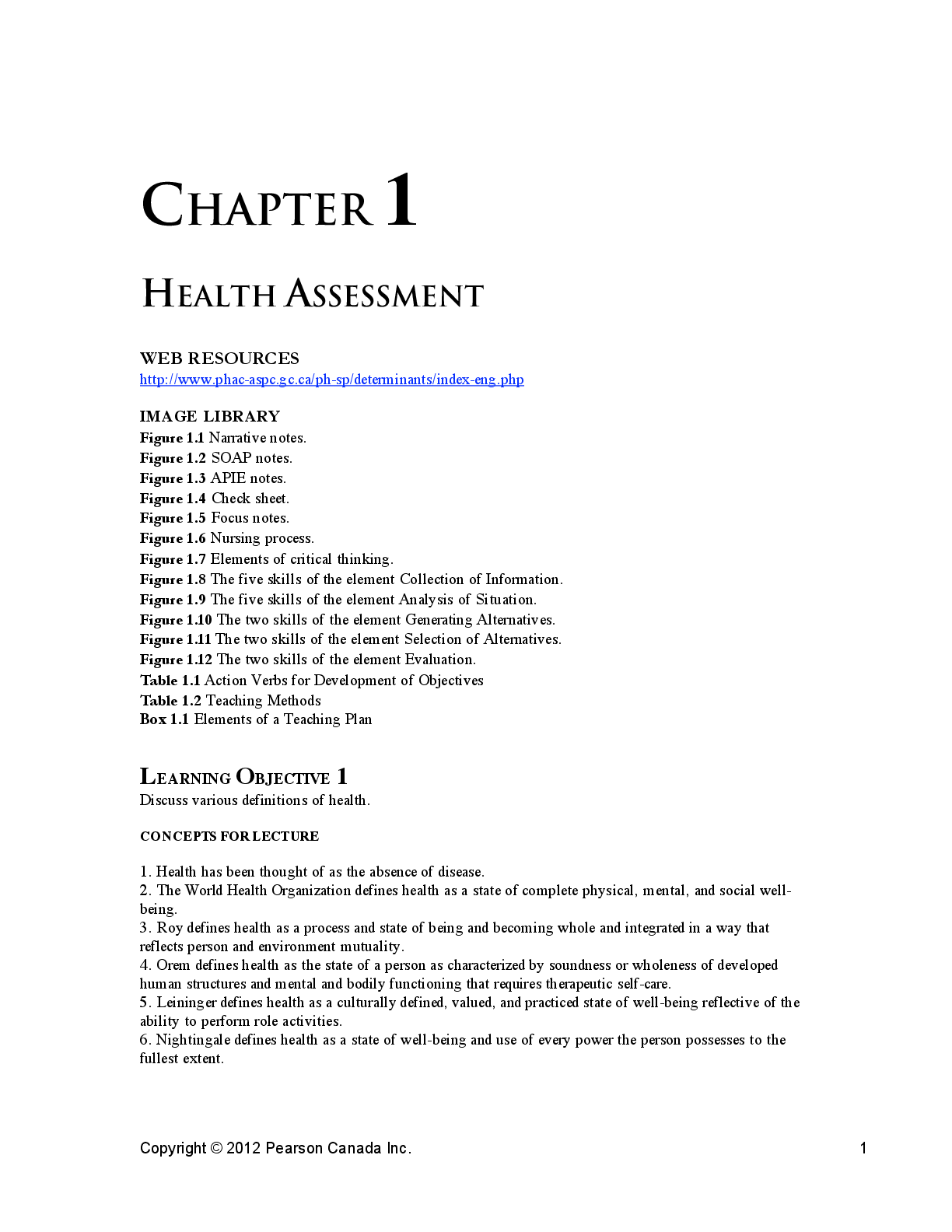
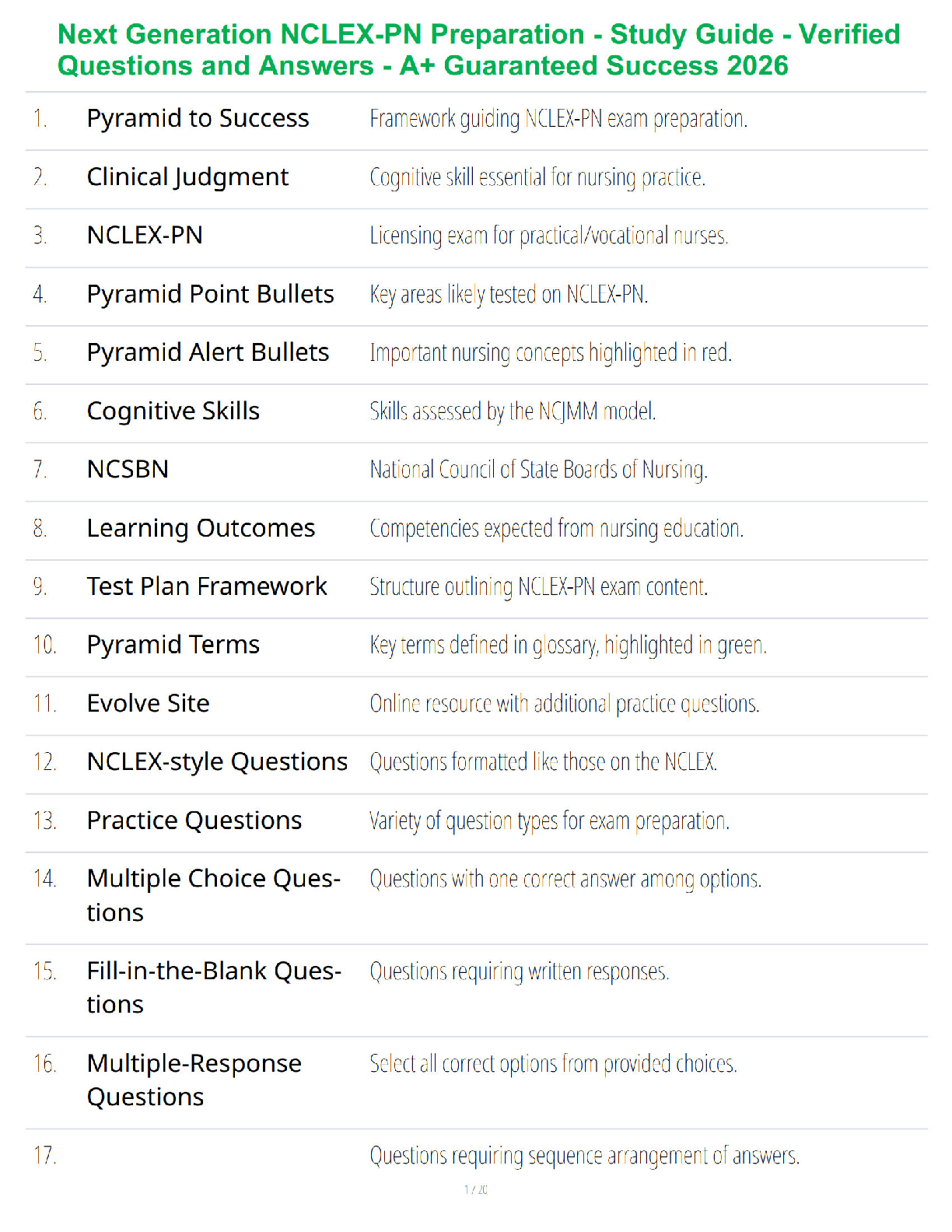
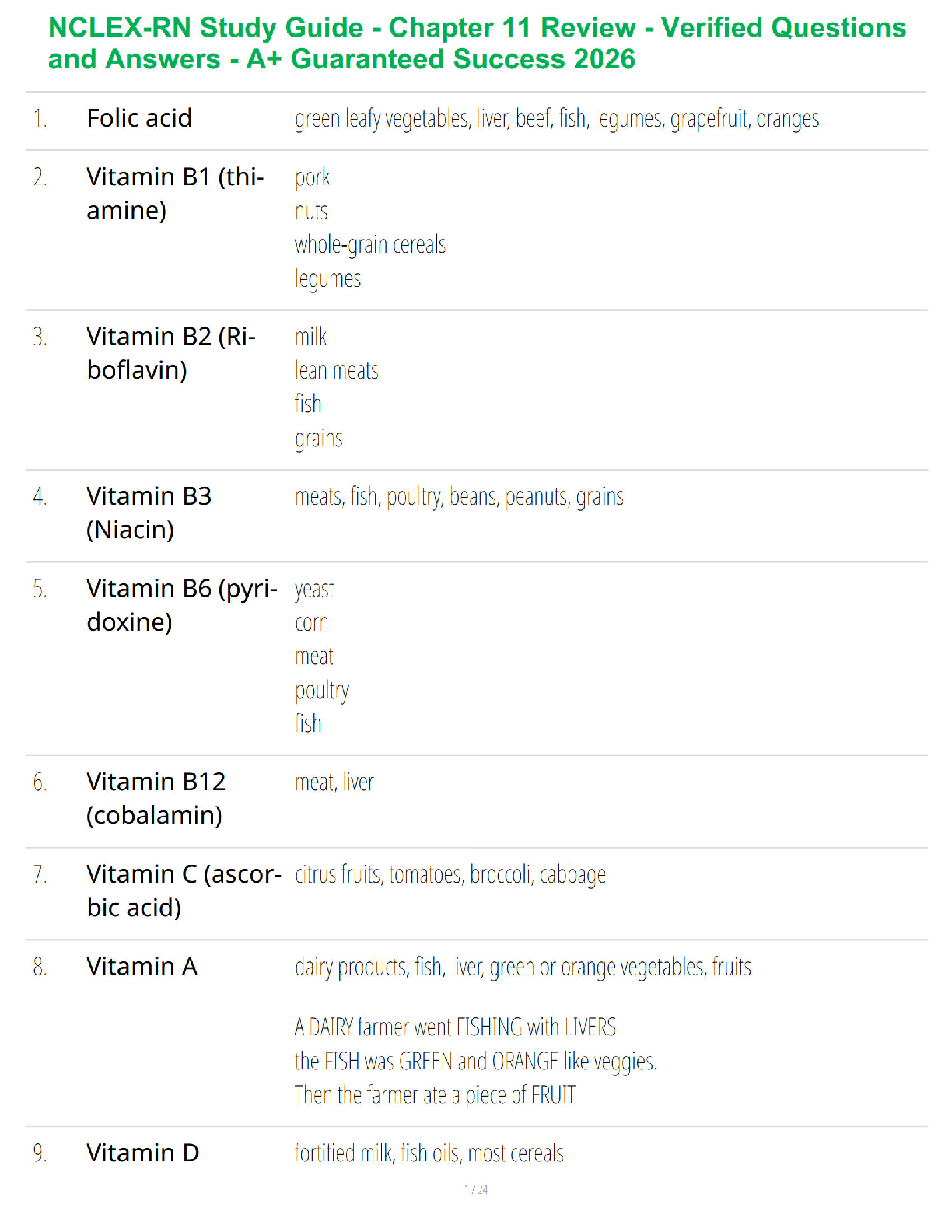
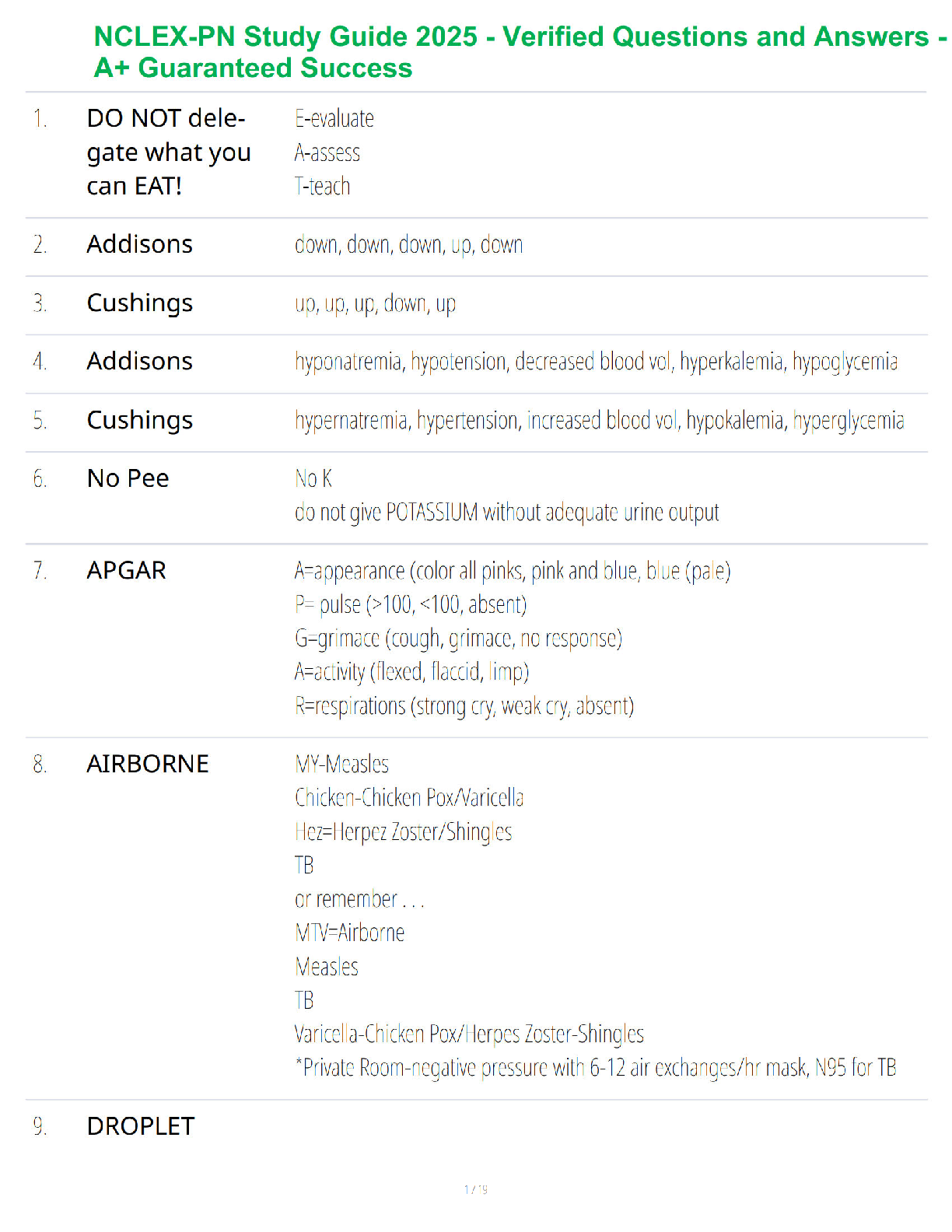
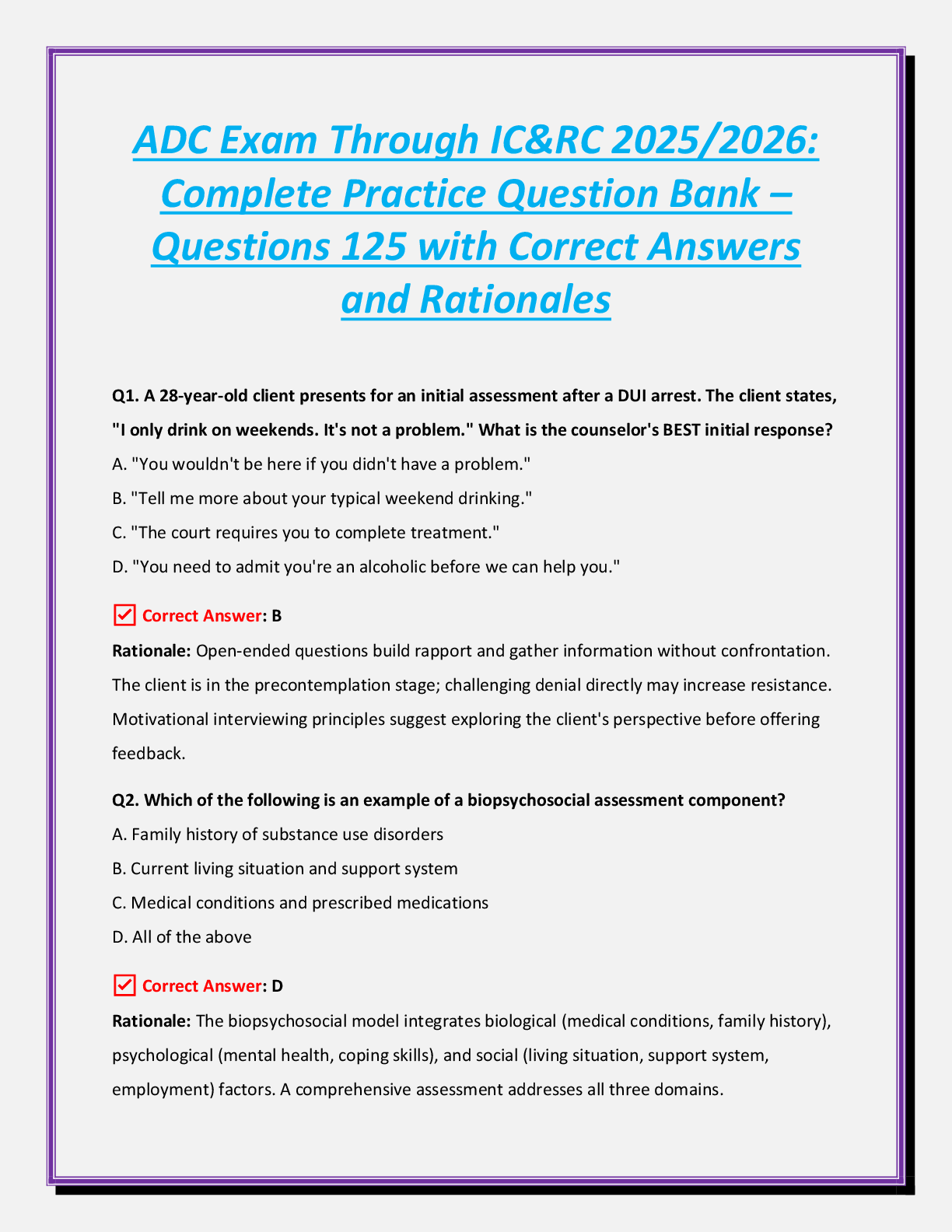



.png)
.png)
.png)
.png)
.png)
.png)
.png)