Module 1 (Chapter 2,4,5 Nursing Now!)
Chapter 2
Identify the “father of modern medicine” and key historical persons who advanced
the nursing profession
Hippocrates was considered to be the father of modern medicine
...
Module 1 (Chapter 2,4,5 Nursing Now!)
Chapter 2
Identify the “father of modern medicine” and key historical persons who advanced
the nursing profession
Hippocrates was considered to be the father of modern medicine. His beliefs focused on
harmony with the natural law instead of on appeasing the gods. He emphasized treating the
whole client-mind, body, spirt, and environment -and making diagnoses on the basis of
symptoms rather than on an isolated idea of a disease
Florence Nightingale is universally regarded as the founder of modern nursing. Dedicated her
life to improving health care and nursing standards. Played a huge part in the Crimean War and
helped to improve nursing education, hospital conditions, sanitation, and health care in general.
Opened the Florence Nightingale School of Nursing and Midwifery.
Isabel Adams Hampton Robb dedicated her life to raising the standards of nursing education in
the United States. She was the director of the Illinois Training School for nurses, and some of her
ideas were developed and implemented, such as a grading policy for students. She also
advocated for the reduction of the long hours involved in training nurses. She headed the John
Hopkins Training School for Nurses, and brought together leaders from key nursing schools to
for the American Society of Superintendents of Training Schools for Nurses, and served as
chairwoman. This group was the precursor to the National League for Nursing. Robb was also
the first president of the American Nurses Association. She also helped develop the American
Journal of Nursing, the first professional journal dedicated to the improvement of nursing.
Lillian Wald opened the Henry Street Settlement, a storefront health clinic in one of the poorest
sections in the city of New York. This clinic allowed organization nurses to make home visits,
focused on sanitary conditions, and children’s health. Wald became a dedicated social reformer,
an efficient fundraiser, and an eloquent speaker. She is also credited with the founding of the
American Red Cross’s Town and Country Nursing Service. She founded and became the first
president of the National Organization for Public Health Nursing. Many child health and
wellness programs in use today are based on her efforts.
Lavinia Lloyd Dock contributions as a reformer focused on the professionalization of nursing the
equality of women. She wrote the first medication textbook for nurses, and worked along Lillian
Wald and Isabel Robb. Spent most of her career dedicated to the pursuit of equal rights. She also
believed poverty and squalor contributed to poor health, and dedicated herself to social reform to
address these problems. One of the most influential leaders in the early 20th century.
Annie W. Goodrich provided nursing care at Lillian Wald’s Henry Street Settlement after
receiving her nursing degree. She was known as an outstanding nursing educator and ran a
number of nursing schools. She was appointed state inspector of nursing schools, a position that
up until that time had only been held by physicians. She was the dean of the US army nursing
school and Yale school of nursing. She established a nursing training program at Vassar College.
She had demonstrated that teaching theoretical information in a classroom was just as importantin training highly skilled nurses in clinical practice. Her many writings about nursing education
and her experiences with military nursing have been a great contribution to the nursing
profession.
Loretta C. Ford is credited with founding the nurse practitioner (NP) practice. She worked with
pediatrician, Dr. Henry K. Silver to form the first NP program after noticing a shortage on family
physicians. Ford also became the founding dean of the University of Rochester School of
Nursing and director of the Nursing Service at the University Hospital in 1972. She was inducted
into the National Women’s Hall of Fame for being recognized as an internationally renowned
nursing leader who has transformed the profession of nursing and made health care more
accessible to the general public. She also won the Blackwell award, which is given to a woman
who has shown exemplifying outstanding service to humanity.
Review the evolution of symbols in nursing and significance of these symbols
In Modern society, the symbols connect the professions to their historical roots and provide the
philosophical basis for the work they do.
The significance of the lamp is really the significance of light. For years, lamps were used to
push back the darkness. It dispelled fear and allowed people to pursue learning long after the sun
went down. It often was used as a religious symbol that represented an eternal flame that dispels
darkness and evil. The lamp was first used as a symbol for the nursing profession at the time of
Florence Nightingale. The lamp became a sign for caring, comfort, and often the difference
between life and death. It retains its significance as a symbol of the ideals and selfless devotion
of Florence Nightingale. It also signifies the knowledge and learning that the graduate has
attained during their years in the nursing program.
The Nursing pin can trace its origins to the heavy protective war shields used by soldiers as far
back as the Greek and Roman Empires. The pinning ceremony is part of a long tradition that
acknowledges nursing graduates as belonging to a unique group and identifies them as new
members of the health-care community. It is a symbol of their legal authority as licensed
professionals. It’s a medal of honor.
The Cap can be traced back to an early Christian era group of women called deaconesses. They
were set apart from other women of the period by the white head covering, which indicated their
primary service was to care for the sick. The white covering eventually evolved into a white cap
that signified “service to others.” It is a sign of service to those in need, and is a reminder of the
unchanging values of wisdom, faith, honesty, trust, and dedication of nursing.
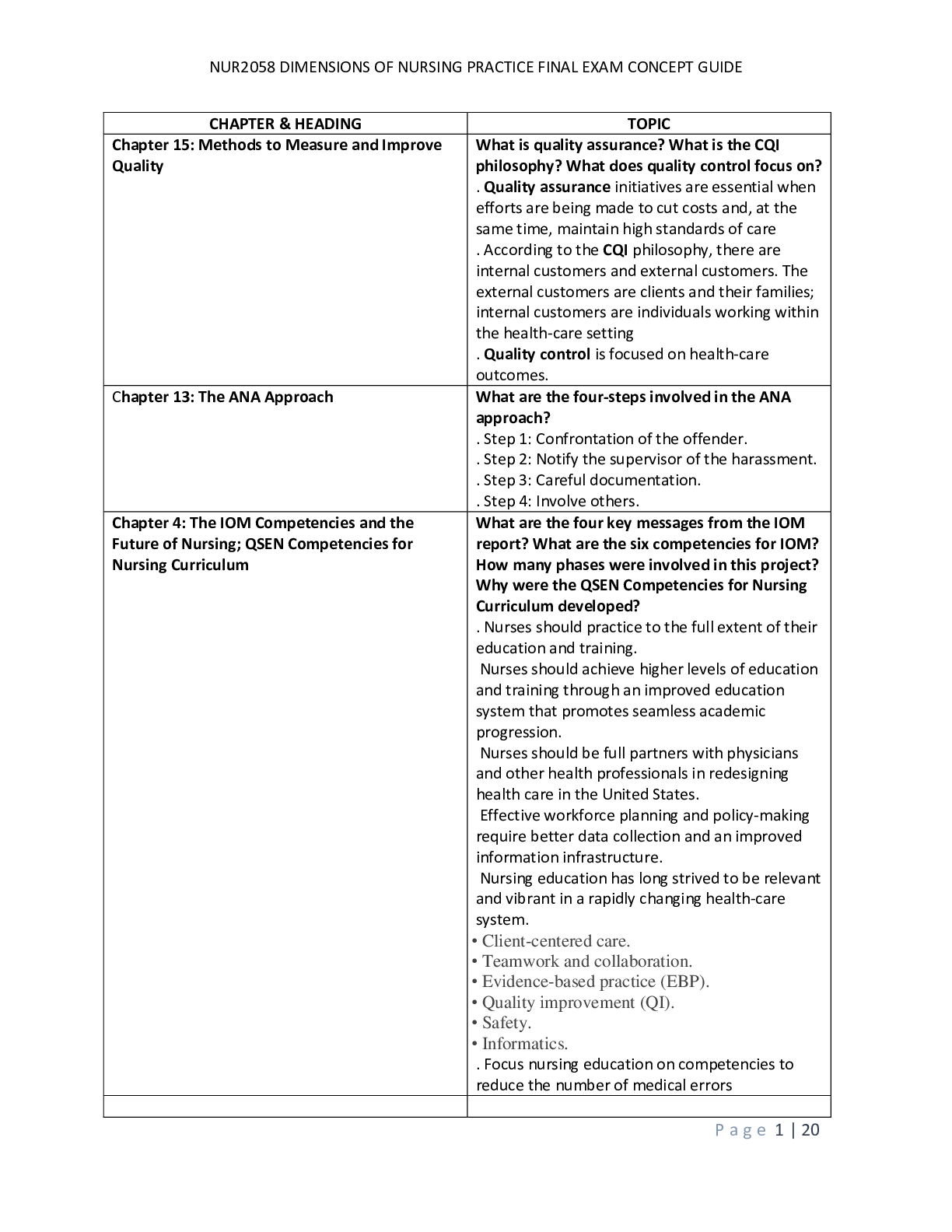
Chapter 4
List the QSEN competencies and relationship to nursing education
1.Client-Centered care
2.Teamwork and Collaboration3.Evidence-Based Practice (EBP)
4.Quality Improvement (QI)
5.Safety
6.Informatics
Identify and discuss the importance of interpersonal education for nurses
Two or more students from different professions learning about, from and with each other to
enable effective collaboration and improve health outcomes. Interdisciplinary learning helps to
improve the real-world outcomes for the well-being of clients. Poor communication and lack of
teamwork among health-care professionals were major contributions to the increased number of
medicine and other errors in the hospital setting. In conjunction with other health-care
disciplines, could integrate teaching and learning to improve health-care outcomes. Four key
competences found in interprofessional education:
Values and Ethics for interprofessional practice
Roles and responsibilities
Interprofessional communication
Teams and Teamwork
They recommend that these competences be emphasized throughout nursing and other
professional health-care curriculums.
Chapter 5
Identify the purpose and needs for nursing licensure
Licensure is conducted by the state through the enforcement powers of its regulatory boards to
protect the public’s health, safety, and welfare by establishing professional standards. Licensure
for nurses, as for any other professional who deals with the public, is necessary to ensure that
everyone who claims to be a nurse can function at a minimal level of competency and safety. It
helps to set the standards of care.
Review examples of ways a nursing license may be revoked
Conviction of a serious crime
Demonstration of gross negligence or unethical conduct in the practice of nursing
Failure to renew a nursing license while still continuing to practice nursing
Use of illegal drugs or alcohol during the provision of care for clients or use that
carries over and affects the client’s health
Willful violation of the state’s nurse practice act
Revocation of the license to practice nursing is one of the most severe punishments that a nurse
can experience. The nursing profession is responsible for monitoring and enforcing its own
standards through the state licensing board. Identify why it is important for nurses to join professional organizations
The establishment of a professional organization is one of the most important defining
characteristics of a profession. An association is a group of people banding together to achieve a
specific purpose. By working together for a specific purpose, an association or organization
amplifies its impact, and by developing a strategic plan, it focuses that impact to achieve certain
results. Nurses need and use power in every aspect of their professional lives. An individual
nurse probably does not have much influence, but for nurses as a group, the potential is increased
exponentially by the organization. The dedications to high-quality nursing standards and
improved methods of practice by the major nursing organizations has led to improved care and
increased benefits to the public as a whole. Nurses need power for supervising unlicensed
personal and negotiating with the administration for increased independent of practice.
Define ways a professional organization can impact nursing
The National League of Nursing was the first national nursing organization to provide
accreditation for nursing programs at all levels. Its primary purpose is to maintain and improve
the standards of nursing education. Its bylaws state that its purpose is to foster the development
and improvement of hospital, industrial, and public health.
The American Association of Colleges of Nursing was established to help colleges with schools
of nursing work together to improve the standards for higher education for professional nursing.
It serves the public interest by assessing and identifying nursing programs that engage in
effective educational practices. The AACN has developed the guidelines for the education of
professional nursing that is widely used as the theoretical basis for baccalaureate curriculum.
The International Council of Nurses consists of national nursing organizations, and the ICN
serves as the international organizations for professional nursing. The goal of the ICN is to
improve health and nursing care throughout the world.
The National Student Nurses’ Association is an independent legal cooperation established in
1953 to represent the needs of nursing students. The main purpose of the NSNA is to help
maintain high standards of education in schools of nursing, with the ultimate goal of educating
high-quality nurses who will provide excellent health care.
Sigma Theta Tau is an honors organization that was established in colleges and universities to
recognize individuals who have demonstrated leadership or made important contributions to
professional nursing. It is international, and candidates are selected from among senior nursing
students or graduate or practicing nurses.
Together, these organizations help improve nursing education and improve care. These
organizations also help to increase benefits for health-care professionals. They help establish
nursing standards and help to improve the nursing practice. By having organization, nurse can
have a louder voice on concerns and issues within the nursing field
Chapter 1
Define Evidence-Based Practice (EBP)Evidence-Based practice is the practice of nursing in which interventions are based on data from
research that demonstrates that they are appropriate and successful. It involves a systematic
process of uncovering, evaluating, and using information from research as the basis for making
decisions about and providing client care.
Determine the main method in which nurses can gain power in nursing
The referent source of power depends on establishing and maintaining a close personal
relationship with someone. Nurses often obtain power from this source when they establish and
maintain good therapeutic relationships with their clients.
The expert source of power derives from the amount of knowledge, skill, or expertise that an
individual or group has. This power source is exercised by the individual or group when
knowledge, skills, or expertise is either used or withheld in order to influence the behavior of
others.
The reward source of power depends on the ability of one person to grant another some type of
reward for specific behaviors or changes in behavior.
The coercive source of power is the flip side of the reward source. The ability to reprimand,
withhold rewards, and threaten punishment is the key element underlying coercive source of
power.
The legitimate source of power depends on a legislative or legal act that gives the individual or
organization a right to make decisions that they might not otherwise have the authority to make.
The collective source of power is often used in a broader context than individual client care and
is the underlying source for many other sources of power.
Nurses can increase their power by professional unity, political activity, accountability and
professionalism, networking, and future trends in the nursing profession. Professional Unity is
the first and most important way in which a nurse can gain power. The most powerful
groups are those that are organized and most united. A nurse can gain power through political
actions, although this produces some discomfort in many nurses. Showing professionalism and
accountability will also help a nurse gain power, as well as establishing a nursing support
network.
Chapter 17
Define Civility and examples of civility in nursing education
Civility is based on recognizing that all human beings are important. A simple definition of
civility is for people to treat others as they would wish to be treated. Civility is one of the
underpinnings of caring and can even be considered a moral imperative. Civility in the
profession makes caring the focal point of their practice.
EXAMPLES of civility in the classroom:
Practice Proper door etiquette Assume Goodwill
Listen and respect others
Be flexible and open-minded
Keep cell phones on silent and use proper phone etiquette
Use laptop for class work only
Do not have side conversations
Give notice of change in advance
Be present and on time
Have fun!
Describe behaviors that are considered uncivil and civil in the clinical setting
Incivility is the lack of civility. It is a very broad term that includes a wide range of what is
considered to be unacceptable behavior in a civilized society. Incivility can be viewed as a
continuum of impolite behaviors with a lot of overlap between them.
EXAMPLES of incivility in a clinical setting:
- Workplace hostility
- Bullying
- Lateral/ Horizontal Violence
- Vertical Violence
- Workplace Violence
- Threatening
- Physical harm
- Impoliteness/Rudeness
- Harassing
- Failing to clarify an unreadable order
- Lifting or ambulating heavy or debilitated clients without assistance rather than asking
for help
- Using unfamiliar pieces of equipment without asking for instructions first
- Carrying out orders the nurse did not believe were correct
EXAMPLES of civility in a clinical setting:
- Assume goodwill
- Respect and celebrate differences
- Communicate respectfully
- Listen Carefully
- Come to clinical prepared and on time
- Share work equally among group members
- Resolve conflicts directly and with respect
- Have Fun!
Module 3 (Chapter 14 Nursing Now!)Objective 1: Contrast the various healthcare delivery settings and the diverse clients they
serve
What is healthcare delivery? How does this affect nursing care? What demographic
trends are affecting healthcare delivery? What are the 4 systems types in Western
Medicine and what are the goals of each system?
The delivery of health care is the action or activities of supplying or providing services to
maintain health, detect illnesses, and cure those who are ill or injured. Although the US has one
of the best healthcare systems, the Nation’s health-care delivery system is mediocre at best. One
of the goals of the health-care reform is to bring the high-quality care experienced by some to
those who are less fortunate or do not have employer-based insurance plans. Demographics
affecting health-care delivery:
Age: Between now and the year 2050, the number of persons 65 years or older is
expected to double. Of this number, many will eventually become more dependent on the
health-care delivery system as a result of chronic health problems.
Chronicity: Another factor influencing the climate of health-care delivery is the longterm and expensive nature of many health problems.
Understanding the approach to health care in comparison with other countries is important in
assessing the challenges to and potential health-care delivery. The Four Systems:
Type 1 Systems
In this system, private approaches to health services predominate. Physicians, other caregivers,
and clients have maximum autonomy. In this plan, individuals who can afford private health
insurance, or who simply can pay for their health care, choose their care providers can receive
health services. Those who cannot pay, do not have choice or benefit. Private insurance,
preserve autonomy, acceptance of social differences.
Type 4 Systems
On the opposite end of the spectrum from type 1 is type 4. This type of health-care system
focuses on keeping the general public healthy so that they can continue to contribute to society
and the economy. Socialized health system, essential service, physicians as state employees.
Type 3 Systems
Between the extremes of type 1 and type 4 health-care systems are two types- type 2 and type 3.
The type 3 system is funded and operated by the government. With this system, the stateoperated and state-funded health services were based on an egalitarian value. National health
service, egalitarian, public management.
Type 2 SystemsThis system is a hybrid of the type 1 and type 3 systems. Egalitarian values are given high
priority, but so are practitioner and client autonomy. This system uses tax dollars to pay for
health services through health insurance available from a nonprofit agency (E.g. government).
National health insurance, egalitarian, preserve autonomy.
What is prospective payment system? What is a capitated payment system?
The prospective payment system is one of the most significant factors that has influenced cost
control. This system required facilities providing services to Medicare clients to be reimbursed
using a fixed-rate system and included monetary incentives to reduce the length of hospital stays.
Medicare clients are classified using a diagnosis-related group, and the facilities are reimbursed a
predetermined amount.
Capitation, or a capitated payment system, was introduced to encourage cost-effectiveness in a
growing health-care system. In this system, participants pay a flat rate, usually through their
employer, to belong to a managed care organization (MCO) for a specified period of time. The
health-care providers who serve the participants receive a fixed amount for each participant in
the health-care plan.
Have an understanding of each health-care model listed in boxes 14.1-14.5
Managed Care Organizations (MCOs): Provide comprehensive, preventive, and treatment
services to a specific group of voluntarily enrolled persons
- Staff Model: Physicians are salaried employees of the MCO
- Group Model: MCO contracts with single group practice
- Network Model: MCO contracts with multiple group practices and/or integrated
organizations
[Show More]
.png)



.png)