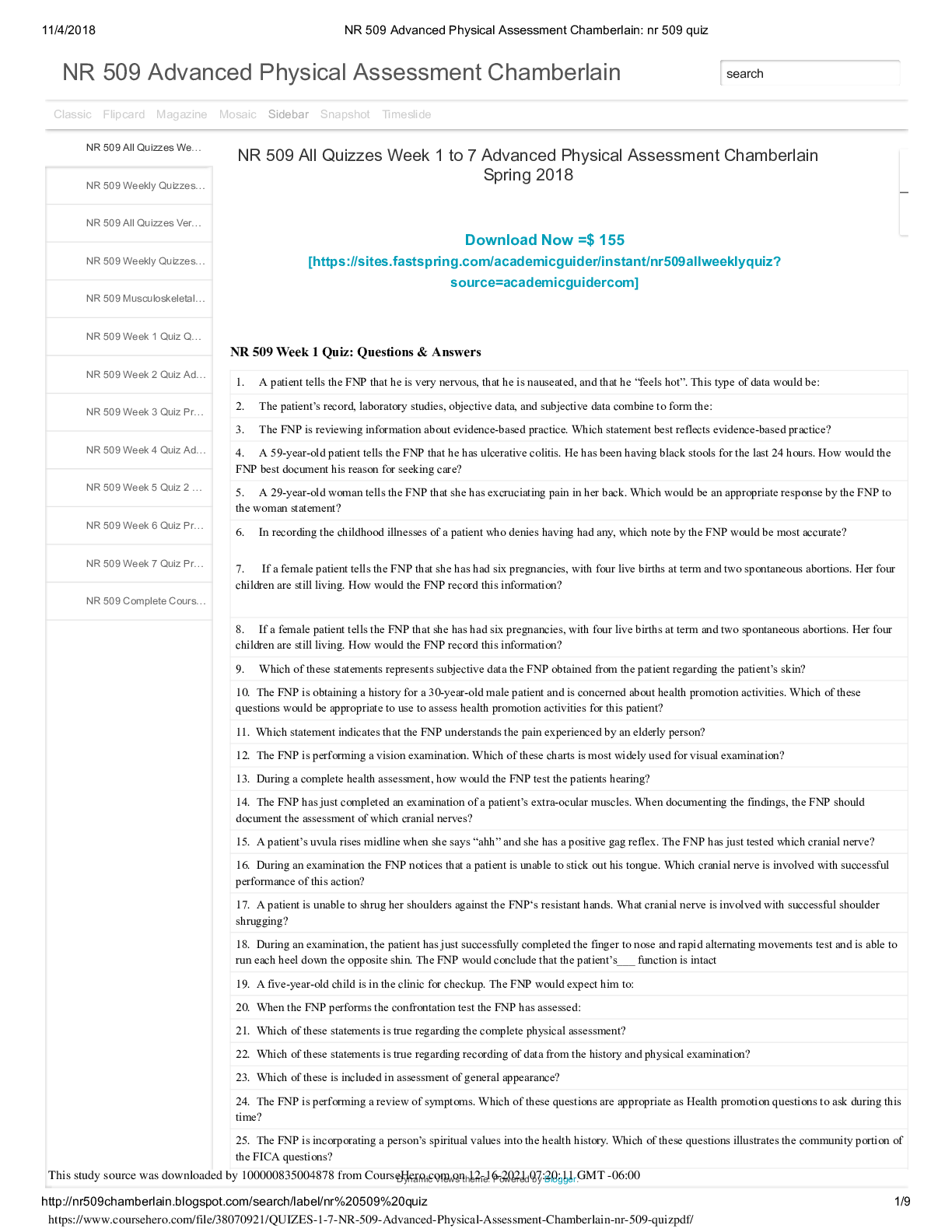
NR 509 Week 1 Quiz: Questions & Answers
1. A patient tells the FNP that he is very nervous, that he is nauseated, and that he “feels hot”. This type of data would be:
2. The patient’s record, laboratory studies, object
...
NR 509 Week 1 Quiz: Questions & Answers
1. A patient tells the FNP that he is very nervous, that he is nauseated, and that he “feels hot”. This type of data would be:
2. The patient’s record, laboratory studies, objective data, and subjective data combine to form the:
3. The FNP is reviewing information about evidence-based practice. Which statement best reflects evidence-based practice?
4. A 59-year-old patient tells the FNP that he has ulcerative colitis. He has been having black stools for the last 24 hours. How would the
FNP best document his reason for seeking care?
5. A 29-year-old woman tells the FNP that she has excruciating pain in her back. Which would be an appropriate response by the FNP to
the woman statement?
6. In recording the childhood illnesses of a patient who denies having had any, which note by the FNP would be most accurate?
7. If a female patient tells the FNP that she has had six pregnancies, with four live births at term and two spontaneous abortions. Her four
children are still living. How would the FNP record this information?
8. If a female patient tells the FNP that she has had six pregnancies, with four live births at term and two spontaneous abortions. Her four
children are still living. How would the FNP record this information?
9. Which of these statements represents subjective data the FNP obtained from the patient regarding the patient’s skin?
10. The FNP is obtaining a history for a 30-year-old male patient and is concerned about health promotion activities. Which of these
questions would be appropriate to use to assess health promotion activities for this patient?
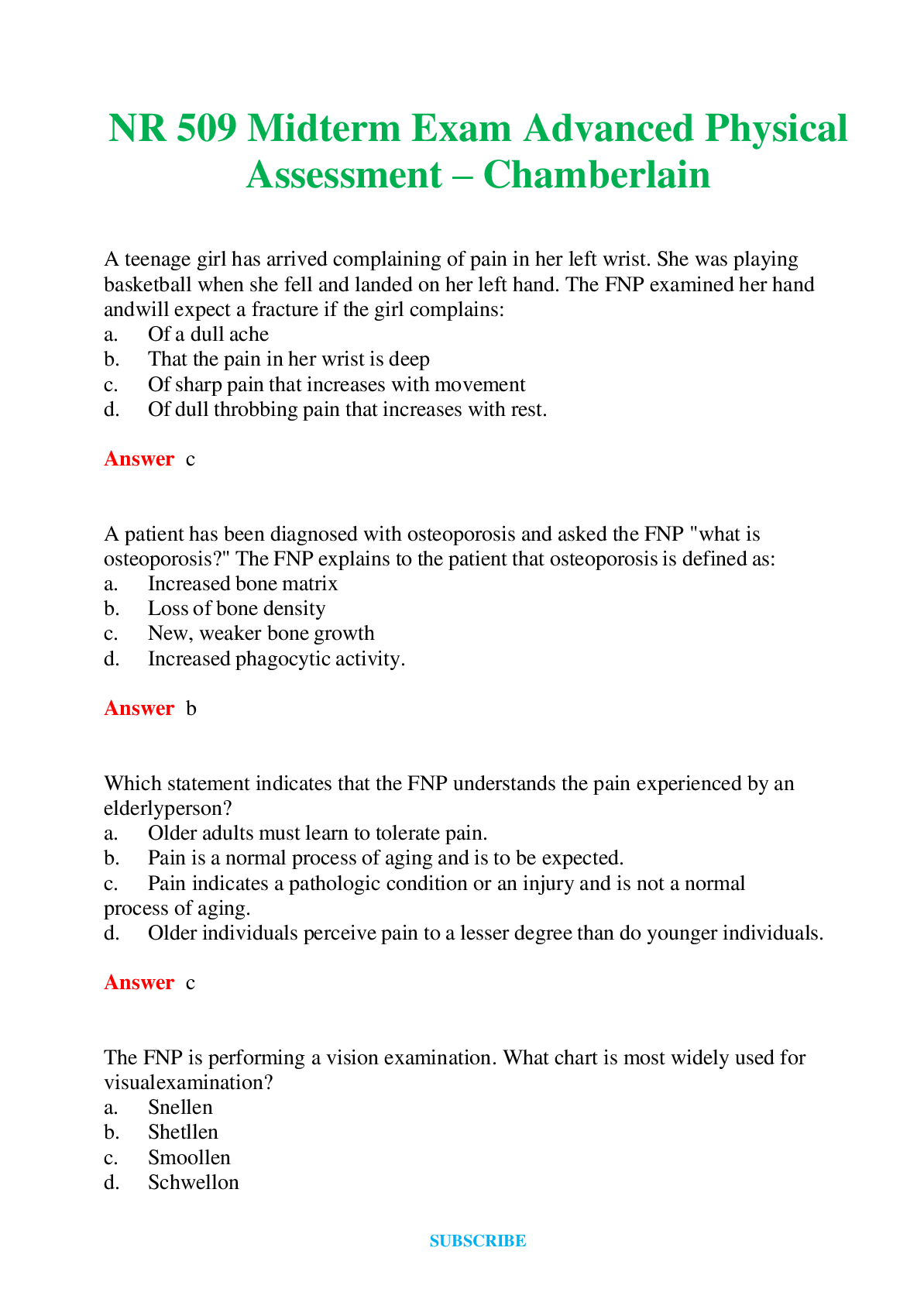
11. Which statement indicates that the FNP understands the pain experienced by an elderly person?
12. The FNP is performing a vision examination. Which of these charts is most widely used for visual examination?
13. During a complete health assessment, how would the FNP test the patients hearing?
14. The FNP has just completed an examination of a patient’s extra-ocular muscles. When documenting the findings, the FNP should
document the assessment of which cranial nerves?
15. A patient’s uvula rises midline when she says “ahh” and she has a positive gag reflex. The FNP has just tested which cranial nerve?
16. During an examination the FNP notices that a patient is unable to stick out his tongue. Which cranial nerve is involved with successful
performance of this action?
17. A patient is unable to shrug her shoulders against the FNP‘s resistant hands. What cranial nerve is involved with successful shoulder
shrugging?
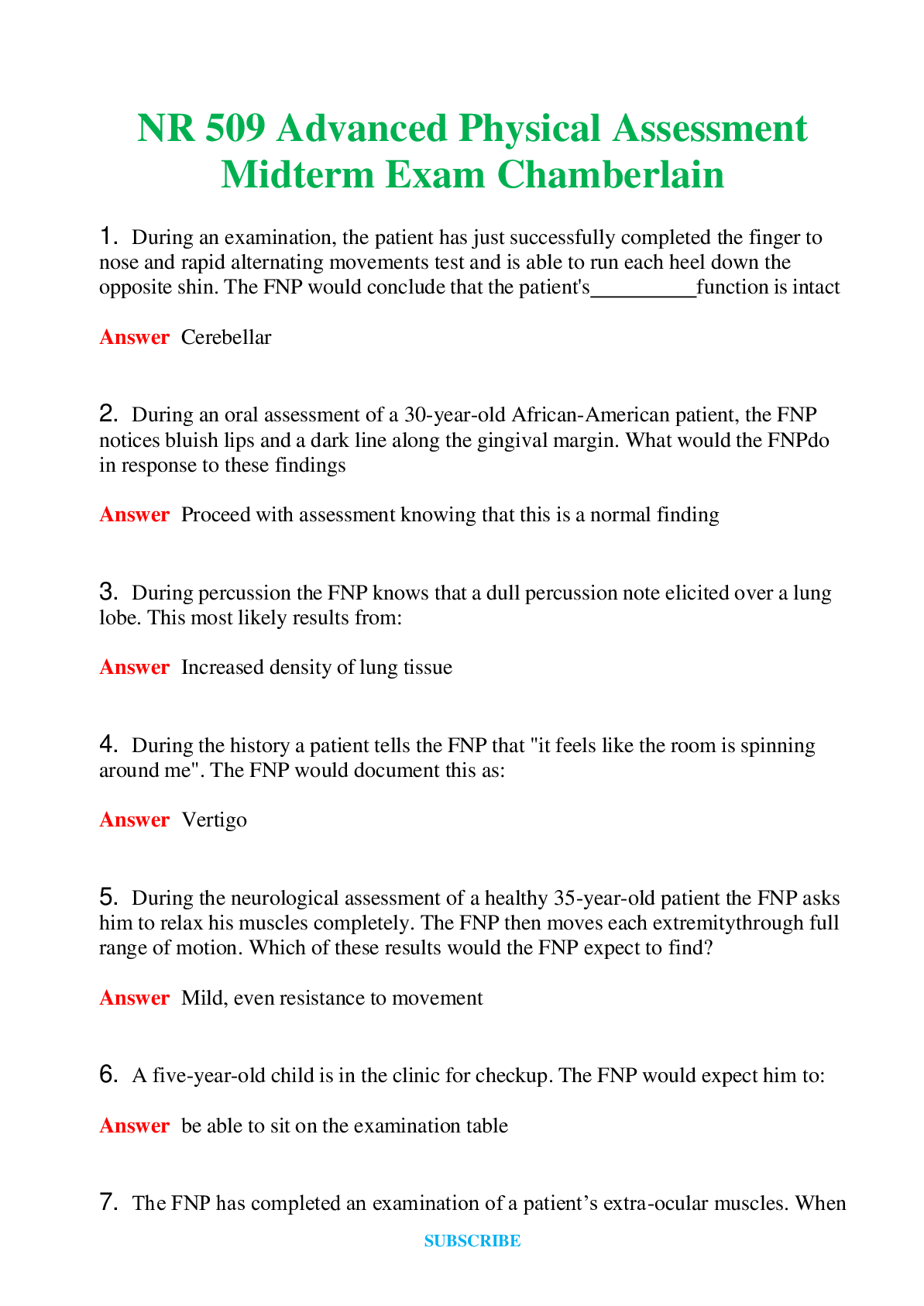
18. During an examination, the patient has just successfully completed the finger to nose and rapid alternating movements test and is able to
run each heel down the opposite shin. The FNP would conclude that the patient’s___ function is intact
19. A five-year-old child is in the clinic for checkup. The FNP would expect him to:
20. When the FNP performs the confrontation test the FNP has assessed:
21. Which of these statements is true regarding the complete physical assessment?
22. Which of these statements is true regarding recording of data from the history and physical examination?
23. Which of these is included in assessment of general appearance?
24. The FNP is performing a review of symptoms. Which of these questions are appropriate as Health promotion questions to ask during this
time?
25. The FNP is incorporating a person’s spiritual values into the health history. Which of these questions illustrates the community portion of
the FICA questions?
26. The FNP is preparing to complete a health assessment on a 16-year-old girl whose parents have brought her to the clinic. Which
NR 509 All Quizzes Week 1 to 7 Advanced Physical Assessment Chamberlain
Spring 2018
Dynamic Views theme. Powered by Blogger.
Classic Flipcard Magazine Mosaic Sidebar Snapshot Timeslide
NR 509 Advanced Physical Assessment Chamberlain search
This study source was downloaded by 100000796615030 from CourseHero.com on 08-03-2021 03:20:49 GMT -05:00
https://www.coursehero.com/file/38070921/QUIZES-1-7-NR-509-Advanced-Physical-Assessment-Chamberlain-nr-509-quizpdf/
This study resource was
shared via CourseHero.com
11/4/2018 NR 509 Advanced Physical Assessment Chamberlain: nr 509 quiz
http://nr509chamberlain.blogspot.com/search/label/nr%20509%20quiz 2/9
NR 509 Weekly Quizzes…
NR 509 All Quizzes Ver…
NR 509 Weekly Quizzes…
NR 509 Musculoskeletal…
NR 509 Week 1 Quiz Q…
NR 509 Week 2 Quiz Ad…
NR 509 Week 3 Quiz Pr…
NR 509 Week 4 Quiz Ad…
NR 509 Week 5 Quiz 2 …
NR 509 Week 6 Quiz Pr…
NR 509 Week 7 Quiz Pr…
NR 509 Complete Cours…
NR 509 All Quizzes We…
instruction would be appropriate for the parents before the interview begins?
NR-509 Week 2 Quiz: Questions & Answers
1. A mother brings her two month old daughter in for an examination says “my daughter rolled over against the wall and now I
have noticed that she has the spot soft on the top of her head, is there something terribly wrong?” The FNP‘s best response
would be:
2. During percussion the FNP knows that a dull percussion note elicited over a lung lobe. This most likely results from:
3. The patient is unable to differentiate between sharp and dull stimulation to both sides of her face. The FNP suspects Damage
to:
4. When examining the face, the FNP is aware that the two pairs of salivary gland‘s that are accessible to examination are the
_____ glands
5. A patient comes to the clinic complaining of neck and shoulder pain and is unable to turn her head. The FNP suspects
damage to cranial nerve ____ and proceeds with the examination by____
6. When examining a patient’s cranial nerve function, the FNP remembers that the muscles in the neck that are innervated by
CN XI are the:
7. The patient’s laboratory data reveal an elevated thyroxine level. The FNP would proceed with an examination of the _____
gland
8. A patient says that she has recently noticed a lump in the front of her neck below her “Adams apple” that seems to be getting
bigger. During the assessment, the finding that leaves the FNP to suspect that this may not be a cancerous thyroid nodule is
that the lump:
9. The FNP notices that the patient’s submental lymph nodes are enlarged. In an effort to identify the cause of the node
enlargement, the FNP would assess the patient’s:
10. The FNP is aware that the four areas in the body were lymph nodes accessible are the:
11. A 52-year-old patient describes the presence of occasional floaters or spots moving in front of his eyes. The FNP should
know that floaters are usually not significant and are caused by:
12. The FNP is preparing to assess the visual acuity of a 16-year-old patient. How should the FNP proceed?
13. A patient’s vision is recorded as 20/30 when the Snellen eye chart is used. The FNP interprets these results to indicate that:
14. A patient is unable to read even the largest letters on the Snellen chart. The FNP should take which action next:
15. A patient’s vision is reported as 20/80 in each eye. The FNP interprets this finding to mean that
16. When performing the corneal light reflex assessment, the FNP notes that the light is reflected at 2 o’clock in each eye. The
FNP should
17. The FNP is performing the diagnostic positions test. Normal findings would be which of these results?
18. During an assessment of the sclera of an African-American patient, the FNP would consider which of these an expected
finding?
19. A 60-year-old man is at the clinic for an examination. The FNP suspects that he has ptosis of one eye. How should the FNP
check for this?
20. The FNP is doing an assessment on a 21-year-old patient and notices that his nasal mucosa appears pale gray and swollen.
What would be the most appropriate question to ask the patient?
21. The FNP is palpating the sinus areas. If the findings are normal, then the patient should report which sensation?
22. During an oral assessment of a 30-year-old African-American patient, the FNP notices bluish lips and a dark line along the
gingival margin. What would the FNP do in response to these findings
23. During an assessment of a 20-year-old patient with a three day history of nausea and vomiting the FNP notices dry mucous
and deep vertical fissures on the tongue. These findings are reflective of:
24. The FNP is reviewing the technique of palpating for tactile fremitus with a new graduate. Which statement by the graduate
FNP reflects a correct understanding of tactile fremitus?
25. The FNP student is reviewing physical assessment findings of the HEENT system associated with pregnancy. Which
statement by the graduate FNP reflects a correct understanding of expected HEENT changes associated with pregnancy?
During pregnancy:
NR 509 Week 2 Quiz Review – (Jarvis 8,9,13,14,15,16,18), (Swartz 4,6,7,8,9,10)
1. What does dullness when percussing lung fields: Jarvis pg 427
2. Facial sensation controlled by which CN: Jarvis 283,
3. Know what two salivary glands are accessible during exam
4. What CN is being … when pt shrugs shoulders Jarvis 646
5. What muscles are being …. when …. CN 11 (spinal accessory nerve)
6. Concern for malignant nodules versus benign lymph nodule
7. Know what you’d do next if you palpated a submental lymph node: Jarvis pg 253
8. Define visual acuity
9. Know what to do if your patient can’t read the largest number on the Snellen chart: Jarvis 289
10. Example of good visual acuity : Jarvis 289
11. Example of poor visual acuity: Jarvis 289
12. What is …. with corneal light reflex13. Know normal variances of sclera : Jarvis 283
14. Know how to check for Ptosis: Jarvis 292
Dynamic Views theme. Powered by Blogger.
Classic Flipcard Magazine Mosaic Sidebar Snapshot Timeslide
search
This study source was downloaded by 100000796615030 from CourseHero.com on 08-03-2021 03:20:49 GMT -05:00
https://www.coursehero.com/file/38070921/QUIZES-1-7-NR-509-Advanced-Physical-Assessment-Chamberlain-nr-509-quizpdf/
This study resource was
shared via CourseHero.com
11/4/2018 NR 509 Advanced Physical Assessment Chamberlain: nr 509 quiz
http://nr509chamberlain.blogspot.com/search/label/nr%20509%20quiz 3/9
NR 509 Weekly Quizzes…
NR 509 All Quizzes Ver…
NR 509 Weekly Quizzes…
NR 509 Musculoskeletal…
NR 509 Week 1 Quiz Q…
NR 509 Week 2 Quiz Ad…
NR 509 Week 3 Quiz Pr…
NR 509 Week 4 Quiz Ad…
NR 509 Week 5 Quiz 2 …
NR 509 Week 6 Quiz Pr…
NR 509 Week 7 Quiz Pr…
NR 509 Complete Cours…
NR 509 All Quizzes We…
15. What does ptosis indicate: Jarvis 292
16. Nasal fissure of pt with chronic allergies : Jarvis 271
Acute allergies : Jarvis p 363 .
17. What is an abnormal palpation of sinuses: Jarvis 362
Normal palpation of sinuses
18. Know normal variations in gingival margin
19. Know what a dehydrated oral cavity will look like: Jarvis 387
20. What is tactile fremitus, how do you test for it and what does it indicate. Jarvis 425
NR 509 Week 2 Quiz Review & Study Guide (Jarvis 8,9,13,14,15,16,18), (Swartz 4,6,7,8,9,10)
NR 509 Week 3 Quiz: Questions & Answers
1. A teenage girl has arrived complaining of pain in her left wrist. She was playing basketball when she fell and landed on her
left hand. The FNP examined her hand and will expect a fracture if the girl complains:
2. A patient has been diagnosed with osteoporosis and asked the FNP “what is osteoporosis?” The FNP explains to the patient
that osteoporosis is defined as:
3. Patient states, “I can hear a crunching or grating sound when I kneel”. She also states “that it is very difficult to get out of bed
in the morning because of stiffness and pain in my joints”. The FNP should assess for signs of what problem?
4. When taking the history on a patient with a seizure disorder the FNP assesses whether the patient has an aura. Which of these
would be the best question for obtaining this information?
5. The FNP is teaching a class on osteoporosis prevention to a group of post menopausal women. A participant shows that she
needs more instruction when she states I will:
6. The FNP is performing a neurological assessment on a 41-year-old woman with a history of diabetes. When testing her
ability to feel the vibrations of a tuning fork the FNP notices that the patient is unable to feel vibrations on the great toe or
ankle bilaterally, but she is able to feel vibrations on both patella. Given this information what would the FNP suspect?
7. And 80-year-old woman is visiting the clinic for a check up. She states “I can’t walk as much as I used to”. The FNP is
observing from motor dysfunction in her hip and should have her:
8. The FNP is testing the function of cranial nerve XI. Which of these best describes the response the FNP should expect if the
nerve is intact? The patient:
9. A 50-year-old woman is in a clinic for weakness in her left arm and leg that she noticed for the past week. The FNP should
perform which type of neurologic examination?
10. During the neurological assessment of a healthy 35-year-old patient the FNP asks him to relax his muscles completely. The
FNP then moves each extremity through full range of motion. Which of these results would the FNP expect to find?
11. A woman who is 8 months pregnant comments that she has noticed a change in posture and is having lower back pain. The
FNP tells her that during pregnancy women have a posture shift to compensate for the enlarging fetus. This shift and posture
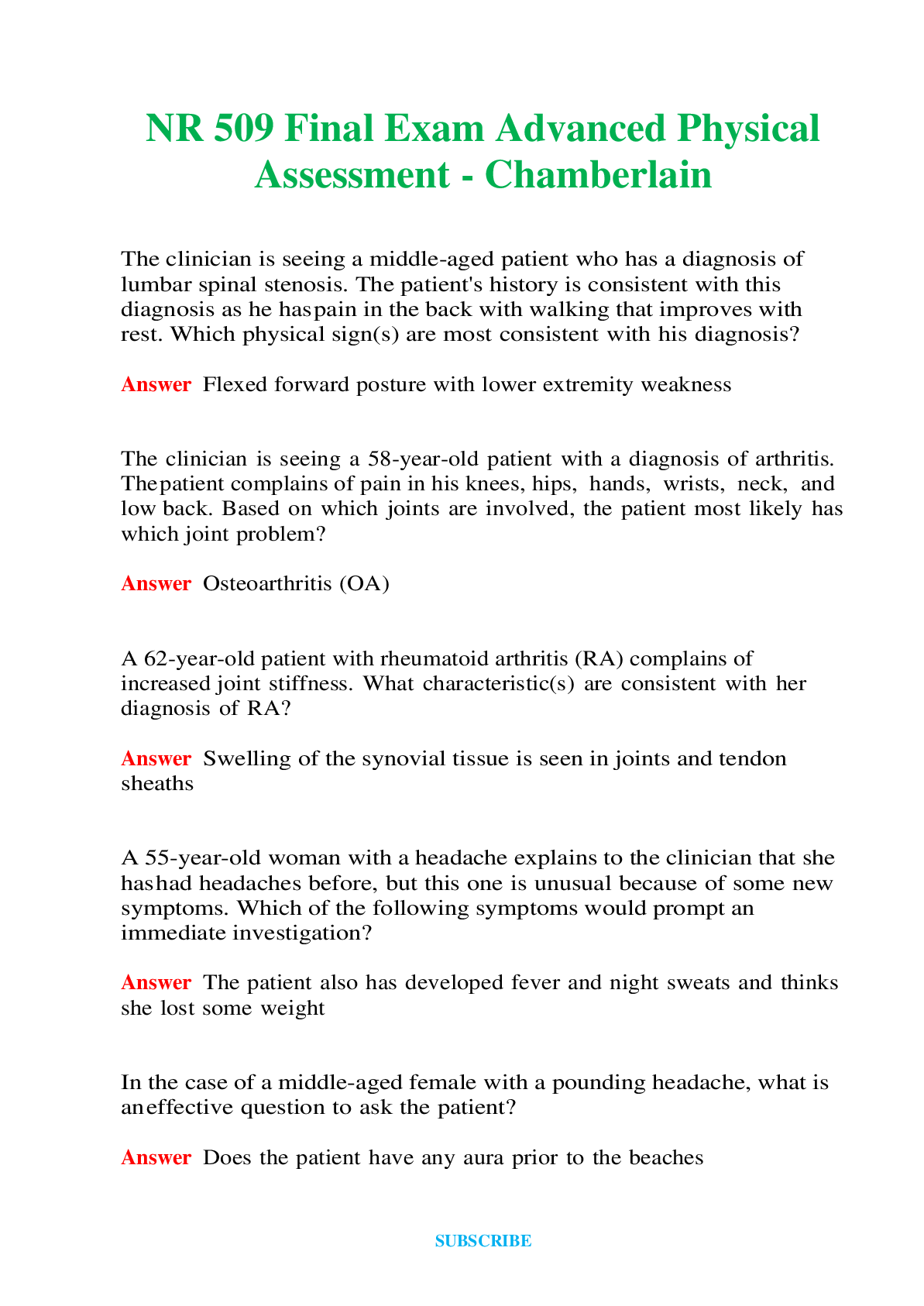
is known as:
12. A patient is able to flex his right arm forward without difficulty or pain but is unable to abduct his arm because of pain and
muscle spasm’s. The FNP should suspect:
13. A professional tennis player comes into the clinic complaining of a sore elbow. The FNP will assess for tenderness at the:
14. The FNP suspect that a patient has carpal tunnel syndrome and wants to perform the Phalens test. To perform this task the
FNP should instruct the patient to:
15. During the history a patient tells the FNP that “it feels like the room is spinning around me”. The FNP would document this
as:
16. The assessment of a 60-year-old patient has taken longer than anticipated. In testing his pain perception the FNP decides to
complete the test as quickly as possible. When the FNP applies the sharp point of a pin on his arm several times he is only
able to identify these as one very sharp prick. What would be the most accurate explanation for this?
17. An 85-year-old patient comments during his annual physical that “he seems to be getting shorter as he ages”. The FNP
should explain that decrease height occurs with aging because:
18. A patient is complaining of pain in his joints that is worse in the morning, is better after he has moved around for a while, and
then gets worse again if he sits for long periods of time. The FNP should assess for other signs of what problem?
19. When the FNP asks a 68-year-old patient to stand with feet together and arms at his side with his eyes closed he starts to
sway and moves his feet farther apart. The FNP would document this finding as:
20. During an assessment of the cranial nerves the FNP finds the following asymmetry when the patient smiles or frowns,
uneven lifting of eyebrows, sagging of lower eyelids, and escape of air when the FNP presses against the right path cheek.
This would indicate dysfunction of which of these cranial nerves?
21. The FNP is teaching a class on osteoporosis prevention to a group of postmenopausal women which of these actions is the
best way to prevent or delay bone loss in this group?
22. In obtaining a history on a 74 year old patient the FNP notes that he drinks alcohol daily and that he has noticed a tremor in
his hands that affects his ability to hold thing. With this information what should the FNP‘s response be?
23. During a history of a 78-year-old man his wife states that “he occasionally has problems with short-term memory loss and
confusion. He can’t even remember how to button his shirt”. In doing the assessment of his sensory system which action of
the FNP‘s is most appropriate?
24. While obtaining a history of a 3 month old infant from the mother the FNP asks about the infants ability to suck and grass the
mothers finger. What is the FNP assessing?
25. The FNP is doing an assessment on a 29-year-old woman who visits the clinic complaining of always dropping things and
falling down. While testing rapid alternating movements the FNP notices that the woman is unable to pat both her knees. Her Dynamic Views theme. Powered by Blogger.
Classic Flipcard Magazine Mosaic Sidebar Snapshot Timeslide
search
This study source was downloaded by 100000796615030 from CourseHero.com on 08-03-2021 03:20:49 GMT -05:00
https://www.coursehero.com/file/38070921/QUIZES-1-7-NR-509-Advanced-Physical-Assessment-Chamberlain-nr-509-quizpdf/
This study resource was
shared via CourseHero.com
11/4/2018 NR 509 Advanced Physical Assessment Chamberlain: nr 509 quiz
http://nr509chamberlain.blogspot.com/search/label/nr%20509%20quiz 4/9
NR 509 Weekly Quizzes…
NR 509 All Quizzes Ver…
NR 509 Weekly Quizzes…
NR 509 Musculoskeletal…
NR 509 Week 1 Quiz Q…
NR 509 Week 2 Quiz Ad…
NR 509 Week 3 Quiz Pr…
NR 509 Week 4 Quiz Ad…
NR 509 Week 5 Quiz 2 …
NR 509 Week 6 Quiz Pr…
NR 509 Week 7 Quiz Pr…
NR 509 Complete Cours…
NR 509 All Quizzes We…
response is very slow and she misses frequently. What should the FNP suspect?
26.
NR-509 Week 4 Quiz: Questions & Answers
1. A 35-year-old man is seen in the clinic for an infection in his left foot. Which of these findings should the FNP expect to see
during an assessment of this patient?
2. The direction of blood flow through the heart is best described by which of these
3. In assessing the carotid artery’s of an older patient with cardiovascular disease, the FNP would
4. When listening to heart sounds the FNP knows that the valve closures that can be heard best at the base of the heart are
5. The sack that surrounds and protects the heart is called the
6. When assessing a newborn infant who is five minutes old the FNP knows that which of these statements would be true?
7. The FNP is performing an assessment on an adult. The adults vital signs are normal and capillary refill is five seconds. What
should the FNP do next?
8. During an assessment of an older adult the FNP should expect to notice which finding as normal physiologic change
associated with aging process?
9. The mother of a three month old infant states that her baby has not been gaining weight. With further questioning the FNP
finds that the infant falls asleep after nursing and wakes up after a short amount of time hungry again. What other
information with the FNP want to have?
10. In assessing a patient’s major risk factors for heart disease which would the FNP want to include when taking a history?
11. The FNP is … the pulses of a patient who has been admitted for untreated hyperthyroidism. The FNP should expect to find
a____pulse
12. A patient complains of leg pain that wakes him at night. He states that he has been having problems with his legs. ….. his
legs when they are … and disappears when he dangles them. He recently noticed a sore on the inner aspect of his right ankle.
On the basis of this history information the FNP interprets that the patient is most likely experiencing
13. During an assessment the FNP uses the profile sign to detect
14. Which of these statements describes the closure of the valves in a normal cardiac cycle?
15. When performing a peripheral vascular assessment on a patient the FNP is unable to palpate the ulnar pulses. The patient skin
is warm and capillary refill is normal. The FNP should next
16. A 67-year-old patient states that he “recently began have pain in his left calf when climbing the 10 stairs to his apartment”.
This pain is relieved by sitting for about two minutes then he’s able to resume activities. The FNP interprets this patient is
most likely experiencing
17. In assessing a 70-year-old man the FNP finds the following blood pressure 140/100 mmHg, heart rate 104 and slightly
irregular, split S2. Which of these findings can… by expected hemodynamic changes related to age?
18. The FNP is examining the lymphatic system of a healthy three year old child. Which finding should the FNP expect?
19. The FNP is preparing to perform modified Allen test. Which is an appropriate reason for this test?
20. A 25-year-old woman is in her fifth month of pregnancy has a blood pressure of 100/70 mmHg. In reviewing her previous
exam the FNP notes that her blood pressure in her second month was 124/80 mmHg. When evaluating this change what does
the FNP know to be true?
21. Findings from an … of a 70-year-old patient with swelling in his ankles include jugular venous pusations, 5 cm above the
sternal angle when the head of his bed is …. 45°. The FNP knows that this finding indicate:
22. The component of the conduction system referred to as the pacemaker of the heart is the
23. The FNP is reviewing anatomy and physiology of the heart. Which statement best … by atrial kick?
24. A 45-year-old man is in the clinic for a routine physical. During history the patient states he has been having difficulty
sleeping. I’ll be sleeping great and then I wake up and feel like I can’t catch my breath. The FNP‘s best response to this
would be
25. When assessing a patient the FNP notes that the left femoral pulse as diminished 1+/4+. What should the FNP do next?
1. NR 509 Week 3 Quiz (Version 2)
1. What piece of equipment can be used to test for peripheral neuropathy
2. How would you test for Romberg sign
3. Diagnosis for patient with complaint of room spinning
4. Know expected postural changes in pregnancy
5. Know what the phalen’s test is and how to conduct it
6. Hands back to back for 60 secs looking for development of
7. Positive Phalen’s test
8. Older pt that can’t remember to tie shoes in order to assess this you first want to?
9. What is loss of bone density
10. Disease that is accompanied by joint pain in the morning that improves with movement and worsens with sitting
11. What is summation effect and what does it mean
12. Know what is normal findings in passive ROM
13. … evaluate a pt with migraines in regard to if they have an aura
14. Know abnormal finding of rotator cuff
15. Know the type of neuro exam to complete on a pt presenting with one sided weakness
16. Understand tennis elbow
17. Know common reflexes at various ages
18. What tremors improve with ETOH
Dynamic Views theme. Powered by Blogger.
Classic Flipcard Magazine Mosaic Sidebar Snapshot Timeslide
search
This study source was downloaded by 100000796615030 from CourseHero.com on 08-03-2021 03:20:49 GMT -05:00
https://www.coursehero.com/file/38070921/QUIZES-1-7-NR-509-Advanced-Physical-Assessment-Chamberlain-nr-509-quizpdf/
This study resource was
shared via CourseHero.com
11/4/2018 NR 509 Advanced Physical Assessment Chamberlain: nr 509 quiz
http://nr509chamberlain.blogspot.com/search/label/nr%20509%20quiz 5/9
NR 509 Weekly Quizzes…
NR 509 All Quizzes Ver…
NR 509 Weekly Quizzes…
NR 509 Musculoskeletal…
NR 509 Week 1 Quiz Q…
NR 509 Week 2 Quiz Ad…
NR 509 Week 3 Quiz Pr…
NR 509 Week 4 Quiz Ad…
NR 509 Week 5 Quiz 2 …
NR 509 Week 6 Quiz Pr…
NR 509 Week 7 Quiz Pr…
NR 509 Complete Cours…
NR 509 All Quizzes We…
19. Understand CN 11
20. What concerns exist when pt is slow with RAM
21. R/O MS
22. Know education for pts on exercises that help to prevent osteoporosis
23. What does hip abduction reveal
NR 509 Week 4 Quiz (25 Points)
1. Question: A 35-year-old man is seen in the clinic for an infection in his left foot. Which of these findings should the FNP
expect to see during an assessment of this patient?
2. Question: The direction of blood flow through the heart is best described by which of these
3. Question: In assessing the carotid artery’s of an older patient with cardiovascular disease, the FNP would
4. Question: When listening to heart sounds the FNP knows that the valve closures that can be heard best at the base of the
heart are
5. Question: The sack that surrounds and protects the heart is called the
6. Question: When assessing a newborn infant who is five minutes old the FNP knows that which of these statements would be
true?
7. Question: The FNP is performing an assessment on an adult. The adults vital signs are normal and capillary refill is five
seconds. What should the FNP do next?
8. Question: During an assessment of an older adult the FNP should expect to notice which finding as normal physiologic
change associated with aging process?
9. Question: The mother of a three month old infant states that her baby has not been gaining weight. With further questioning
the FNP finds that the infant falls asleep after nursing and wakes up after a short amount of time hungry again. What other
information with the FNP want to have?
10. Question: In assessing a patient’s major risk factors for heart disease which would the FNP want to include when taking a
history?
11. Question: The FNP is assessing the pulses of a patient who has been admitted for untreated hyperthyroidism. The FNP
should expect to find a____pulse
12. Question: A patient complains of leg pain that wakes him at night. … states that he has been having problems with his legs.
He has pain in his legs when they are … and disappears when he dangles them. He recently noticed a sore on the inner aspect
of his right ankle. On the basis of this history information the FNP interprets that the patient is most likely experiencing
13. Question: During an assessment the FNP uses the profile sign to detect
14. Question: … these statements describes the closure of the valves in a normal cardiac cycle?
15. Question: When performing a peripheral vascular assessment on a patient the FNP is unable to palpate the ulnar pulses. The
patient skin is warm and capillary refill is normal. The FNP should next
16. Question: A 67-year-old patient states that he “recently began have pain in his left calf when climbing the 10 stairs to his
apartment”. This pain is relieved by sitting for about two minutes then he’s able to resume activities. The FNP interprets this
patient is most likely experiencing
17. Question: In assessing a 70-year-old man the FNP finds the following blood pressure 140/100 mmHg, heart rate 104 and
slightly irregular, split S2. Which of these findings can … explained by expected hemodynamic changes related to age?
18. Question: The FNP is examining the lymphatic system of a healthy three year old child. Which finding should the FNP
expect
[Show More]