1. What organ is found in the retroperitoneal position?
a. kidneys
2. What is the name of the pancreatic enzyme that digest lipids?
a. Lipase
3. Which part of the nephron is responsive or effective by ADH?
a. Collec
...
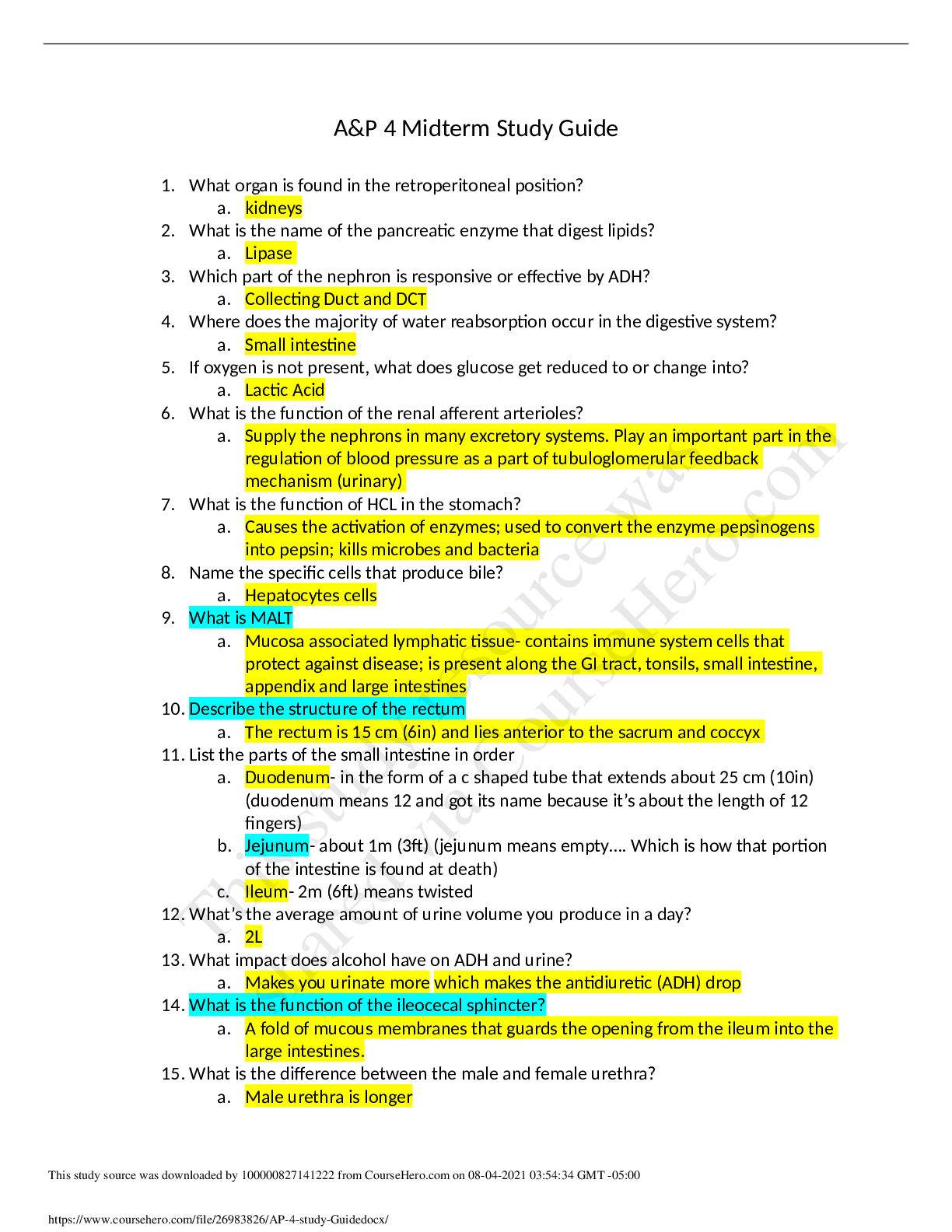
1. What organ is found in the retroperitoneal position?
a. kidneys
2. What is the name of the pancreatic enzyme that digest lipids?
a. Lipase
3. Which part of the nephron is responsive or effective by ADH?
a. Collecting Duct and DCT
4. Where does the majority of water reabsorption occur in the digestive system?
a. Small intestine
5. If oxygen is not present, what does glucose get reduced to or change into?
a. Lactic Acid
6. What is the function of the renal afferent arterioles?
a. Supply the nephrons in many excretory systems. Play an important part in the
regulation of blood pressure as a part of tubuloglomerular feedback
mechanism (urinary)
7. What is the function of HCL in the stomach?
a. Causes the activation of enzymes; used to convert the enzyme pepsinogens
into pepsin; kills microbes and bacteria
8. Name the specific cells that produce bile?
a. Hepatocytes cells
9. What is MALT
a. Mucosa associated lymphatic tissue- contains immune system cells that
protect against disease; is present along the GI tract, tonsils, small intestine,
appendix and large intestines
10. Describe the structure of the rectum
a. The rectum is 15 cm (6in) and lies anterior to the sacrum and coccyx
11. List the parts of the small intestine in order
a. Duodenum- in the form of a c shaped tube that extends about 25 cm (10in)
(duodenum means 12 and got its name because it’s about the length of 12
fingers)
b. Jejunum- about 1m (3ft) (jejunum means empty…. Which is how that portion
of the intestine is found at death)
c. Ileum- 2m (6ft) means twisted
12. What’s the average amount of urine volume you produce in a day?
a. 2L
13. What impact does alcohol have on ADH and urine?
a. Makes you urinate more which makes the antidiuretic (ADH) drop
14. What is the function of the ileocecal sphincter?
a. A fold of mucous membranes that guards the opening from the ileum into the
large intestines.
15. What is the difference between the male and female urethra?
a. Male urethra is longer
This study source was downloaded by 100000827141222 from CourseHero.com on 08-04-2021 03:54:34 GMT -05:00
16. Location of the pyloric sphincter
a. A band of smooth muscles at the junction between the pylorus of the stomach
and the duodenum of the small intestine.
17. What is countercurrent multiplication and where does it occur?
a. proximal convoluted Tubule (PCT)
18. What is the normal PH levels in the urine?
a. 4.6-8.0
19. Define metabolism?
a. Refers to all the chemical reactions taking place in the body
20. What are the functions of the tongue?
a. Participates in chewing swallowing and speech
21. What is peristalsis?
a. A progression of coordinated contractions and relaxation of the circular and
longitudinal layers of the muscle.
22. Where are the Renal arcuate veins found?
a. Located at the border of the renal cortex and renal medulla
23. What is the function of the ureter?
a. Transports urine from the kidney to the bladder
24. Define chylomicrons
a. Mass about 80 nm in diameter; long chains of fatty acids and monoglycerides
are recombined to form triglycerides which later form into globules along with
phospholipids and cholesterol and become coated with protein.
25. What is the function of rugae?
a. When the stomach is empty, the mucosa lies in large folds, or rugae (wrinkles)
26. 3 steps of urine formation
a. glomerular filtration
b. tubular reabsorption
c. tubular secretion
27. Where each step happens in the nephron
a. Filtration- renal corpuscle
b. Reabsorption- PCT/ DCT loop of Henle, collecting duct
c. Secretion- Collecting Duct
28. What is glucagon? Where is it made? And what is its function?
a. Hormone produced by the alpha cells of the pancreatic islets that increases
blood glucose levels; hormone that brings up sugar levels in the blood.
29. Define glycolysis
a. Converts glucose into pyruvate, used to form ATP and NADH
30. What does the presences of high levels of ketone bodies in the blood and urine
indicate?
a. abnormalities in the blood and urine
31. What is the function of the intestinal villi?
a. Increase the surface area for reabsorption
32. Define anabolism
a. Chemical reaction that combines simple molecules and monomers to form the
body’s structural and functional components; synthesizing from small to big
33. How much atp are y
[Show More]