Medical Studies > EXAM > NURS 105 NCLEX QUESTIONS_ Sensory (2020) – Faulkner CC | NURS 105 NCLEX QUESTIONS_ Sensory (2020) (All)
NURS 105 NCLEX QUESTIONS_ Sensory (2020) – Faulkner CC | NURS 105 NCLEX QUESTIONS_ Sensory (2020)
Document Content and Description Below
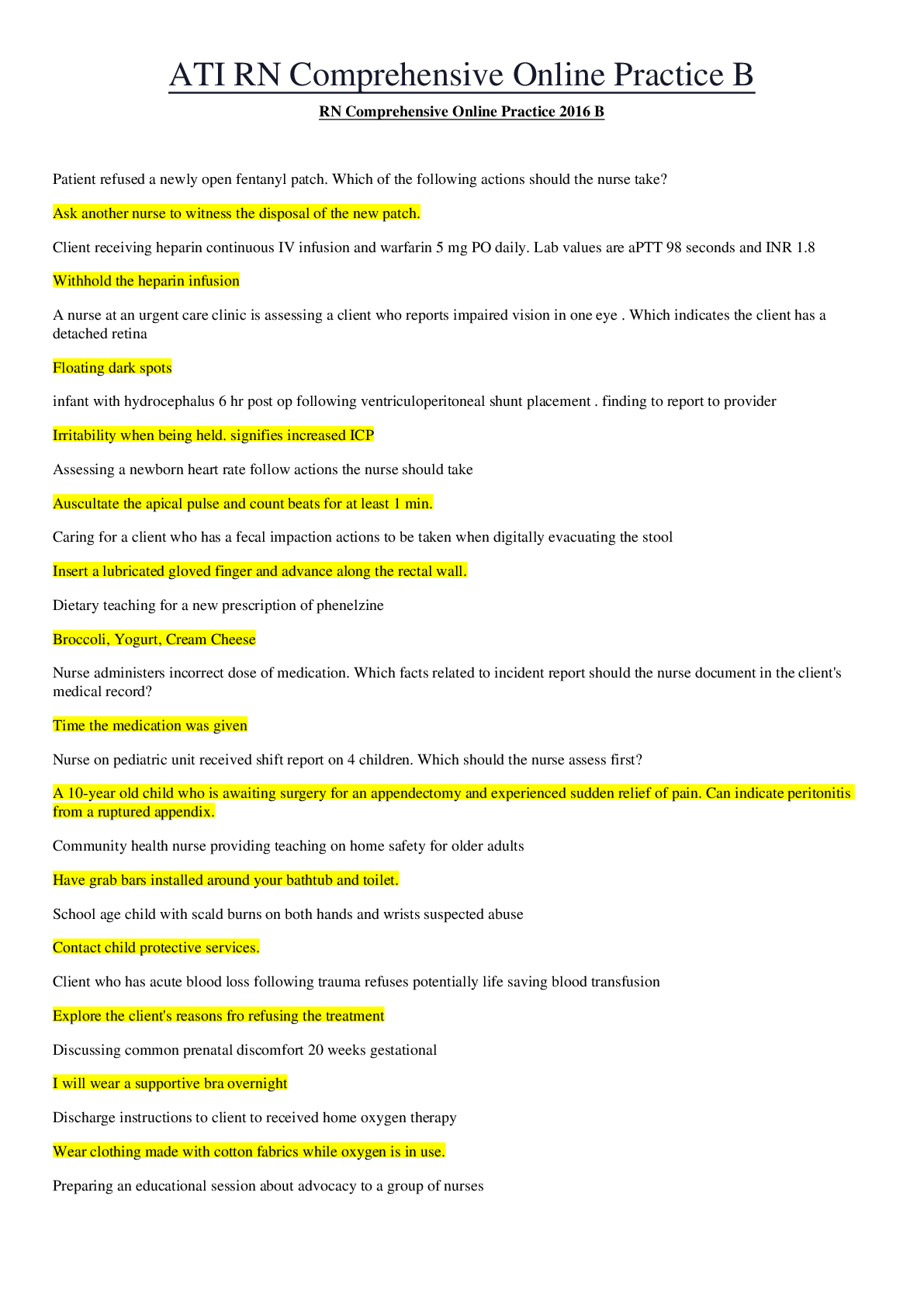
NURS 105 NCLEX QUESTIONS_ Sensory (2020) – Faulkner CC (Medical Surgical Nursing) Sensory For which client does the nurse recommend annual evaluation by an ophthalmologist? (pg. 971) A. 35-yea ... r-old man with asthma B. 21-year-old man with psoriasis C. 24-year-old woman with diabetes D. 38-year-old woman who has lost 50 pounds The client who had cataract surgery with a lens implant 1 week ago remarks to the home care nurse that after his daughter left to go to her home in another state yesterday, he combined all of his prescribed eye drops together in one container so he had fewer drops to administer. What is the nurse’s best response? (pg 984) A. “This is not a good idea because not all of the drugs are on the same schedule.” B. “That is a good idea; just remember to not touch the dropper to your eye when giving yourself the drops.” C. “Call your surgeon immediately and get new prescriptions because together these drugs can lower your blood pressure.” D. “Call your surgeon immediately and get new prescriptions to use one at a time because these drugs cannot be mixed together.” The older adult client asks whether the white ring in the iris of both eyes is a cataract that can be removed to improve her vision. What is the nurse’s best response? (7th edition pg 1045) A. “A cataract forms inside the eye, not on the surface. This growth should be assessed for cancer.” B. “This type of ring in the eye gets worse as intraocular pressure increases, leading to glaucoma.” C. “This ring is a cataract, and it cannot be removed until it reaches and covers over the pupil.” D. “The ring is just a buildup of deposits, not a cataract, and never interferes with vision.” Which client assessment finding does the nurse report to the health care provider immediately? (7th edition pg 1048) A. The left pupil is slightly smaller than the right pupil B. Both eyes twitch when the client looks to the far lateral gaze position C. The right pupil does not change size when a light is shined directly at it. D. The lowest line the client can read clearly at 20 feet on the Snellen chart is marked 50 feet. Which assessment is most important for the nurse to perform before instilling travoprost (Travatan) into the client’s eye? (pg 989) A. Measuring the client’s blood pressure B. Measuring the client’s intraocular pressure C. Checking the cornea for abrasions or open areas D. Assessing heart rate and rhythm for 1 full minute Which precaution is most important for the nurse to teach a client who is prescribed to use an ophthalmic ointment? (7th ed pg 1056) A. “Keep the tube in the refrigerator to make the ointment easier to control when you squeeze the tube.” B. “Wear gloves when you apply the ointment to prevent absorbing the drug through your skin.” C. “Patch your eye at night to prevent ointment from getting on your bedding or in your hair.” D. “Do not drive with ointment in your eyes.” Which comment made by a client 1 week after a corneal transplant indicates to the nurse a need to review postoperative care? (7th edition pg 1059) A. “I have been feeding my cat on the counter so that I don’t have to bend over.” B. “I have been using an icepack on my eye to reduce the redness and swelling.” C. “My daughter has been helping me inspect my eye and place the eyedrops.” D. “Instead of reading a book, I now listen to books on tape.” A client who had cataract removal with placement of an intraocular implant 1 week ago now calls in and reports that her eye is more bloodshot than it was yesterday and that a small amount of greenish drainage is present. What is the priority nursing action? (7th edition pg 1062) A. Reassure the client that these symptoms are normal for this stage of recovery after cataract surgery. B. Explain how to apply a wet compress to the affected eye for 15 minutes four times daily. C. Instruct the client to come to the office immediately to be seen by the ophthalmologist. D. Instruct the client to use the antibiotic eyedrops four times daily instead of twice daily. Which assessment question is most important for the nurse to ask a client with glaucoma who has just been prescribed the drug apraclonidine (lopidine)? (7th edition pg 1067) A. “Are you allergic to sulfa drugs?” B. “What othere drugs do you currently take?” C. “Do you have any difficulty passing urine?” D. “Do you have asthma or any other respiratory problem?” Which precaution is most important for the nurse to teach a 62-year-old client newly diagnosed with early-stage dry age-related macular degeneration? (pg 989) A. Quit smoking B. Quit drinking alcoholic beverages C. Eat more dark green, red, and yellow vegetables D. Wear dark glasses whenever he or she is outside or in bright interior lighting environments A client whose sister was just diagnosed with autosomal recessive retinitis pigmentosa is pregnant with a male fetus. The client’s husband has no relatives with the disorder. She asks what the chances are that her son could be affected. What is the nurse’s best response? (7th edition pg 1070) A. “Because it is likely that you are a carrier and your husband does not have any affected relatives, only your daughters can develop the disease.” B. “Because it is likely that you are a carrier and your husband does not have any affected relatives, none of your children will have the disease but each child will have a 50% risk for being a carrier.” C. “Because your sister actually has retinitis pigmentosa, the risk for your children having the disorder is 50% with each pregnancy.” D. “Because you are a woman, your daughters will each have a 50% risk for having the disease, and all of your sons will be carriers.” Which action by a nurse is most likely to increase accurate communication with a client who has low vision? (pg 994) A. Speaking slowly and loudly B. Enhancing the talk using hand gestures C. Being very specific with descriptions and directions D. Marking the door of the client’s room to indicate his or her vision status A client with reduced vision who is 1 day postoperative for a non-vision problem expresses concern to the nurse that he is afraid if a hospital fire occurred he would not be able to get out in time? Which nurse response or action is most likely to allay his fears? (7th edition pg 1075) A. Demonstrating how to close the door and place wet towels at the bottom edge of the door. B. Reminding him that the hospital meets all current fire codes and has never experienced a major fire. C. Helping him count the steps to the stairway exit and reminding him that he is on the second floor. D. Reassuring him that even if a fire broke out, the nurses and other personnel would stay on the unit with him. With which client does the nurse avoid performing an otoscopic examination? (pg 1002) A. 34-year-old woman who is pregnant B. 90-year-old woman who is visually impaired C. 75-year-old man with dizziness and vertigo D. 70-year-old man with advanced Alzheimer’s disease The client is a 28-year-old woman who reports to the nurse that she has experienced reduced hearing in both ears during the past 2 years. Which health issue or personal factor is most likely to be associated with the reduced hearing? (7th edition pg 1082) A. Use of cotton-tipped applicators to clean the ears for her entire adult life B. Use of oral contraceptives as the method of birth control for the past 3 years C. Participation in a vegetarian diet that permits milk and eggs for the past 5 years D. Management of chronic joint pain with daily naproxen (Aleve) for the past 3 years. Which precaution or action is the priority for the nurse to teach the client who is scheduled to undergo tympanometry, pure-tone audiometry, and caloric testing? (7th edition pg 1086) A. Avoid aspirin and aspirin-containing products for 1 week before testing B. Shower and wash your hair the night before testing C. Do not eat or drink within 4 hours before testing D. Do not smoke for 24 hours before the testing The client who has tinnitus is taking these drugs daily: 1 multiple vitamin, losartan (Cozaar) 50 mg, aspirin 650 mg, and diphenhydramine (Benadryl) 25 mg. Which drug alerts the nurse to a possible cause of tinnitus? (pg 1008) A. Aspirin B. Losartan C. Multiple Vitamin D. Diphenhydramine Which lifestyle modification does the nurse suggest to the client with Meniere’s disease to reduce the frequency or intensity of acute episodes? (pg 1009) A. Quitting cigarette smoking B. Avoiding aspirin-containing drugs C. Reducing the amount of saturated fats in the diet D. Avoiding crowds and people who have upper respiratory infections [Show More]
Last updated: 3 years ago
Preview 1 out of 5 pages
 – Faulkner CC.png)
Buy this document to get the full access instantly
Instant Download Access after purchase
Buy NowInstant download
We Accept:

Reviews( 0 )
$10.50
Can't find what you want? Try our AI powered Search
Document information
Connected school, study & course
About the document
Uploaded On
Aug 22, 2020
Number of pages
5
Written in
All

Additional information
This document has been written for:
Uploaded
Aug 22, 2020
Downloads
0
Views
61





 – University of the People.png)