WK 8 study questions 2.
Question 1
In a community-based hypertension testing program called HT-Aware, the detection level for high blood
pressure is set at 140 mmHg for systolic blood pressure. A separate testing prog
...
WK 8 study questions 2.
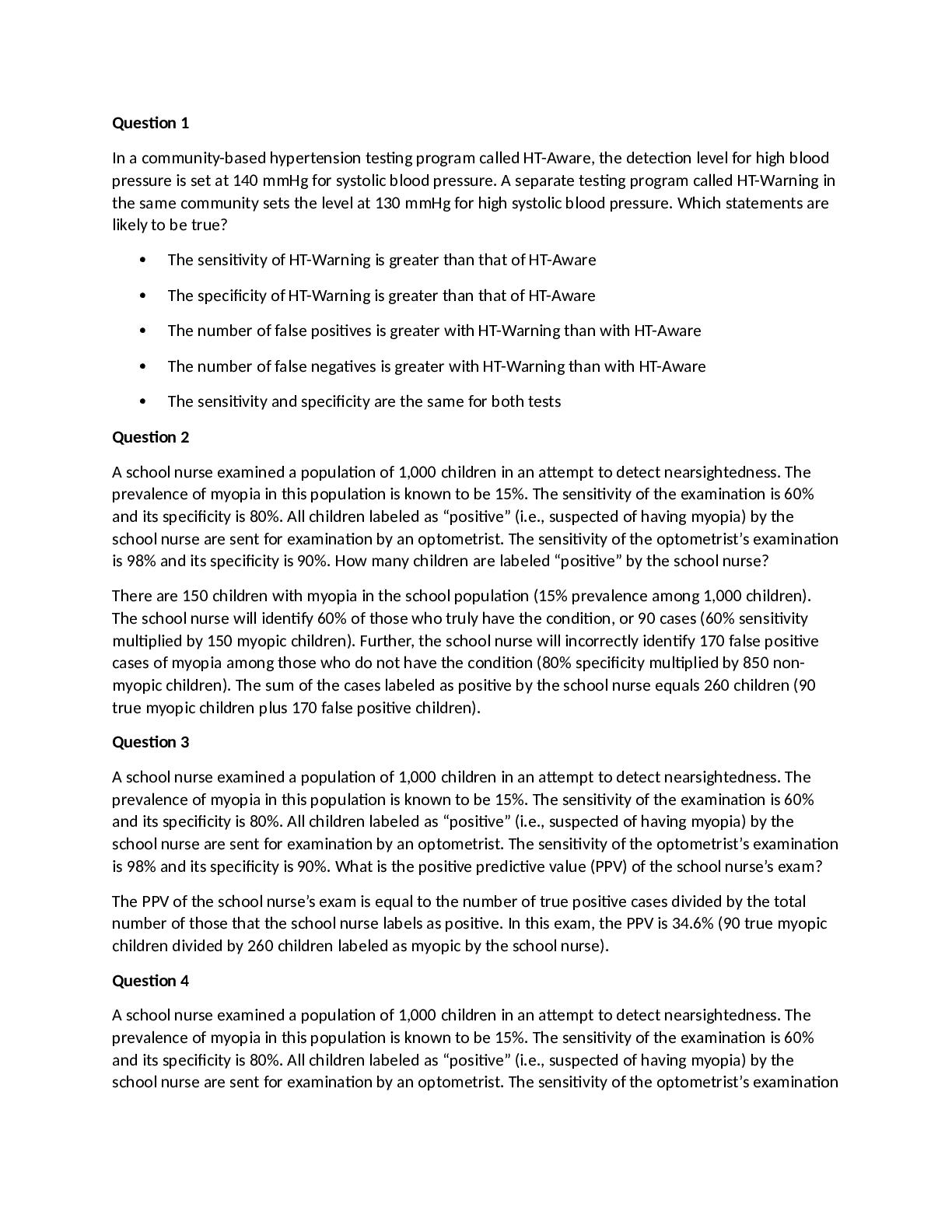
Question 1
In a community-based hypertension testing program called HT-Aware, the detection level for high blood
pressure is set at 140 mmHg for systolic blood pressure. A separate testing program called HT-Warning in
the same community sets the level at 130 mmHg for high systolic blood pressure. Which statements are
likely to be true?
Question 2
A school nurse examined a population of 1,000 children in an attempt to detect nearsightedness. The
prevalence of myopia in this population is known to be 15%. The sensitivity of the examination is 60%
and its specificity is 80%. All children labeled as “positive” (i.e., suspected of having myopia) by the
school nurse are sent for examination by an optometrist. The sensitivity of the optometrist’s examination
is 98% and its specificity is 90%. How many children are labeled “positive” by the school nurse?
Question 3
A school nurse examined a population of 1,000 children in an attempt to detect nearsightedness. The
prevalence of myopia in this population is known to be 15%. The sensitivity of the examination is 60%
and its specificity is 80%. All children labeled as “positive” (i.e., suspected of having myopia) by the
school nurse are sent for examination by an optometrist. The sensitivity of the optometrist’s examination
is 98% and its specificity is 90%. What is the positive predictive value (PPV) of the school nurse’s exam?
Question 4
A school nurse examined a population of 1,000 children in an attempt to detect nearsightedness. The
prevalence of myopia in this population is known to be 15%. The sensitivity of the examination is 60%
and its specificity is 80%. All children labeled as “positive” (i.e., suspected of having myopia) by the
school nurse are sent for examination by an optometrist. The sensitivity of the optometrist’s examination
is 98% and its specificity is 90%. How many children will be labeled myopic following the optometrist’s
exam?
Question 5
A school nurse examined a population of 1,000 children in an attempt to detect nearsightedness. The
prevalence of myopia in this population is known to be 15%. The sensitivity of the examination is 60%
and its specificity is 80%. All children labeled as “positive” (i.e., suspected of having myopia) by the
school nurse are sent for examination by an optometrist. The sensitivity of the optometrist’s examination
is 98% and its specificity is 90%. What is the positive predictive value (PPV) of the optometrist’s exam?
Question 6
A school nurse examined a population of 1,000 children in an attempt to detect nearsightedness. The
prevalence of myopia in this population is known to be 15%. The sensitivity of the examination is 60%
and its specificity is 80%. All children labeled as “positive” (i.e., suspected of having myopia) by the
school nurse are sent for examination by an optometrist. The sensitivity of the optometrist’s examination
is 98% and its specificity is 90%. What is the negative predictive value (NPV) of the optometrist’s exam?
Question 7
A school nurse examined a population of 1,000 children in an attempt to detect nearsightedness. The
prevalence of myopia in this population is known to be 15%. The sensitivity of the examination is 60%
and its specificity is 80%. All children labeled as “positive” (i.e., suspected of having myopia) by the
school nurse are sent for examination by an optometrist. The sensitivity of the optometrist’s examination
is 98% and its specificity is 90%. What is the overall sensitivity of the sequential examinations?
[Show More]