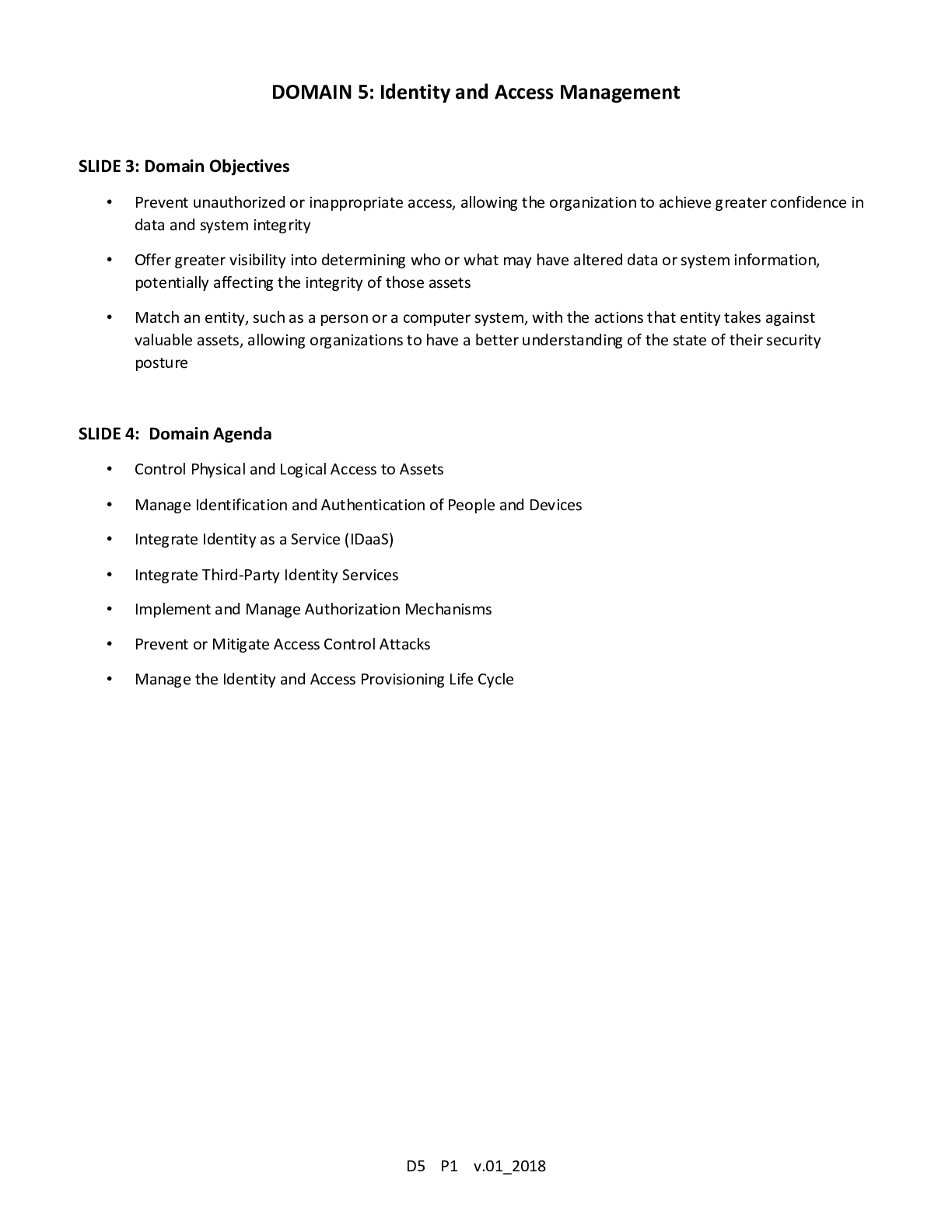
DOMAIN 5: Identity and Access Management
SLIDE 3: Domain Objectives
• Prevent unauthorized or inappropriate access, allowing the organization to achieve greater confidence in
data and system integrity
• Offer greater
...
DOMAIN 5: Identity and Access Management
SLIDE 3: Domain Objectives
• Prevent unauthorized or inappropriate access, allowing the organization to achieve greater confidence in
data and system integrity
• Offer greater visibility into determining who or what may have altered data or system information,
potentially affecting the integrity of those assets
• Match an entity, such as a person or a computer system, with the actions that entity takes against
valuable assets, allowing organizations to have a better understanding of the state of their security
posture
SLIDE 4: Domain Agenda
• Control Physical and Logical Access to Assets
• Manage Identification and Authentication of People and Devices
• Integrate Identity as a Service (IDaaS)
• Integrate Third-Party Identity Services
• Implement and Manage Authorization Mechanisms
• Prevent or Mitigate Access Control Attacks
• Manage the Identity and Access Provisioning Life CycleD5 P2 v.01_2018
Control Physical and Logical Access to Assets
SLIDE 6: Module Topics
• Access Control Systems
• Administration
• Physical Access Control
SLIDE 7: Access Control Systems
Physical or electronic systems are designed to control who, or what, has access to a network.
The simplest example of a physical access control system is a door that can be locked, limiting people to one side
of the door or the other.
The use of electronic systems allows an administrator to precisely define access privileges for each user.
Access control systems that span computer networks are typically administered in a central location, with each
user being given a unique identity. Access can be granted on a case-by-case basis
When installing these systems, consider who uses the system and how it will be used.
SLIDE 8: Types of Access Control
■ Facility access control protects enterprise assets and provides a history of who gained access as well as when
the access was granted. >> time and attendance functionality.
In truly integrated environments, physical access controls, time and attendance, and logical access controls can
be provided via a single set of credentials that work across all three applications.
■ Logical access controls are protection mechanisms that limit users’ access to information and restrict their
access on the system.
Logical access controls are either built into the operating system, or may apart of the “logic” built into an
application. EX: A Database Management Systems (DBMS)
Logical access controls may also be present in specialized components that regulate communications between
computers and networks
[Show More]