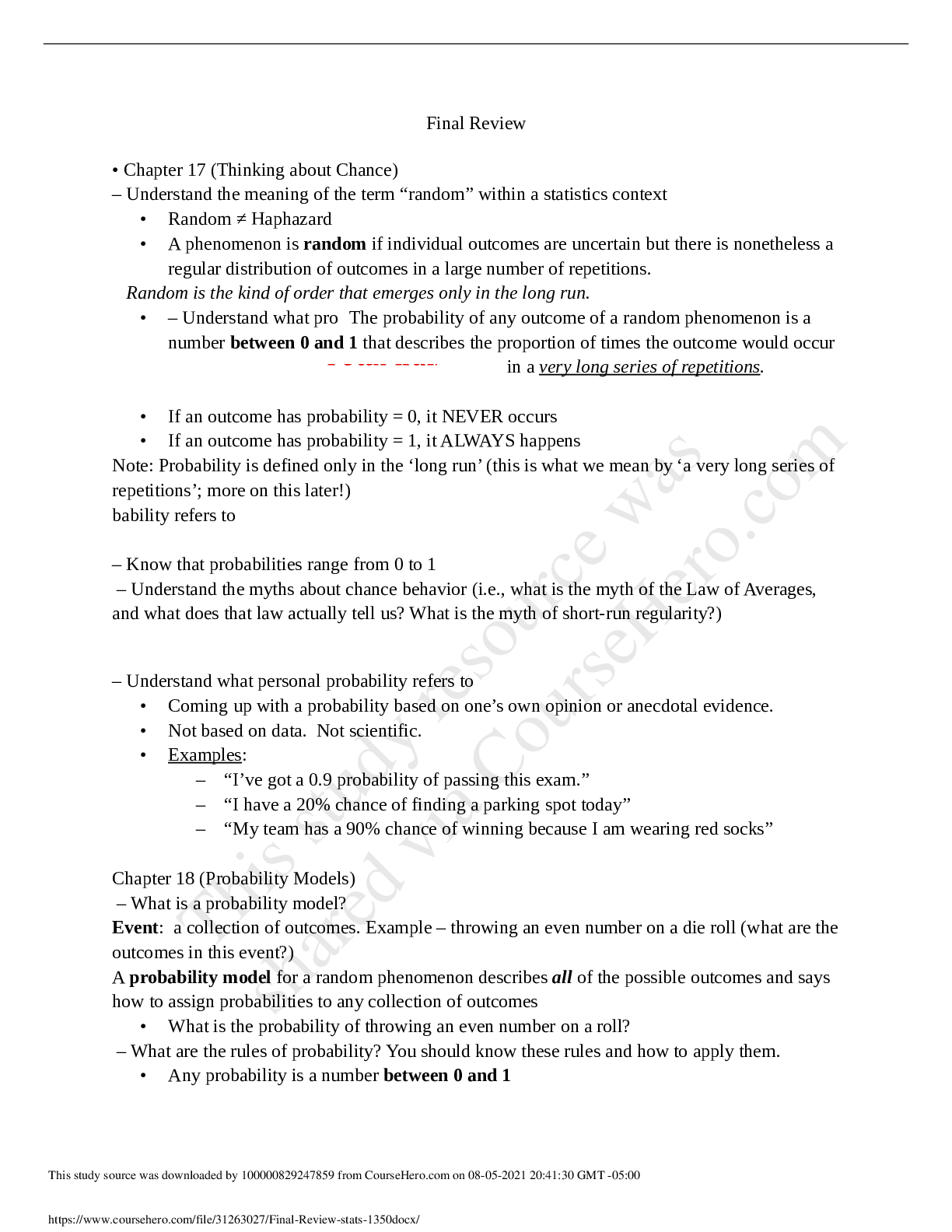
Statistics > EXAM REVIEW > Ohio State University STATS 1350 Final Review (All)
Ohio State University STATS 1350 Final Review
Document Content and Description Below
Last updated: 5 months ago
Preview 1 out of 7 pages
Instant download
Buy this Document to get the Full Access Instantly
Provided by Students Who Aced it
We Verify Document Content to Gurantee Accuracy
Reviews( 0 )
Document information
Connected school, study & course
About the document
Uploaded On
Aug 06, 2021
Number of pages
7
Written in
All

Additional information
This document has been written for:
Uploaded
Aug 06, 2021
Downloads
0
Views
204
Topic Tags
Related Subjects & Courses
Explore similar study resources and related concepts.
Recommended For You
Get more on EXAM REVIEW »
Sampling Design and Analysis, 3e by Sharon Lohr (Solutions Man...
.png)
Business Statistics, 4e Norean Sharpe, Richard Veaux, Paul Vel...
Solutions Manual for Business Statistics Communicating with Nu...
The Basic Practice of Statistics, 9th Edition Moore, Notz, Fli...
Business Statistics Communicating with Numbers, 4e Sanjiv Jagg...
.png)
Introduction to Statistical Investigations, 2e Tintle, Chance,...

Essentials of Statistics for the Behavioral Sciences 3rd Editi...

Test Bank for Advanced and Multivariate Statistical Methods Pr...
Auditing A Practical Approach with Data Analytics, 2e Raymond...
Introduction to Statistical Investigations, 2e Tintle, Chance,...

Test Bank for Essentials of Statistics for the Behavioral Scie...

Data Analysis and Statistics for Geography, Environmental Scie...

An Introduction to Statistical Concepts, 4e Debbie Hahs-Vaughn...
Practice of Statistics in the Life Sciences, Digital Update, 4...

Making Sense of Statistics A Conceptual Overview, 7e Fred Pyrc...
An Introduction to Statistical Concepts, 4e by Debbie Hahs-Vau...

Introduction to the Practice of Statistics, 10e David Moore, G...
.png)
Business Statistics For Contemporary Decision Making, 3rd Cana...
.png)