Question 1
The population of a city on February 15, 2005, was 36,600. The city has a passive surveillance system that collects hospital and private physician reports of influenza cases every month. During the period bet
...
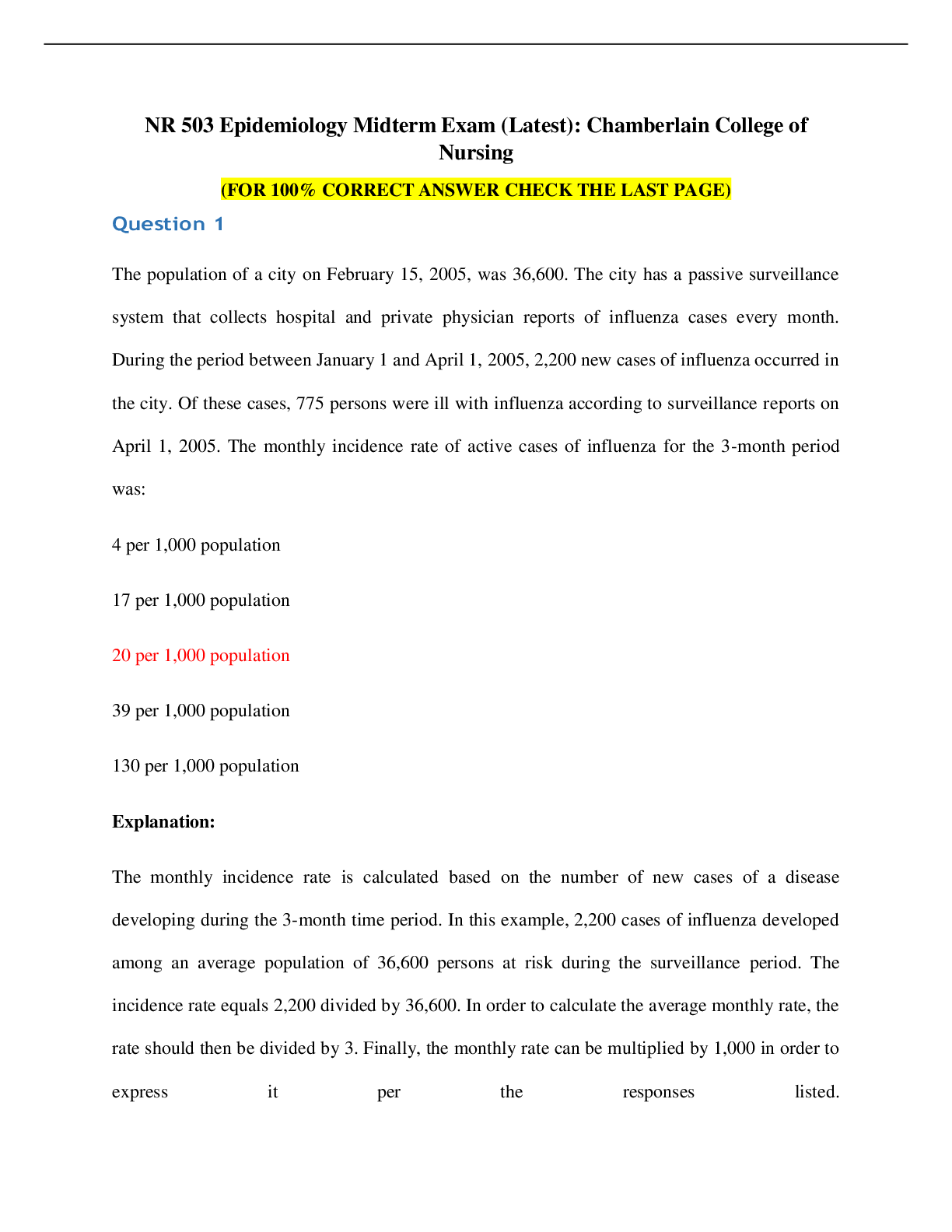
Question 1
The population of a city on February 15, 2005, was 36,600. The city has a passive surveillance system that collects hospital and private physician reports of influenza cases every month. During the period between January 1 and April 1, 2005, 2,200 new cases of influenza occurred in the city. Of these cases, 775 persons were ill with influenza according to surveillance reports on April 1, 2005. The monthly incidence rate of active cases of influenza for the 3-month period was:
4 per 1,000 population
17 per 1,000 population
20 per 1,000 population
39 per 1,000 population
130 per 1,000 population
Explanation:
The monthly incidence rate is calculated based on the number of new cases of a disease developing during the 3-month time period. In this example, 2,200 cases of influenza developed among an average population of 36,600 persons at risk during the surveillance period. The incidence rate equals 2,200 divided by 36,600. In order to calculate the average monthly rate, the rate should then be divided by 3. Finally, the monthly rate can be multiplied by 1,000 in order to express it per the responses listed.
Question 2
What would be the effect on age-specific incidence rates of uterine cancer if women with hysterectomies were excluded from the denominator of incidence calculations assuming that most women who have had hysterectomies are older than 50 years of age.
The rates in all age groups would remain the same.
Only rates in women older than 50 years of age would tend to decrease.
Rates in women younger than 50 years would increase compared to women older than 50 years of age.
Rates would increase in women older than 50 years of age but may decrease in younger women as they get older.
It cannot be determined whether the rates would increase or decrease.
Explanation:
Women who have had hysterectomies (i.e., removal of the uterus) are no longer at risk for uterine cancer. For women older than 50 years of age, this would increase the age-specific incidence rate as there would be the same number of uterine cancers occurring among fewer women at risk. Further, rates may decrease among younger women who have had hysterectomies as they are no longer at risk for uterine cancer and thus may decrease the number of potential cases occurring in their age group over time.
Question 3
The ability of a single person to remain free of clinical illness following exposure to an infectious agent is known as:
Hygiene Vaccination Herd immunity Immunity Latency Explanation:
Immunity is the capacity of a single individual to avoid disease susceptibility when exposed to an infectious agent. Herd immunity is a population characteristic. For certain diseases, individual immunity can be acquired by vaccination, but this is not true for all infectious diseases.
Question 4
Which of the following reasons can explain why a person who did not consume the infective food item got sick?
They were directly exposed to persons who did eat the infective food item Diarrhea is a general symptom consistent with a number of illnesses There may have been an inaccurate recall of which foods were eaten
All of the above None of the above Explanation:
Without knowledge as to the specific agent in this instance, it is also likely that it can be spread by direct contact with infected persons. Since diarrhea is a general disease symptom, it is possible that several infectious agents may be present at this meal or others eaten during the same time period. Further, information regarding food consumption may have been collected long after the disease episode. This may have led persons to incorrectly remember the foods that they consumed.
[Show More]