Nutrition Discussion Board
Week 1
Part 1
Explain the components of a nutritional assessment. What important
subjective and objective assessment findings will assist the nurse in
developing a nutritional plan?
Use
...
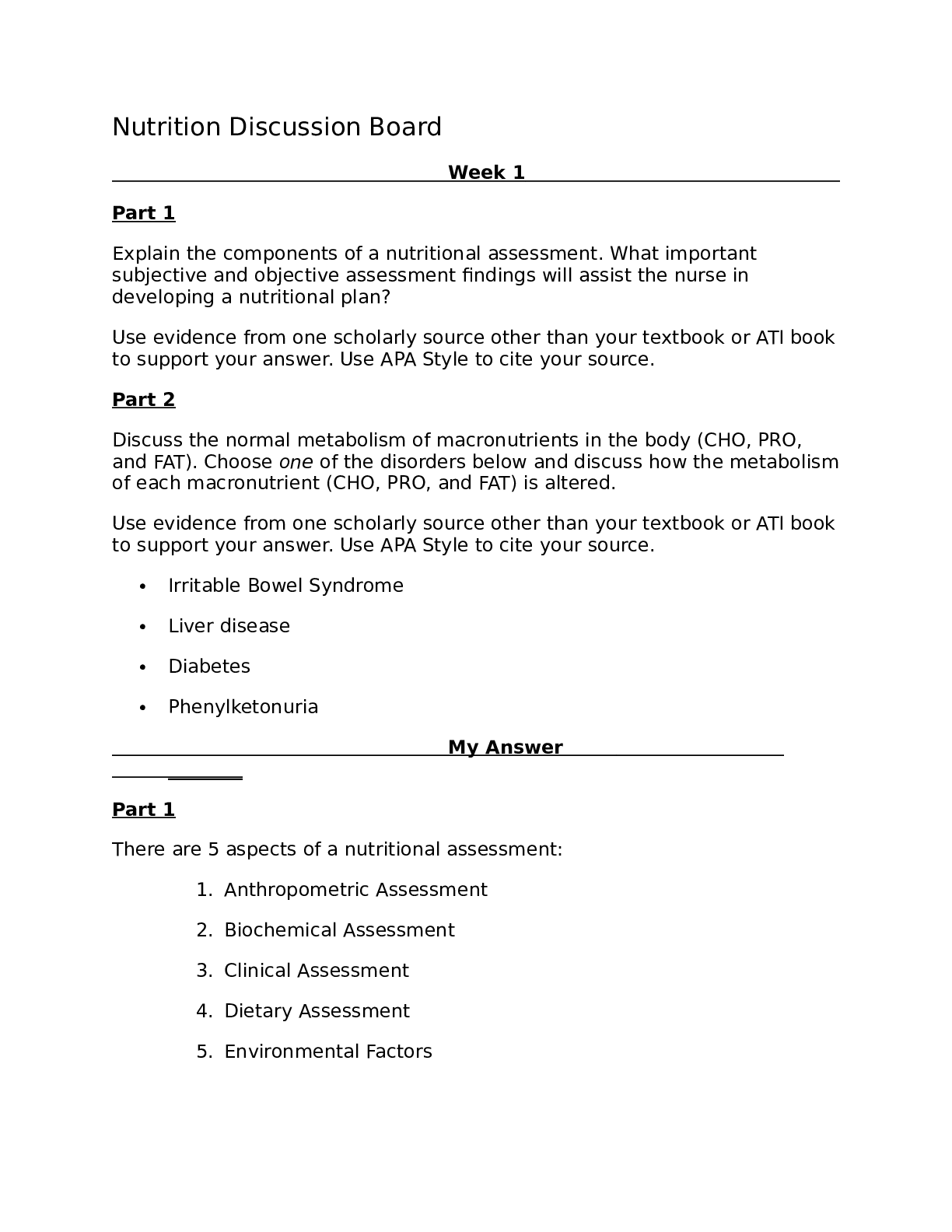
Nutrition Discussion Board
Week 1
Part 1
Explain the components of a nutritional assessment. What important
subjective and objective assessment findings will assist the nurse in
developing a nutritional plan?
Use evidence from one scholarly source other than your textbook or ATI book
to support your answer. Use APA Style to cite your source.
Part 2
Discuss the normal metabolism of macronutrients in the body (CHO, PRO,
and FAT). Choose one of the disorders below and discuss how the metabolism
of each macronutrient (CHO, PRO, and FAT) is altered.
Use evidence from one scholarly source other than your textbook or ATI book
to support your answer. Use APA Style to cite your source.
Irritable Bowel Syndrome
Liver disease
Diabetes
Phenylketonuria
My Answer
________
Part 1
There are 5 aspects of a nutritional assessment:
1. Anthropometric Assessment
2. Biochemical Assessment
3. Clinical Assessment
4. Dietary Assessment
5. Environmental Factors
These are all included in a nutritional assessment. Anthropometric is
objective data that focuses on the physical aspects of the human anatomy.
Such as: current weight and weight changes, body mass index (BMI), or mid
upper arm circumference. This data is important because weight affects the
amount of effort that is place upon the heart and other vital organs.
The Biochemical Assessment is objective data that is obtained through blood
tests. It examines hemoglobin levels including glycated hemoglobin HbA1c
which is used to identify the average range of a person’s blood sugar over an
extended period of time. This test also examines for micronutrients, sodium,
calcium and phosphate along with several other chemicals within the blood.
They examine these to check the functionality of vital organs like the liver,
and kidneys.
The Clinical Assessment is also a collection of objective data. This is the
information that the medical professionals gain from their examination of a
patient’s heart, lungs, brain, GI tract, and anything else that might be
affected. This is an important assessment to do because it establishes a
baseline. Diseases can influence a person’s nutritional state and can cause
them to not receive the proper nutrition.
Dietary Assessments are a collection of subjective data. With this
assessment the nurse is looking for how much energy a patient has had, or
their hydration or fluid status on a regular basis. They also ask the patient
what they typically eat throughout a regular day and what they recall eating
within the past 24 hours.
The Environmental factors are both subjective and objective data. This
includes assessing a patient’s ability to eat or consume food. Dentures,
dysphagia, food intolerance, diarrhea or vomiting. The social factors
involving meal times and food such as: budget constraints, meal timings,
family support, mobility issues ability to shop and or to cook. All of these
things affect a patient’s nutrition and can cause them to suffer from
malnutrition.
All of these are vital parts of a nutritional assessment and if a patient is
lacking in one area it can lead to malnutrition and other health issues.
Home. (n.d.). Retrieved from https://www.bapen.org.uk/nutrition-support/assessment-andplanning/nutritional-assessment?showall=1%5C
[Show More]