Women play a prominent role in tragedy and in Roman myth. Develop an argument for
EITHER the nobility and power of women OR their instability and danger. Choose only
ONE of these positions and discuss how the women (3
...
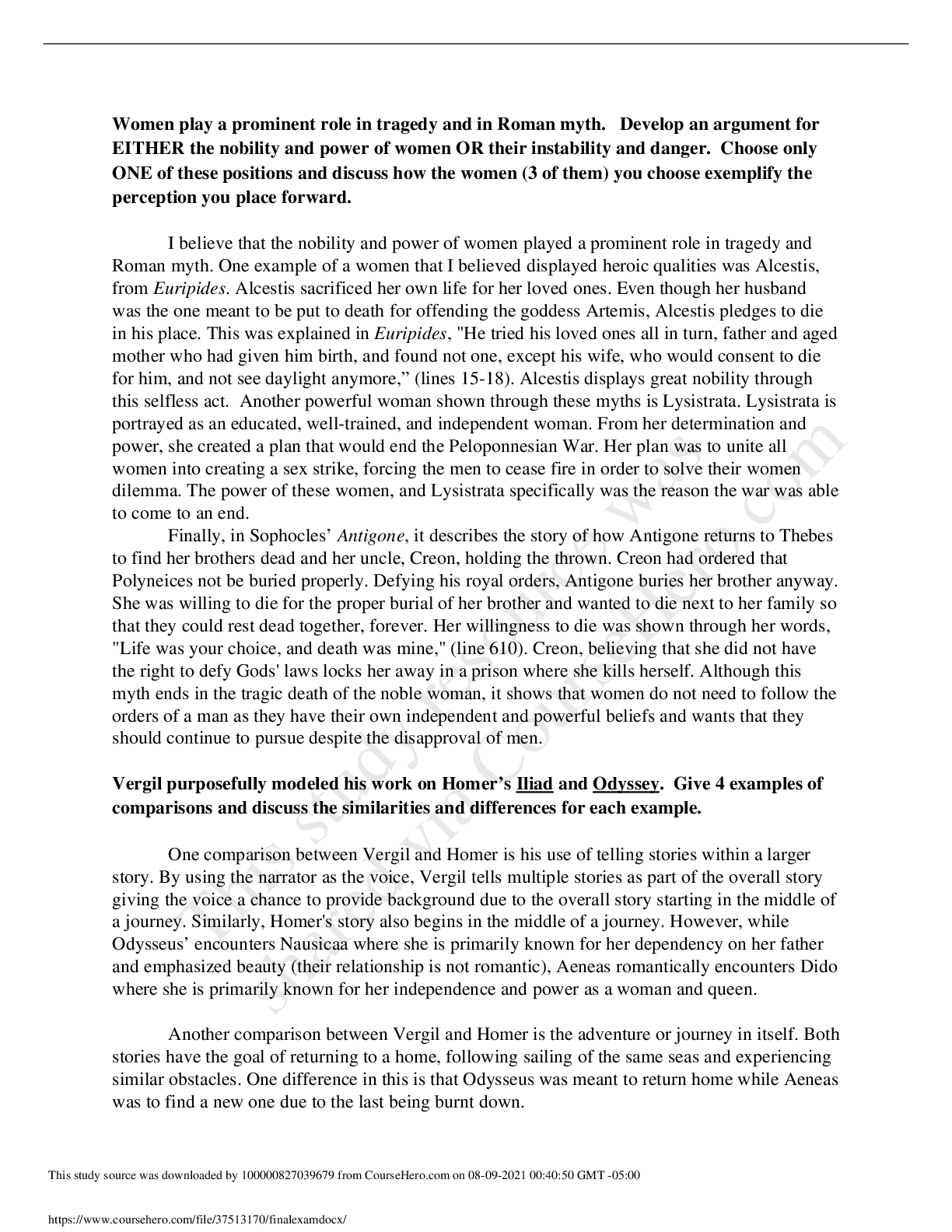
Women play a prominent role in tragedy and in Roman myth. Develop an argument for
EITHER the nobility and power of women OR their instability and danger. Choose only
ONE of these positions and discuss how the women (3 of them) you choose exemplify the
perception you place forward.
I believe that the nobility and power of women played a prominent role in tragedy and
Roman myth. One example of a women that I believed displayed heroic qualities was Alcestis,
from Euripides. Alcestis sacrificed her own life for her loved ones. Even though her husband
was the one meant to be put to death for offending the goddess Artemis, Alcestis pledges to die
in his place. This was explained in Euripides, "He tried his loved ones all in turn, father and aged
mother who had given him birth, and found not one, except his wife, who would consent to die
for him, and not see daylight anymore,” (lines 1518). Alcestis displays great nobility through
this selfless act. Another powerful woman shown through these myths is Lysistrata. Lysistrata is
portrayed as an educated, welltrained, and independent woman. From her determination and
power, she created a plan that would end the Peloponnesian War. Her plan was to unite all
women into creating a sex strike, forcing the men to cease fire in order to solve their women
dilemma. The power of these women, and Lysistrata specifically was the reason the war was able
to come to an end.
Finally, in Sophocles’ Antigone, it describes the story of how Antigone returns to Thebes
to find her brothers dead and her uncle, Creon, holding the thrown. Creon had ordered that
Polyneices not be buried properly. Defying his royal orders, Antigone buries her brother anyway.
She was willing to die for the proper burial of her brother and wanted to die next to her family so
that they could rest dead together, forever. Her willingness to die was shown through her words,
"Life was your choice, and death was mine," (line 610). Creon, believing that she did not have
the right to defy Gods' laws locks her away in a prison where she kills herself. Although this
myth ends in the tragic death of the noble woman, it shows that women do not need to follow the
orders of a man as they have their own independent and powerful beliefs and wants that they
should continue to pursue despite the disapproval of men.
Vergil purposefully modeled his work on Homer’s Iliad and Odyssey. Give 4 examples of
comparisons and discuss the similarities and differences for each example.
One comparison between Vergil and Homer is his use of telling stories within a larger
story. By using the narrator as the voice, Vergil tells multiple stories as part of the overall story
giving the voice a chance to provide background due to the overall story starting in the middle of
a journey. Similarly, Homer's story also begins in the middle of a journey. However, while
Odysseus’ encounters Nausicaa where she is primarily known for her dependency on her father
and emphasized beauty (their relationship is not romantic), Aeneas romantically encounters Dido
where she is primarily known for her independence and power as a woman and queen.
Another comparison between Vergil and Homer is the adventure or journey in itself. Both
stories have the goal of returning to a home, following sailing of the same seas and experiencing
similar obstacles. One difference in this is that Odysseus was meant to return home while Aeneas
was to find a new one due to the last being burnt down
[Show More]