*NURSING  >  NCLEX  >  NURS 618 Saunders Med Surg Immune Revised 2020 (All)

NURS 618 Saunders Med Surg Immune Revised 2020

Document Content and Description Below

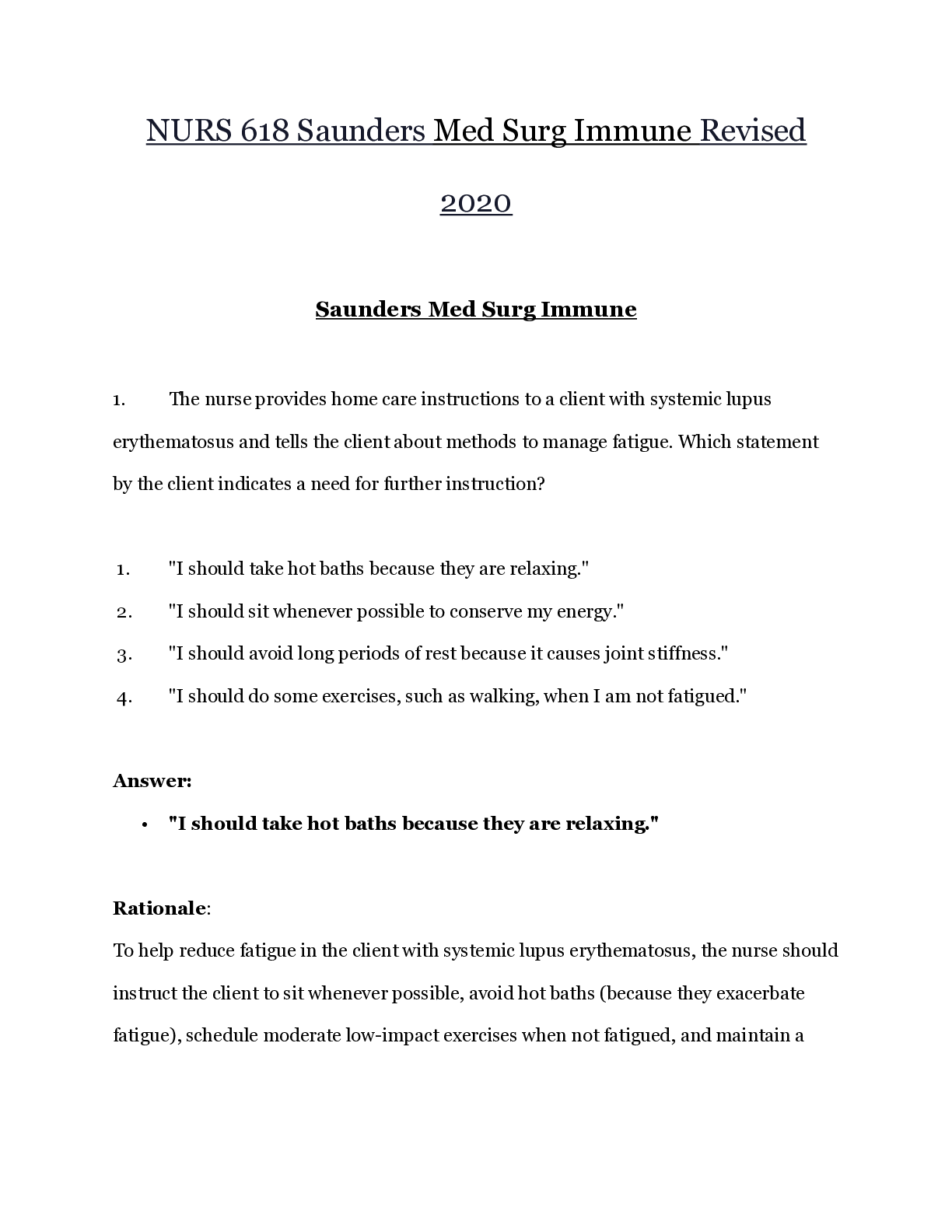
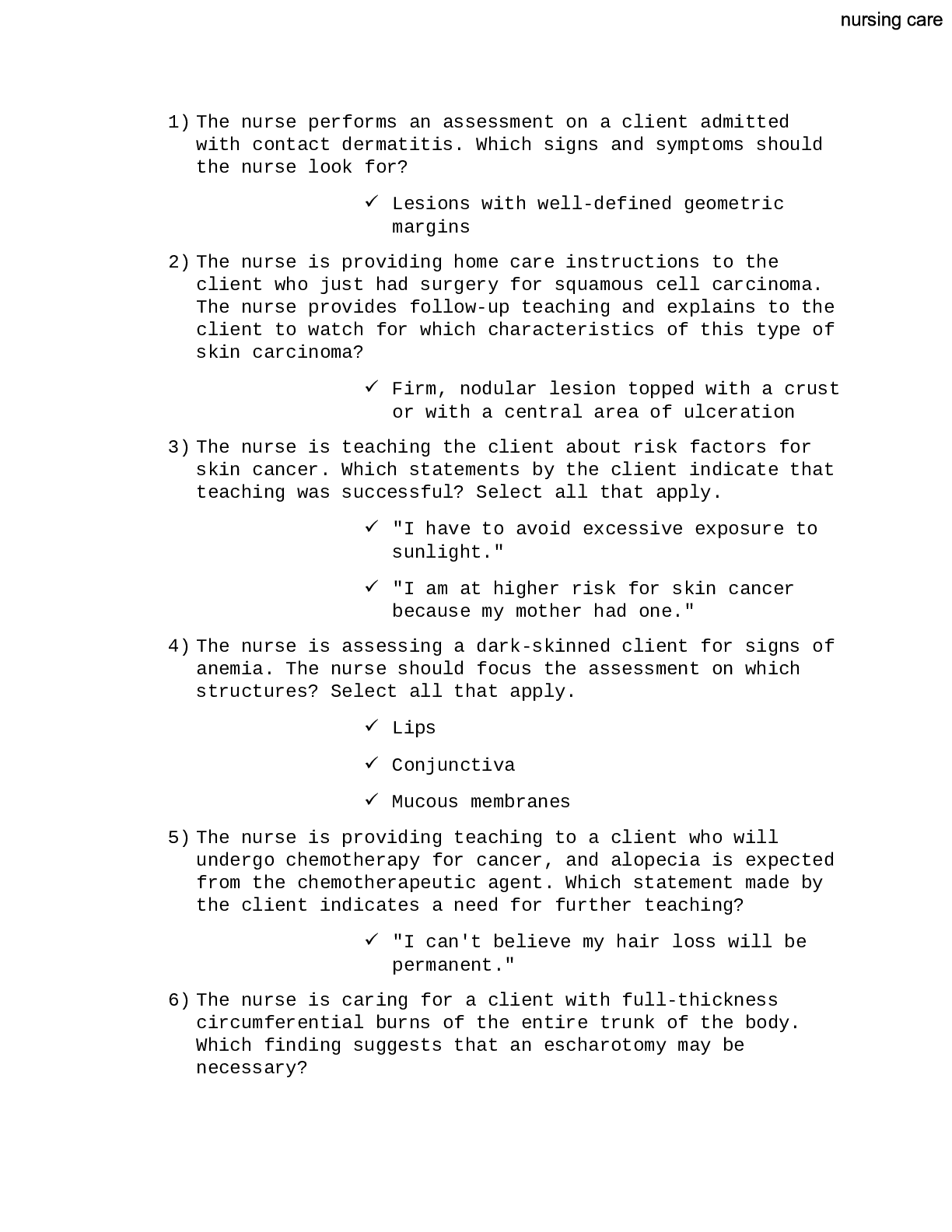
1. The nurse provides home care instructions to a client with systemic lupus erythematosus and tells the client about methods to manage fatigue. Which statement by the client indicates a need for furt ... her instruction? 1. "I should take hot baths because they are relaxing." 2. "I should sit whenever possible to conserve my energy." 3. "I should avoid long periods of rest because it causes joint stiffness." 4. "I should do some exercises, such as walking, when I am not fatigued." Answer: • "I should take hot baths because they are relaxing." Rationale: To help reduce fatigue in the client with systemic lupus erythematosus, the nurse should instruct the client to sit whenever possible, avoid hot baths (because they exacerbate fatigue), schedule moderate low-impact exercises when not fatigued, and maintain a balanced diet. The client is instructed to avoid long periods of rest because it promotes joint stiffness. 3. The nurse is assisting in planning care for a client with a diagnosis of immunodeficiency and should incorporate which action as a priority in the plan? 1. Protecting the client from infection 2. Providing emotional support to decrease fear 3. Encouraging discussion about lifestyle changes 4. Identifying factors that decreased the immune function Answer: • Protecting the client from infection Rationale: The client with immunodeficiency has inadequate or absence of immune bodies and is at risk for infection. The priority nursing intervention would be to protect the client from infection. Options 2, 3, and 4 may be components of care but are not the priority. 4. A client calls the nurse in the emergency department and states that he was just stung by a bumblebee while gardening. The client is afraid of a severe reaction because the client's neighbor experienced such a reaction just 1 week ago. Which action should the nurse take? 1. Advise the client to soak the site in hydrogen peroxide. 2. Ask the client if he ever sustained a bee sting in the past. 3. Tell the client to call an ambulance for transport to the emergency department. 4. Tell the client not to worry about the sting unless difficulty with breathing occurs. Answer: • Ask the client if he ever sustained a bee sting in the past. Rationale: In some types of allergies, a reaction occurs only on second and subsequent contacts with the allergen. The appropriate action, therefore, would be to ask the client if he ever experienced a bee sting in the past. Option 1 is not appropriate advice. Option 3 is unnecessary. The client should not be told "not to worry." 6. Which interventions apply in the care of a client at high risk for an allergic response to a latex allergy? Select all that apply. 1. Use nonlatex gloves. 2. Use medications from glass ampules. 3. Place the client in a private room only. 4. Keep a latex-safe supply cart available in the client's area. 5. Avoid the use of medication vials that have rubber stoppers. 6. Use a blood pressure cuff from an electronic device only to measure the blood pressure. Answers: 1. Use non-latex gloves. 2. Use medications from glass ampules. 4. Keep a latex-safe supply cart available in the client's area. 5. Avoid the use of medication vials that have rubber stoppers. Rationale: If a client is allergic to latex and is at high risk for an allergic response, the nurse would use nonlatex gloves and latex-safe supplies, and would keep a latex-safe supply cart available in the client's area. Any supplies or materials that contain latex would be avoided. These include blood pressure cuffs and medication vials with rubber stoppers that require puncture with a needle. It is not necessary to place the client in a private room. 7.A client presents at the health care provider's office with complaints of a bulls-eye rash on his upper leg. Which question should the nurse ask first? 1. "Do you have any cats in your home?" 2. "Have you been camping in the last month?" 3. "Have you or close contacts had any flu-like symptoms within the last few weeks?" 4. "Have you been in physical contact with anyone who has the same type of rash?" Answer: • "Have you been camping in the last month?" Rationale: The nurse should ask questions to assist in identifying the cause of Lyme disease, which is a multisystem infection that results from a bite by a tick carried by several species of deer. The rash from a tick bite can be a ring-like rash occurring 3 to 4 weeks after a bite and is commonly seen on the groin, buttocks, axillae, trunk, and upper arms or legs. Option 1 is referring to toxoplasmosis, which is caused by the inhalation of cysts from contaminated cat feces. Lyme disease cannot be transmitted from one person to another. [Show More]

Last updated: 3 years ago

Preview 1 out of 61 pages

Buy Now

Instant download

We Accept:

Payment methods accepted on Scholarfriends (We Accept)
Preview image of NURS 618 Saunders Med Surg Immune Revised 2020 document

Buy this document to get the full access instantly

Instant Download Access after purchase

Buy Now

Instant download

We Accept:

Payment methods accepted on Scholarfriends (We Accept)

Reviews( 0 )

$9.50

Buy Now

We Accept:

Payment methods accepted on Scholarfriends (We Accept)

Instant download

Can't find what you want? Try our AI powered Search

144
0

Document information


Connected school, study & course


About the document


Uploaded On

Aug 18, 2021

Number of pages

61

Written in

All

Seller


Profile illustration for Senpai
Senpai

Member since 6 years

12 Documents Sold

Reviews Received
3
0
0
0
0
Additional information

This document has been written for:

Uploaded

Aug 18, 2021

Downloads

 0

Views

 144

Document Keyword Tags

Recommended For You

Get more on NCLEX »

$9.50
What is Scholarfriends

Scholarfriends.com Online Platform by Browsegrades Inc. 651N South Broad St, Middletown DE. United States.

We are here to help

We're available through e-mail, Twitter, Facebook, and live chat.
 FAQ
 Questions? Leave a message!

Follow us on
 Twitter

Copyright © Scholarfriends · High quality services·