1.
Acid-base balance/ventilators
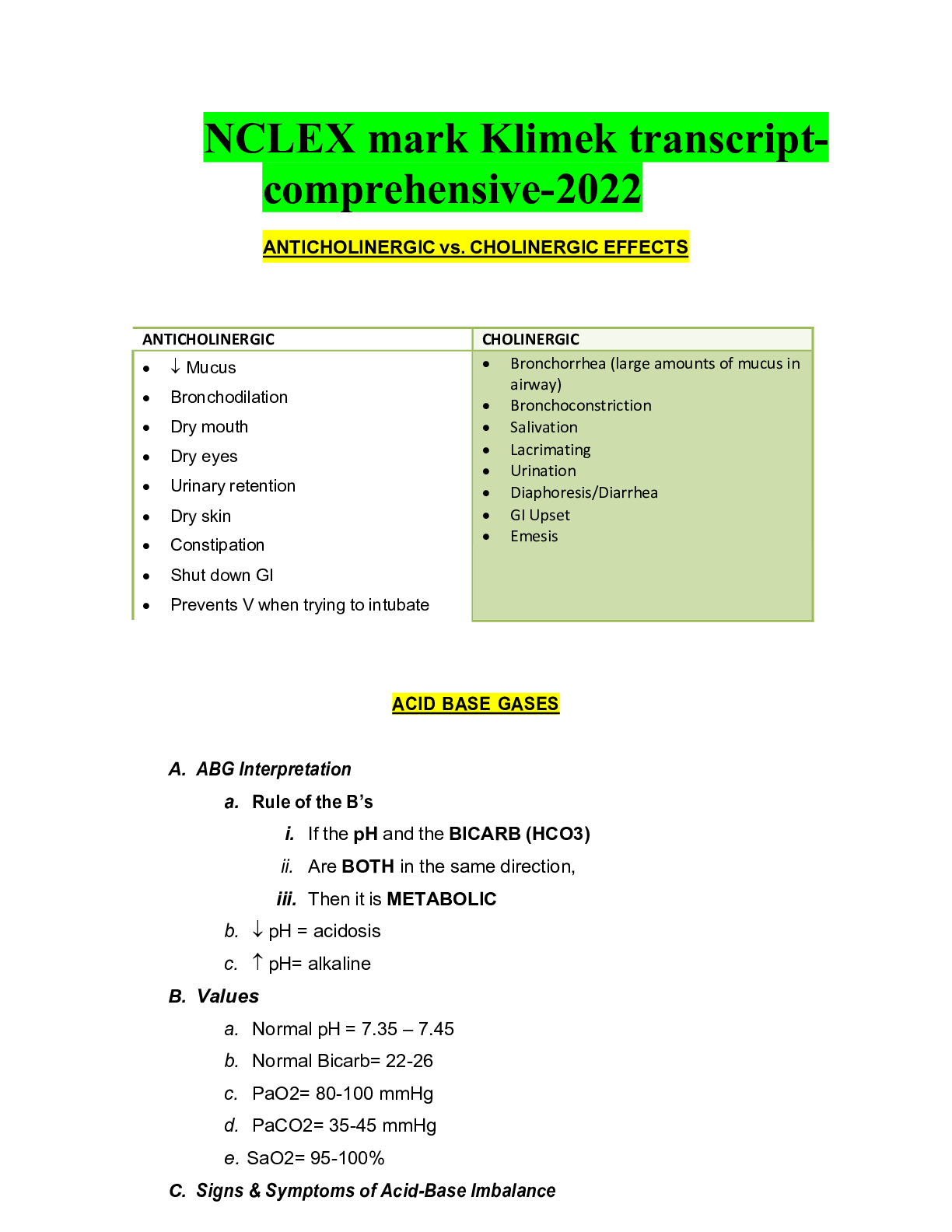
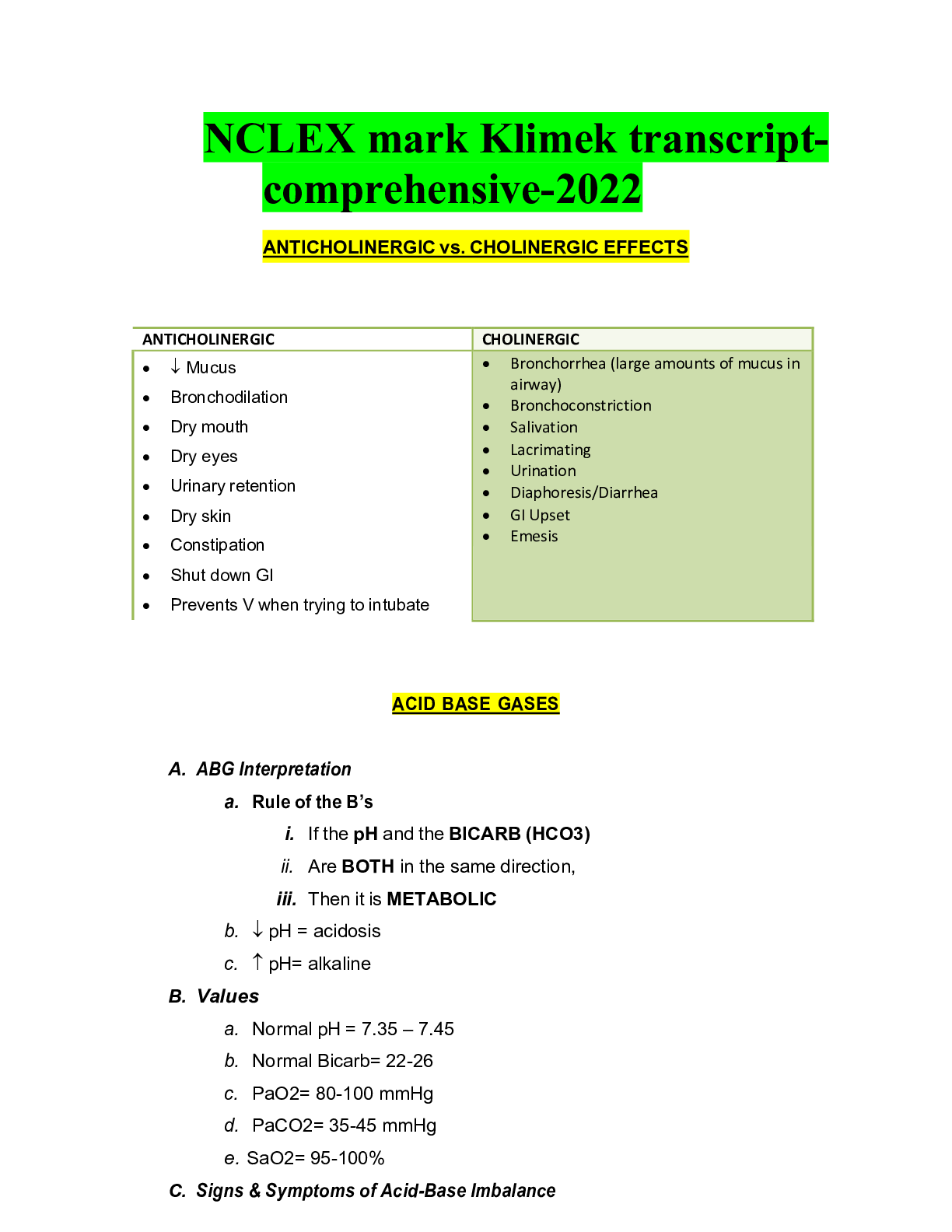
Rule of the B’s.. If the pH & the bicarb are both in the same direction = metabolic
If they are in different directions = respiratory
pH = 7.35-7.45 acidosis/alkalosis
HCO3 (bicarb)
...
1.
Acid-base balance/ventilators
Rule of the B’s.. If the pH & the bicarb are both in the same direction = metabolic
If they are in different directions = respiratory
pH = 7.35-7.45 acidosis/alkalosis
HCO3 (bicarb) = 22-26 (2+2+2 = 6)
CO2 = 45-35
ex:
pH: 7.30 = ↓
bicarb: 20 = ↓ = metabolic acidosis
ex:
pH: 7.58 =↑
bicarb: 32 = ↑ = metabolic alkalosis
ex:
pH: 7.22 =↓
bicarb: 30 =↑ = respiratory acidosis
ex:
You are providing care to a client with the following blood gas results: pH 7.32, CO2 49, HCO3
29, PO2 80 & SaO2 90%. Based on the results, the client is experiencing:
↓ = acidosis, ↑ = respiratory
-opioid: CNS depressant.. know the symptoms (sedation, respiratory depression, etc)..
*principle: acid base signs/symptoms..as the pH goes… so goes my patient!!!
-when pH goes up; patient goes up.. (everything gets irritable!)
-when pH goes down; patient goes down! (systems in your body shut down)
…except with potassium: when pH goes up; potassium goes down… when pH goes down;
potassium goes up!
(up) alkalosis: irritibility, hyper-reflexia (3 & 4), tachypnea, tachycardia, borborygmi
(increased bowel sounds), seizure, aspirate..
(down) acidosis: hypo-reflexia, bradycardia, lethergy (obtunded), paralytic ileus (decreased
bowel sounds), coma, respiratory arrest (ambu-bag!!)
Kussmaul breathing is a deep and labored breathing pattern often associated with severe
metabolic acidosis, particularly diabetic ketoacidosis (DKA) but also kidney failure… MAC
Kussmaul!!
M: metabolic
AC: acidosis
ex:
pT has respiratory acidosis… (select all that apply)..
+1 reflexes
diarhhea
adynamic ileus
spasm
urinary retention
tachycardia
2nd degree mobits type 2 heart block
hypokalemia
SATA questions: *never only 1… never all of them*
diarhhea will cause a metabolic acidosis.. but once you get acidodic, it will shut your bowels
down = paralytic ileus
…with scenarios.. always ask first “is it lung?” = respiratory
…then ask if the pt is over-ventilating or under-ventilating?
over-ventilating = alkalosis
under-ventilating = acidosis
…it’s about the SaO2!!! (pay attention!!)
if it isn’t lung = metabolic..
if pt has prolonged gastric vomiting or suctioning… it’s always metabolic alkalosis…
why? losing acid = becomes basic..
for everything else that is not lung - choose metabolic acidosis..
-if you don’t know the answer… always answer metabolic acidosis..ventilators
alarms.. high pressure alarm… triggered by increasure resistance to air flow.. (machine is
pushing too hard to get air into the lungs).. respiratory alkalosis
3 obstructions: kink in tubing (get kink out), water condensing within the tube (empty
tube), mucus secretions in the airway (turn, cough, deep breathe… then suction).. suction
as needed!! *in that order*…
low pressure alarm.. decreased resistance (too easy for the machine..)
respiratory acidosis
Low pressure alarms are triggered by decreased resistance to airflow & can be
caused by disconnections of the main tubing or oxygen sensor tubing… Tubing
(reconnect it!) - oxygen sensor tube (reconnect it UNLESS tube is on t
the floor - bag them & call Respiratory therapist if this happens)
Respiratory alkalosis = ventilator setting may be too high.
Respiratory acidosis = ventilator setting may be too low.
What does “wean” mean? gradually decrease with the goal of getting off altogether
ex:
Doc says wean off vent in AM… 6am ABG’s show resp. acidosis…
a) follow order
b) call respiratory
c) hold order.. call doc
d) begin to decrease the settings
MASLOW’s Priorities (HIGHest - LOWest)
physiological
safety
comfort
psychological (problems within the person)
social (problems with other people)
spiritual
ex:
Arrange from HIGHest - LOWest…
denial, spiritual distress, pain in elbow, fall risk, pathological family dynamics & electrolyte
imbalance…
= electrolyte imbalance (psyiological), fall risk (safety), pain in elbow (comfort), denial
(psychological), pathological family dynamics (social) & spiritual distress (spiritual)
2.
alcoholism.. (or any abuse)
#1 problem = denial *refusal to accept the reality of a problem*
You treat denial by confronting it…pronouns ~
good: i…
bad: you…
positions ~
good: i’m having a difficult time reading this…
bad: you wrote it wrong..
loss & grief: Denial Anger Bargining Depression Acceptance
don’t confront it; support it..
ex:
You have a pt that just hand a hand amputated & they say, “I can’t wait to get back to playing the
piano”… You say “Oh, how long have you played, etc? - you NEVER say “You can’t because you
only have 1 hand”
abuse = confront
loss = support
#2 problem = dependency *when the abuser get the significant other to do something.. “Call
my boss, i’m sick”* (abuser gets to keep abusing..)
= co-dependency *calls the boss*… (positive self esteem)
How to treat this?!? Set limits and enforce them… Learn to say NO!
manipulation = when the abuser gets the significant other to do things for him or her… the
nature of the act is dangerous or harmful
how is it like dependency? the abuser is getting the other person to do something
no harm = dependent / co-dependent (wife buying alcohol for husband)
dangerous/harmful = manipulated (kid buying alcohol for father)
…depends on legal/illegal………….
Wernicke-Korsakoff Syndrome (WKS) is a neurological disorder. Wernicke's
Encephalopathy and Korsakoff's Psychosis are the acute and chronic phases, respectively,
of the same disease. WKS is caused by a deficiency in the B1 vitamin thiamine. Thiamine (B1)
plays a role in metabolizing glucose to produce energy for the brain.
primary symptom of WKS = amnesia with confabulation (making up stories) *they believe
the lie..*
ex:
You have a pt who believes he is Ronald Regan’s Natioal Security Officer… And they want to go
to a cabinet meeting… :/ WHAT DO YOU DO?!? Redirect!! (“well, why don’t you get a shower
and then we’ll go watch CNN and see what the news is in Washington D.C.”)
WKS is…
-It’s preventable & arrestable (stop it from getting worse) - Take vitamin B1
-Irreversible… *About 70%*Antibuse (disulfiram)
-alcoholism medication *aversion therapy!*
It can treat problem drinking by creating an unpleasant reaction to alcohol. It's used in recovery
programs that include medical supervision and counseling.
How long does it take to get into & out of their system… 2 weeks
Patient teaching - teach how to avoid NAUSEA, VOMITING & DEATH
NO: mouthwash, aftershaves, perfumes/colognes, insect repellants, -elixer (Robitussin),
alcohol-based hand santizers, un-cooked icings (vanilla extract)…
However, they CAN have RED WINE VINAGERETTE!
Overdoses/Withdrawals…
Every abused drug is either an upper or a downer…
*Laxative (not upper or downer) but can be abused by the elderly..
UPPERS: caffiene, cocaine, PCP/LSD, methaphetamines, adderall..
Signs/symptoms: things go up… euphoria, tachycardia, restlessness, irritibility, diarhhea, reflex
3/4, spastic - suction!!!
DOWNERS: heroin, alcohol, marijuana, etc.
Sign/symptoms: things go ↓ ~ lethargic, respiratory depression, bradycardia, reflex 1/2, -
ambubag!!!
2 steps…
Step 1: ask yourself, is it an Upper or Downer
Step 2: ask yourself, is it an Overdose (too much) or Withdrawal (not enough)
If they say: “overdosed on an upper” (too much upper)… pick ↑ things!!
If they say: “downer & intoxication” (too much DOWNER)… pick ↓ things!!
If they say: “withdrawal downer” (don’t have enough downer; too little!)
Too little downer makes everything go up..
Too little upper makes everything go down..
Upper overdose LOOKS LIKE downer withdrawal…
Downer overdose LOOKS LIKE upper withdrawal…
2 situtions (highest priority) =
Respiratory depression/arrest: Downer overdose/upper withdrawal..
Seizure: Upper overdose/downer withdrawal…ex:
Overdose on cocaine: UPPER/OVERDOSE.. (too much UPPER) *aka everything goes ↑*
What would you expect to see? (select all that apply)
-irritability, reflex 3/4, increased temp, borborygmi (increased bowel sounds)
Withdrawing from cocaine.. -Make sure the RR is above 12! Need NARCAN!!!
Drug addiction in the NEWBORN �
Always assume intoxication, not withdrawal at birth
…After 24 hours - it’s in withdrawal..
You are caring for an infant born to a equaline (pain killer) addicted mother… It is 24 hours
after the birth… What do you expect to see.. SELECT ALL THAT APPLY: difficult to console,
low core body temp, exaggerated startle reflex, respiratory depression, seizure risk, shrill
high pitch cry…
alcohol withdrawls = 24 (stable; not life threatening) *AWS*
delirium tremens = 72 hours (unstable; can kill you) *DTS*
AWS: regular diet, semi-private anywhere, up ad lib, no restraints..
DTS: NPO/clear liquid (seizure), private/near nurse’s station, restricted bed rest
(bed pans/urinals), restrained (VEST or 2 point locked leathers *1 arm & opposite
leg*)…
AWS & DTS get a anti-hypertensive (BP pill) - everything is going up - keep everything down…
They both get a tranquilizer, because their up… multivitamin *b1* to prevent WKS.
DRUGS:
aminoglycocides - powerful antibiotics (the BIG GUNS!!!)
think: a mean old mycin = serious, life threatening, resistent, gram negative (TB, etc.)… if it
ends in mycin = mean old mycin
*not mean old mycins: erythromycin, zithromycin, clarithromycin (thro)
if it has thro = throw it off the list…
toxic effects:
mycin = mice (ears)… oto-toxic!! -monitor hearing, tinnitus, vertigo (equalibrium)
human ear shaped like kidney… nephro-toxicity! -monitor creatinine (best indicator for
kidney function)… 8 (fits in a kidney) toxic to cranial #8 and you administer them Q8H… route:
IM or IV.. do not give PO, because they are not absorbed..
ORAL mycins: hepatic coma (liver coma) amonia level gets too high.. pre-op bowel surgery
(to clean the bowel)… #1 action: sterilize the bowel… which?! neomycin and canomycin…
“Who can sterilize my bowel?! NEO KAN!!!” ☺
T: trough: when the drug is at its lowest…
A: adminster
P: peak: when the drug is at its highest…
Why do we do a TAP?! (narrow therapeutic window) what works/what kills…Lasiks: 10-120 (wide)
Dig: 0.125 - 0.25 (narrow) DO a TAP!
IV push..
TROUGH: b4 sub: 30 mins.. b4 iv: 30 mins.. b4 IM: 30 mins… b4 subQ: 30 mins.. b4 PO: 30
mins..
PEAK: after sub: 5-10 mins.. after iv: 15-30 mins.. after IM: 30-60 mins… after subQ: SEE
Diabetes lecture.. after PO: DON’T WORRY ABOUT IT..
3.
Calcium Channel Blockers: are like VALIUM for your ❤!!!
…calms you down.. calms the heart down!
Tachy = yes
shock = no
negative inotropic, negative chronotropic, negative dromotropic = calm/relax… cardiac
depressant
-what do they treat: antihypertensives, anti-angina, anti-atrial-aarrhythmia, SVT (atrial)
Side effects: HA, HTN
Name: ends in -dapine… + Cardizem & Verapimil…
Cardizem (can be continous IV)
-Check BP: Hold CCB if SYSTOLIC is < 100!
Cardiac Arrthymias - knowing how to read EKG strips…
Know these 4 patterns!!
1) normal sinus rhythm
2) v-fib (no pattern)
3) v-tach (there’s a pattern)
4) asystole
normal sinus rhythm
a-fiba flutter
v-fib
v-tach
asystole
QRS de-polarization = ventricular
P wave = atrial
6 rhythms…
-a lack of QRS’s = asystole
-saw tooth = a flutter
-chaotic = atrial fibrilation
-chaotic = ventricular fibrilation
-QRS = ventricular tachycardia (bizzarre)
-periodic bizarre wide QRS = PVC (low priority… can elevate to moderate: if there are more
than 6/min.. or more than 6 PVC’s in a row.. or if the PVC falls on the T wave of the previous
beat) PVC’s never reach HIGH..
LETHAL arrhytmias.. (they will kill you in 8 minutes or less)
-asystole (HIGH) ::::::::::::::::::::::::::::::::::::::::CONTENT CONTINUED IN THE ATTACHMENT:::::::::::::::::::::::::::::::::::::::::::::::::::
[Show More]