Lecture 9 Psych Medications
- All psych medications cause 2 things regardless of classification:
- Lower’s blood pressure
- Weight changes (usually increase weight)
Phenothiazine’s
- Phenothiazine’s are an
...
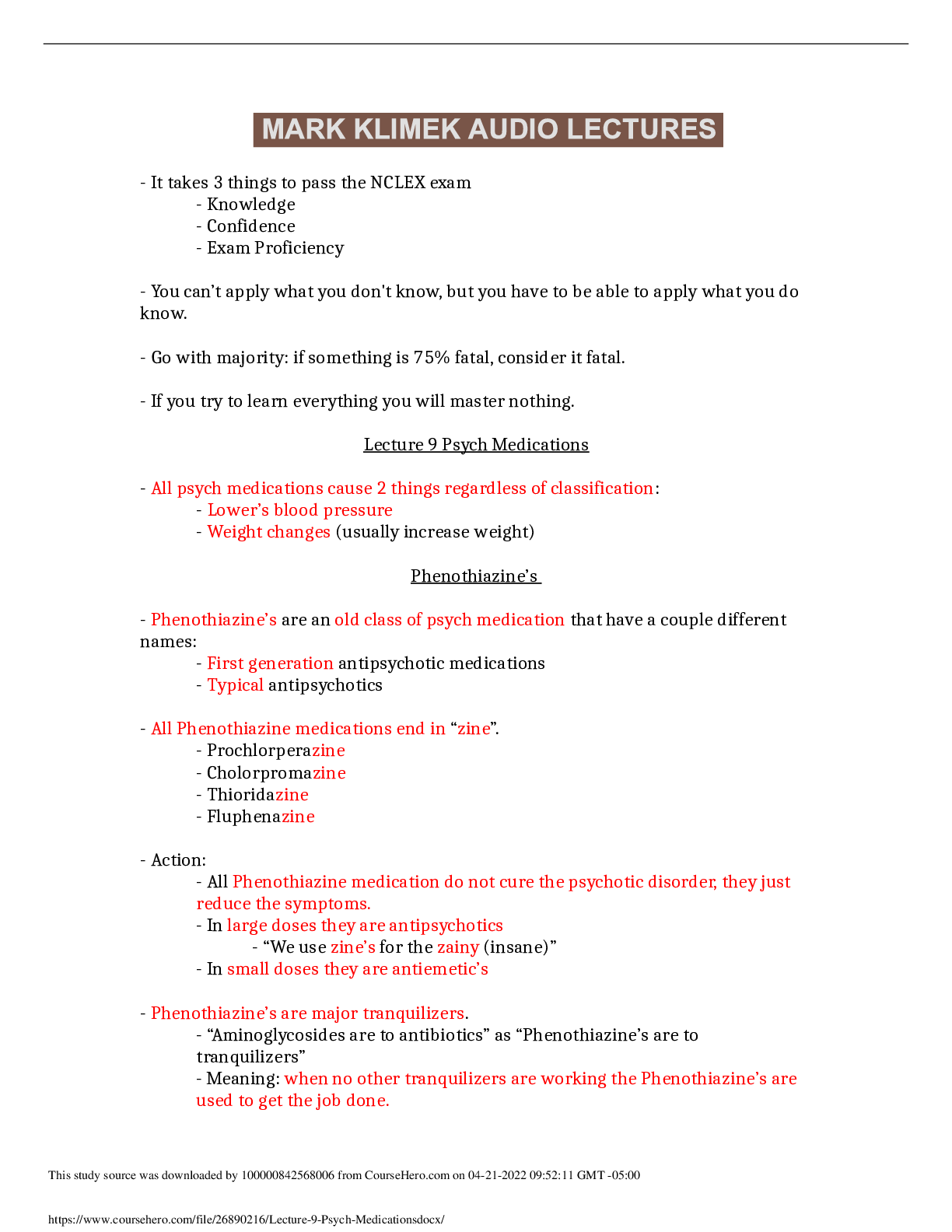
Lecture 9 Psych Medications
- All psych medications cause 2 things regardless of classification:
- Lower’s blood pressure
- Weight changes (usually increase weight)
Phenothiazine’s
- Phenothiazine’s are an old class of psych medication that have a couple different names:
- First generation antipsychotic medications
- Typical antipsychotics
- All Phenothiazine medications end in “zine”.
- Prochlorperazine
- Cholorpromazine
- Thioridazine
- Fluphenazine
- Action:
- All Phenothiazine medication do not cure the psychotic disorder, they just reduce the symptoms.
- In large doses they are antipsychotics
- “We use zine’s for the zainy (insane)”
- In small doses they are antiemetic’s
- Phenothiazine’s are major tranquilizers.
- “Aminoglycosides are to antibiotics” as “Phenothiazine’s are to tranquilizers”
- Meaning: when no other tranquilizers are working the Phenothiazine’s are used to get the job done.
- Side effects of Phenothiazine’s:
- Phenothiazine’s have a long list of major side effects:
- Anticholinergic effects (primarily dry mouth)
- Blurred vision
- Constipation
- Drowsiness
- EPS (Extrapyramidal syndrome): drug induced Parkinson’s
- Photosensitivity
- Agranulocytosis (low WBC count): immunosuppressed
- Nursing Care:
- The nursing care is focused on treating the side effects of Phenothiazine’s
- Since patients on these medications have blurred vision, drowsiness, and EPS, the number one concern is risk for injury.
- Cogentin and Artane are given to reduce EPS effects
- Decanoate:
- Typically abbreviated with the letter “D”
- Thioridazine “D”
- If the “D” comes after the name of the medication it means it is a long-acting medication. Meaning it is given once IM and its actions last for weeks or months at a time.
- This is for noncompliant patients.
Tricyclic Antidepressants NSSRI
- Tricyclic Antidepressants are and old class of antidepressant medications that fall under the category of NSSRI (Non-Selective Serotonin Reuptake Inhibitors) medications.
- These medications are mood elevators that are used to treat depression.
- Elavil (amitriptyline)
- Tofranil (imipramine)
- Avitil
- Deceril
- Side effects of Tricyclic Antidepressants:
- Anticholinergic (primarily dry mouth)
- Blurred vision
- Constipation
- Drowsiness
- Euphoria
- The patient must take these medications for at least 2 - 4 weeks before the effects kick in.
Benzodiazepines
- Benzodiazepines are antianxiety medications
- Benzodiazepines are considered to be minor tranquilizers
- “Zine’s” major tranquilizers
- “Zep’s” minor Tranquilizers
- Benzodiazepines always have “zep” in their names:
- Clonazepam
- Chlordiazepoxide (Librium)
- Diazepam (valium)
- Lorazepam (Ativan)
- These medications are more the just minor tranquilizers:
- Used in pre-op to induce anesthesia
- Used as a muscle relaxant
- Used in alcohol withdrawal to prevent seizures
- Help people when they are fighting the ventilator
- These medications work quickly to produce the desired effect but should not be taken for more than two weeks. They can be taken PRN, but have a risk of addiction.
- For patients that come to the emergency department with anxious-depression they will be given a benzodiazepine and an anti depressant. The benzodiazepine is given for 2 weeks with the antidepressant because it works quickly to reduce symptoms. After 2 weeks the antidepressant effects kick in and there is no longer a need for the benzodiazepine.
- Side effects:
- Anticholinergic (primarily dry mouth)
- Blurred vision
- Constipation
- Drowsiness
- Nursing care:
- Nursing care is focused on treating the side effects.
- Blurred vision, and drowsiness leaves the patient at risk for injury.
Monoamine Oxidase Inhibitors (MAOI)
- MAOI’s are antidepressants.
- Not given as a first line antidepressant, rarely seen.
- These medications are still around (usually in elderly patients with long history of depression) because once you are on an MAOI antidepressant you can’t get off them without having withdrawal.
- MAOI antidepressant’s drugs start with “Mar”, “Nar”, and “Par”.
- Marplan (Isocarboxazid)
- Nardil (Phenelzine)
- Parnate (Tranylcypromine)
- Side effects:
- Anticholinergic (primarily dry mouth)
- Constipation
- Drowsiness
- Patient teaching:
- The patient must avoid all foods containing Tyramine to prevent severe hypertensive crisis.
- Bananas, avocados, and dried fruits
- No organ meats (heart, liver, kidney, tongue, hotdogs)
- No preserved meats (smoked, dried, cured, or pickled)
- No cheeses or yogurt (except for cottage and mozzarella)
- No alcohol
- No chocolate or caffeine
- No over the counter medications.
Lithium
- Lithium is an electrolyte.
- Used for treating mania in bipolar disorder.
::::::::::::::::::::::::::::::::::::::::CONTENT CONTINUED IN THE ATTACHMENT:::::::::::::::::::::::::::::::::::::::::::::::::::
[Show More]