Week 3: Psychiatric Disorders and Screening
NR-601 Primary Care of the Maturing and Aged Family
Susan Brown
January 2020
Screening tools:
Depression: Patient Health Questionnaire-9 (PHQ-9)
A common disorder that a
...
Week 3: Psychiatric Disorders and Screening
NR-601 Primary Care of the Maturing and Aged Family
Susan Brown
January 2020
Screening tools:
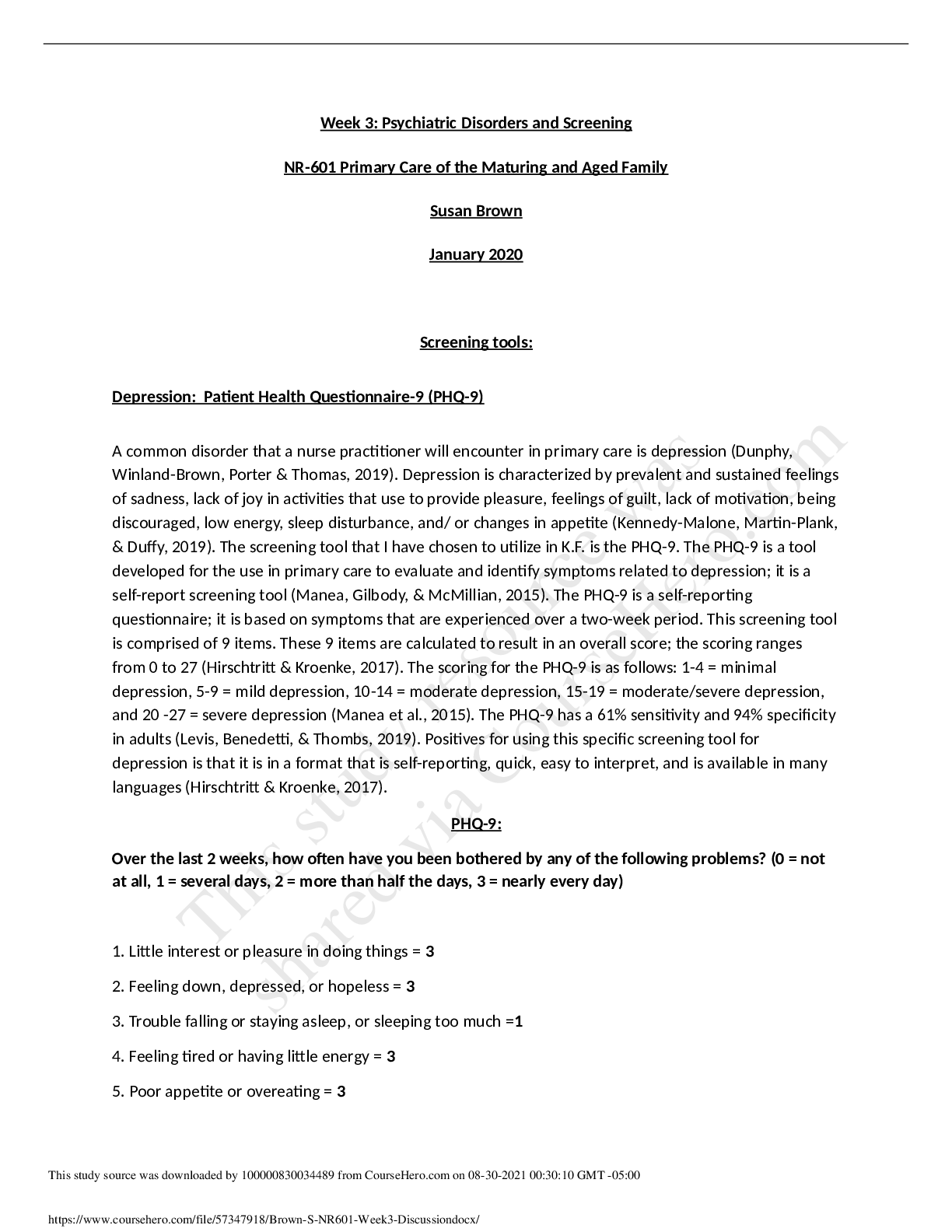
Depression: Patient Health Questionnaire-9 (PHQ-9)
A common disorder that a nurse practitioner will encounter in primary care is depression (Dunphy,
Winland-Brown, Porter & Thomas, 2019). Depression is characterized by prevalent and sustained feelings
of sadness, lack of joy in activities that use to provide pleasure, feelings of guilt, lack of motivation, being
discouraged, low energy, sleep disturbance, and/ or changes in appetite (Kennedy-Malone, Martin-Plank,
& Duffy, 2019). The screening tool that I have chosen to utilize in K.F. is the PHQ-9. The PHQ-9 is a tool
developed for the use in primary care to evaluate and identify symptoms related to depression; it is a
self-report screening tool (Manea, Gilbody, & McMillian, 2015). The PHQ-9 is a self-reporting
questionnaire; it is based on symptoms that are experienced over a two-week period. This screening tool
is comprised of 9 items. These 9 items are calculated to result in an overall score; the scoring ranges
from 0 to 27 (Hirschtritt & Kroenke, 2017). The scoring for the PHQ-9 is as follows: 1-4 = minimal
depression, 5-9 = mild depression, 10-14 = moderate depression, 15-19 = moderate/severe depression,
and 20 -27 = severe depression (Manea et al., 2015). The PHQ-9 has a 61% sensitivity and 94% specificity
in adults (Levis, Benedetti, & Thombs, 2019). Positives for using this specific screening tool for
depression is that it is in a format that is self-reporting, quick, easy to interpret, and is available in many
languages (Hirschtritt & Kroenke, 2017).
PHQ-9:
Over the last 2 weeks, how often have you been bothered by any of the following problems? (0 = not
at all, 1 = several days, 2 = more than half the days, 3 = nearly every day)
1. Little interest or pleasure in doing things = 3
2. Feeling down, depressed, or hopeless = 3
3. Trouble falling or staying asleep, or sleeping too much =1
4. Feeling tired or having little energy = 3
5. Poor appetite or overeating = 3
[Show More]