Chamberlain College of Nursing NR 507 FINAL EXAM STUDY GUIDE021 NR507 PATH FINAL EXAM STUDY GUIDE
REPRODUCTIVE
Endometrial cycle and occurrence of ovulation
Manifestation of female reproductive functioning is menstrua
...
Chamberlain College of Nursing NR 507 FINAL EXAM STUDY GUIDE021 NR507 PATH FINAL EXAM STUDY GUIDE
REPRODUCTIVE
Endometrial cycle and occurrence of ovulation
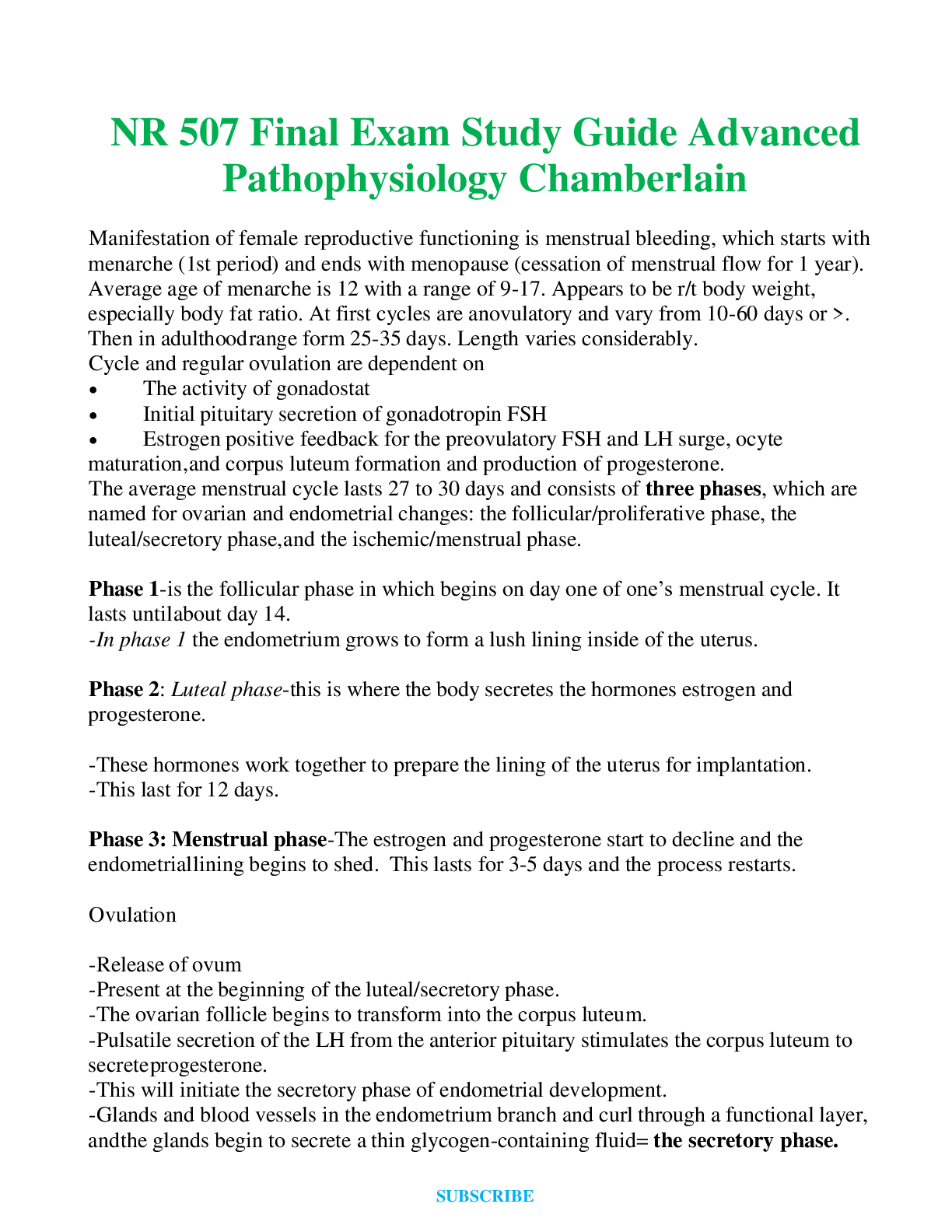
Manifestation of female reproductive functioning is menstrual bleeding, which starts with menarche (1st
period) and ends with menopause (cessation of menstrual flow for 1 year). Average age of menarche is
12 with a range of 9-17. Appears to be r/t body weight, especially body fat ratio. At first cycles are
anovulatory and vary from 10-60 days or >. Then in adulthood range form 25-35 days. Length varies
considerably.
Cycle and regular ovulation are dependent on
• The activity of gonadostat
• Initial pituitary secretion of gonadotropin FSH
• Estrogen positive feedback for the preovulatory FSH and LH surge, oocyte maturation, and
corpus luteum formation and production of progesterone.
The average menstrual cycle lasts 27 to 30 days and consists of three phases, which are named for ovarian and
endometrial changes: the follicular/proliferative phase, the luteal/secretory phase, and the ischemic/menstrual
phase.
Phase 1-is the follicular phase in which begins on day one of one’s menstrual cycle. It lasts until about
day 14.
-In phase 1 the endometrium grows to form a lush lining inside of the uterus.
Phase 2: Luteal phase-this is where the body secretes the hormones estrogen and progesterone.
-These hormones work together to prepare the lining of the uterus for implantation.
-This last for 12 days.
Phase 3: Menstrual phase-The estrogen and progesterone start to decline and the endometrial lining
begins to shed. This lasts for 3-5 days and the process restarts.
Ovulation
-Release of ovum
-Present at the beginning of the luteal/secretory phase.
-The ovarian follicle begins to transform into the corpus luteum.
-Pulsatile secretion of the LH from the anterior pituitary stimulates the corpus luteum to secrete
progesterone.
-This will initiate the secretory phase of endometrial development.-Glands and blood vessels in the endometrium branch and curl through a functional layer, and the glands
begin to secrete a thin glycogen-containing fluid= the secretory phase.
*If conception occurs the nutrient-laden endometrium is ready for implantation.
*The HCG hormone is secreted 3 days after fertilization by blastocytes and maintains the corpus luteum
once implantation occurs at day 6 or 7.
*HCG can be detected in maternal blood or urine about 8-10 days after ovulation.
*Production of estrogen and progesterone continue until placenta can adequately maintain hormonal
production.
*Ovulatory cycles have a length of 24-26.5 days.
*The primary ovarian follicle requires 10-12.5 days to develop.
*The luteal phase appears at 14 days.
Ovarian events of the menstrual cycle are controlled by gonadotropins. High FSH levels stimulate follicle and ovum
maturation (follicular phase), then a surge of LH causes ovulation, which is followed by development of the corpus
luteum (luteal phase).
Ovarian hormones control the uterine (endometrial) events of the menstrual cycle. During the
follicular/proliferative phase of the ovarian cycle, estrogen produced by the follicle causes the endometrium to
proliferate (proliferative phase) and induces the LH surge and progesterone production in the granulosa layer.
During the luteal/secretory phase, estrogen maintains the thickened endometrium, and progesterone
causes it to develop blood vessels and secretory glands (secretory phase). As the corpus luteum degenerates,
production of both hormones drops sharply, and the “starved” endometrium degenerates and sloughs off, causing
menstruation, the ischemic/menstrual phase.
Cyclic changes in hormone levels also cause thinning and thickening of the vaginal epithelium, thinning and
thickening of cervical secretions, and changes in basal body temperature.
Uterine Prolapse
descent of cervix or entire uterus into vaginal canal. In severe cases the uterus falls completely through
the vagina and protrudes from the introitus. Symptoms of other pelvic floor disorders may also be
present. Tx depends on severity of symptoms and physical condition of woman. First line treatment is
often a pessary- removable mechanical device that holds uterus in position. The pelvic fascia may be
strengthened through kegels or by estrogen therapy in menopausal women. Healthy BMI, preventing
constipation, and treating chronic cough may also help. Surgical repair with or without hysterectomy is
the last resort.
Page-771 fig 25.11
-Dropping of the cervix or the entire uterus into the vaginal canal.-In severe cases the uterus completely through the vagina and protrudes from the introitus.
-Symptoms of other pelvic floor disorders may also be present.
Symptoms: urinary-sensation of incomplete emptying of bladder, incontinence,frequency,bladder
splinting to accomplish voiding.
Bowel-constipation or feeling of rectal fullness, difficult defecation, stool or flatus incontinence.
*Pain or bulging includes pelvic pressure, low back pain, and vagina, bladder or rectum bulging.
*Sexual-decreased sensation, lubrication or arousal.
-Dyspareunia
Treatment:
-Depends on age and severity.
-Isometric exercise-strengthen the pubococcygeal muscle. KEGELS*
-Estrogen-to improve tone and vascularity of fascial support POSTMENOPAUSAL*
-Pessary—a removable device to hold pelvic organs in place.
-Weight loss
-Stool softeners to avoid constipation
-tx of lung and cough conditions
PCOS
Polycystic ovary syndrome (PCOS) is a difficult syndrome to diagnose because several factors are
involved. It is a syndrome in which at least two of the following are present: oligo-ovulation or
anovulation, elevated levels of androgens, or clinical signs of hyperandrogenism and polycystic ovaries.
Prolonged anovulation leads to infertility, menstrual bleeding disorders, hirsutism, acne, endometrial
hyperplasia, cardiovascular disease, and diabetes mellitus in women with hyperinsulinemia.
Presenting s/s: obesity, menstrual disturbance, oligomenorrhea, amenorrhea, regular menstruation,
hyperandrogenism, infertility or they could be asymptomatic.
Diagnosis of PCOS is based on evidence of androgen excess, chronic anovulation, and inappropriate gonadotropin secretion.
Tests for impaired glucose tolerance are recommended. As stated, polycystic ovaries do noT have to be present and, conversely,
their presence alone does not establish the diagnosis. Goals of treatment include reversing signs and symptoms of androgen
excess, instituting cyclic menstruation, restoring fertility, and ameliorating any associated metabolic or endocrine, or both,
disturbances.*Most common cause of anovulation and ovulatory dysfunction in women.
*Leading cause of infertility and most common endocrine disturbance.
*Mostly common in younger women
*Usually has two/three of the following: irregular ovulation, elevated levels of androgens (testosterone), and the appearance of
polycystic ovaries on ultrasound.
*Polycystic ovaries do not need to be present to dx POS.
*Thyroid dysfunction, hyperprolactinemia, and congenital adrenal hyperplasia must be ruled out first.
*Associated with metabolic dysfunction, dyslipidemia, insulin resistance, and obesity.
*Strong genetic component and possibly differentially inherited.
*Difficult to diagnose as symptoms may change over time.
*80% of women have one or more of the symptoms with normal ovaries.
*More prominent sx as we age.
*May be associated with Cushing’s syndrome, acromegaly, premature ovarian failure, obesity, congenital adrenal hyperplasia,
thyroid disease and androgen producing adrenal tumors.
Pathophysiology:
*Underlying cause is unknown
*Genetic involvement suggested because of steroid and androgen biosynthesis.
*No single factor accounts for abnormalities of pcos.
***A HYPERANDROGENIC STATE IS A CARDINAL GEATURE IN THE PATHOGENSIS OF PCOS***
-3 X LIKELY TO HAVE INSULIN RESISTENCE.
*Insulin stimulates androgen secretion by the ovarian stroma and reduces the serum sex hormone-binding globulin.
* Free testosterone levels increase
*Excessive androgens affect follicular growth and insulin affects follicular decline by suppressing apoptosisDecreased intraovarian receptors for estrogen receptor -a- or insulin like growth factor 1, increased leptin levels, or direct
infrared redaction select ovarian cells.
*Intrauterine and early child enviroment contribute to childhood development.
*Weight gain aggravates symptoms and women will have an increased leptin level.
*Leptin levels are increased in thin women as well
*Leptin influences the hypothalamic pulsatility of GNRH and interaction with HPO.
*Dysfunction in ovarian follicle development results from inappropriate gondatropin secretes and triggers the beginning of
anovulation.
*FSH is low and LH are high.
*Persistent LH elevation causes an increase in androgens *DHEA (in adrenal glands and testosterone). And Androstenedione and
dhea in the ovary.
*Characterized by excessive levels of androgen and estrogen.
-increased androgen contributes to a premature follicular failure (anovulation).
-Persistent anovulation causes the pearly white smooth capsules (polycystic ovaries).
-Thickening of the tunica, increased cortical stromal thickening, and hyperplasia.
-**Women with PCOS 3 x greater of developing uterine cancer.
Clinical Manifestations:
*Appear within 2 years of puberty.
*May not present until normal menstrual function or pregnancy.
*Obese
*Anovulation, hyperandrogenism, insulin resistance
*infertility, hirsutism, acne, dysfunctional bleeding.
*More likely to experience sleep apnea.
Evaluation and Treatment:*dx is made based on androgen excess, chronic anovulation, and sonographic evidence of polycystic ovaries.
*Must have 2 -3 of these.
*Impaired glucose tolerance test is recommended
*Goals are to suppress androgen, instituting menstruation, restore fertility, and reduce endocrine disturbance.
**FIRST LINE TREATMENT= COMBINED ORAL CONTRACEPTIVES**
-This helps to initiate regular menses.
-Lifestyle modifications= exercise and weight loss.
--Insulin resistance= metformin
-If pregnancy is not desired- progesterone therapy is important to oppose estrogen effects on the endometrium to help monthly
bleeding.
**FOR OBESE WOMEN LIFESTYLE MODIFICATIONS ARE FIRST LINE**
-CLOMIPHENE CITRATE CAN BE USED TO FACILITATE OVULATION*
Testicular cancer & Risk factors
Highly treatable, usually curable cancer most often develops in young and middle aged men. Rare, but
most common form of cancer between young men 15-35. More common on R side than left. Germ cell
tumors arising from male gametes: seminomans and nonseminomas. Seminomas are most common,
least aggressive. Nonseminomas include embryonal carcinomas, teratomas, and choriocarcinomas, most
aggressive but rare. Neoplasm cause is unknown. Genetic predisposition is suggested d/t incidence in
brothers, identical twins and close male relatives.
Risk factors: cryptochordism- neoplasms develop more commonly in contralateral testis. Abnormal
testicular development, HIV and AIDS, Klinefelter syndrome, and hx of testicular cancer.
Symptoms that require evaluation for Breast CancerClinical manifestation Pathophysiology
Chest pain Metastasis to lung
Dilated blood vessels Obstruction of venous return by fast growing
tumor
Dimpling of skin Can occur with invasion of dermal lymphatics
because of retraction of cooper ligament
Edeme of arm Local inflammation of lymphatic obstruction
Hemorrhage Erosion of blood vessels
Local pain Local obstruction by tumor
Nipple/areolar eczema Paget disease
Nipple discharge in a nonlactating woman Spontaneous and intermittent d/c caused by
tumor obstruction
Nipple retraction Shortening of mammary ducts
Pitting of the skin Obstruction of subq lymphatics, resulting in fluid
accumulation
Reddened skin, local tenderness, warmth Inflammation
Skin retraction Involvement of suspensory ligaments
Ulceration Tumor necrosis
Signs of premenstrual dysphoric disorder (PMDD)
• The cyclic recurrence (in the luteal phase of the menstrual cycle) of distressing physical, physical,
psychologic, or behavioral changes that impair interpersonal relationships or interfere with usual
activities.
• Neurotransmitters, GABA, and noradrenaline may have mediating or moderating roles on
symptom manifestation. These neurotransmitters have demonstrated interactions with estrogen
and progesterone and all of these are neuroactive with known mood and behavior effects,
including negative mood, irritability, aggression, and impulse control.
• Symptoms usually appear a week before menstruation and end a few days after your period
starts. When this happens, some women have trouble functioning at home, at work and in
relationships during this time.
• Women show symptoms of irritability, nervousness, anger, insomnia, anxiety, paranoia, trouble
sleeping, N&V, headaches, fainting.
Dysfunctional uterine bleeding
• DUB is heavy or irregular bleeding in the absence of organic disease, such as submucous fibroids,
endometrial polyps, blood dyscrasias, pregnancy, infection, or systemic disease.
• This accounts for 70% of all hysterectomies and almost all endometrial ablation procedures.
• Caused by the lack of ovulation. Normal periods result in the complex interplay of the
hypothalamus, the pituitary, the ovary, and the uterine endometrium. Disruptions in this system
can affect the amount and structure of the uterine endometrium causing it to shed irregularly or
heavily.
• Occurs more in women ages 40-50 because they are at the end of their reproductive years and
are more likely to ovulate irregularly.
• PCOS can lead to irregular heavy uterine bleeding• The formation of the follicle and its rupture release an ovum which is a very important part of
the menstrual cycle. As the follicles forms it produces estrogen. Following ovulations, the remain
portions of the follicle, known as the corpus luteum, releases progesterone. Progesterone acts
on the endometrium to limit growth and causes, which helps limit bleeding during endometrial
shedding.
• If a follicle forms but never releases in the ovum, the follicle may continue to produce estrogen
which causes thickening of the endometrium. This causes the endometrium to be able to shed in
a predictable fashion.
Pathophysiology of prostate cancer
• More than 95% of prostatic neoplasms are adenocarcinomas and most occur in the periphery of the prostate.
Prostatic adenocarcinoma is a heterogenous group of tumors.
• Estrogen receptor -a has shown evidence to participate in the pathogenesis of prostate cancer.
• This ER-a receptor leads to inflammation, proliferation and development of premalignant lesions. ER-B leads to
antiproliferative, anti-inflammatory, and potentially anticarcinogenic effect that tries to balance ER-a and the
androgens involved.
• Increased expression of ER-a has been shown to increase prostate cancer progression, metastasis.
• The prostate glands require male hormones, known as androgens, to work properly. Androgens include testosterone,
which is made in the testes, dehydroepiandrosterone, made in the adrenal glands; and dihydrotestosterone, which is
converted from testosterone within the prostate itself. Androgens are also responsible for secondary sex
characteristics such as facial hair and increased muscle mass. Prostate cancer is classified as an adenocarcinoma, or
glandular cancer, that begins when normal semen- screening prostate gland cells mutate into cancer cells. The region
of prostate gland where the adenocarcinoma is most common is the peripheral zone. Initially, small clumps of cancer
cells remain confined to otherwise normal prostate glands, a condition known as carcinoma in situ or prostate
intraepithelial neoplasia (PIN). Although there is no proof that PIN is a precursor, it is closely associated with cancer.
Overtime, these cancer cells begin to multiply and spread to the surrounding prostate tissue (the stroma) forming a
tumor. Eventually, the tumor may grow large enough to invade nearby organs such as the seminal vesicles, or the
rectum, or the tumor cells may develop the ability to travel in the blood stream and lymphatic system
HPV and development of cervical cancer
• Cervical cancer is almost exclusively caused by cervical human papillomavirus (HPV) infection.
• Infection with “high-risk” (oncogenic) types of HPV (predominately 16 and 18) is necessary
precursor to development of precancerous cell changes, known as dysplasia of the cervix that
leads to invasive cancer.
• With these cell changes, they can be detected noninvasively through examination of the cervical
cells. The cells can be destroyed to prevent cancer development if dysplasia can be detected
early.
• The line where two cell types meet, known as the transformation zone, is very vulnerable to
oncogenic effects of HPV. In girls and young woman, a large portion of the cervix is covered with
columnar epithelium, a condition called squamous metaplasia. As women age the
transformation zone moves as the squamous epithelium covers the surface of the cervix. The
younger the woman is when she contracts HPV, the more sensitive cervical cells are exposed.
• Vaccinating against HPV early before the initiate of sexual activity is important
• Normally, women can clear most HPV infections by the immune system. But some cannot which
contributes to the develop of cervical cancer.
ENDOCRINE
Body’s process for adapting to high hormone levels: Negative-feedback systems are important in maintaining hormone
concentrations within physiologic ranges. The lack of negative-feedback inhibition on hormonal release often results inpathologic conditions. hormonal imbalances and related conditions are caused by excessive hormone production, which is the
result of failure to “turn off” the system.
High concentrations of hormone decrease the number of receptors, called down-regulation. Thus the cell can adjust its
sensitivity to the concentration of the signaling hormone. The receptors on the plasma membrane are continuously synthesized
and degraded, so that changes in receptor concentration may occur within hours. Various physiochemical conditions also can
affect both the receptor number and the affinity of the hormone for its receptor. Some of these physiochemical conditions are
the fluidity and structure of the plasma membrane, pH, temperature, ion concentration, diet, and the presence of other
Cushing’s Syndrome: overproduction of anterior pituitary ACTH by a pituitary adenoma; chronic excess cortisol (at any age)
With ACTH-dependent hypercortisolism, the excess ACTH stimulates excess production of cortisol and there is loss of feedback
control of ACTH secretion. Whatever the cause, two observations consistently apply to individuals with Cushing syndrome: (1)
they do not have diurnal or circadian secretion patterns of ACTH and cortisol, and (2) they do not increase ACTH and cortisol
secretion in response to a stressor.
Exogenous result from administration of glucocorticoids. Endogenous either corticotropin dependent (most common & caused
by ACTH-secreting pituitary tumor) or corticotropin independent (usually caused by an adrenal cortical tumor).
Clinical features: weight gain in trunk, face, and cervical areas. “truncal obesity, moon face, buffalo hump”. Transient weight gain
from sodium and water retention may be present because of the mineralocorticoid effects of cortisol, exhibited when cortisol is
present in high levels. Glucose intolerance occurs because of cortisol-induced insulin resistance and increased gluconeogenesis
and glycogen storage by the liver. Protein wasting is caused by the catabolic effects of cortisol on peripheral tissues. Muscle
wasting leads to muscle weakness and is especially obvious in the muscles of the extremities with thinning of the limbs. In bone,
loss of the protein matrix and increases in bone resorption lead to osteoporosis and can result in pathologic fractures, vertebral
compression fractures, bone and back pain, kyphosis, and reduced height. Hypercalciuria may result in renal stones, which are
experienced by approximately 20% of individuals with this disease. Loss of collagen also leads to thin, weakened integumentary
tissues through which capillaries are more visible; the tissues are easily stretched by adipose deposits
[Show More]