NR 503 Mid-term Study Guide.docx
1. Understand and compare the different measures of morbidity
a. Incidence and prevalence
i. Define
A prevalence rate is the proportion of the population that has a health condition
...
NR 503 Mid-term Study Guide.docx
1. Understand and compare the different measures of morbidity
a. Incidence and prevalence
i. Define
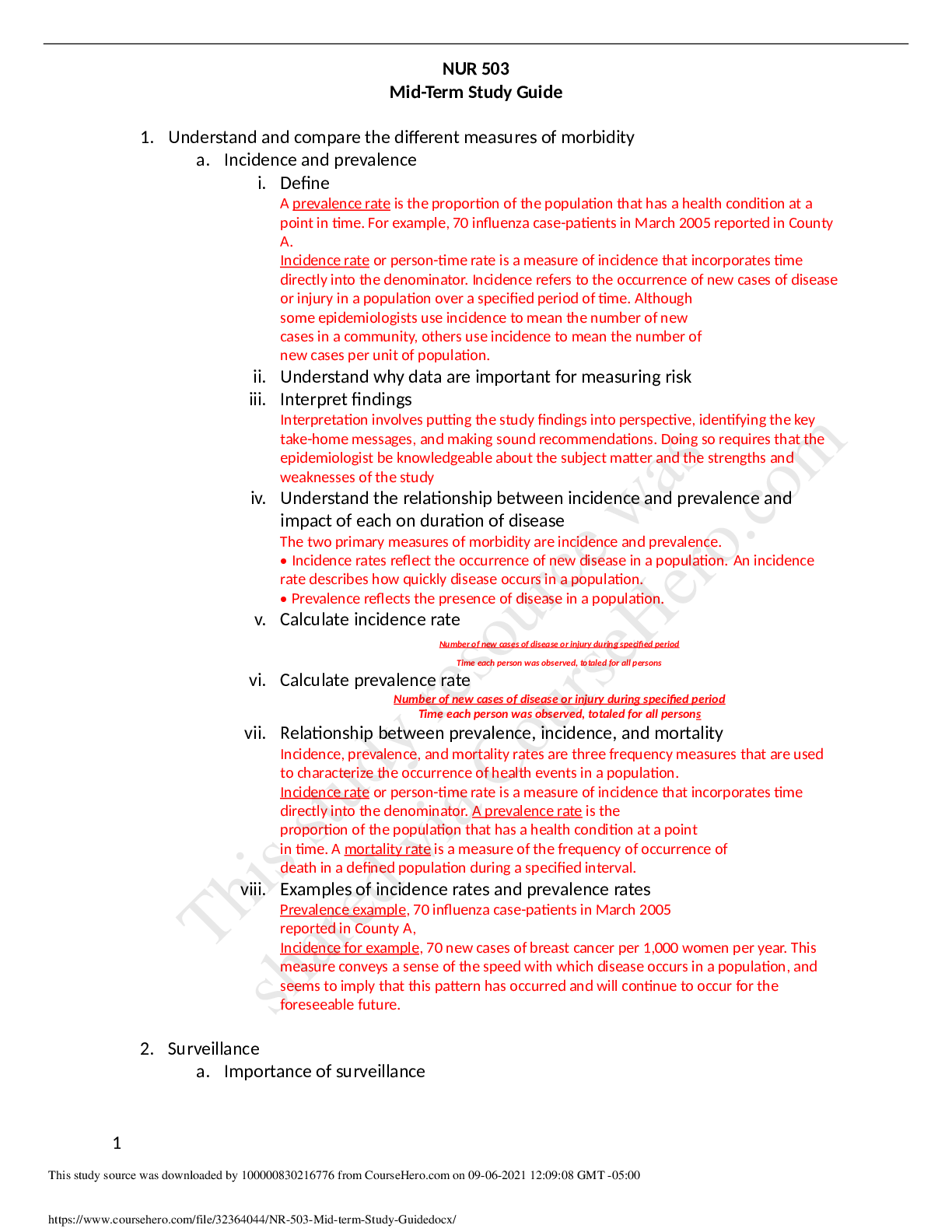
A prevalence rate is the proportion of the population that has a health condition at a
point in time. For example, 70 influenza case-patients in March 2005 reported in County
A.
Incidence rate or person-time rate is a measure of incidence that incorporates time
directly into the denominator. Incidence refers to the occurrence of new cases of disease
or injury in a population over a specified period of time. Although
some epidemiologists use incidence to mean the number of new
cases in a community, others use incidence to mean the number of
new cases per unit of population.
ii. Understand why data are important for measuring risk
iii. Interpret findings
Interpretation involves putting the study findings into perspective, identifying the key
take-home messages, and making sound recommendations. Doing so requires that the
epidemiologist be knowledgeable about the subject matter and the strengths and
weaknesses of the study
iv. Understand the relationship between incidence and prevalence and
impact of each on duration of disease
The two primary measures of morbidity are incidence and prevalence.
• Incidence rates reflect the occurrence of new disease in a population. An incidence
rate describes how quickly disease occurs in a population.
• Prevalence reflects the presence of disease in a population.
v. Calculate incidence rate
Number of new cases of disease or injury during specified period
Time each person was observed, totaled for all persons
vi. Calculate prevalence rate
Number of new cases of disease or injury during specified period
Time each person was observed, totaled for all persons
vii. Relationship between prevalence, incidence, and mortality
Incidence, prevalence, and mortality rates are three frequency measures that are used
to characterize the occurrence of health events in a population.
Incidence rate or person-time rate is a measure of incidence that incorporates time
directly into the denominator. A prevalence rate is the
proportion of the population that has a health condition at a point
in time. A mortality rate is a measure of the frequency of occurrence of
death in a defined population during a specified interval.
viii. Examples of incidence rates and prevalence rates
Prevalence example, 70 influenza case-patients in March 2005
reported in County A,
Incidence for example, 70 new cases of breast cancer per 1,000 women per year. This
measure conveys a sense of the speed with which disease occurs in a population, and
seems to imply that this pattern has occurred and will continue to occur for the
foreseeable future.
2. Surveillance
a. Importance of surveillance
Public health surveillance is the ongoing, systematic collection, analysis,
interpretation, and dissemination of health data to help guide public health
decision making and action. Surveillance is equivalent to monitoring the pulse of
the community. The purpose of public health surveillance, which is sometimes
called “information for action,”18 is to portray the ongoing patterns of disease
occurrence and disease potential so that investigation, control, and prevention
measures can be applied efficiently and effectively
b. Define and discuss passive verses active surveillance, including examples and
advantages and disadvantages of each
surveillance, passive public health surveillance in which data are sent to the health agency
without prompting. form of data collection, in which health-care providers send
reports to a health department on the basis of a known set of rules
and regulations, is called passive surveillance (provider-initiated). Investigators may conduct
what is sometimes called stimulated or enhanced passive surveillance by sending a letter
describing the situation and asking for reports of similar cases
surveillance, active public health surveillance in which the health agency solicits reports. This
active surveillance (health department- initiated) is usually limited to specific diseases over a
limited period of time, such as after a community exposure or during an outbreak. They
may conduct active surveillance by telephoning or visiting the facilities to collect information on
any additional cases.
3. Understand, compare, and interpret the different measures of mortality, including
calculating and interpreting data in tables
a. Importance of having numerator (# of deaths) and denominators (population at
risk) when determining risk
b. Absolute number verses a rate
c. Mortality rates
d. Age adjusted mortality rates
e. Case-fatality rate
f. Proportionate mortality ratio
4. Define, interpret, and compare measures of validit
Validity refers to whether surveillance data are measuring what they are intended to measure. As such,
validity is related to sensitivity and predictive value positive. See page 44 for table 5.10
a. Sensitivity: the ability of a test, case definition, or surveillance system to identify
true cases; the proportion of people with a health condition (or the proportion of
outbreaks) that are identified by a screening test or case definition (or
surveillance system).
b. Specificity: the ability or a test, case definition, or surveillance system to exclude
persons without the health condition of interest; the proportion of persons
without a health condition that are correctly identified as such by a screening
test, case definition, or surveillance system.
c. Characteristics of a good screening test:
5. Understand how realiability can be improved for screening tests
6. Disease transmission and outbreaks
a. Define attack rate: an attack rate is the proportion of the population that develops illness
during an outbreak. For example, 20 of 130 persons developed diarrhea after attending a picnic.
[Show More]