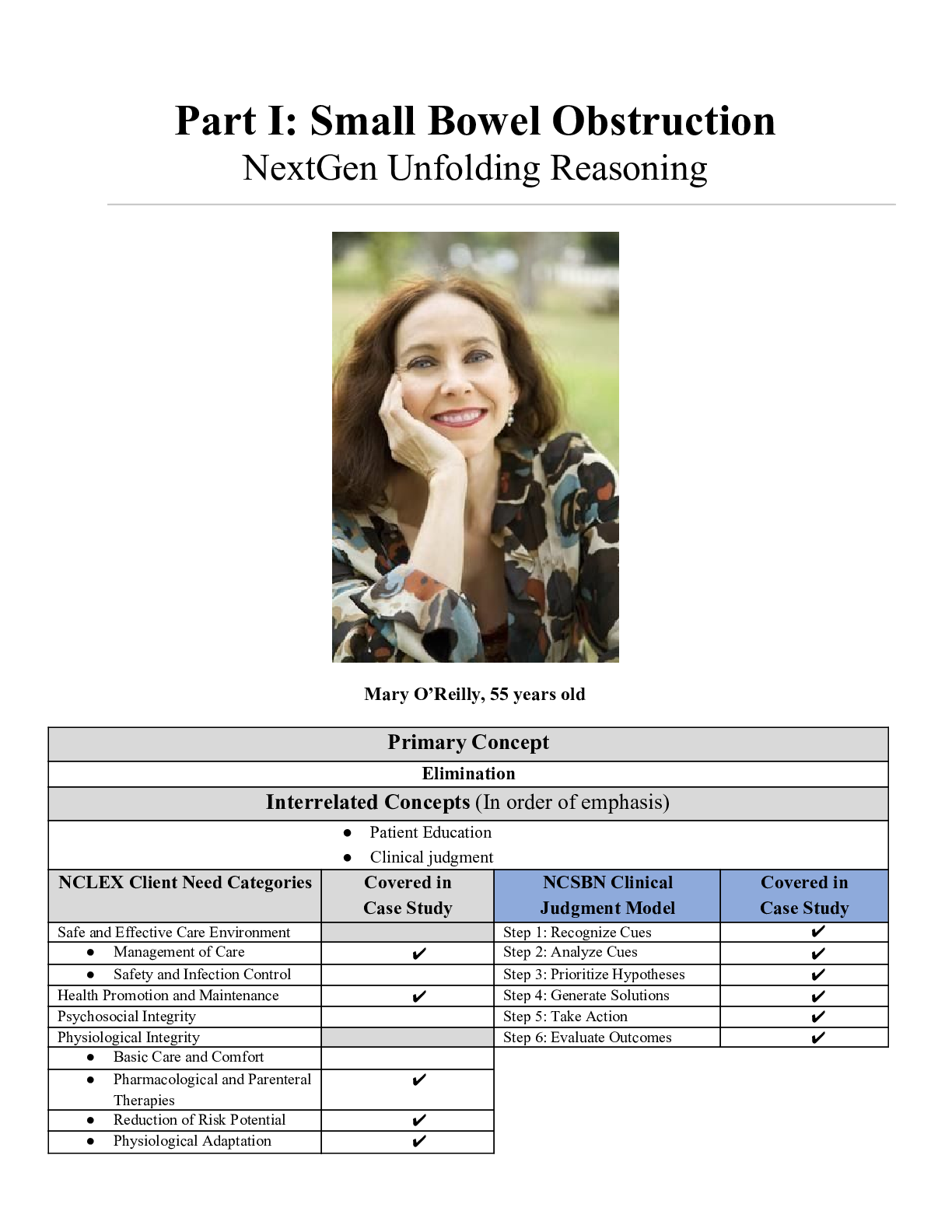
• Clotting
Clinical Judgment
Patient Education
NCLEX Client Need
Categories
Percentage of Items from Each
Category/Subcategory Covered in Case Study
Safe and Effective Care
Environment
✓Management of Care 1
...
• Clotting
Clinical Judgment
Patient Education
NCLEX Client Need
Categories
Percentage of Items from Each
Category/Subcategory Covered in Case Study
Safe and Effective Care
Environment
✓Management of Care 17-23% ✓
✓Safety and Infection
Control 9-15%
Health Promotion and
Maintenance 6-12% ✓
Psychosocial Integrity 6-12% ✓
Physiological Integrity
✓Basic Care and Comfort 6-12% ✓
✓Pharmacological and
Parenteral Therapies 12-18% ✓
✓Reduction of Risk
Potential 9-15% ✓
✓Physiological Adaptation 11-17% ✓
© 2018 Keith Rischer/www.KeithRN.com
UNFOLDING Reasoning
History of Present Problem:
Jim Olson is a 45-year-old male with a history of cirrhosis and ETOH abuse who has
not had any medical care the last ten years. He began vomiting large amounts of
bright red blood when he woke up this morning. He was found on the floor of the
bathroom by Sheila, his girlfriend, when he became lightheaded and fell on the floor
and was too weak to get up. Sheila called 911.
Paramedics report that there was a large dark red/black stool in the toilet. They
were able to get an 18-gauge IV in the right antecubital vein, and Jim received 500
mL of 0.9% NS. His initial BP was 80/40 at the scene, and his most recent BP is
82/44 with a current heart rate of 128, sinus tachycardia.
Personal/Social History:
Jim recently lost his job as a construction laborer and was divorced six months ago.
His ex-wife has full custody of his two children. Jim’s girlfriend states that he has
been more depressed lately and has been drinking more heavily since his divorce.
He takes ibuprofen daily for chronic back pain.
What data from the histories are RELEVANT and must be interpreted
as clinically significant by the nurse?
(Reduction of Risk Potential)
RELEVANT Data from Present
Problem: - -Pmh of cirrhosis and
ETOH abuse
-No medical care in last 10 yrs.
-Vomiting large amounts of bright red
blood, red/black stool
-Lightheaded/ too weak to get up after
falling on floor
Clinical Significance:
ETOH abuse is one of the most common
causes of liver cirrhosis. He has not had
medical care in 10 years, so we do not know
the stage or degree of damage to his liver.
Vomiting bright red blood reflects an upper GI
bleed. He could have developed esophageal
varices, which happens with advancing liver
cirrhosis when normal blood flow to the liver is
blocked by scar tissue. The varices could
-BP: 82/44, HR:128, sinus tachy
have r
[Show More]