History > DISCUSSION POST > Hist 410 - Week 2 Discussion.2021 (All)
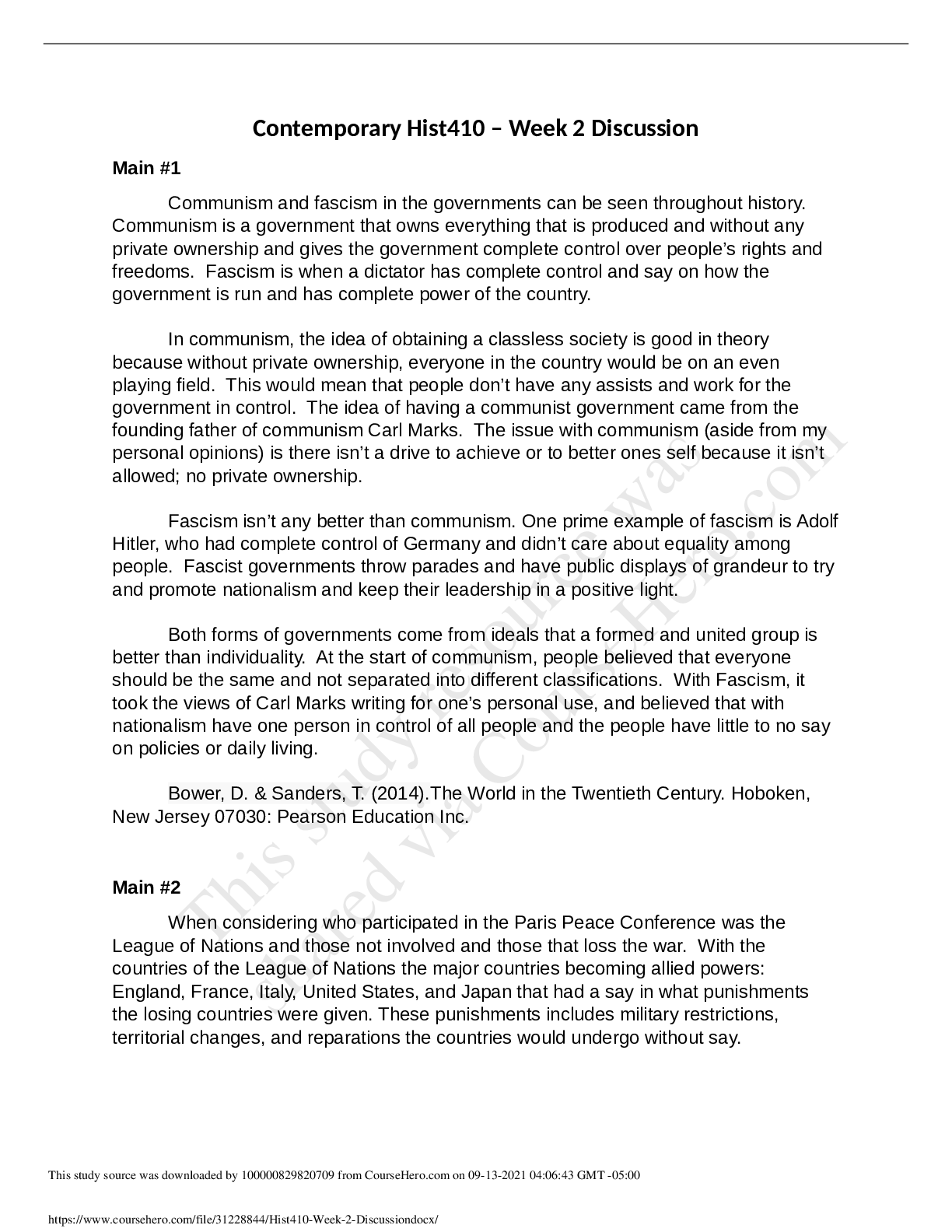
Hist 410 - Week 2 Discussion.2021
Document Content and Description Below
Last updated: 3 years ago
Preview 1 out of 4 pages
Instant download
Buy this Document to get the Full Access Instantly
Provided by Students Who Aced it
We Verify Document Content to Gurantee Accuracy
Reviews( 0 )
Document information
Connected school, study & course
About the document
Uploaded On
Sep 13, 2021
Number of pages
4
Written in
All

Additional information
This document has been written for:
Uploaded
Sep 13, 2021
Downloads
0
Views
160
Topic Tags
Related Subjects & Courses
Explore similar study resources and related concepts.
Recommended For You
Get more on DISCUSSION POST »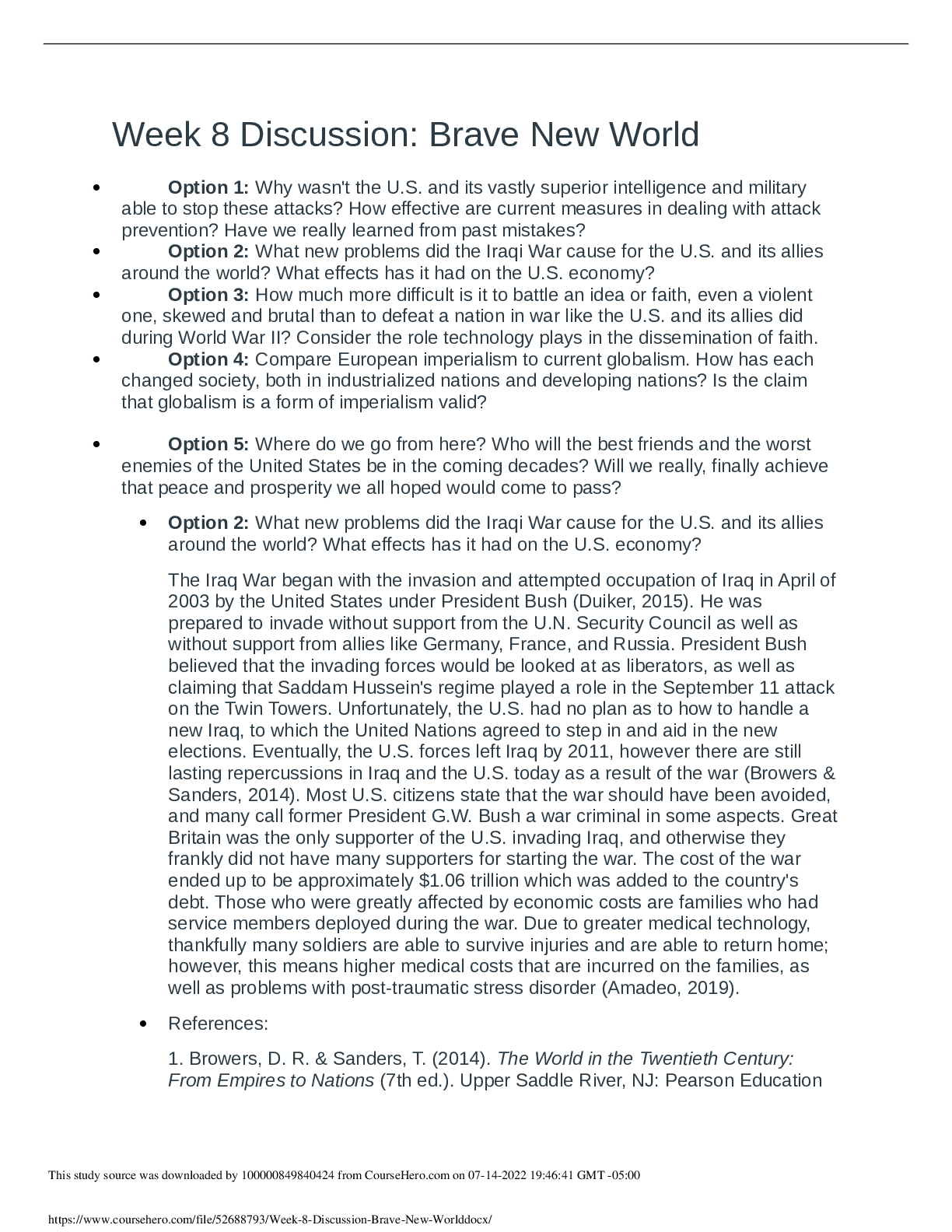
HIST 410N Week 8 Discussion: Brave New World (Option 2: What N...

HIST-410N Week 8 Discussion: Brave New World (Option 1: Why Wa...

HIST 410N Week 7 Discussion: Cold War and Communism (Option 2:...
HIST 410N Week 6 Discussion: Epic Changes in Africa Asia and t...

HIST-410N Week 6 Discussion: Epic Changes in Africa Asia and t...

HIST-410N Week 4 Discussion: World War II (Option 2: Examine t...
[GRADED A) HIST 410N Week 4 Discussion: World War II (Option 1...

HIST 410N Week 2 Discussion: The Rise of Communism and Fascism...

HIST-410N Week 2 Discussion: The Rise of Communism and Fascism...

HIST 410N Week 1 Discussion: The First Total War (Option 2: Se...

HIST-410N Week 1 Discussion: The First Total War (Option 1: Id...

HIST 410N Week 1 Discussion: The First Total War (All Options...
HIST 410N Week 2 Discussion (Responses Included): The Rise of...

HIST410N Week 3 Assignment: Case Study – Mobilizing the Masses...

HIST 410N Week 2 Assignment: Essay – Video Analysis | Video An...
HIST 410N WEEK 8 ASSIGNMENT: final exam discussion Completed f...
.png)
HIST 410N FINAL EXAM 3 – QUESTION AND ANSWERS (Graded A)

HIST 410N Final Exam Version 3 (Questions with Answers) | Scor...
.png)
HIST 410N FINAL EXAM 4– QUESTION AND ANSWERS & EXPLANATIONS (...
![Preview of [solved] NR 228 Discussion post 2021](https://scholarfriends.com/storage/docx.png)