Mental Health Case Study
Case Study, Mohr: CHAPTER 1, Introduction to Psychiatric–Mental Health Nursing
In completing the case study, students will be addressing the following learning objectives:
Explain elements t
...
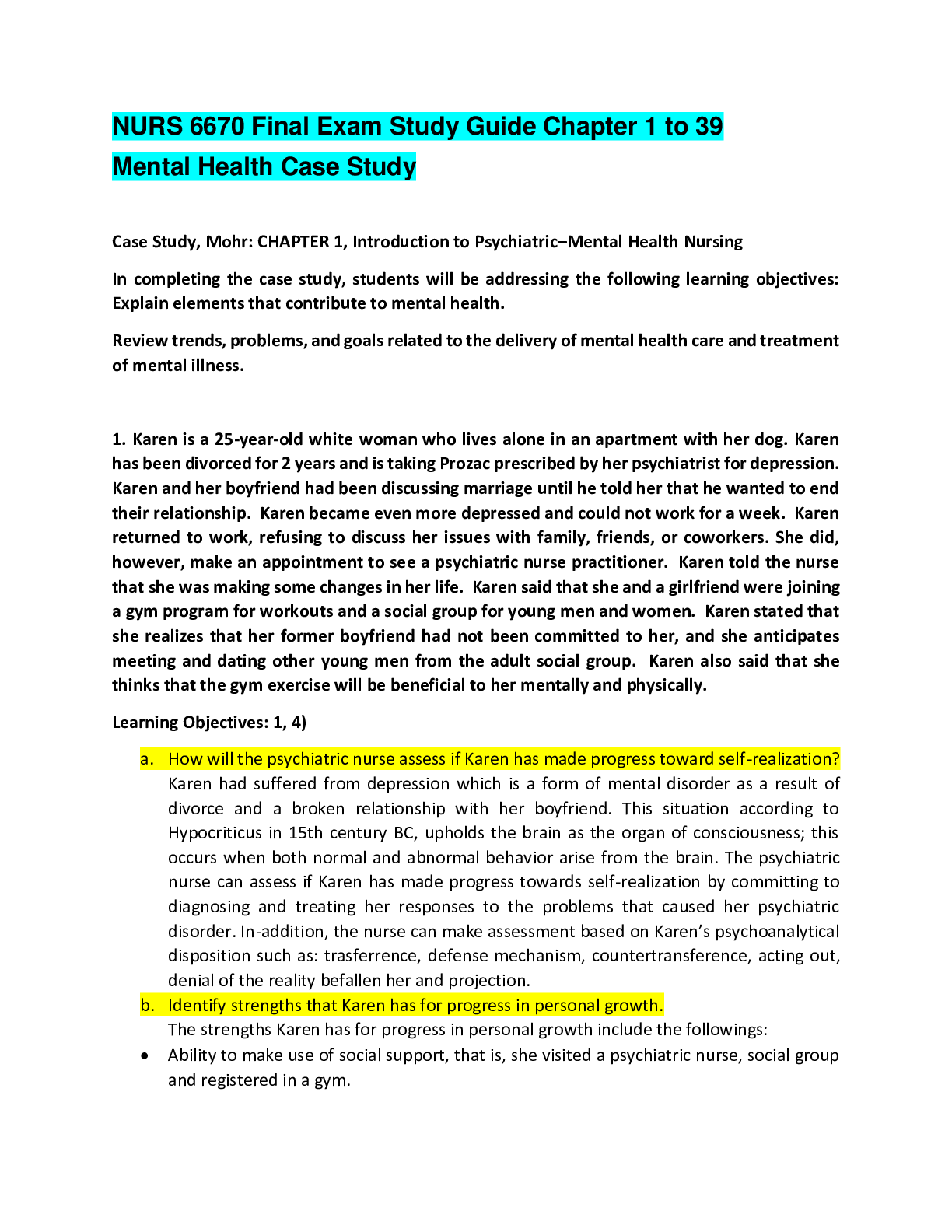
Mental Health Case Study
Case Study, Mohr: CHAPTER 1, Introduction to Psychiatric–Mental Health Nursing
In completing the case study, students will be addressing the following learning objectives:
Explain elements that contribute to mental health.
Review trends, problems, and goals related to the delivery of mental health care and
treatment of mental illness.
1. Karen is a 25-year-old white woman who lives alone in an apartment with her dog. Karen
has been divorced for 2 years and is taking Prozac prescribed by her psychiatrist for
depression. Karen and her boyfriend had been discussing marriage until he told her that he
wanted to end their relationship. Karen became even more depressed and could not work for
a week. Karen returned to work, refusing to discuss her issues with family, friends, or
coworkers. She did, however, make an appointment to see a psychiatric nurse practitioner.
Karen told the nurse that she was making some changes in her life. Karen said that she and a
girlfriend were joining a gym program for workouts and a social group for young men and
women. Karen stated that she realizes that her former boyfriend had not been committed to
her, and she anticipates meeting and dating other young men from the adult social group.
Karen also said that she thinks that the gym exercise will be beneficial to her mentally and
physically.
Learning Objectives: 1, 4)
a. How will the psychiatric nurse assess if Karen has made progress toward self-realization?
Karen had suffered from depression which is a form of mental disorder as a result of
divorce and a broken relationship with her boyfriend. This situation according to
Hypocriticus in 15th century BC, upholds the brain as the organ of consciousness; this
occurs when both normal and abnormal behavior arise from the brain. The psychiatric
nurse can assess if Karen has made progress towards self-realization by committing to
diagnosing and treating her responses to the problems that caused her psychiatric
disorder. In-addition, the nurse can make assessment based on Karen’s psychoanalytical
disposition such as: trasferrence, defense mechanism, countertransference, acting out,
denial of the reality befallen her and projection.
b. Identify strengths that Karen has for progress in personal growth.
The strengths Karen has for progress in personal growth include the followings:
Ability to make use of social support, that is, she visited a psychiatric nurse, social group
and registered in a gym.
She was realistic about her situation, therefore made herself ready to face the reality
before her.
Karen sought immediate medical attention where she was administered with Prozac to
help mitigate her depression state.
Her cognitive behavioral responses showed optimism towards a better life as well as
fighting against her depressed state. Hence, her willingness to date younger men.
c. Karen has been seeking treatment for her depression. Analyze the factors that might
contribute to Karen’s reluctance to discuss her depression with others.
Karen’s reluctance to discuss her depression with others hinges on the fact that her depression
was a kind called social depression. Social depression is a psychological disorder caused by
several factors such as: interpersonal relationship which involves the relationship between a
person and the interactions of emotions of each individual expressed directly and discreetly to
each other. Another is a Common interpersonal relationship, this includes : Family, social
environment (work place), and interaction among age groups and genders. Because Karen had
divorce and broken relationship, she didn’t feel safe in herself discussing her depression with
family and friends but to seek a professional whose job is to attend to her depressed case.
Hence, her neuroticism was calm and strong willed.
Case Study, Mohr: CHAPTER 2, Neuroscience: Biology and Behavior
In completing the case study, students will be addressing the following learning objectives:
Discuss neuroplasticity and how this concept relates to mental health and mental illness.
Briefly explain the importance of interaction between genes and environment, the role of
endophenotypes, and the stress-diathesis model of psychiatric illness.
1. Michael is a 22-year-old college senior whose GPA has declined with this semester’s
grades. Michael plans to apply to medical school and thinks that the lower GPA may
prevent his acceptance to medical school. For the last 2 weeks, Michael has skipped most
classes because he has insomnia and fatigue. Michael is now very depressed and has been
thinking of suicide. He took a loaded gun from his father’s gun cabinet and then wrote a
suicide note to his family. At the last moment, he telephoned 911 and told them of his
suicide plan. The police came, took the gun away, and then took Michael to the city
hospital to be admitted for psychiatric treatment. In the admission interview with the
psychiatric nurse, Michael said that his pastor thought that only weak-willed people
experienced depression and that it was a punishment for personal sins and the sins of one’s
ancestors. Michael told the nurse that he must be weak-willed and will never be able to
accomplish anything. The psychiatric nurse explained that multiple factors are the cause
of depression. The nurse told Michael that one theory holds that an imbalance of
neurotransmitters, or chemical messengers of the brain, occurs in depression.
Neurotransmitters influence the individual’s emotions, thoughts, and subsequent behavior.
Recent research implies that neurobiology, heredity, as well as Psychological and
environmental factors may be involved in the development and progression of depression.
(Learning Objectives: 5, 6)
a. Will Michael think that the psychiatric nurse’s explanation for the cause of depression is
more correct than that of his pastor?
No. It is indeed difficult for Michael to accept the doctor’s opinion since before he fell sick,
he had information from the pastor on depression on which he solely believed and now he is
a living prove.
b. Michael asks the nurse why he has to have psychotherapy. He states that he only needs to
take a couple of pills to get better. How should the nurse respond to Michael’s question
and comment?
The nurse has to explain to Michael why he should consider psychotherapy. Because of
the many misconceptions about psychotherapy, you may be reluctant to try it out. Even if
you know the realities instead of the myths, you may feel nervous about trying it
yourself. Overcoming that nervousness is worth it. That’s because any time your quality
of life isn’t what you want it to be, psychotherapy can help. Taking only pills will not
help but increase the effects because most of these medication have side effects which
would have been avoided by psychotherapy.
c. Develop an assessment question for each of the following possible causes of Michael’s
development of depression: Genetic, Environment and Stress.
From the Geriatric Depression Scale: “Do you prefer to stay at home rather than going out and
doing new things?” This question asks for a yes or no answer and recognizes that isolation and
withdrawal are common signs of depression — especially in the elderly.
From the MADRS: “How is your sleep?” Answers include: Sleeping as usual, slight difficulty,
sleep reduced by at least two hours, or getting less than three hours of sleep at night. Greater
sleep disturbance signals a greater risk for depression.
From the Beck Depression Inventory: “How is your energy?” Declines in energy level are a
common sign of depression — the more significant your lack of energy, the higher your
depression risk rating. Possible answers to this question include: As much energy as ever, less
energy than before, not enough to do much, or not enough to do anything
Case Study, Mohr
CHAPTER 3, Conceptual Frameworks and Theories:
In completing the case study, students will be addressing the following learning objective:
Give examples of behavioral and cognitive-behavioral interventions.
The student nurse has been assigned a 37-year-old woman admitted to the psychiatric
hospital with an anxiety disorder. This morning, the student notices that the client has a
tense facial expression and is walking constantly around the group room. The student
walked over to the client and used reflective communication by stating, “I see that you have
a tense expression and are walking around almost all of the time. Is there something that
we could discuss?” The client replied that she has talked on the telephone to her mother
who was keeping her children while she was in the hospital. The client said that her mother
had told her that she was not a good mother, and then said, “I guess I am a bad mother, but
I could never measure up to my mother’s expectations.” The student has learned that
negative self-talk can greatly aggravate anxiety and lead to depression. The student
decided to use a behavioral intervention with the client and asked the client who is a good
artist and why the client liked the artist’s works. The student and the client then made a list
of activities that the client liked. The student taught the client to engage in one of these
activities when an unpleasant experience evoked negative thoughts. The following day, the
student decided that the client needed some cognitive restructuring for her relationship
with her mother. The student taught the client that during discussions with her mother,
feelings of incompetence might be experienced when the mother made negative comments.
The client was instructed that if her mother made negative comments about parenting, she
was to immediately tell her mother that she was a good parent to her children and
terminate the conversation at the first opportunity.
(Learning Objective: 3)
a. Will the client be able to learn cognitive restructuring in her relationship with her
mother?
Yes, she will learn because by keeping positive thought, her cognitive restructure will
develop to the positive. Based on the above facts and behavioral intervention made
between client and the student nurse it is possible to established a good and collaborative
relationship with her mother. Besides, client can also be able to gain of cognition to
maintain a fruitful relationship with her mother.
Anxiety is a normal reaction to certain situations. A small level of anxiety is normal, but
severe anxiety can be a serious problem. Academic anxiety can become more detrimental
over time than community based anxiety. Much evidence supports the notion that social
anxiety causes impairment in many domains of life, such as romantic relationships,
friendships, work, and physical health.
b. How will engaging in activities help the client with her anxiety?
Based on the everyday behavior of client the patient nurse decided a plan that how to
solve this problem. Then the student nurse asks client what happened? From this nurse
learn that some phone call received from home relative to negative thought. The student
has learned that negative self-talk can greatly aggravate anxiety and lead to depression.
That is why nurse decided some plan and asked to each client who are great artist their
favorite items or activities. Then, according to that nurse can able to engage the client
into her favorite hobbies, when an unpleasant experience evoked negative thoughts. The
next day, the student decided that the client has been gaining some cognitive restructuring
for her relationship with her mother.
Finally, the student nurse had advice to the client that in future when her mother made
some negative thought or narration regarding parenting she should immediately and
confidently tell her mother that she was a good parent to her children and closed this
[Show More]
.png)