Anatomy Review
• Four chambers separated by valves, whose main purpose is to prevent
backflow of blood
Atria right and left
Ventricles right and left
• Four valves in heart
2 atrioventricular (AV) valves – allow bl
...
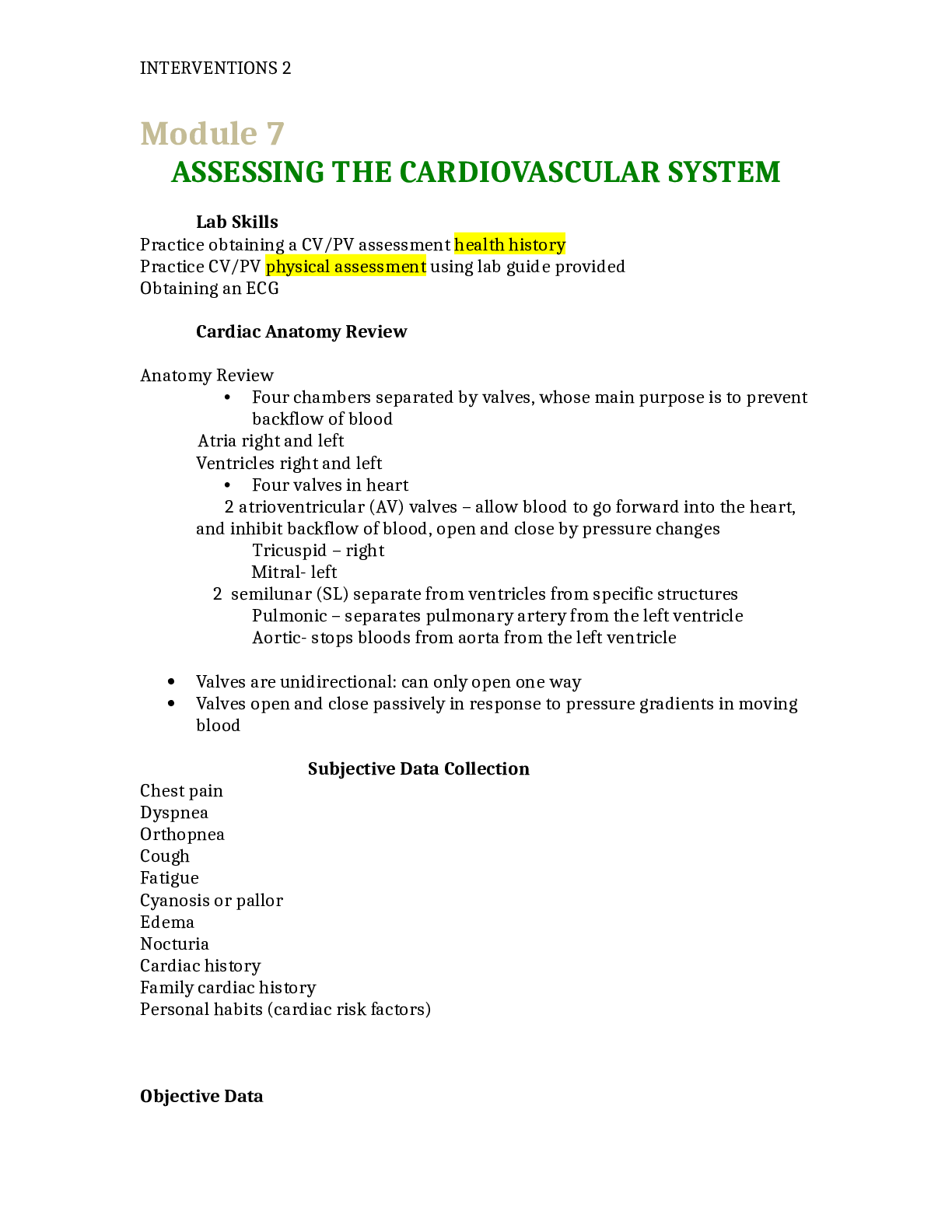
Anatomy Review
• Four chambers separated by valves, whose main purpose is to prevent
backflow of blood
Atria right and left
Ventricles right and left
• Four valves in heart
2 atrioventricular (AV) valves – allow blood to go forward into the heart,
and inhibit backflow of blood, open and close by pressure changes
Tricuspid – right
Mitral- left
2 semilunar (SL) separate from ventricles from specific structures
Pulmonic – separates pulmonary artery from the left ventricle
Aortic- stops bloods from aorta from the left ventricle
Valves are unidirectional: can only open one way
Valves open and close passively in response to pressure gradients in moving
blood
Subjective Data Collection
Chest pain
Dyspnea
Orthopnea
Cough
Fatigue
Cyanosis or pallor
Edema
Nocturia
Cardiac history
Family cardiac history
Personal habits (cardiac risk factors)
Objective DataINTERVENTIONS 2
Objective Data Collection: Inspection
Eyes
• Xanthelasma
• Corneal arcus – yellowish/grey ring surrounding the iris associated
with hyperlipidemia
Neck vessels
Neck vessels
-Carotid artery
-Jugular veins
• Internal
• External
Palpation
Note strength
Compare palpation of carotid and auscultation of apical pulse
Position the patient supine with the head of the table slightly elevated
Using the palm of the hand palpate for pulsations going from apex to
LSB to base.
Palpate for apical pulse noting
o location by ICS and distance from the midsternal line
o size of pulsation
o Quality of the apical pulse
Auscultation
Auscultate carotids with the bell listening for a bruit (blowing swishing
sounds, blood flow turbulence)
Ask the patient to stop breathing momentarily.
Listen for a blowing or rushing sound--a bruit. Do not be
confused by heart sounds or murmurs transmitted from the
chest.
Palpate carotid arteries
Note strength
Compare palpation of carotid and auscultation of apical pulse
When auscultating the carotid pulses, what is a normal finding?
1. A soft blowing sound
2. A loud grunting noise
3. A beat simultaneous with the heart rate
4. No sound
[Show More]








.png)
.png)