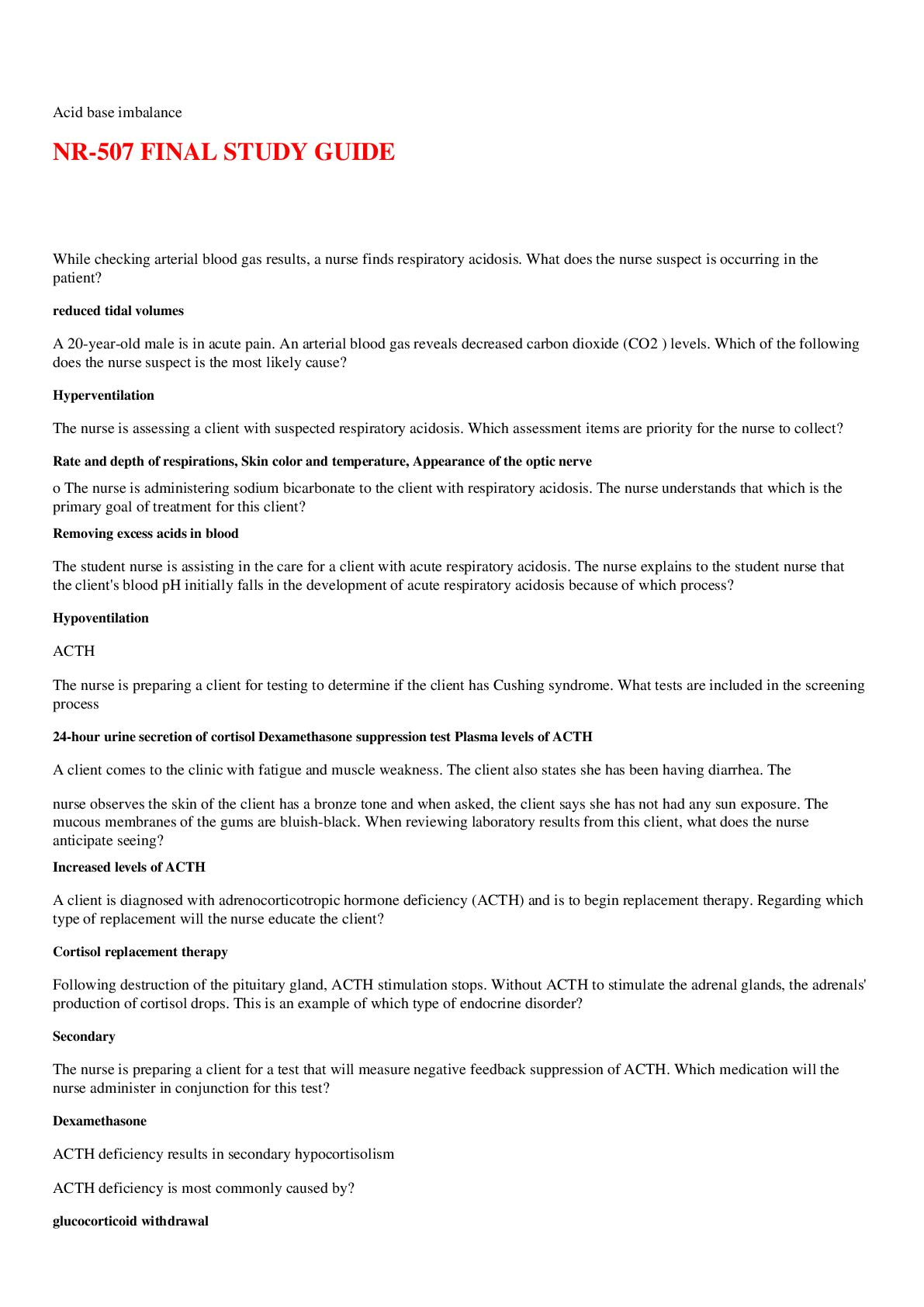
ACOG guidelines regarding well women exams- age specific screening, laboratory tests, evaluation and counseling
and immunizations
Ages 13-18:
Ages 19-39:
Ages 40-65:
Ages 65 and older:
What is the ASCCP recommended
...
ACOG guidelines regarding well women exams- age specific screening, laboratory tests, evaluation and counseling
and immunizations
Ages 13-18:
Ages 19-39:
Ages 40-65:
Ages 65 and older:
What is the ASCCP recommended management for an ASCUS (atypical squamous cells of undetermined
significance) pap result with a positive high-risk HPV 16 cotest in a 26-year-old woman without a history of
abnormal pap smears?
Colposcopy
A well-woman visit for an adolescent should include which of the following?
A general health history focusing on reproductive and sexual health concerns (menses, gynecologic,
and pregnancy related) and psychosocial (family related, peer related, emotional, and physical as well
as related to abuse, drug use, and alcohol use) concerns
Physical exam, screening tests, and immunizations as indicated by the health history and gynecologic
considerations for an external-only inspection of the genitalia
ACOG Pap smear guidelines- starts at age 21 and is done every three years. Age 30 and older doe a pap and HPV
every five years if co test is done, if just pap then do every 3 years. Can stop at age 65 if a negative history for 1o
years or if the patient has had a hysterectomy with no history of cervical cancer.
A Bethesda system Pap smear report that reads LSIL is most consistent with which classification?
CIN 1
A single Pap smear reading of ASCUS in a patient negative for HPV infection should have what as follow-up?
Routine screening
A female patient is 35 years old. She has never had an abnormal PAP smear and has had regular screening since age
18. If she has a normal PAP smear with HPV testing today, when should she have the next cervical cancer
screening?
5 years
A young sexually active client at the family planning clinic is advised to have a Papanicolaou (Pap) smear. She has
never had a Pap smear before. What should the nurse include in the explanation of this procedure?
The Pap smear can detect cancer of the cervix
Lab results on your 26-year-old patient show a negative Pap smear with a positive human papillomavirus (HPV)
screen. Which procedure will be required next?
Repeat Pap and HPV screen
Which of the following is not part of the criteria for an older woman to cease having any future Pap tests performed?
Over 55 years of age
Amenorrhea (Primary and Secondary)
Primary and Secondary Amenorrhea
Primary amenorrhea: No menarche by the age of 15 years (with or without development of secondary
sexual characteristics). Half of cases are caused by chromosomal disorders (50%) such as Turner syndrome.
Puberty is delayed if there is no breast development by age 13 years, absence of pubic
hair at age 14 years, and no menarche by age 15 years.
Secondary amenorrhea: No menses for three cycles, or 6 months if previously had menses. Most common
cause is ).
Secondary Amenorrhea Associated With Exercise and Underweight
Excessive exercise and/or sports participation have a higher incidence of amenorrhea (and infertility) due to
relative caloric deficiency
"Female athlete triad"; anorexia nervosa/restrictive eating, amenorrhea, and osteoporosis
Labs
Pregnancy test (serum human chorionic gonadotropin [hCG])
Serum prolactin level (rule out prolactinoma-induced amenorrhea)
Serum TSH; also follicle-stimulating hormone (FSH) and luteinizing hormone (LH; rule out
premature ovarian failure)
If amenorrhea for more th
[Show More]





![Preview of WEEK **5 [Chamberlain university]NR 602 IHUMAN Case Week #5 Deborah Arnaudin 54 Year Old](https://browseimages.nyc3.digitaloceanspaces.com/paper-images/2026/03/31/zbQKePwt2026-03-31-11-4669cc328fcad96.png)








.png)
 (1).png)