SOPHIA PATHWAYS
Approaches to Studying Religions
Unit 2 Milestone
You passed this Milestone
19 questions were answered correctly.
6 questions were answered incorrectly.
1
Which of the following is an example of a
...
SOPHIA PATHWAYS
Approaches to Studying Religions
Unit 2 Milestone
You passed this Milestone
19 questions were answered correctly.
6 questions were answered incorrectly.
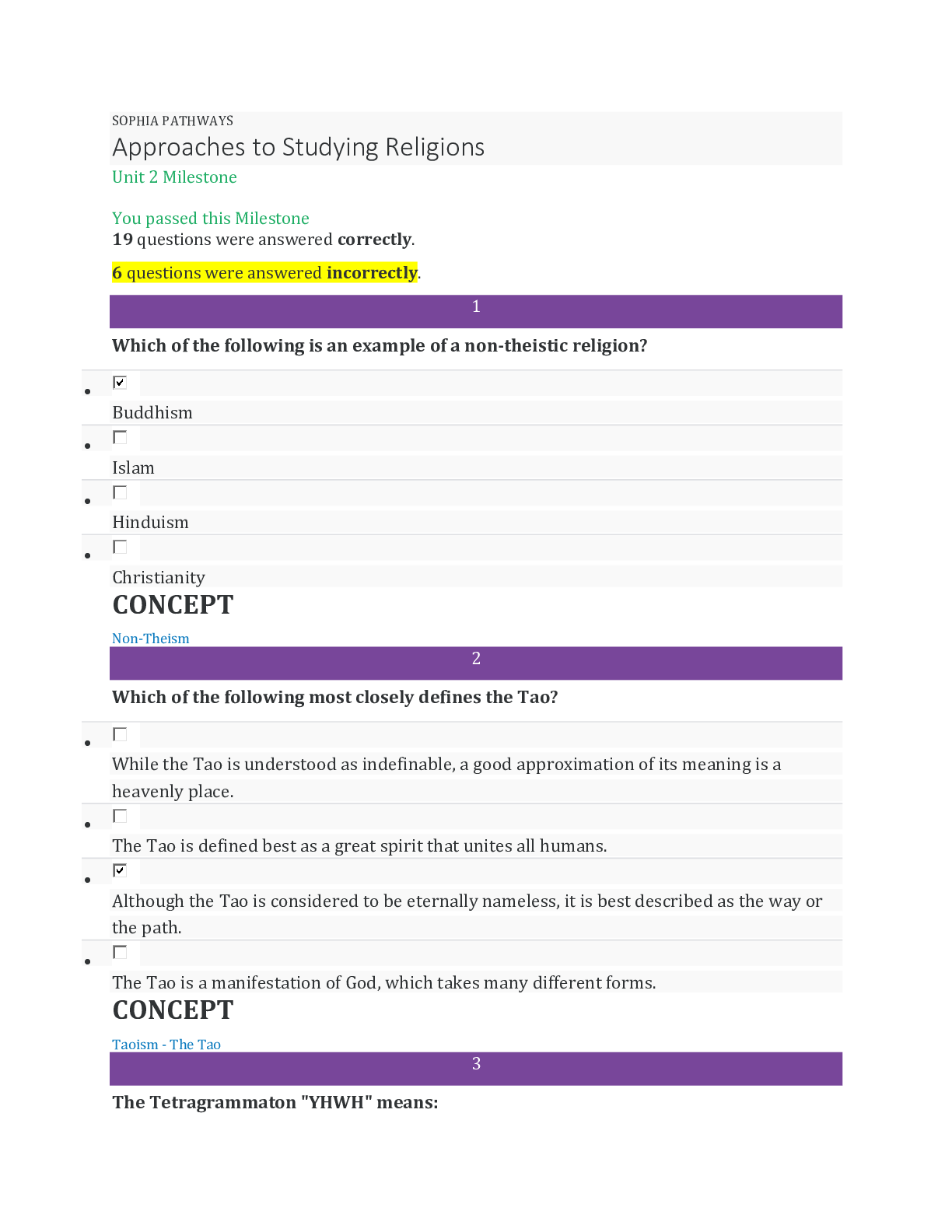
1
Which of the following is an example of a non-theistic religion?
•
Buddhism
•
Islam
•
Hinduism
•
Christianity
CONCEPT
Non-Theism
2
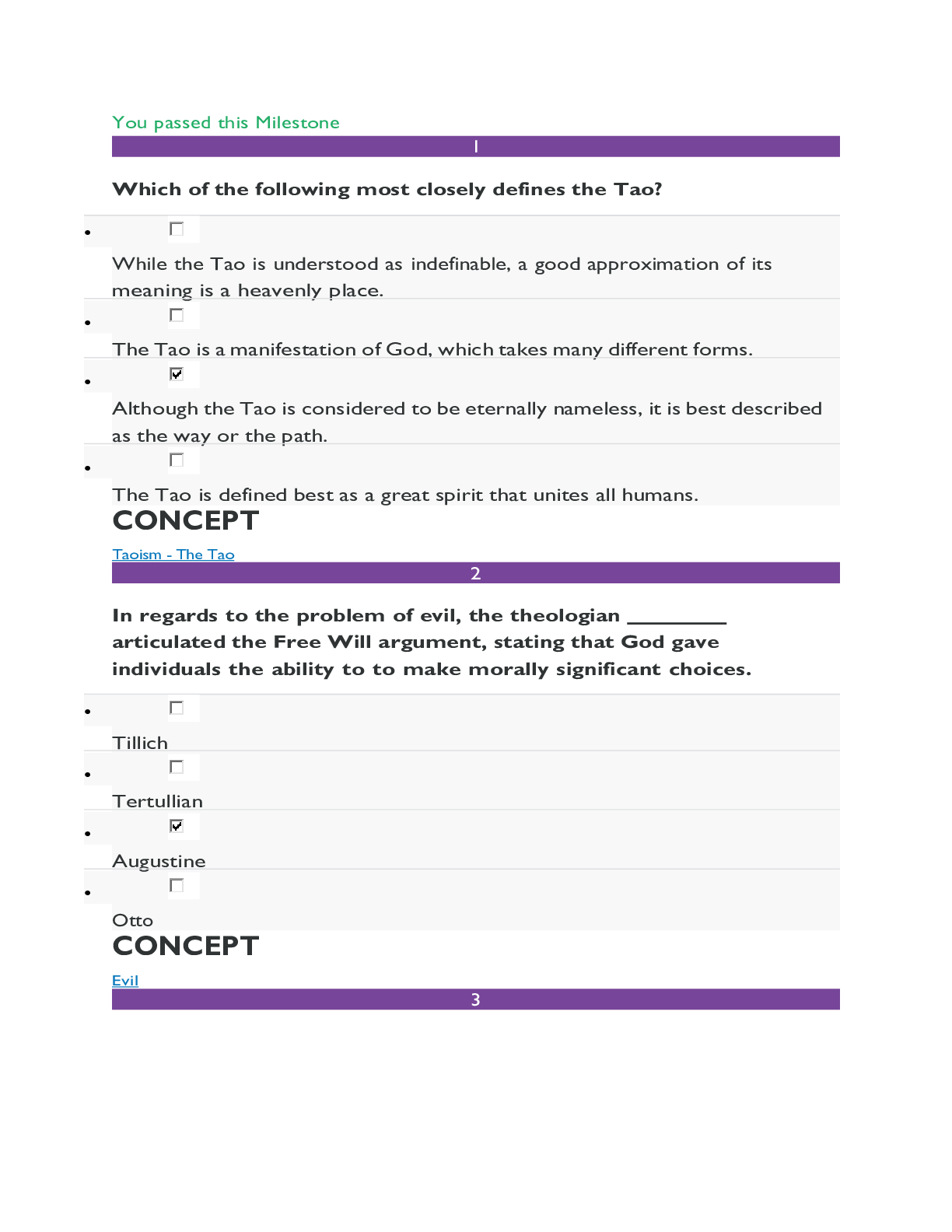
Which of the following most closely defines the Tao?
•
While the Tao is understood as indefinable, a good approximation of its meaning is a
heavenly place.
•
The Tao is defined best as a great spirit that unites all humans.
•
Although the Tao is considered to be eternally nameless, it is best described as the way or
the path.
•
The Tao is a manifestation of God, which takes many different forms.
CONCEPT
Taoism - The Tao
3
The Tetragrammaton "YHWH" means:
•
"King."
•
"Ground of Life."
•
"I am that I am."
•
"Lord."
CONCEPT
Judaism- Yahweh
4
Which of the following best describes the relationship between revelations and
religious narratives?
•
Revelations and religious narratives refer to the exact same phenomena.
•
Individuals always come to know religious narratives through revelation.
•
Revelations are one possible form of religious narrative, often thought to be the most
compelling.
•
Revelations are the most common, almost mundane, form of religious narrative.
CONCEPT
Revelations
5
Which of the following choices is a common element or purpose of creation stories,
as outlined in this pathway?
•
To explain who will be rewarded in the afterlife
•
To answer the question, “Where did I come from?”
•
To provide information on proper moral conduct
•
To explain why God exists
CONCEPT
Early Creation Stories
6
Although problematic questions of human existence have doctrinal or philosophical
answers, they are also:
•
addressed by practices in many traditions.
•
ultimately unsuccessful in the eyes of most practitioners.
•
the sole topic that religious myths are concerned with.
•
not a concern for the average practitioner.
CONCEPT
Overview of "The Problem"
7
What does the concept "Summum bonum" describe?
•
An ethical goal unattainable by humanity.
•
The innate goodness of the human soul.
•
The ultimate end which humans ought to pursue.
•
The greatest possible being, or God.
CONCEPT
Summum Bonum
8
In most forms of Islam, what is Allah's relationship to the physical universe?
•
Allah sustains the physical universe, which has always existed.
•
The physical universe is part of Allah's "body" (or substance).
•
Allah will eventually end the physical universe, which has eternally existed.
•
Allah created the physical universe.
CONCEPT
Islam- Allah
9
What is the practice of evangelism?
•
The act of worshipping publicly.
•
The attempt to return a religion to its original, usually conservative, form.
•
The act of giving religious doctrines purely for the sake of education, not persuasion.
•
The attempt to persuade non-believers to join one's religion.
CONCEPT
Transmission of the Teaching
10
Which of the following best describes the term "ritual?"
•
A collective action directed solely at material ends, e.g. hunting for food
•
A sacred action repeated in a similar way over time
•
A spontaneous new action directed at the divine
•
Any practice that exists outside of accepted religious or social convention
CONCEPT
Action
11
What is the term "mysticism" most associated with?
•
An experience of direct contact with the divine.
•
A set of rational arguments about the divine.
•
Travel to a site associated with a sp
[Show More]




![Preview of [SOLVED] HIEU 201 / HIEU201 Chapter 2 Quiz (LATEST 2022)](https://scholarfriends.com/storage/HIEU_201_Chapter_2_Quiz.png)
![Preview of [SOLVED] HIEU 201 / HIEU201 Chapter 8 Quiz (LATEST 2022)](https://scholarfriends.com/storage/HIEU_201_Chapter_8_quiz.png)





![Preview of [SoIved] Liberty University HLTH 640 quiz 1](https://scholarfriends.com/storage/Liberty-University-GLST-650-EXAM-3.png)


.png)



.png)













