Review Test Submission: Q&A Quiz 2
User Sandra Asomugha
Course 201930 Summer 2019 HLTH 511-B02 LUO
Test Q&A Quiz 2
Started 5/19/19 8:51 PM
Submitted 5/19/19 8:58 PM
Due Date 5/26/19 11:59 PM
Status Completed
Atte
...
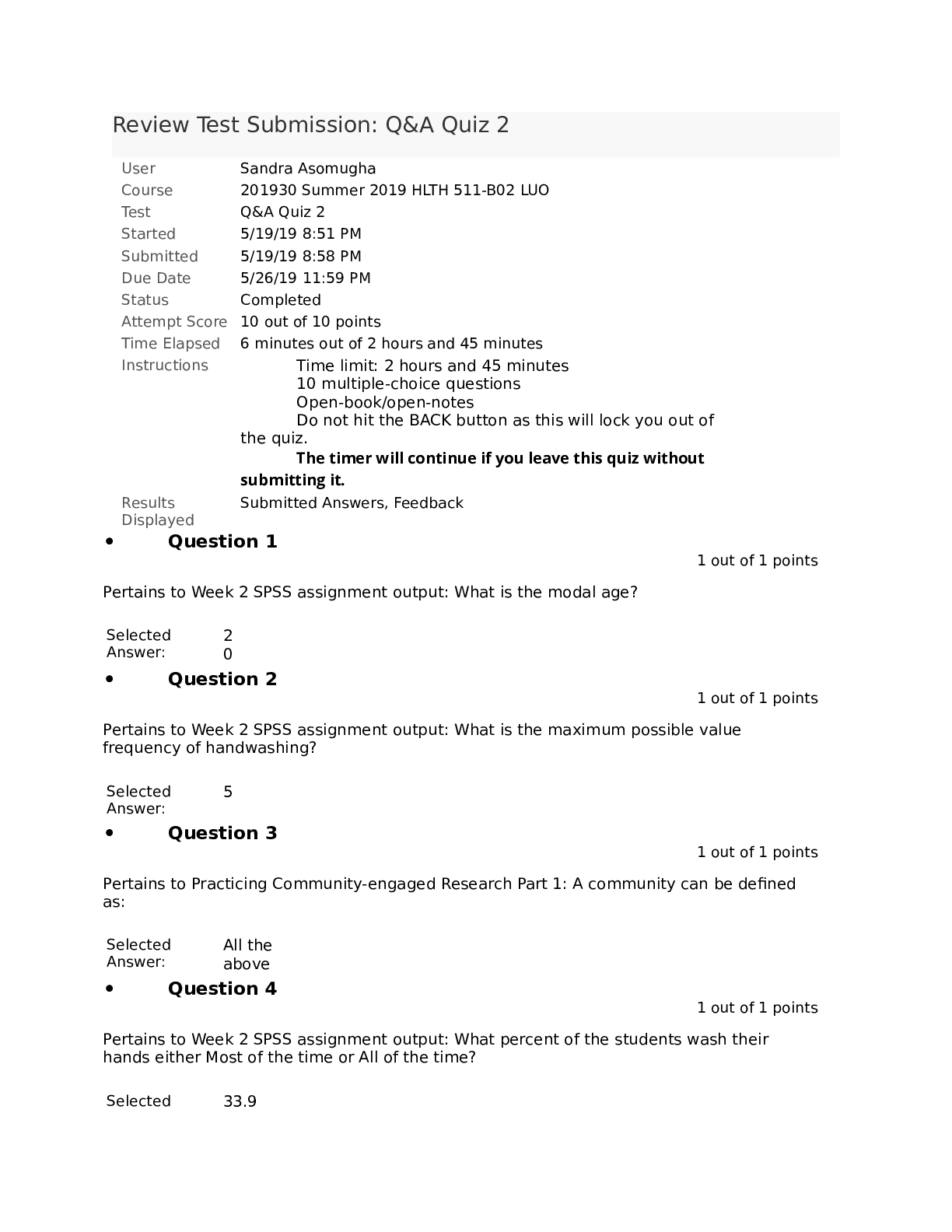
Review Test Submission: Q&A Quiz 2
User Sandra Asomugha
Course 201930 Summer 2019 HLTH 511-B02 LUO
Test Q&A Quiz 2
Started 5/19/19 8:51 PM
Submitted 5/19/19 8:58 PM
Due Date 5/26/19 11:59 PM
Status Completed
Attempt Score 10 out of 10 points
Time Elapsed 6 minutes out of 2 hours and 45 minutes
Instructions Time limit: 2 hours and 45 minutes
10 multiple-choice questions
Open-book/open-notes
Do not hit the BACK button as this will lock you out of
the quiz.
The timer will continue if you leave this quiz without
submitting it.
Results
Displayed
Submitted Answers, Feedback
Question 1
1 out of 1 points
Pertains to Week 2 SPSS assignment output: What is the modal age?
Selected
Answer:
2
0
Question 2
1 out of 1 points
Pertains to Week 2 SPSS assignment output: What is the maximum possible value
frequency of handwashing?
Selected
Answer:
5
Question 3
1 out of 1 points
Pertains to Practicing Community-engaged Research Part 1: A community can be defined
as:
Selected
Answer:
All the
above
Question 4
1 out of 1 points
Pertains to Week 2 SPSS assignment output: What percent of the students wash their
hands either Most of the time or All of the time?
Selected 33.9
Answer: %
Question 5
1 out of 1 points
Pertains to Week 2 SPSS assignment output: Which of the following (if any) are true?
Selected
Answer:
all the
above
Question 6
1 out of 1 points
Pertains to Practicing Community-engaged Research Part 1: Which of the following is NOT
a characteristic CBPR
Selected
Answer:
Begins with a research topic of importance to the
researcher
Question 7
1 out of 1 points
Pertains to Practicing Community-engaged Research Part 1: Which of the following is true
with regard to community engaged research?
Selected
Answer:
A and
B.
Question 8
1 out of 1 points
Pertains to Practicing Community-engaged Research Part 1: Which of the following is a
characteristic CBPR?
Selected
Answer:
A and
B
Question 9
1 out of 1 points
Pertains to Week 2 SPSS assignment output: Which age represents the highest number of
students?
Selected
Answer:
2
0
Question 10
1 out of 1 points
Pertains to Practicing Community-engaged Research Part 1: Individuals who consent to be
part of community-based research are referred to as:
Selected
Answer:
Participan
ts
Friday, July 5, 2019 12:02:20 AM EDT
Review Test Submission: Q&A Quiz 3
User Sandra Asomugha
Course 201930 Summer 2019 HLTH 511-B02 LUO
Test Q&A Quiz 3
Started 5/26/19 5:55 PM
Submitted 5/26/19 6:07 PM
Due Date 6/2/19 11:59 PM
Status Completed
Attempt Score 10 out of 10 points
Time Elapsed 11 minutes out of 2 hours and 45 minutes
Instructions Time limit: 2 hours and 45 minutes
7 multiple-choice and true/false questions
Open-book/open-notes
Do not hit the BACK button as this will lock you out of
the quiz.
The timer will continue if you leave this quiz without
submitting it.
Results
Displayed
Submitted Answers, Feedback
Question 1
1 out of 1 points
Pertains to output generated for SPSS assignment for Week 3: Observe the descriptives
table for seconds of handwashing summarized by sex of students.
Based on the standard deviation and variance the data for which of the following are most
closely clustered around the mean?
Selected
Answer:
Femal
es
Question 2
2 out of 2 points
Pertains to the slide presentation “Practicing Community engaged Research – Part 2”:
Which of the following should be considered when building trust with a community:
Selected
Answer:
All the
above
Question 3
2 out of 2 points
Pertains to the slide presentation “Practicing Community engaged Research – Part 2”: In
the definition of community – engagement stated by the Centers for Disease Control and
Prevention geographic proximity is considered relevant.
Selected
Answer:
Tru
e
Question 4
2 out of 2 points
Pertains to the slide presentation “Practicing Community engaged Research – Part 2”:
Which of the following is NOT considered a benefit of using a community engaged
approach to research.
Selected
Answer:
Community-engagement has no effect on improving the reliability and
validity of measurement tools and questions and study procedures
Question 5
1 out of 1 points
Pertains to output generated for SPSS assignment for Week 3: Observe the 95%
confidence interval for the mean for the
[Show More]