Question 1 2 / 2 points
An 18-year-old man presents with periumbilical pain, vomiting, and abdominal cramping over the past
48 hours. Physical examination reveals rebound tenderness and laboratory analysis shows the pr
...
Question 1 2 / 2 points
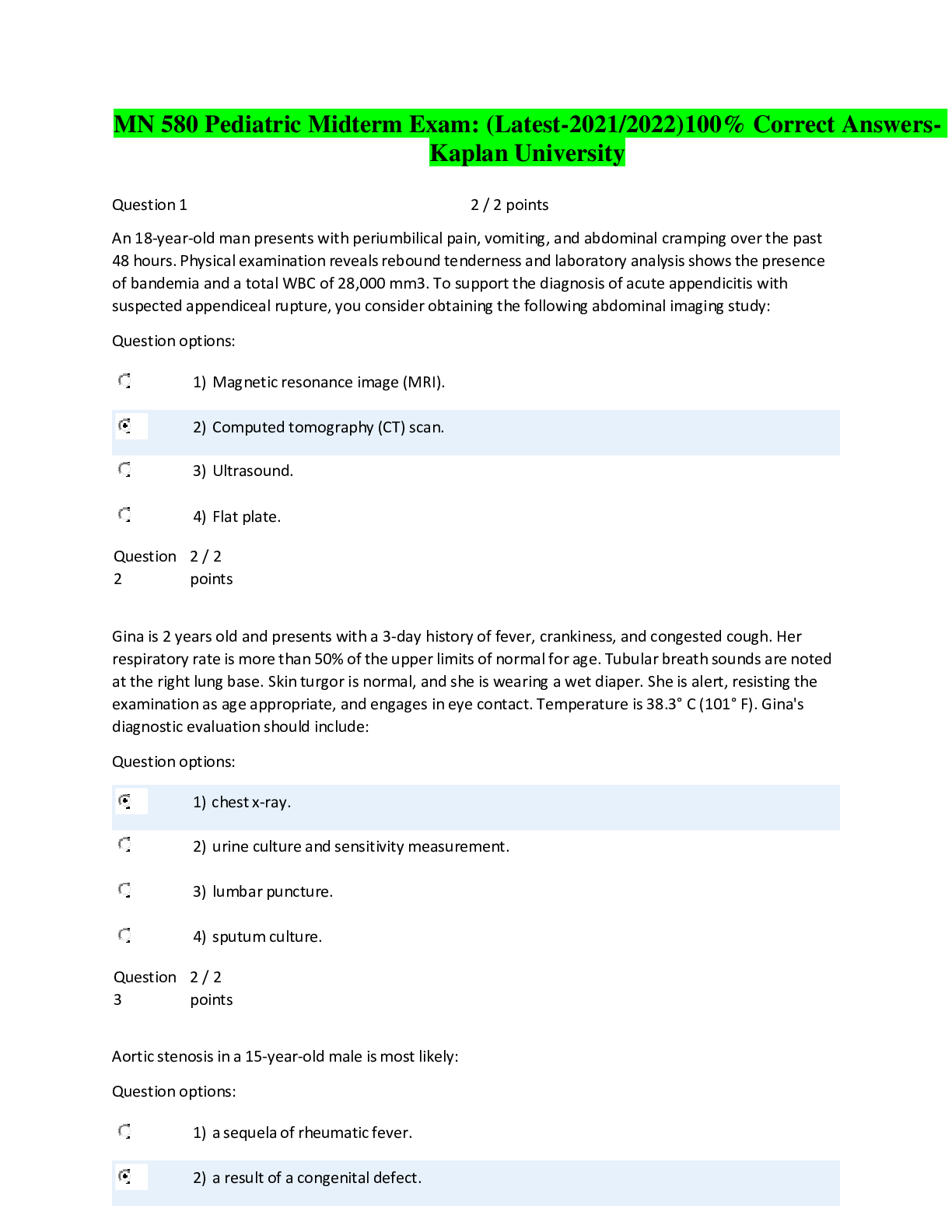
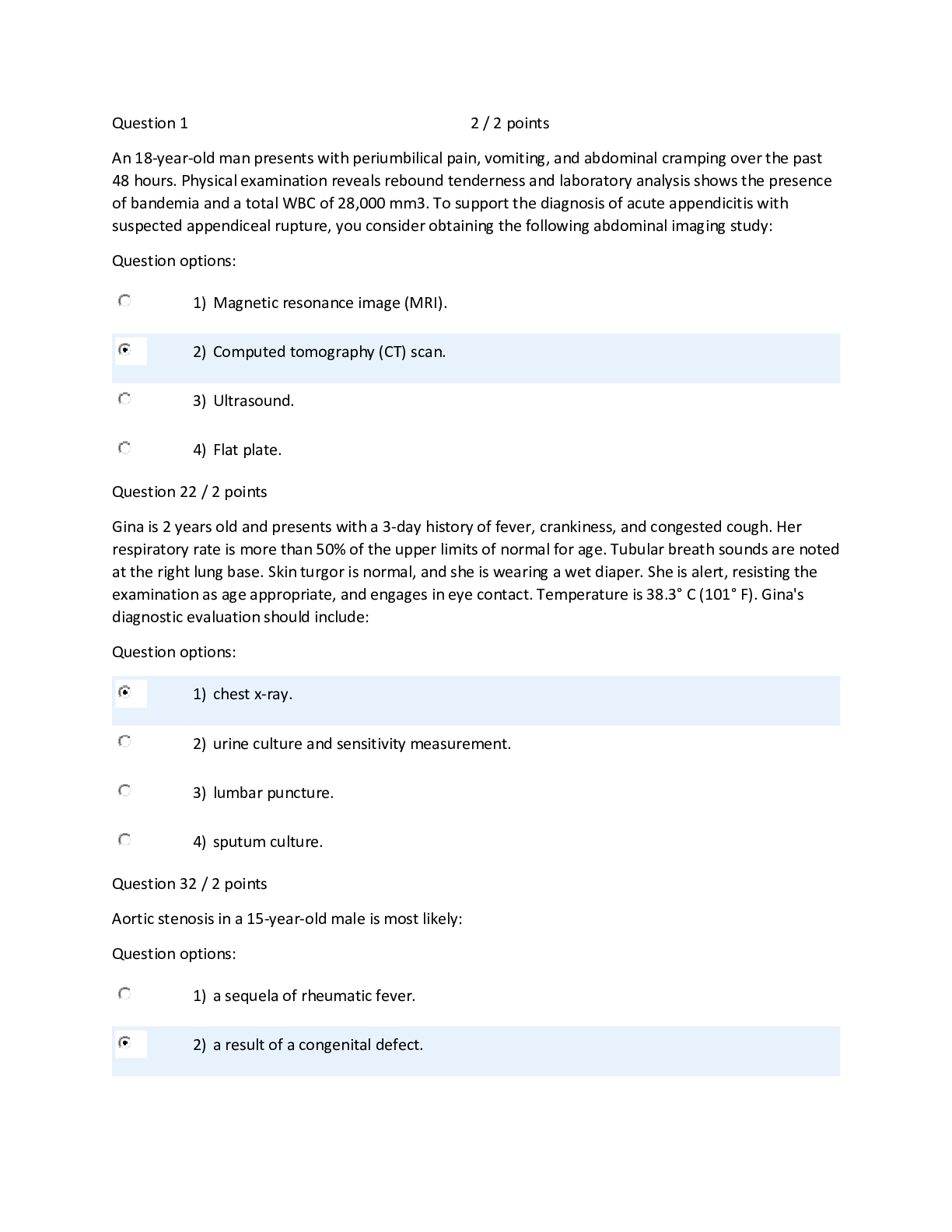
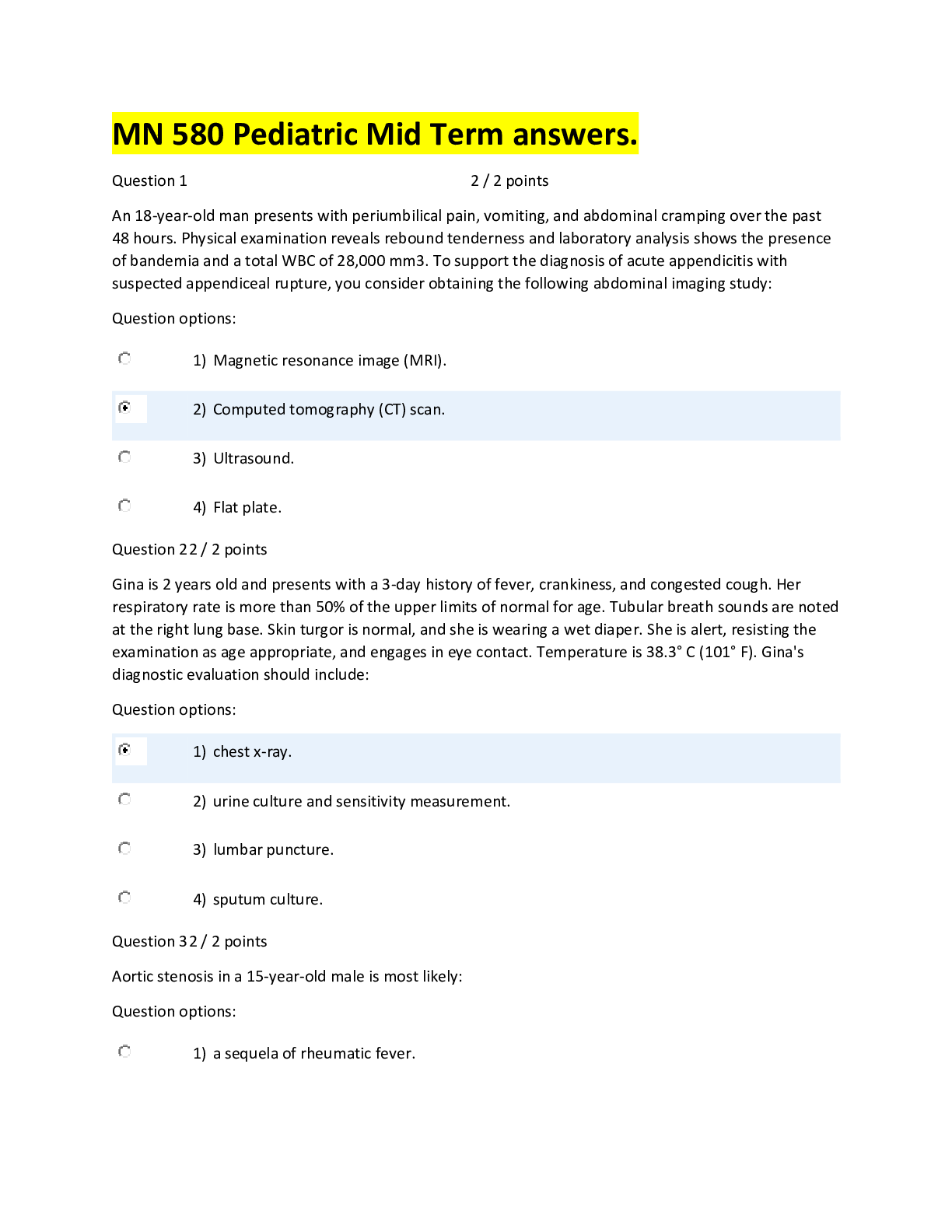
An 18-year-old man presents with periumbilical pain, vomiting, and abdominal cramping over the past
48 hours. Physical examination reveals rebound tenderness and laboratory analysis shows the presence
of bandemia and a total WBC of 28,000 mm3. To support the diagnosis of acute appendicitis with
suspected appendiceal rupture, you consider obtaining the following abdominal imaging study:
Question options:
1) Magnetic resonance image (MRI).
2) Computed tomography (CT) scan.
3) Ultrasound.
4) Flat plate.
Question
2
2 / 2
points
Gina is 2 years old and presents with a 3-day history of fever, crankiness, and congested cough. Her
respiratory rate is more than 50% of the upper limits of normal for age. Tubular breath sounds are noted
at the right lung base. Skin turgor is normal, and she is wearing a wet diaper. She is alert, resisting the
examination as age appropriate, and engages in eye contact. Temperature is 38.3° C (101° F). Gina's
diagnostic evaluation should include:
Question options:
1) chest x-ray.
2) urine culture and sensitivity measurement.
3) lumbar puncture.
4) sputum culture.
Question
3
2 / 2
points
Aortic stenosis in a 15-year-old male is most likely:
Question options:
1) a sequela of rheumatic fever.
2) a result of a congenital defect.
3) calcific in nature.
4) found with atrial septal defect.
Question
4
2 / 2
points
Which of the following laboratory tests can identify the causative organism of bronchiolitis?
Question options:
1) Nasal washing antigen test.
2) Antibody test via blood sample.
3) Urine culture.
4) A laboratory test is not available.
Question
5
2 / 2
points
A Still murmur:
Question options:
1) is heard in the presence of cardiac pathology.
2) has a humming or vibratory quality.
3) is a reason for denying sports participation clearance.
4) can become louder when the patient is standing.
Question
6
2 / 2
points
A physiological murmur has which of the following characteristics?
Question options:
1) Occurs late in systole.
2) Is noted in a localized area of auscultation.
3) Becomes softer when the patient moves from supine to standing.
4) Frequently obliterates S2.
Question
7
2 / 2
points
You anticipate that adult car seat belts fit correctly when a child is approximately _____ tall and is____
old.
Question options:
1) 51 inches (129.5 cm), 6 to 8 years
2) 53 inches (134.6 cm), 5 to 7 years
3) 57 inches (144.8 cm), 8 to 12 years
4) 59 inches (150 cm), 12 to 14 years
Question
8
2 / 2
points
Physical examination findings in otitis externa include:
Question options:
1) tympanic membrane immobility.
2) increased ear pain with tragus palpation.
3) tympanic membrane erythema.
4) tympanic membrane bullae.
Question
9
2 / 2
points
In infants, solid foods are best introduced no earlier than:
Question options:
1) 1–3 months.
2) 3–5 months.
3) 4–6 months.
4) 6–8 months.
Question
10
2 / 2
points
When advising a patient about injectable influenza immunization, the nurse practitioner (NP) considers
the following about the use of this vaccine:
Question options:
1) Its use is not recommended in sickle cell anemia.
2) Its use is limited to children older than 2 years.
3) Its use is limited due to containing live virus.
4) Its use is recommended for virtually all members of the population.
Question
11
2 / 2
points
A healthy 2-year-old child is able to:
Question options:
1) speak in phrases of two or more words.
2) throw a ball at a target.
3) scribble spontaneously.
4) ride a tricycle.
Question
12
2 / 2
points
The preferred treatment option for a 6-year-old boy with pertussis is:
Question options:
1) amoxicillin.
2) ceftriaxone.
3) azithromycin.
4) levofloxacin.
[Show More]