1. Question :
Your patient is morbidly obese and cannot sit on a bicycle or walk a treadmill. She
also has marked and severe emphysema. You need to make an assessment of the
risk of significant CAD and your patient’s
...
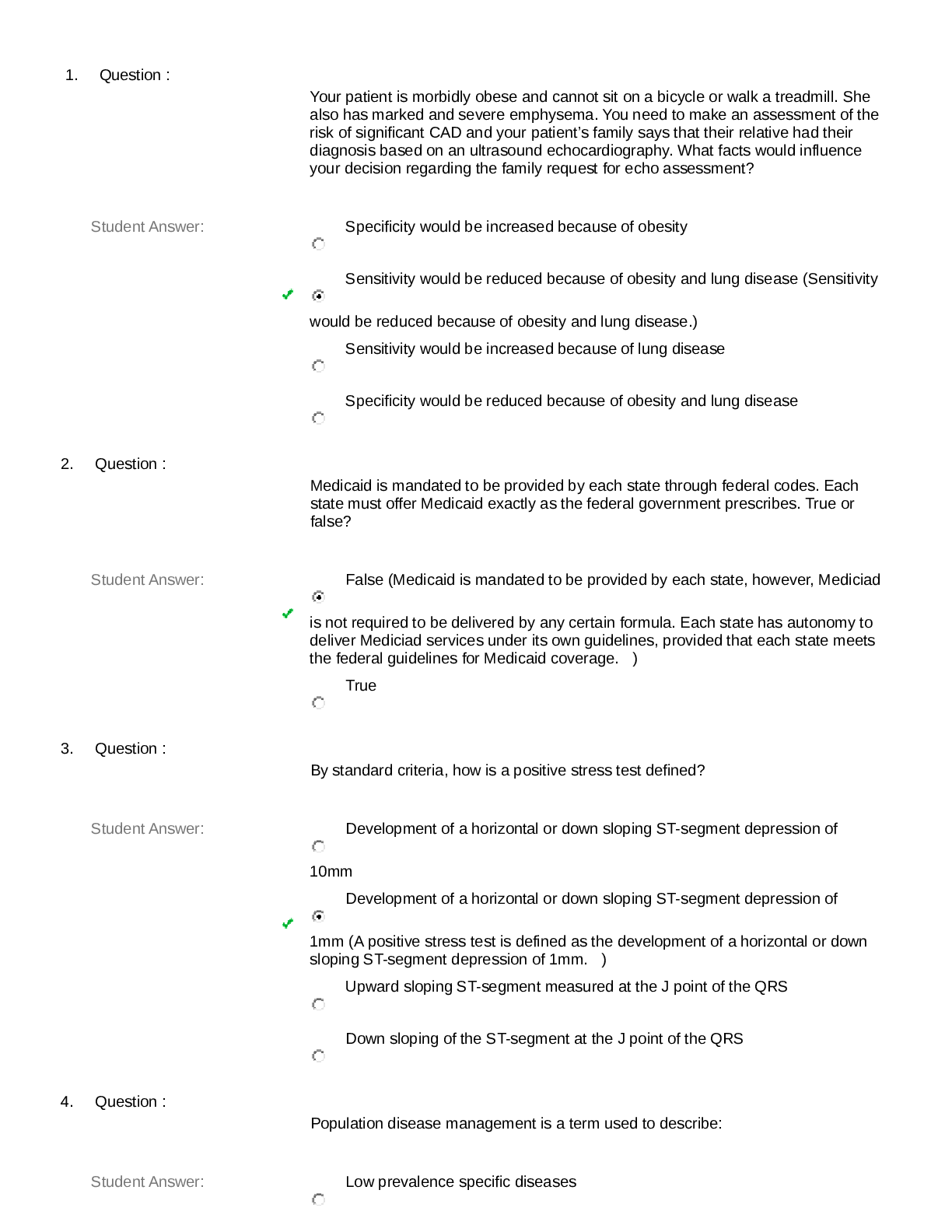
1. Question :
Your patient is morbidly obese and cannot sit on a bicycle or walk a treadmill. She
also has marked and severe emphysema. You need to make an assessment of the
risk of significant CAD and your patient’s family says that their relative had their
diagnosis based on an ultrasound echocardiography. What facts would influence
your decision regarding the family request for echo assessment?
Student Answer: Specificity would be increased because of obesity
Sensitivity would be reduced because of obesity and lung disease (Sensitivity
would be reduced because of obesity and lung disease.)
Sensitivity would be increased because of lung disease
Specificity would be reduced because of obesity and lung disease
2. Question :
Medicaid is mandated to be provided by each state through federal codes. Each
state must offer Medicaid exactly as the federal government prescribes. True or
false?
Student Answer: False (Medicaid is mandated to be provided by each state, however, Mediciad
is not required to be delivered by any certain formula. Each state has autonomy to
deliver Mediciad services under its own guidelines, provided that each state meets
the federal guidelines for Medicaid coverage. )
True
3. Question :
By standard criteria, how is a positive stress test defined?
Student Answer: Development of a horizontal or down sloping ST-segment depression of
10mm
Development of a horizontal or down sloping ST-segment depression of
1mm (A positive stress test is defined as the development of a horizontal or down
sloping ST-segment depression of 1mm. )
Upward sloping ST-segment measured at the J point of the QRS
Down sloping of the ST-segment at the J point of the QRS
4. Question :
Population disease management is a term used to describe:
Student Answer: Low prevalence specific diseases
High prevalence specific diseases (Population disease management is a term
used to describe the high prevalence of specific diseases. )
Low specificity diseases states
High specificity disease states
5. Question :
What are two of the most common forms of Exercise Stress Tests used today?
Student Answer: Bicycle and treadmill (Bicycle and treadmill are the two most common forms
of exercise stress tests used today. )
Unicycle and Running in pace
Thallium and Dobutamine
Bicycle and rowing machine
6. Question :
You are counseling a patient diagnosed with stress-induced ischemia. You base
your discussion on your knowledge that stress-induced ischemia is thought to be
caused by what phenomena?
Student Answer: Too many carbonated drinks
Diet and exercise
Endothelial dysfunction of the microvascular (You base your discussion on
your knowledge that stress-induced ischemia is thought to be caused by
endothelial dysfunction of the microvascular.)
Heart muscle dysfunction
7. Question :
Narrowed coronary arteries or plague rupture within the arteries of the coronary
system may directly cause which condition?
Student Answer: Venous Statis
Diabetes
Hypertension
Coronary artery disease (Narrowed coronary arteries, plague rupture, and
sometimes even spasms of the coronary arteries are the three most common direct
causes for the diagnosis of coronary artery disease. )
8. Question :
Of the following, which is the best answer when asked for an advantage of
echocardiogram exercise testing over thallium stress testing?
Student Answer: Results are available more quickly (Echocardiogram exercise test results are
available more quickly.)
Does not depend on operator experience
Doesn’t matter because there are no advantages
Costs are the same
9. Question :
A 55-year old man is referred to your clinic. He has been sedentary all of his life, is
gaining weight and wishes to get into better physical shape. He has never had any
chest pain or shortness of breath when walking or climbing a flight of stairs. Before
recommending a vigorous exercise routine for this patient, you order what test?
Student Answer: Stool samples
CBC
ETT (Many patients have underlying CAD but remain asymptomatic. Before
beginning any new vigorous activities after years of sedentary lifestyle, it is
recommended that the patient obtains an ETT to rule out underlying CAD.)
Thyroid levels
10. Question :
What ECG changes can reduce the specificity of the ETT?
Student Answer: Paced rhythm and resting bundle branch block (The ECG changes that can
reduce the specificity of the ETT are paced rhythm and resting bundle branch
block. )
Low voltage up sloping of the ST-segment
Exercise induced bundle branch blocks
Paced rhythm and exercise induced bundle branch blocks
11. Question :
In women, you need to know the limitations of certain tests for CAD. For example,
single-photon emissions CT imaging, while an acceptable test for most men and
some women, is technically limited in women for two reasons. From the following,
choose the best possible answer.
Student Answer: Breasts and fat deposits in abdomen
Smoking rates and lack of uptake of photons
Breasts and smaller coronary arteries (Single-photon emissions CT imaging is
technically limited in women due to breasts and smaller coronary arteries.)
Multiple vessel disease and fat deposits
12. Question :
Improvements in the delivery and management of healthcare are necessary if we
are to improve the overall health of this nation’s population. Which of the following
are identified in your readings as strategic in the movement to improve the
healthcare system?
Student Answer: Monetary savings and limited disruption in healthcare delivery
Population management and healthcare practice (Population management
and healthcare practice are strategic in the movement to improve the nation’s
healthcare system. )
Socialized medicine and governmental controls
President and Congress
13. Question :
The sensitivity of a routine ETT is effort dependent. What physiological changes
occur during effort in the routine ETT?
Student Answer: Decrease in coronary blood flow
Increased coronary flow and increased systolic blood pressure (The
physiological changes that occur during effort in the routine ETT are increased
coronary flow and increased systolic blood pressure.)
Rapid heart rates and coronary artery narrowing
Decreased heart rate and increased systolic blood pressure
14. Question :
Your mentor says that you should be prepared to know how to determine the
maximum heart rate for your patient during the ETT. How is the age-predicted
maximum heart rate during an ETT determined?
Student Answer: 220+age
120-age
220-age (The age-predicted maximum heart rate during an ETT determined
by subtracting the patient’s age from 220 (220 – age). )
65+age
15. Question :
Medicare hospital insurance (Part A) is funded through what system?
Student Answer: Interest from investments
State income taxes
Federal income taxes
Federal payroll taxes (Medicare Part A is funded through federal payroll
taxes. )
16. Question :
We all know that collaboration is integral to becoming a successful nurse
practitioner. Among collaborations, however, only one can be considered as the
most important. While each example below is important, which is the most
important collaboration? The one that occurs:
Student Answer: Between the patient and their family
Between the patient and the nurse practitioner (The collaboration that is most
important is the one that occurs between the patient and the nurse practitioner. )
[Show More]