Test Bank
to accompany
Neuroscience, Sixth Edition
Purves • Augustine • Fitzpatrick • Hall • LaMantia • Mooney • Platt • White
Chapter 8: Synaptic Plasticity
Multiple Choice
1. What causes synaptic facilitation?
a
...
Test Bank
to accompany
Neuroscience, Sixth Edition
Purves • Augustine • Fitzpatrick • Hall • LaMantia • Mooney • Platt • White
Chapter 8: Synaptic Plasticity
Multiple Choice
1. What causes synaptic facilitation?
a. Buildup of Ca2+ in the presynaptic terminal
b. Release of greater than usual number of synaptic vesicles
c. Release of synaptic vesicles loaded with extra neurotransmitter
d. Activation of synaptotagmin 7 by means of phosphorylation
e. Stronger binding of Ca2+ to synaptotagmin 7
Answer: a
Textbook Reference: Short-Term Synaptic Plasticity
Bloom’s Level: 2. Understanding
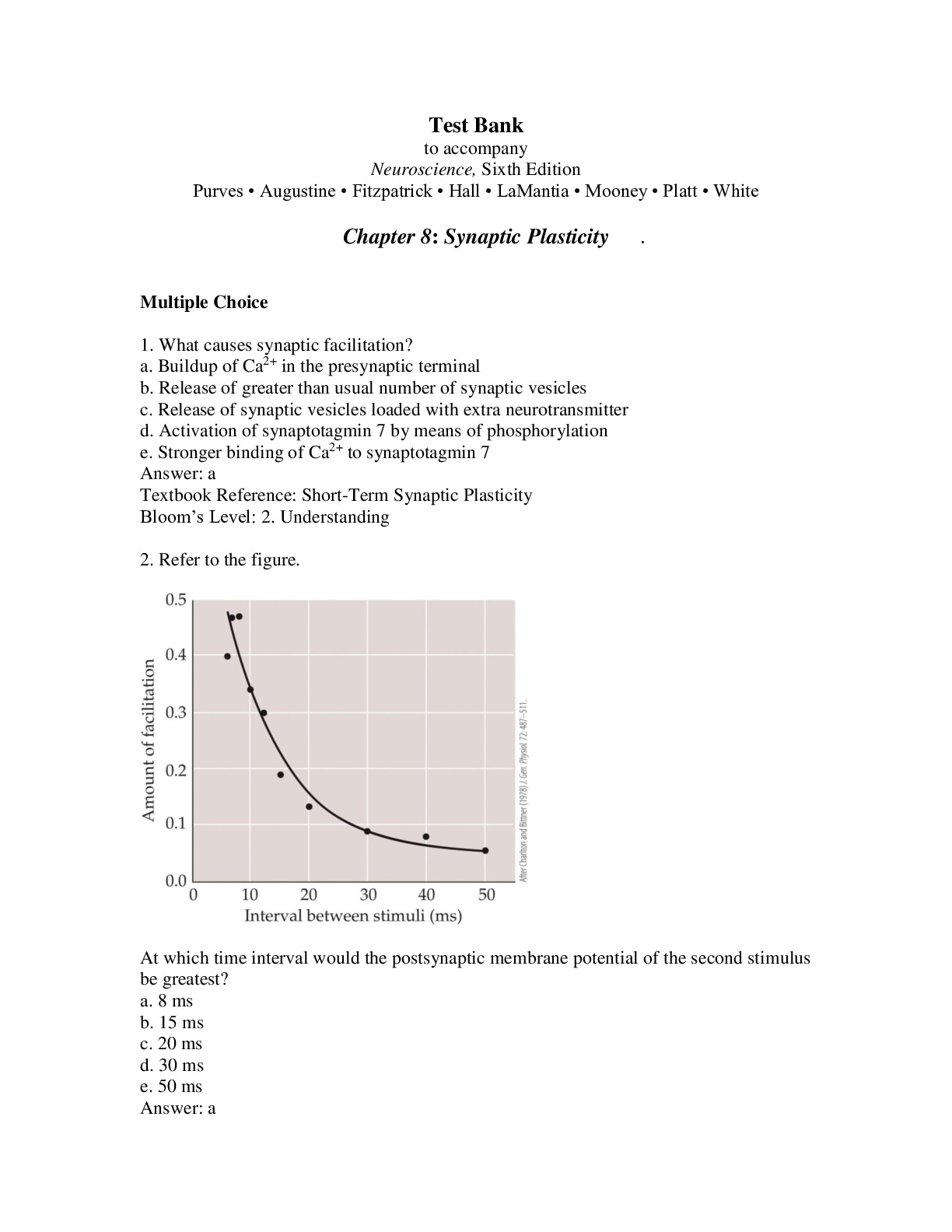
2. Refer to the figure.
At which time interval would the postsynaptic membrane potential of the second stimulus
be greatest?
a. 8 ms
b. 15 ms
c. 20 ms
d. 30 ms
e. 50 ms
Answer: a
Textbook Reference: Short-Term Synaptic Plasticity
Bloom’s Level: 4. Analyzing
3. Refer to the figure.
Which statement describes the depicted phenomenon most accurately?
a. Synaptic depression directly correlates with the concentration of extracellular Ca2+
.
b. Synaptic depression directly correlates with the amount of neurotransmitter released.
c. Synaptic depression is inversely correlated with the amount of neurotransmitter
released.
d. Synaptic depression depends on the rate of neurotransmitter release.
e. Synaptic depression depends on the concentration of neurotransmitter in synaptic
vesicles.
Answer: b
Textbook Reference: Short-Term Synaptic Plasticity
Bloom’s Level: 4. Analyzing
4. How would an increase in external Ca2+ concentration affect synaptic depression?
a. It would increase the rate of depression.
b. It would reduce the rate of depression.
c. It would decrease the rate of neurotransmitter release and induce depression.
d. It would increase the rate of neurotransmitter release and delay depression.
e. It would have no effect on depression.
Answer: a
Textbook Reference: Short-Term Synaptic Plasticity
Bloom’s Level: 3. Applying
5. Which type of short-term synaptic plasticity lasts the longest?
a. Potentiation
b. Augmentation
c. Depression
d. Facilitation
e. Post-tetanic potentiation
Answer: e
Textbook Reference: Short-Term Synaptic Plasticity
Bloom’s Level: 1. Remembering
6. What characteristic(s) make(s) Aplysia californica a practical model organism for
studying the nervous system?
a. Its great magnitude and variety of neurons
b. Its large neurons
c. The random location of its neurons
d. That it is aquatic
e. All of the above
Answer: b
Textbook Reference: Long-Term Synaptic Plasticity and Behavioral Modification in
Aplysia
Bloom’s Level: 2. Understanding
7. Refer to the figure.
In which form of plasticity is this neural circuit involved, and which component of the
circuit makes this form of plasticity possible?
a. Habituation; interneuron
b. Habituation; modulatory interneuron
c. Sensitization; interneuron
d. Sensitization; modulatory interneuron
e. Sensitization; motor neuron
Answer: d
Textbook Reference: Long-Term Synaptic Plasticity and Behavioral Modification in
Aplysia
Bloom’s Level: 4. Analyzing
8. Refer to the figure.
Repeated stimulation of the siphon results in habituation. Which synaptic change occurs
during habituation?
a. The synapse between the sensory and motor neurons is depressed.
b. The synapse between the sensory and motor neurons is potentiated.
c. The synapse between the sensory neuron and the interneuron is depressed.
d. The synapse between the sensory neuron and the modulatory interneuron is depressed.
e. The synapse between the interneuron and the motor neuron is depressed.
Answer: a
Textbook Reference: Long-Term Synaptic Plasticity and Behavioral Modification in
Aplysia
Bloom’s Level: 4. Analyzing
9. Refer to the figure.
The function of which synapse is altered during sensitization?
[Show More]