Test Bank
to accompany
Neuroscience, Sixth Edition
Purves • Augustine • Fitzpatrick • Hall • LaMantia • Mooney • Platt • White
Chapter 14: The Vestibular System
Multiple Choice
1. The sensory system that processes
...
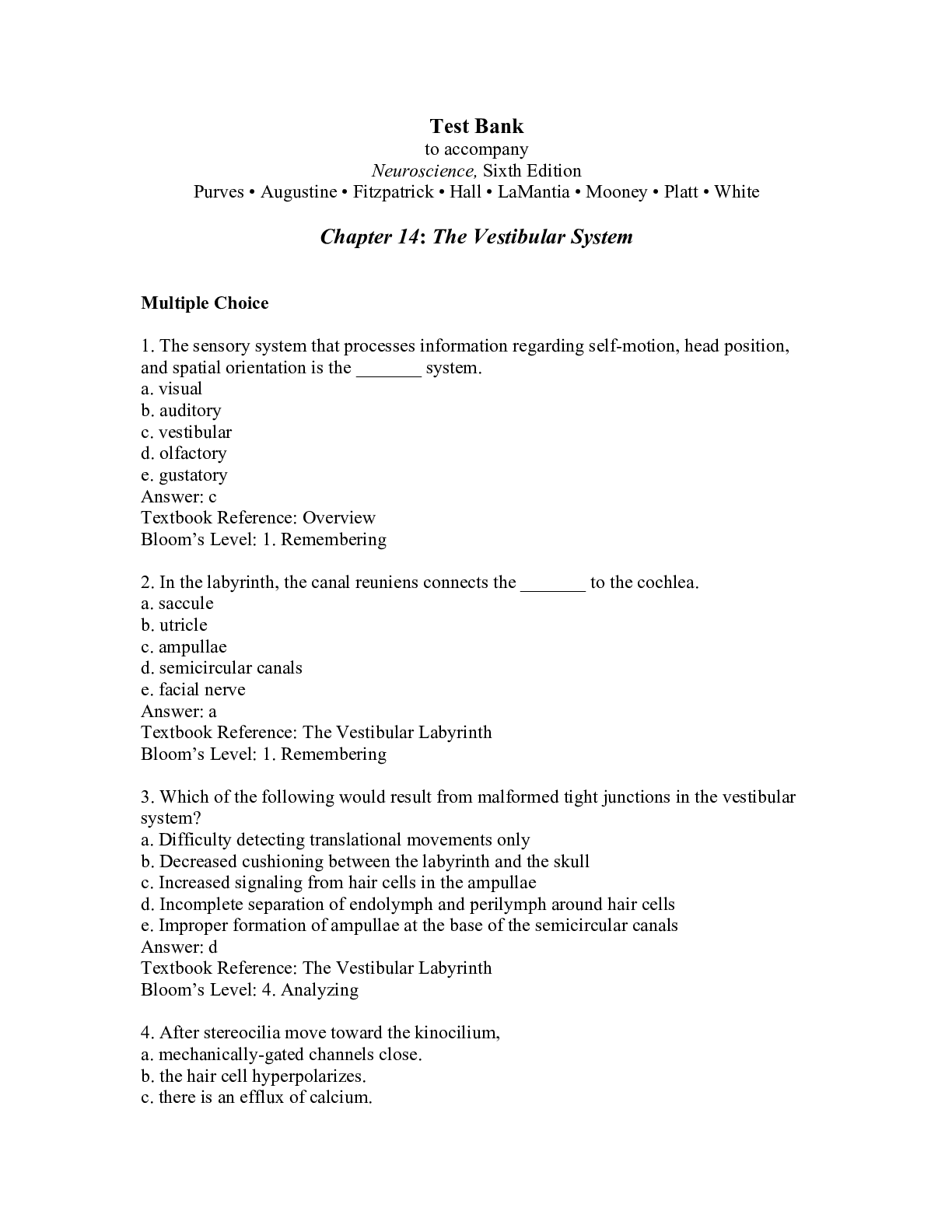
Test Bank
to accompany
Neuroscience, Sixth Edition
Purves • Augustine • Fitzpatrick • Hall • LaMantia • Mooney • Platt • White
Chapter 14: The Vestibular System
Multiple Choice
1. The sensory system that processes information regarding self-motion, head position,
and spatial orientation is the _______ system.
a. visual
b. auditory
c. vestibular
d. olfactory
e. gustatory
Answer: c
Textbook Reference: Overview
Bloom’s Level: 1. Remembering
2. In the labyrinth, the canal reuniens connects the _______ to the cochlea.
a. saccule
b. utricle
c. ampullae
d. semicircular canals
e. facial nerve
Answer: a
Textbook Reference: The Vestibular Labyrinth
Bloom’s Level: 1. Remembering
3. Which of the following would result from malformed tight junctions in the vestibular
system?
a. Difficulty detecting translational movements only
b. Decreased cushioning between the labyrinth and the skull
c. Increased signaling from hair cells in the ampullae
d. Incomplete separation of endolymph and perilymph around hair cells
e. Improper formation of ampullae at the base of the semicircular canals
Answer: d
Textbook Reference: The Vestibular Labyrinth
Bloom’s Level: 4. Analyzing
4. After stereocilia move toward the kinocilium,
a. mechanically-gated channels close.
b. the hair cell hyperpolarizes.
c. there is an efflux of calcium.
d. there is a decreased release of transmitter from the hair cell.
e. there is increased signaling in the vestibular nerve.
Answer: e
Textbook Reference: Vestibular Hair Cells
Bloom’s Level: 2. Understanding
5. Why is it important that transduction channels are open at rest?
a. To maintain separation of perilymph and endolymph
b. To allow hair cells to signal both increases and decreases
c. To permit movement of stereocilia in either direction
d. So that transmitter is released only when stereocilia move toward the kinocilium
e. To facilitate vestibular nerve firing in only when the head changes position
Answer: b
Textbook Reference: Vestibular Hair Cells
Bloom’s Level: 3. Applying
6. The area that divides the utricle and saccule into two populations of hair cells with
different polarities is called
a. Scarpa’s ganglion.
b. the semicircular canal.
c. the striola.
d. the canal reuniens.
e. the labyrinth.
Answer: c
Textbook Reference: Vestibular Hair Cells
Bloom’s Level: 1. Remembering
7. Hair cells are located in the _______ and otoconia are embedded in the _______.
a. macula; otolithic membrane
b. gelatinous layer; otolithic membrane
c. gelatinous layer; macula
d. macula; gelatinous membrane
e. otolithic membrane; macula
Answer: a
Textbook Reference: Otolith Organs: The Utricle and Saccule
Bloom’s Level: 2. Understanding
8. In a monkey, which of the following would be a symptom of nonfunctional otoconia?
a. Increased sensitivity to head movements
b. Detection only of vertical movements
c. Detection only of horizontal plane movements
d. Detection only of rotational movements
e. Decreased sensation of head movements
Answer: e
Textbook Reference: Otolith Organs: The Utricle and Saccule
Bloom’s Level: 4. Analyzing
9. What type of movement do the saccule and utricle respond to, respectively?
a. Vertical; rotational
b. Vertical; horizontal
c. Rotational; vertical
d. Horizontal; vertical
e. Horizontal; rotational
Answer: b
Textbook Reference: Otolith Organs: The Utricle and Saccule
Bloom’s Level: 2. Understanding
10. Which type of movement would the saccule detect?
a. Tilting of the head to the side
b. Quick acceleration in a roller coaster
[Show More]