Week 1: Leadership Theory: Application to Advanced Nursing Practice
Select one leadership theory or style that aligns with your personal philosophy and leadership stance.
Explain the selected theory or style, and discu
...
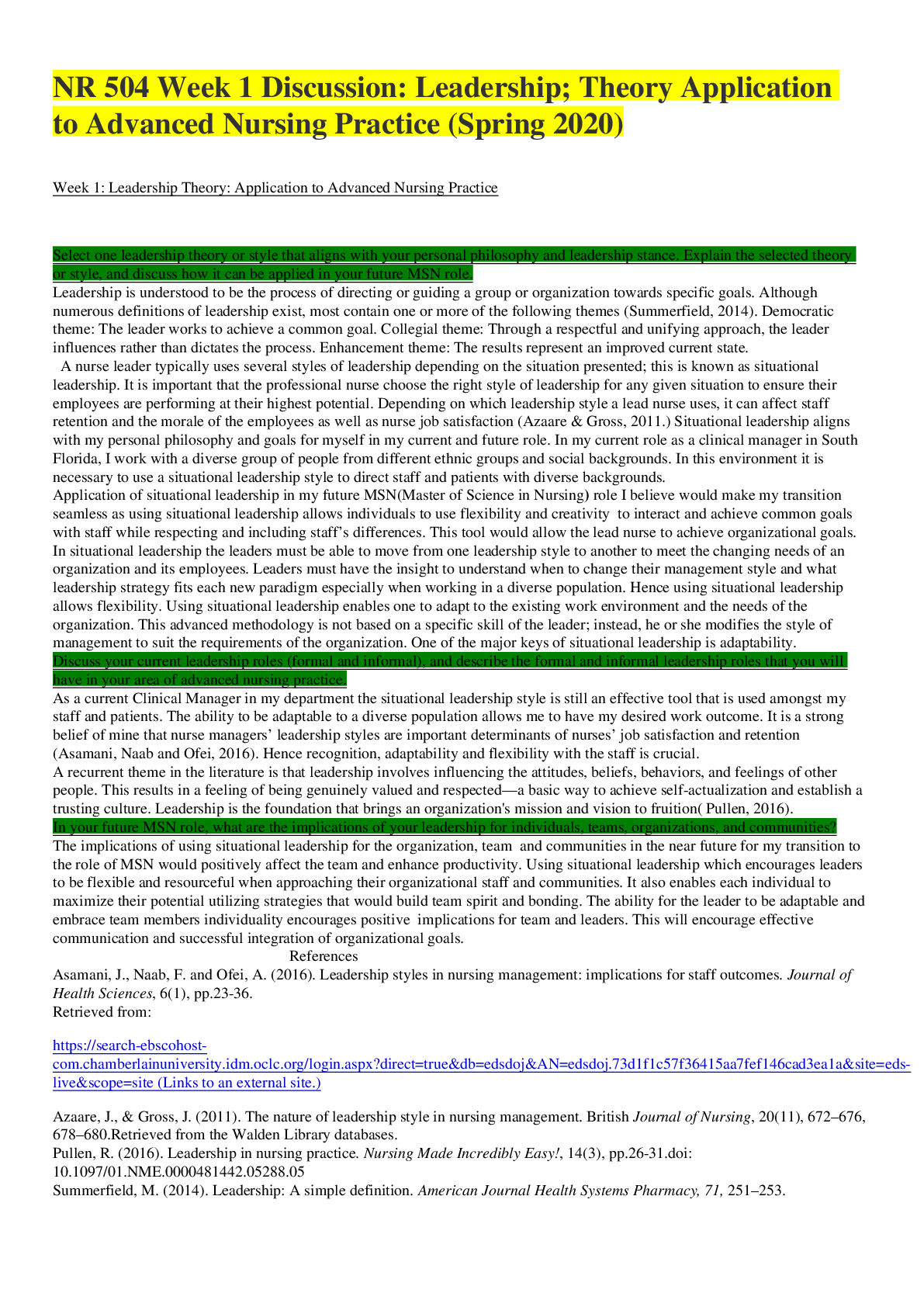
Week 1: Leadership Theory: Application to Advanced Nursing Practice
Select one leadership theory or style that aligns with your personal philosophy and leadership stance.
Explain the selected theory or style, and discuss how it can be applied in your future MSN role.
Leadership is understood to be the process of directing or guiding a group or organization towards
specific goals. Although numerous definitions of leadership exist, most contain one or more of the
following themes (Summerfield, 2014). Democratic theme: The leader works to achieve a common goal.
Collegial theme: Through a respectful and unifying approach, the leader influences rather than dictates
the process. Enhancement theme: The results represent an improved current state.
A nurse leader typically uses several styles of leadership depending on the situation presented; this is
known as situational leadership. It is important that the professional nurse choose the right style of
leadership for any given situation to ensure their employees are performing at their highest potential.
Depending on which leadership style a lead nurse uses, it can affect staff retention and the morale of the
employees as well as nurse job satisfaction (Azaare & Gross, 2011.) Situational leadership aligns with my
personal philosophy and goals for myself in my current and future role. In my current role as a clinical
manager in South Florida, I work with a diverse group of people from different ethnic groups and social
backgrounds. In this environment it is necessary to use a situational leadership style to direct staff and
patients with diverse backgrounds.
Application of situational leadership in my future MSN(Master of Science in Nursing) role I believe would
make my transition seamless as using situational leadership allows individuals to use flexibility and
creativity to interact and achieve common goals with staff while respecting and including staff’s
differences. This tool would allow the lead nurse to achieve organizational goals. In situational leadership
the leaders must be able to move from one leadership style to another to meet the changing needs of an
organization and its employees. Leaders must have the insight to understand when to change their
management style and what leadership strategy fits each new paradigm especially when working in a
diverse population. Hence using situational leadership allows flexibility. Using situational leadership
enables one to adapt to the existing work environment and the needs of the organization. This advanced
methodology is not based on a specific skill of the leader; instead, he or she modifies the style of
management to suit the requirements of the organization. One of the major keys of situational
leadership is adaptability.
Discuss your current leadership roles (formal and informal), and describe the formal and informal
leadership roles that you will have in your area of advanced nursing practice.
As a current Clinical Manager in my department the situational leadership style is still an effective tool
that is used amongst my staff and patients. The ability to be adaptable to a diverse population allows me
to have my desired work outcome. It is a strong belief of mine that nurse managers’ leadership styles are
important determinants of nurses’ job satisfaction and retention (Asamani, Naab and Ofei, 2016). Hence
recognition, adaptability and flexibility with the staff is crucial.
This study source was downloaded by 100000831988016 from CourseHero.com on 04-24-2022 09:29:37 GMT -05:00
https://www.coursehero.com/file/43688639/Week-1docx/
A recurrent theme in the literature is that leadership involves influencing the attitudes, beliefs,
behaviors, and feelings of other people. This results in a feeling of being genuinely valued and respected
—a basic way to achieve self-actualization and establish a trusting culture. Leadership is the foundation
that brings an organization's mission and vision to fruition( Pullen, 2016).
In your future MSN role, what are the implications of your leadership for individuals, teams,
organizations, and communities?
The implications of using situational leadership for the organization, team and communities in the near
future for my transition to the role of MSN would positively affect the team and enhance productivity.
Using situational leadership which encourages leaders to be flexible and resourceful when approaching
their organizational staff and communities. It also enables each individual to maximize their potential
utilizing strategies that would build team spirit and bonding. The ability for the leader to be adaptable
and embrace team members individuality encourages positive implications for team and leaders. This
will encourage effective communication and successful integration of organizational goals.
References
Asamani, J., Naab, F. and Ofei, A. (2016). Leadership styles in nursing management: implications for staff
outcomes. Journal of Health Sciences, 6(1), pp.23-36.
Retrieved from:
https://search-ebscohost-com.chamberlainuniversity.idm.oclc.org/login.aspx?
direct=true&db=edsdoj&AN=edsdoj.73d1f1c57f36415aa7fef146cad3ea1a&site=eds-live&scope=site (Lin
ks to an external site.)
Azaare, J., & Gross, J. (2011). The nature of leadership style in nursing management. British Journal of
Nursing, 20(11), 672–676, 678–680.Retrieved from the Walden Library databases.
Pullen, R. (2016). Leadership in nursing practice. Nursing Made Incredibly Easy!, 14(3), pp.26-31.doi:
10.1097/01.NME.0000481442.05288.05
Summerfield, M. (2014). Leadership: A simple definition. American Journal Health Systems Pharmacy,
71, 251–253
[Show More]