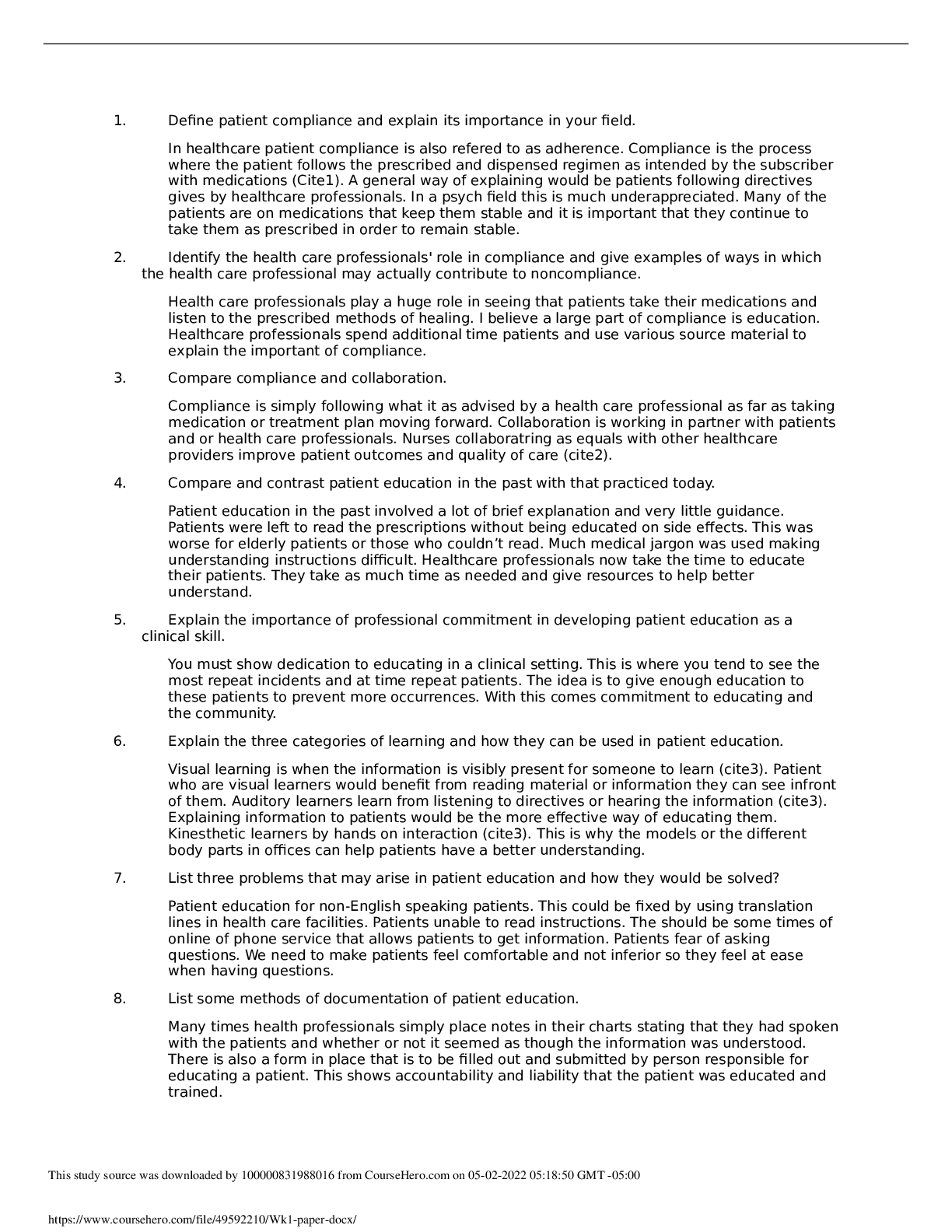
1. Define patient compliance and explain its importance in your field.
In healthcare patient compliance is also refered to as adherence. Compliance is the process
where the patient follows the prescribed and dispensed
...
1. Define patient compliance and explain its importance in your field.
In healthcare patient compliance is also refered to as adherence. Compliance is the process
where the patient follows the prescribed and dispensed regimen as intended by the subscriber
with medications (Cite1). A general way of explaining would be patients following directives
gives by healthcare professionals. In a psych field this is much underappreciated. Many of the
patients are on medications that keep them stable and it is important that they continue to
take them as prescribed in order to remain stable.
2. Identify the health care professionals' role in compliance and give examples of ways in which
the health care professional may actually contribute to noncompliance.
Health care professionals play a huge role in seeing that patients take their medications and
listen to the prescribed methods of healing. I believe a large part of compliance is education.
Healthcare professionals spend additional time patients and use various source material to
explain the important of compliance.
3. Compare compliance and collaboration.
Compliance is simply following what it as advised by a health care professional as far as taking
medication or treatment plan moving forward. Collaboration is working in partner with patients
and or health care professionals. Nurses collaboratring as equals with other healthcare
providers improve patient outcomes and quality of care (cite2).
4. Compare and contrast patient education in the past with that practiced today.
Patient education in the past involved a lot of brief explanation and very little guidance.
Patients were left to read the prescriptions without being educated on side effects. This was
worse for elderly patients or those who couldn’t read. Much medical jargon was used making
understanding instructions difficult. Healthcare professionals now take the time to educate
their patients. They take as much time as needed and give resources to help better
understand.
5. Explain the importance of professional commitment in developing patient education as a
clinical skill.
You must show dedication to educating in a clinical setting. This is where you tend to see the
most repeat incidents and at time repeat patients. The idea is to give enough education to
these patients to prevent more occurrences. With this comes commitment to educating and
the community.
6. Explain the three categories of learning and how they can be used in patient education.
Visual learning is when the information is visibly present for someone to learn (cite3). Patient
who are visual learners would benefit from reading material or information they can see infront
of them. Auditory learners learn from listening to directives or hearing the information (cite3).
Explaining information to patients would be the more effective way of educating them.
Kinesthetic learners by hands on interaction (cite3). This is why the models or the different
body parts in offices can help patients have a better understanding.
7. List three problems that may arise in patient education and how they would be solved?
Patient education for non-English speaking patients. This could be fixed by using translation
lines in health care facilities. Patients unable to read instructions. The should be some times of
online of phone service that allows patients to get information. Patients fear of asking
questions. We need to make patients feel comfortable and not inferior so they feel at ease
when having questions.
8. List some methods of documentation of patient education.
Many times health professionals simply place notes in their charts stating that they had spoken
with the patients and whether or not it seemed as though the information was understood.
There is also a form in place that is to be filled out and submitted by person responsible for
educating a patient. This shows accountability and liability that the patient was educated and
trained.
This study source was downloaded by 100000831988016 from CourseHero.com on 05-02-2022 05:18:50 GMT -0
[Show More]