Vocabulary: atmosphere, biomass, biosphere, carbon reservoir, carbon sink, fossil
fuel, geosphere, greenhouse gas, hydrosphere, lithosphere, photosynthesis
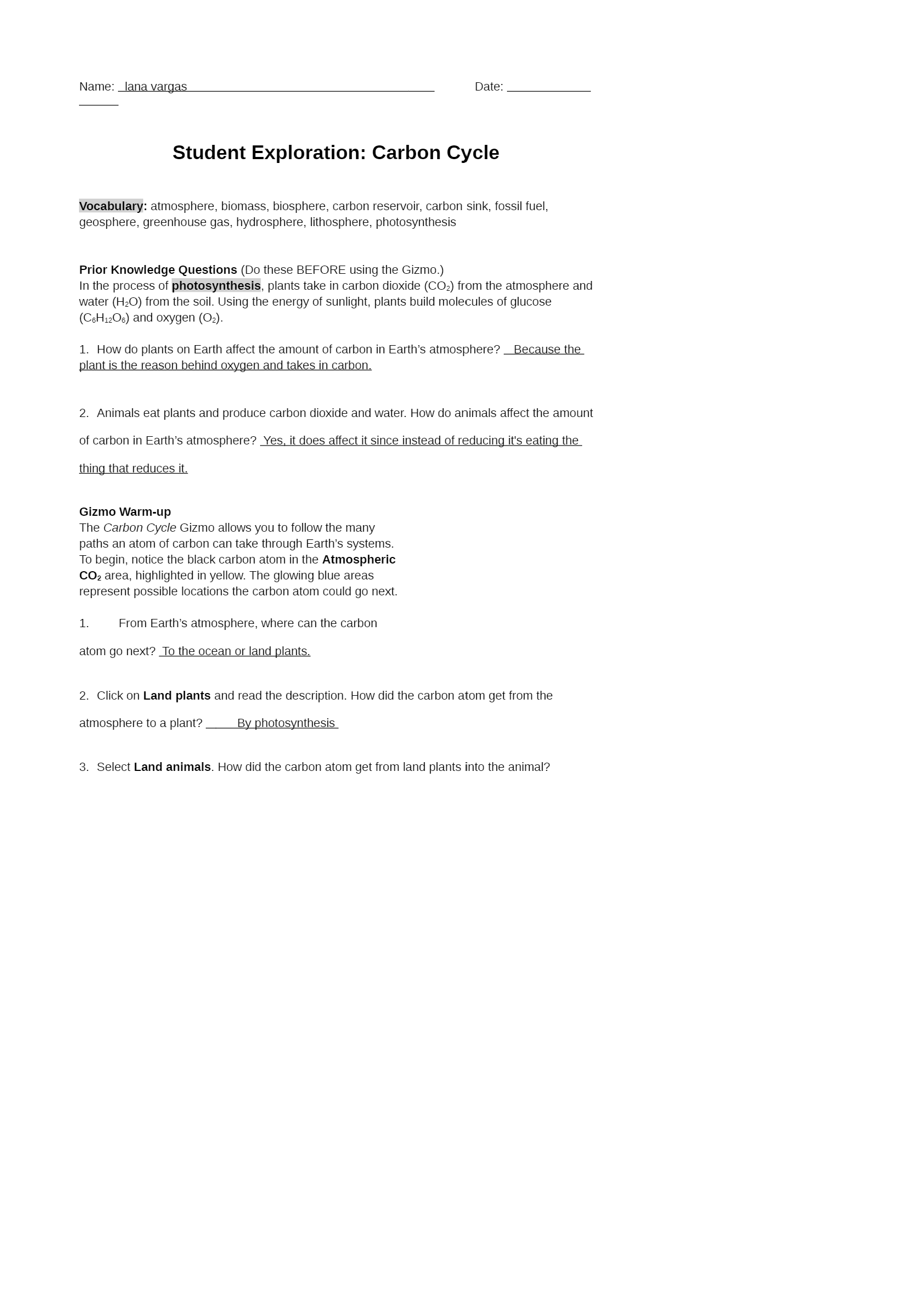
Prior Knowledge Questions (Do these BEFORE using the Gizmo.)
...
Vocabulary: atmosphere, biomass, biosphere, carbon reservoir, carbon sink, fossil
fuel, geosphere, greenhouse gas, hydrosphere, lithosphere, photosynthesis
Prior Knowledge Questions (Do these BEFORE using the Gizmo.)
In the process of photosynthesis, plants take in carbon dioxide (CO2) from the
atmosphere and water (H2O) from the soil. Using the energy of sunlight, plants build
molecules of glucose (C6H12O6) and oxygen (O2).
1. How do plants on Earth affect the amount of carbon in Earth’s atmosphere?
Plants help reduce carbon by absorbing carbon dioxide and making it into oxygen.
2. Animals eat plants and produce carbon dioxide and water. How do animals affect the amount
of carbon in Earth’s atmosphere?
The animals increase the amount of carbon dioxide.
Gizmo Warm-up
The Carbon Cycle Gizmo™ allows you to follow
the many paths an atom of carbon can take
through Earth’s systems. To begin, notice the
black carbon atom in the Atmospheric CO2 area,
highlighted in yellow. The glowing blue areas
represent possible locations the carbon atom
could go next.
1. From Earth’s atmosphere,where can the carbon atom go next?
The land plants, exposed rocks and the ocean.
2. Click on Land plants and read the description. How did the carbon atom get from
the atmosphere to a plant?
Because of Photosynthesis.
This study source was downloaded by 100000830772748 from CourseHero.com on 05-06-2022 14:06:09 GMT -05:00
https://www.coursehero.com/file/70954051/Copy-of-Gizmo-Student-Exploration-Carbon-Cycle-Lab-Modifieddocx/
3. Select Land animals. How did the carbon atom get from land plants into the animal?
Through the process of photosynthesis, carbon dioxide is pulled from the air to produce food made
from carbon for plant growth. Carbon moves from plants to animals. Through food chains, the
carbon that is in plants moves to the animals that eat them. Animals that eat other animals get the
carbon from their food too.
4. Select Atmospheric CO2. How did the carbon atom get from land animals back
to the atmosphere?
The animal releases the carbon back into the air by the process of cellular respiration.
Activity A:
Carbon
pathways
Get the Gizmo ready:
● Click Reset.
Introduction: Earth can be divided into four systems. The atmosphere is the air
above Earth’s surface. The hydrosphere is composed of all of Earth’s water. The
geosphere is the rocky, non-living part of Earth. The biosphere consists of all living
things, including people. Some scientists use the term “anthroposphere” to describe
everything made or modified by humans.
Question: How does carbon move between the atmosphere, hydrosphere,
biosphere, and geosphere?
1. Create: Click Reset. Use the Gizmo to create a path in which the carbon atom
goes from the atmosphere to the hydrosphere, biosphere and geosphere.
Describe each transition briefly.
Atmosphere Hydrosphere
(water)
Biosphere
(living)
Geosphere
(non-living)
Atmospheric
CO2
Ocean Marine plants and
algae.
Sediments
Volcanoes,
burning fossil
fuels, and other
sources.
Rain water breaks
down exposed
rocks.
During
photosynthesis,
marine algae and
plants remove
carbon dioxide.
Uneaten plants
and algae drift
down to the ocean
floor and become a
part of marine
sediments.
This study source was downloaded by 100000830772748 from CourseHero.com on 05-06-2022 14:06:09 GMT -05:00
https://www.coursehero.com/file/70954051/Copy-of-Gizmo-Student-Exploration-Carbon-Cycle-Lab-Modifieddocx/
Activity A (continued from previous page)
2. Explore: Use the Gizmo to create two more carbon paths, each starting and
ending in the atmosphere. Label each location with A for atmosphere, B for
biosphere, G for geosphere, or H for hydrosphere. (You can also use P for
anthroposphere if you like, or just include it in the biosphere.)
[Show More]