Biology 101 Quiz 5
UMUC; BIO. 101
QUIZ: 5,
DNA REPLICATION
Question 1 (5 points)
If a strand of DNA of sequence 5’-TGGACCTAGACC-3’ is replicated, which of the following accurately represents the newly syn
...
Biology 101 Quiz 5
UMUC; BIO. 101
QUIZ: 5,
DNA REPLICATION
Question 1 (5 points)
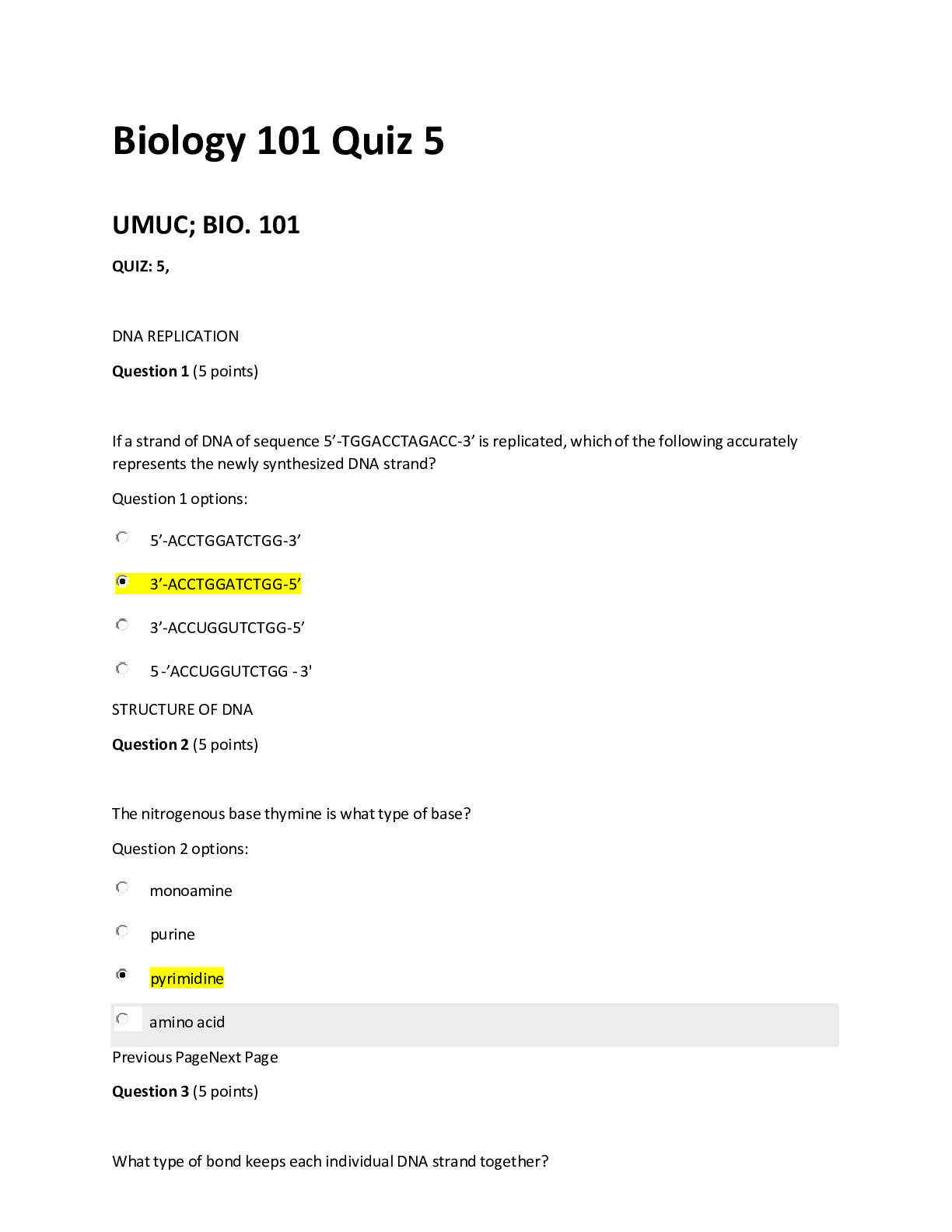
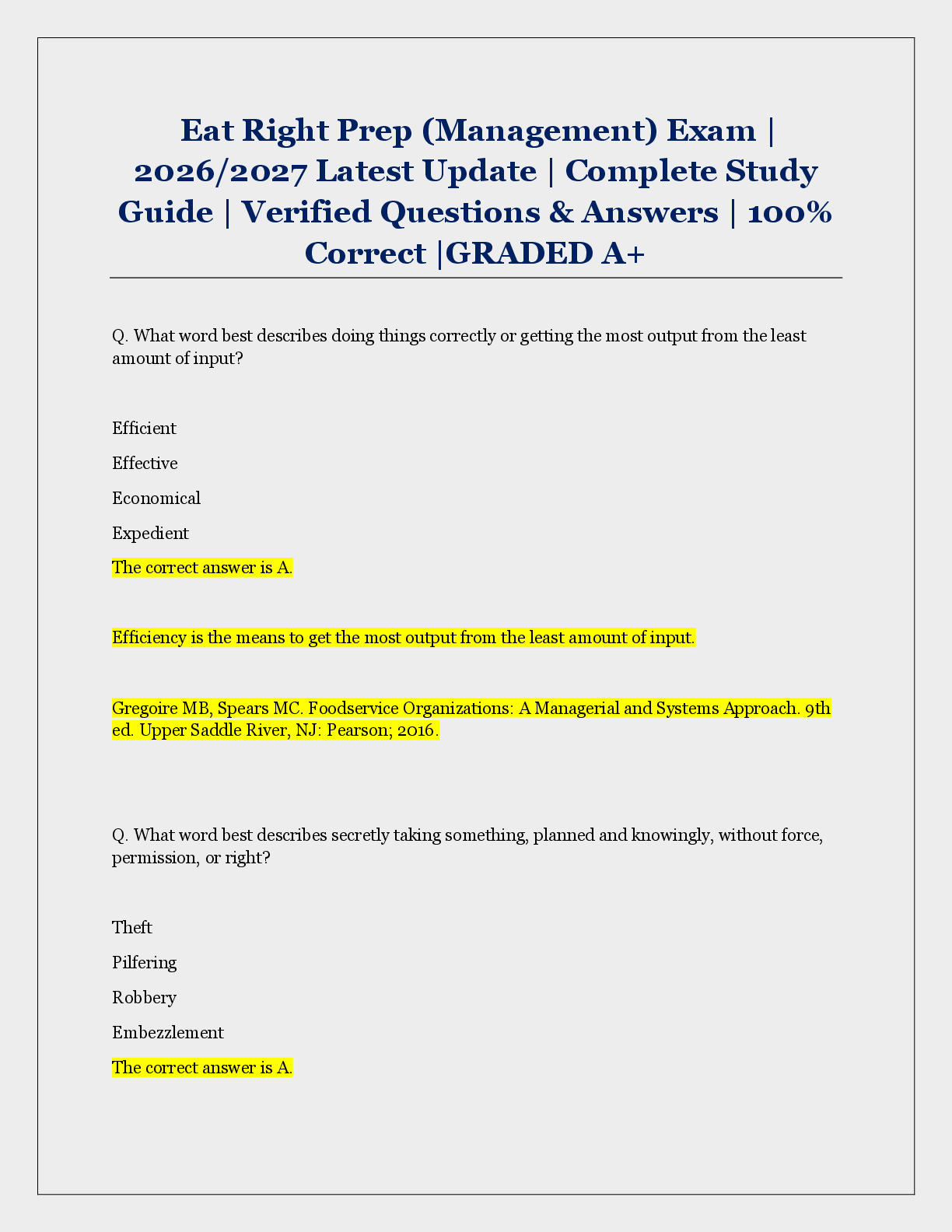
If a strand of DNA of sequence 5’-TGGACCTAGACC-3’ is replicated, which of the following accurately represents the newly synthesized DNA strand?
Question 1 options:
5’-ACCTGGATCTGG-3’
3’-ACCTGGATCTGG-5’
3’-ACCUGGUTCTGG-5’
5 -’ACCUGGUTCTGG - 3' STRUCTURE OF DNA
Question 2 (5 points)
The nitrogenous base thymine is what type of base? Question 2 options:
monoamine purine
pyrimidine
Previous PageNext Page
Question 3 (5 points)
What type of bond keeps each individual DNA strand together?
Question 3 options:
covalent bonds ionic bonds
hydrogen bonds
electrostatic bonds
Question 4 (5 points)
Which of the following accurately shows DNA base pairing and hydrogen bond number? Question 4 options:
Adenine—Thymine, 2 hydrogen bonds Adenine—Thymine, 3 hydrogen bonds Cytosine - Guanine, 2 hydrogen bonds
Cytosine - Guanine, 4 hydrogen bonds
Question 5 (5 points)
What molecule connects the sugars in a strand of DNA? Question 5 options:
ribose
phosphate deoxyribose
hydrogen TRANSCRIPTION
Question 6 (5 points)
Transcription is the transfer of genetic information from . Question 6 options:
mRNA to DNA tRNA to mRNA DNA to mRNA
Question 7 (5 points)
Which enzyme is required during transcription? Question 7 options:
restriction enzymes DNA polymerase
RNA polymerase RNAase
HOW GENES ARE REGULATED
Question 8 (5 points)
Control of gene expression in eukaryotic cells occurs at which level(s)? Question 8 options:
only the transcriptional level
epigenetic and transcriptional levels
epigenetic, transcriptional, and translational levels
epigenetic, transcriptional, post-transcriptional, translational, and post-translational levels
TRANSLATION
Question 9 (5 points)
In the process of translation, which of the following molecules specifies the amino acid sequence of a protein product?
Question 9 options: rRNA
tRNA mRNA DNA
Question 10 (5 points)
Use the genetic code to determine which amino acids the following mRNA sequence code for: GUA GAC GGG
Question 10 options:
Arg, His, Pro Gly, Asp, Val Val, Asp, Gly
Pro, His, Arg
Question 11 (5 points)
If a DNA strand with the sequence GAT TAC GGG ATA GCG is transcribed, which of the following accurately represents the newly synthesized mRNA strand?
Question 11 options:
GAT TAC GGG ATA GCG GUA AUC GGG UAU GCG CTA ATG CCC TAT CGC
CUA AUG CCC UAU CGC
Question 12 (5 points)
An individual has a mutation in the gene that codes for hemoglobin. This results in sickle cell disease. Choose the correct explanation for how this mutation affects the individual's traits.
Question 12 options:
The error in the DNA sequence results in an error in the mRNA molecule during transcription, the error in the mRNA molecule results in an incorrect nucleic acid in the hemoglobin protein which makes it non-functional. The resulting trait is sickle cell disease.
The error in the mRNA sequence results in an error in the DNA molecule during transcription, the error in the DNA molecule results in an incorrect amino acid in the hemoglobin protein which makes it non-functional. The resulting trait is sickle cell disease.
The error in the mRNA sequence results in an error in the DNA molecule during transcription, the error in the DNA molecule results in an incorrect nucleic acid in the hemoglobin protein which
makes it non-functional. The resulting trait is sickle cell disease.
The error in the DNA sequence results in an error in the mRNA molecule during transcription, the error in the mRNA molecule results in an incorrect amino acid in the hemoglobin protein which makes it non-functional. The resulting trait is sickle cell disease
RNA METABOLISM
Question 13 (5 points)
Where are the RNA components of a eukaryotic cell synthesized? Question 13 options:
cell membrane nucleus
cytoplasm
endoplasmic reticulum GENE EXPRESSION
Question 14 (5 points)
Which of the following applies best to post-translational control? Question 14 options:
regulation of gene expression after transcription regulation of gene expression after translation control of epigenetic activation
Question 15 (5 points)
What is a genetically modified organism (GMO)? Question 15 options:
A plant with certain genes added that mimic naturally occurring genes for that plant An organism with an artificially altered genome
An organism made of proteins from two different organisms An animal produced by artificial selection
Question 16 (5 points)
In the reproductive cloning of an animal, what cell type is used as the source of the genome of the cloned animal?
Question 16 options:
A sperm cell An egg cell
Any gamete cell
A somatic (non-gamete)) cell
Question 17 (5 points)
Which of the applications of genomics listed below can be used in agriculture? Question 17 options:
All of the above
Improve crop production Improve disease resistance
Question 18 (5 points)
Which of the options listed below can serve to carry a gene from one organism into a bacteria cell? Question 18 options:
A plasmid
An electrophoresis gel A restriction enzyme
Polymerase chain reaction
Question 19 (5 points)
Which of the following statements about the Flavr Savr tomato are correct? Select all that apply. Question 19 options:
The Flavr Savr tomato was the first genetically modified crop to be approved for human consumption in the U. S.
The Flavr Savr tomato is no longer on the market.
The Flavr Savr tomato has an inserted bacterial gene in its genome that provides herbicide resistance.
The Flavr Savr tomato was genetically engineered to slow down the rotting process for a longer shelf life.
Question 20 (5 points)
What is one way that scientists use metagenomics? Question 20 options:
Forensic analysis
Study the genomes of multiple species in the same environmental niche
Evaluate the effectiveness of drugs based on individual’s genomic sequence
DNA REPLICATION
Question 1 (5 points)
Saved
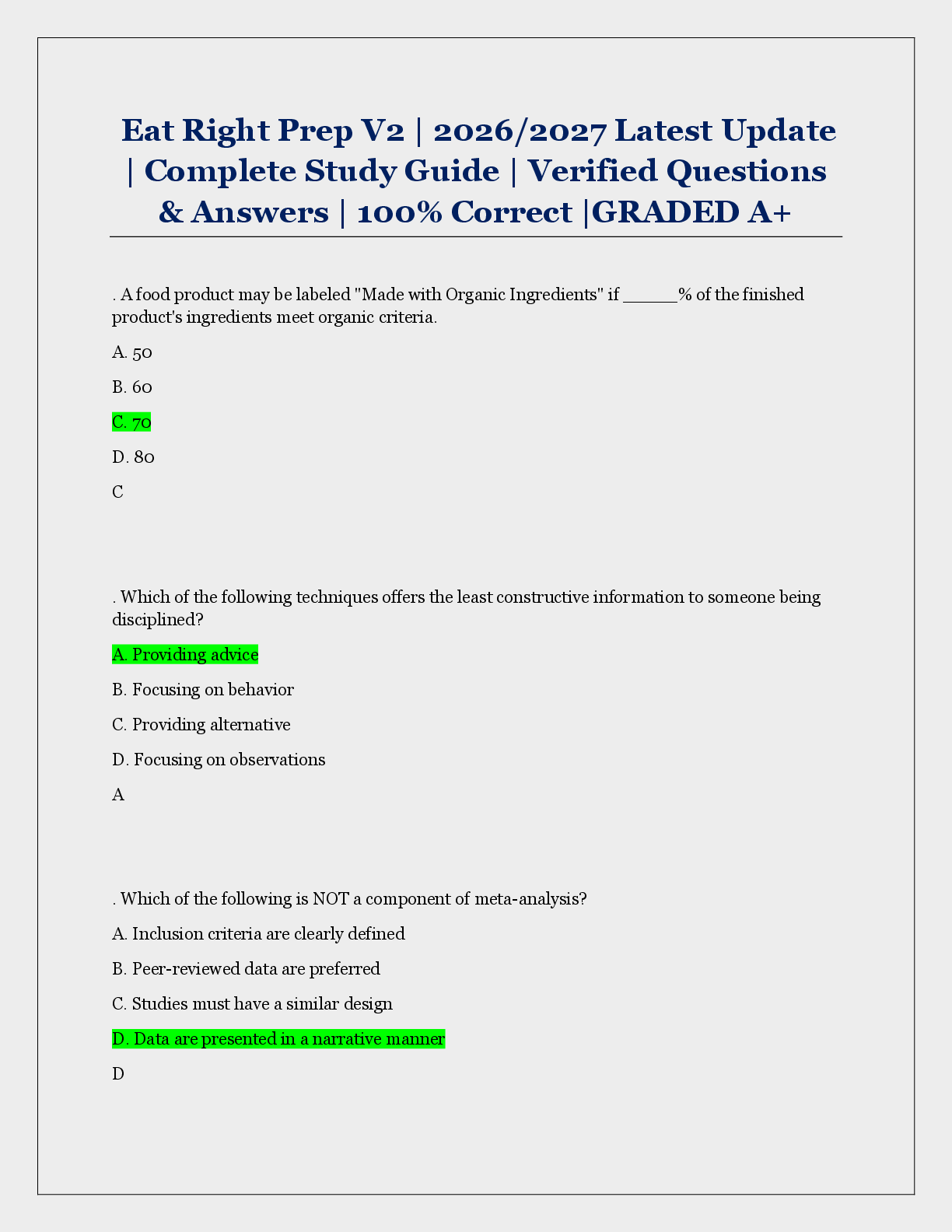
If a strand of DNA of sequence 5’-AATAGCGCGGTATTC-3’ is replicated, which of the following accurately represents the newly synthesized DNA strand?
Question 1 options:
5’-TTATCGCGCCATAAG-3’
5 -’CCACTGTGTTACAAG - 3'
3’-CCACTGTGTTACAAG-5’
STRUCTURE OF DNA
Question 2 (5 points)
What proteins are crucial for creating and maintaining DNA replication forks? Choose the best explanation.
Question 2 options:
Helicase creates the replication fork; primase keeps the single strands from closing shut.
Helicase creates the replication fork; single-strand binding proteins keep the single strands from reuniting.
Ligase creates the replication fork; DNA polymerase II keeps the single strands from reuniting.
Question 3 (5 points)
Which of the following is not a component of nucleotides, the building blocks of DNA? Question 3 options:
deoxyglucose
inorganic phosphate nitrogenous base
deoxyribose
Question 4 (5 points)
What type of bond keeps each individual DNA strand together? Question 4 options:
covalent bonds ionic bonds
hydrogen bonds
electrostatic bonds
Question 5 (5 points)
Which of the following accurately shows DNA base pairing and hydrogen bond number? Question 5 options:
Adenine—Thymine, 2 hydrogen bonds Adenine—Thymine, 3 hydrogen bonds Cytosine - Guanine, 2 hydrogen bonds
Cytosine - Guanine, 4 hydrogen bonds TRANSCRIPTION
Question 6 (5 points)
What is the name of the process that produces RNA using a gene as a template? Question 6 options:
transcription translation transposition
replication DNA POLYMERASE
Question 7 (5 points)
What is the part of the gene called where the DNA polymerase first binds during transcription? Question 7 options:
promoter repressor operon
inducer
HOW GENES ARE REGULATED
Question 8 (5 points)
What does the process of post-translational control refers to? Question 8 options:
regulation of gene expression after transcription regulation of gene expression after translation control of epigenetic activation
period between transcription and translation TRANSLATION
Question 9 (5 points)
In the process of translation, Question 9 options:
a strand of mRNA is formed with nucleotide sequences complementary to those of DNA nucleotide sequences of tRNA are established
rRNA is synthesized with sequences complementary to those of tRNA
Question 10 (5 points)
Use the genetic code to determine which amino acids the following mRNA sequence code for: AAA GCG GAA
Question 10 options: Lys, Ala, Glu
Lys, Phe, Trp Trp, Phe, Lys Glu, Ala, Lys
Question 11 (5 points)
If a DNA strand with the sequence GGCATGCCTATGCGA is transcribed, which of the following accurately represents the newly synthesized mRNA strand?
Question 11 options:
CCGAUCGGUAUCGCA GGCATGCCTATGCGA CCGTACGGATACGCT
CCGUACGGAUACGCU
Question 12 (5 points)
An individual has a mutation in the gene that codes for brown eye color. This results in blue eyes. Choose the correct explanation for how this mutation affects the individual's traits.
Question 12 options:
The error in the DNA sequence results in an error in the mRNA molecule during transcription, the error in the mRNA molecule results in an incorrect amino acid in the brown pigment protein which makes it non-functional. The resulting trait is blue eyes.
The error in the DNA sequence results in an error in the mRNA molecule during transcription, the error in the mRNA molecule results in an incorrect nucleic acid in the brown pigment protein which makes it non-functional. The resulting trait is blue eyes.
The error in the mRNA sequence results in an error in the DNA molecule during transcription, the error in the DNA molecule results in an incorrect amino acid in the brown pigment protein which makes it non-functional. The resulting trait is blue eyes.
The error in the mRNA sequence results in an error in the DNA molecule during transcription, the error in the DNA molecule results in an incorrect nucleic acid in the brown pigment protein which makes it non-functional. The resulting trait is blue eyes.
RNA METABOLISM
Question 13 (5 points)
What is the name given to the portions of eukaryotic mRNA sequence that are removed during RNA processing?
Question 13 options:
exons caps
poly - A tails introns
GENE EXPRESSION
Question 14 (5 points)
Control of gene expression in prokaryotic cells occurs at which level(s)? Question 14 options:
primarily at the transcriptional level epigenetic and transcriptional levels only at the post-translational levels
Question 15 (5 points)
What is the role of Agrobacterium tumefaciens in the production of transgenic plants? Question 15 options:
Tomatoes get increased shelf life when exposed to the beneficial bacteria Agrobacterium tumefaciens.
Transgenic plants are all designed to be resistant to the disease causing bacteria Agrobacterium tumefaciens.
Agrobacterium tumefaciens is a bacteria that is used to move desired genes into the plant cells.
Agrobacterium tumefaciens is a bacteria that produces Bt toxins that kill small mammals.
Question 16 (5 points)
What is a genetically modified organism (GMO)? Question 16 options:
A plant with certain genes added that mimic naturally occurring genes for that plant An organism with an artificially altered genome
An organism made of proteins from two different organisms An animal produced by artificial selection
Question 17 (5 points)
Which of the options listed below can serve to carry a gene from one organism into a bacteria cell? Question 17 options:
A plasmid
An electrophoresis gel A restriction enzyme
Question 18 (5 points)
In the reproductive cloning of an animal, what cell type is used as the source of the genome of the cloned animal?
Question 18 options:
A sperm cell An egg cell
Any gamete cell
A somatic (non-gamete)) cell
Question 19 (5 points)
Which of the following statements about genetically modified organisms (GMOS) are correct? Select all that apply.
Question 19 options:
Transgenic bacteria are used to produce protein for human consumption.
Transgenic goats have been engineered with a human gene that produces blood anticoagulant protein.
Transgenic mice are frequently used to study the effects of gene mutations. Transgenic bacteria are used to produce human growth hormone.
Question 20 (5 points)
What is proteomics?
Question 20 options:
The study of all the genes in an organism The study of prostate cancer
The study of the function of all proteins in an organism
[Show More]