Biochemistry – C785
Unit 4 Quiz
Additional Questions
Part ½
1. Homologous recombination:
a. Repairs a broken chromosome using genetic information from same chromosome
inherited from other parent.
2. Mismatch repai
...
Biochemistry – C785
Unit 4 Quiz
Additional Questions
Part ½
1. Homologous recombination:
a. Repairs a broken chromosome using genetic information from same chromosome
inherited from other parent.
2. Mismatch repair:
a. Fixes mistakes made by DNA polymerase during DNA replication
3. What is the proper order of the steps involved in excision repair?
a. Recognize the damage, remove the damage, resynthesize the sequence, ligate the DNA
backbone.
4. Which of the following is NOT a step in base excision repair?
a. Synthesis of an RNA primer
5. Which statement is true with respect to mismatch repair and nucleotide excision repair (NER)?
a. Mismatch repair follows the same steps as NER.
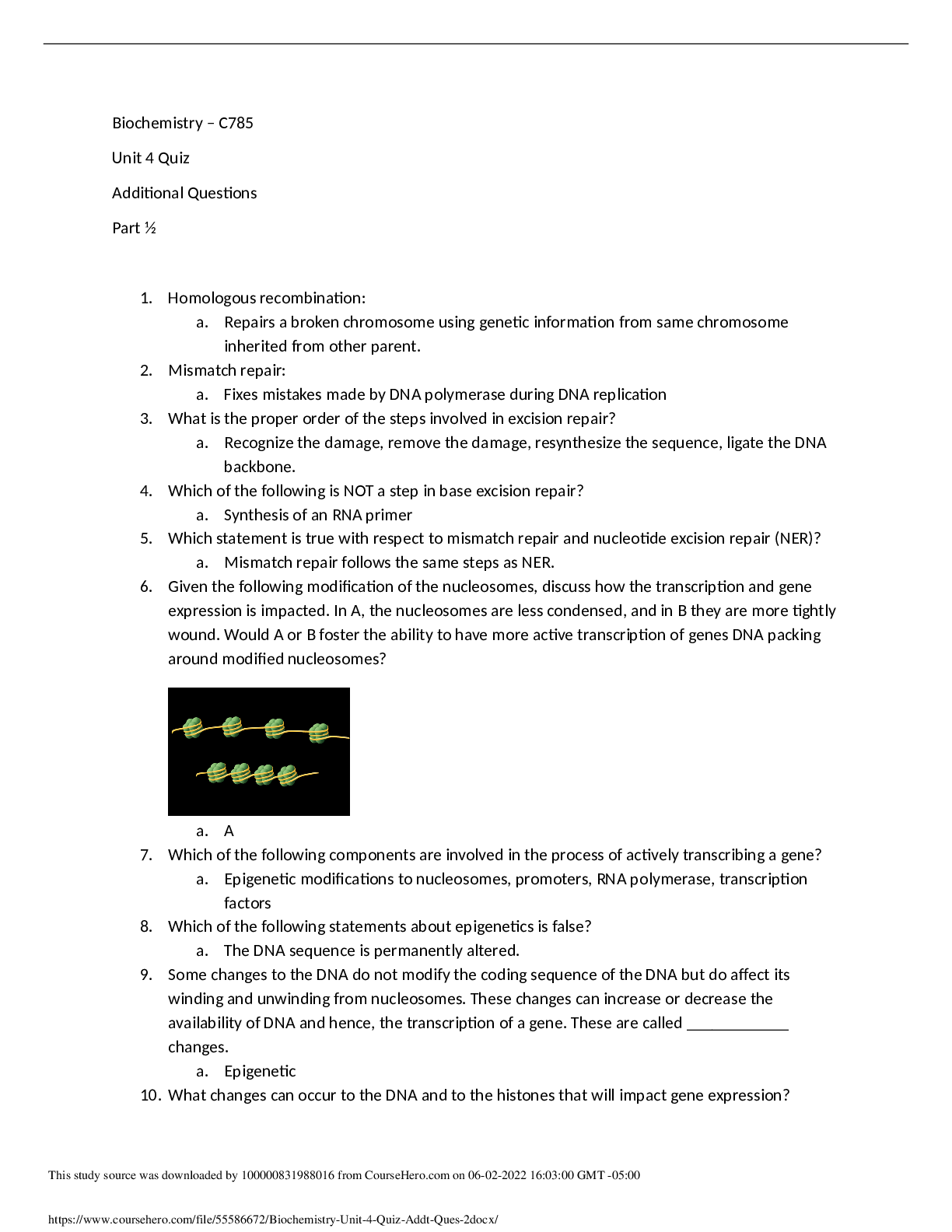
6. Given the following modification of the nucleosomes, discuss how the transcription and gene
expression is impacted. In A, the nucleosomes are less condensed, and in B they are more tightly
wound. Would A or B foster the ability to have more active transcription of genes DNA packing
around modified nucleosomes?
a. A
7. Which of the following components are involved in the process of actively transcribing a gene?
a. Epigenetic modifications to nucleosomes, promoters, RNA polymerase, transcription
factors
8. Which of the following statements about epigenetics is false?
a. The DNA sequence is permanently altered.
9. Some changes to the DNA do not modify the coding sequence of the DNA but do affect its
winding and unwinding from nucleosomes. These changes can increase or decrease the
availability of DNA and hence, the transcription of a gene. These are called ____________
changes.
a. Epigenetic
10. What changes can occur to the DNA and to the histones that will impact gene expression?
This study source was downloaded by 100000831988016 from CourseHero.com on 06-02-2022 16:03:00 GMT -05:00
https://www.coursehero.com/file/55586672/Biochemistry-Unit-4-Quiz-Addt-Ques-2docx/
a. Methylation
11. Proteins that promote coiling of DNA and help prevent DNA strands from "tangling" are called?
a. Histones
12. The LCT gene codes for Lactase, which is responsible for the breakdown of lactose. Which of the
following statements could explain how Lactase activity is increased in the presence of lactose?
a. The presence of lactose causes nucleosomes to separate, exposing the LCT gene.
13. The LEP gene codes for an anorexigenic hormone. Interestingly, breastfeeding has been shown to
alter methylation of the promoter of this gene, leading to increased LEP expression. What is
likely happening in response to breastfeeding:
a. Breastfeeding decreases the methylation of the promoter of the LEP gene, increasing the
spacing between nucleosomes.
14. In the organization of DNA into chromosomes, DNA is wrapped around ______ to form
nucleosomes. Nucleosomes are organized further to form ________.
a. histones; chromatin
15. Histone proteins can be chemically modified by the addition of a methyl group. If this causes
nucleosomes to pack _______, the process of _______ is decreased at those DNA sites.
a. more tightly; transcription
16. What color is the primer in the following diagram?
a. Red
17. DNA polymerase is used in DNA replication and in PCR.
a. True
18. dNTPs are DNA nucleotides used in PCR.
a. True
19. The polymerase chain reaction is a tool used to study protein structure.
a. False
20. A thermocycler is a machine used for PCR that varies the temperature of a sample.
a. True
21. Which of the following changes can NOT be detected using PCR?
a. Epigenetic changes
22. Which of the following components is NOT used in PCR?
a. RNA polymerase
23. DNA polymerase can synthesize new DNA strands in which direction?
a. 5' to 3'
24. The following are steps involved in the polymerase chain reaction. Which is the correct order:
a. Denaturation, annealing, and elongation
25. Assuming there is one copy of the target DNA sequence before PCR, how many copies of DNA
are thereafter 5 PCR cycles?
a. 32
[Show More]