Question 1
1. A nurse explains to a patient that nitroglycerin patches should be applied in the morning and removed in the evening. This medication schedule reduces the potential for
A. adverse effects.
B. toxi
...
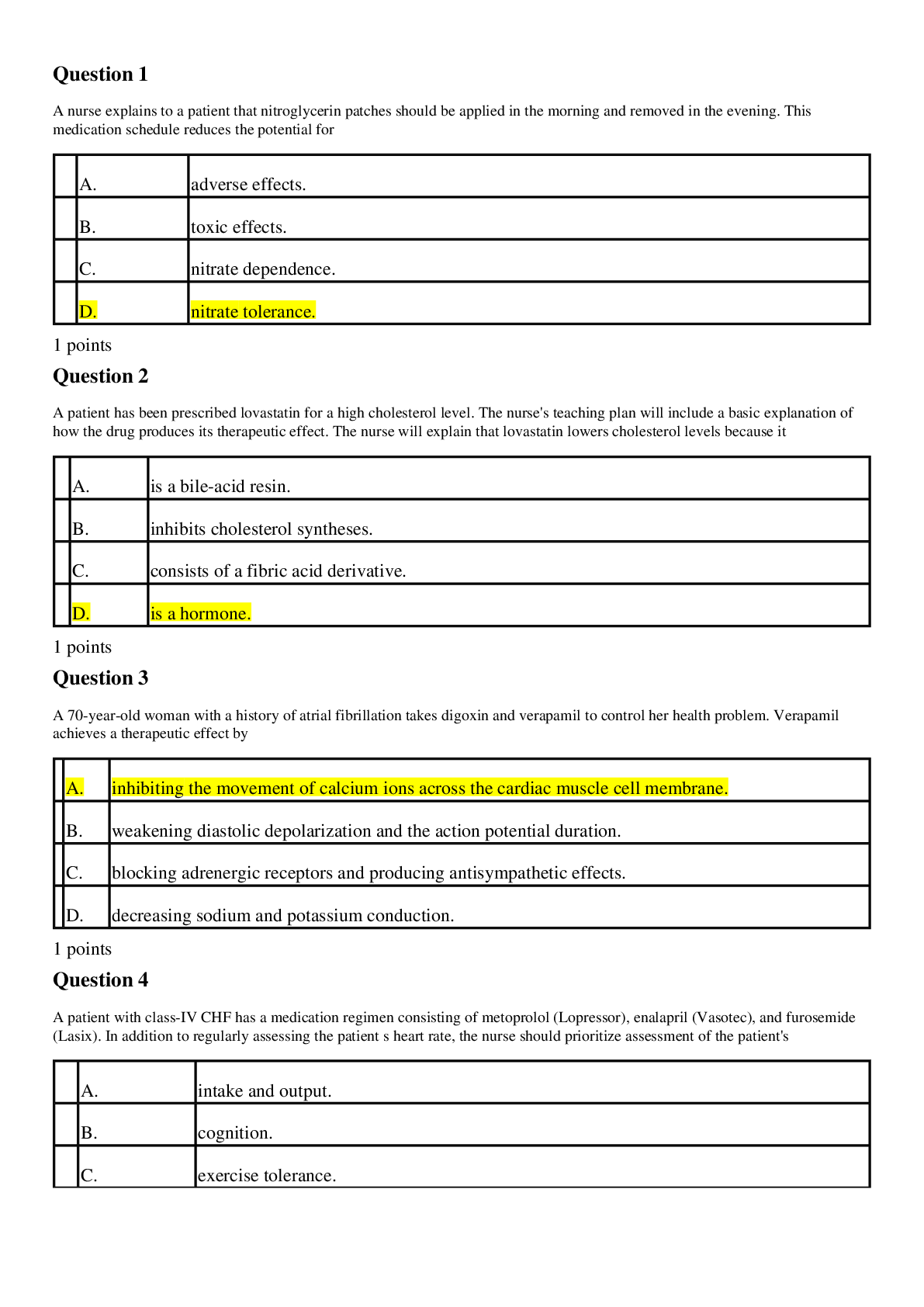
Question 1
1. A nurse explains to a patient that nitroglycerin patches should be applied in the morning and removed in the evening. This medication schedule reduces the potential for
A. adverse effects.
B. toxic effects.
C. nitrate dependence.
D. nitrate tolerance.
1 points
Question 2
1. A patient has been prescribed lovastatin for a high cholesterol level. The nurse's teaching plan will include a basic explanation of how the drug produces its therapeutic effect. The nurse will explain that lovastatin lowers cholesterol levels because it
A. is a bile-acid resin.
B. inhibits cholesterol syntheses.
C. consists of a fibric acid derivative.
D. is a hormone.
1 points
Question 3
1. A 70-year-old woman with a history of atrial fibrillation takes digoxin and verapamil to control her health problem. Verapamil achieves a therapeutic effect by
A. inhibiting the movement of calcium ions across the cardiac muscle cell membrane.
B. weakening diastolic depolarization and the action potential duration.
C. blocking adrenergic receptors and producing antisympathetic effects.
D. decreasing sodium and potassium conduction.
1 points
Question 4
1. A patient with class-IV CHF has a medication regimen consisting of metoprolol (Lopressor), enalapril (Vasotec), and furosemide (Lasix). In addition to regularly assessing the patient s heart rate, the nurse should prioritize assessment of the patient's
A. intake and output.
B. cognition.
C. exercise tolerance.
D. blood pressure.
1 points
Question 5
1. A nurse is providing patient education to a 35-year-old man who has been prescribed clonidine (Catapres) as part of step 2 antihypertensive therapy. The nurse should anticipate that the drug will be administered
A. subcutaneously.
B. transdermally.
C. intravenously.
D. orally.
1 points
Question 6
1. A 39-year-old African-American male is 25 pounds overweight and has been diagnosed with hypertension after three consecutive above-normal blood pressure readings. The most likely initial drug therapy for this patient will be
A. a beta blocker.
B. a calcium channel blocker.
C. a diuretic.
D. an ACE inhibitor.
1 points
Question 7
1. A patient has recently been prescribed a drug that treats his hypertension by blocking the sympathetic receptors in his sympathetic nervous system. This action is characteristic of
A. an adrenergic agonist.
B. a neurotransmitter.
C. a cardiotonic.
D. an adrenergic antagonist.
1 points
Question 8
1. A 62-year-old man has been prescribed extended-release lovastatin. The nurse will instruct the patient to take the medication
A. in the evening.
B. in the early morning.
C. in the afternoon.
D. at bedtime.
1 points
Question 9
1. A female patient is taking 0.125 mg of digoxin daily for heart failure. At a recent clinic visit she reports that since she has been on the drug, she can breathe better and her heart rate has been around 74 beats per minute. The nurse weighs the patient and notices that she has gained 10 pounds since the digoxin therapy was started. The patient is concerned that the additional weight will necessitate an increase in the medication. Which of the following is an appropriate response by the nurse?
A. “No, the drug dosage will have to be decreased.”
B. “I don't know; I will have to ask your physician.”
C. “Yes, the drug dosage will probably have to be increased.”
D. “No, the drug dosage will likely stay the same.”
1 points
Question 10
1. A patient is diagnosed with heart failure and is started on digoxin. On the second day of therapy, lab values, the ECG results, and the patient's symptoms indicate that the medication is not producing a therapeutic effect. An appropriate nursing action would be to
A. seek orders to discontinue digoxin and start another drug.
B. seek orders to increase the dosage.
C. continue to administer the drug as ordered.
D. insist that another drug should be ordered in addition to the digoxin.
1 points
Question 11
1. A nurse is the cardiac care unit is preparing to hang an intravenous dose of dofetilide (Tikosyn) for a patient who has just been admitted. What is the most likely goal of this intervention?
A. To treat sinus bradycardia accompanied by hypotension
B. To resolve the patient's uncompensated heart failure
C. To convert the patient's atrial fibrillation to normal sinus rhythm
D. To treat the patient's ventricular tachycardia
1 points
Question 12
1. A nurse has been following a male patient who is taking hydralazine, clonidine, and a diuretic for hypertension. After 2 weeks of medication therapy, the patient begins to complain of numbness and tingling in his hands and feet. The nurse suspects that these signs or symptoms are
A. signs of peripheral neuritis.
B. a result of new onset diabetes.
C. an adverse effect of the diuretic.
D. an idiosyncratic reaction to clonidine.
1 points
Question 13
1. A nurse is caring for a male patient who has a diagnosis of coronary artery disease (CAD). His drug therapy includes lovastatin. Because the patient has a history of severe renal disease, the nurse will assess for which of the following?
A. Decrease in plasma concentration of lovastatin
B. Increase in the statin tolerance level
C. Decrease in LDL
D. Increase in plasma concentration of lovastatin
1 points
Question 14
1. A 77-year-old patient has a long-standing history of hypertension, a health problem that is being treated with metoprolol and a thiazide diuretic. Before administering the 8 AM dose of these medications, what assessments should the nurse perform and document? (Select all that apply.)
A. Respiratory rate
B. Heart rate
C. Blood pressure
D. Temperature
E. Oxygen saturation
1 points
Question 15
1. A nurse is responsible for patient education for a 48-year-old woman who has been prescribed colestipol. The nurse will instruct the patient to take the medication
A. at bedtime.
B. before a meal.
C. two hours before a meal.
D. after a meal.
1 points
Question 16
1. The nurse is performing patient education for a woman who will soon begin treatment of hyperlipidemia with simvastatin (Zocor). The patient has asked the nurse if there are any “bad side effects” that she should be aware of. Which of the following statements should underlie the nurse's response?
A. Many patients experience gastrointestinal upset with statins, which can be partially alleviated by taking the drug with food.
B. Most patients tolerate statins well, with minor muscle aches being among the most common adverse effects.
C. The patient may experience a dry cough, especially at night, for the first few weeks after starting to take the simvastatin.
D. The patient will have to schedule regular blood work to closely monitor her kidney function for the duration of treatment.
1 points
Question 17
1. A priority nursing assessment for a patient who is to receive an alpha- or beta-adrenergic antagonist would be to
A. monitor respiratory rate.
B. assess heart rate.
C. measure urine output.
D. check blood glucose level.
1 points
Question 18
1. A 55-year-old man's hypertension has not responded adequately to his current medication regimen consisting or an ACE inhibitor, a beta-blocker and a thiazide diuretic. As a result, he will soon begin taking hydralazine (Apresoline) in addition to his existing antihypertensives. The addition of this medication to his regimen means that the nurse must prioritize which of the following nursing actions?
A. Close monitoring of the patient's electrolyte levels
B. Supervision of the patient when performing activities of daily living
C. Checking the patient's blood glucose levels before each meal and at bedtime
D. Frequent assessment of the patient's cardiac status
1 points
Question 19
1. A patient is brought to the emergency department in hypertensive crisis. Nitroprusside is administered intravenously. The patient experiences diaphoresis and dizziness. Which of the following is the appropriate action by the nurse?
A. Slow the rate of the infusion
B. Give the nitroprusside at the ordered rate
C. Obtain an order for naloxone
D. Ask the prescriber to reduce the dose
1 points
Question 20
1. A nurse has administered a medication to a patient with hypertension. The prescribed drug is supposed to decrease cardiac output. A decrease in cardiac output would most likely
A. decrease drug absorption in the blood.
B. increase the synergistic effect of the drug.
C. decrease the amount of circulating blood sent through the kidneys.
D. increase the serum creatinine level.
1 points
Question 21
1. A nurse is caring for a patient who is diabetic and has been diagnosed with hypertension. An angiotensin-converting enzyme inhibitor, captopril, has been prescribed for her. Which of the following should the nurse assess before beginning drug therapy?
A. Serum calcium levels
B. Serum magnesium levels
C. Serum potassium levels
D. Blood glucose levels
1 points
Question 22
1. Several months of treatment with a statin accompanied by lifestyle modifications have failed to appreciably improve a patient's cholesterol levels. Consequently, the patient has been prescribed cholestyramine. The nurse should recognize that this drugs achieves its therapeutic effect by
A. mitigating the harmful effects of atherosclerosis by promoting vasodilation.
B. oxidizing cholesterol to bile acids.
C. binding LDL to HDL.
D. inhibiting the synthesis of cholesterol.
1 points
Question 23
1. A normal maintenance dose for digoxin is 0.125 to 0.5 mg/day. In which of the following patients would the nurse most likely administer a lower-than-normal maintenance dose of digoxin?
A. A 42-year-old female with a third heart sound
B. A 79-year-old male with cardiomegaly
C. A 32-year-old female with cardiomegaly
D. A 25-year-old male with congestive heart failure and atrial fibrillation
1 points
Question 24
1. A 77-year-old man's chronic heart failure is being treated with a regimen of quinapril (Accupril) and furosemide (Lasix). Which of the following assessment findings would suggest that the loop diuretic is contributing to a therapeutic effect?
A. The man's glomerular filtration rate and creatinine levels are within reference ranges.
B. The man's potassium and sodium levels remain with reference ranges.
C. The man's heart rate is between 60 and 70 beats per minute with a regular rhythm.
D. The man's chest sounds are clear and his ankle edema is lessened.
1 points
Question 25
1. A nurse is caring for a patient who is admitted into the cardiac care unit with acute, decompensated heart failure. Nesiritide (Natrecor) has been ordered. When preparing for administration of the drug, the nurse will
A. use the reconstituted solution within a 36-hour period.
B. administer the initial IV bolus over approximately 60 seconds.
C. add the reconstituted vial of medication to a 1,000 mL IV bag.
D. shake the vial vigorously to mix the medication for reconstitution.
A nurse is responsible for patient education for a 48-year-old woman who has been prescribed colestipol. The nurse will instruct the patient to take the medication
Response Feedback: Colestipol is a bile acid sequestrant that promotes the oxidation of cholesterol to bile acids. Cholesterol is the major precursor to bile acids. Bile acids are secreted from the gallbladder and liver into the intestine during digestion. In the intestine, bile acids emulsify the fat and lipid particles from food, promoting absorption. Much of the bile acid that is secreted is reabsorbed and returned to the liver by hepatic circulation. Colestipol binds with the bile acids in the intestine to make them nonresorbable. The bile acids are then eliminated in the stool. Because of this mechanism of action, the drug should be administered before a meal.
[Show More]


_removed.png)