QUESTION 1
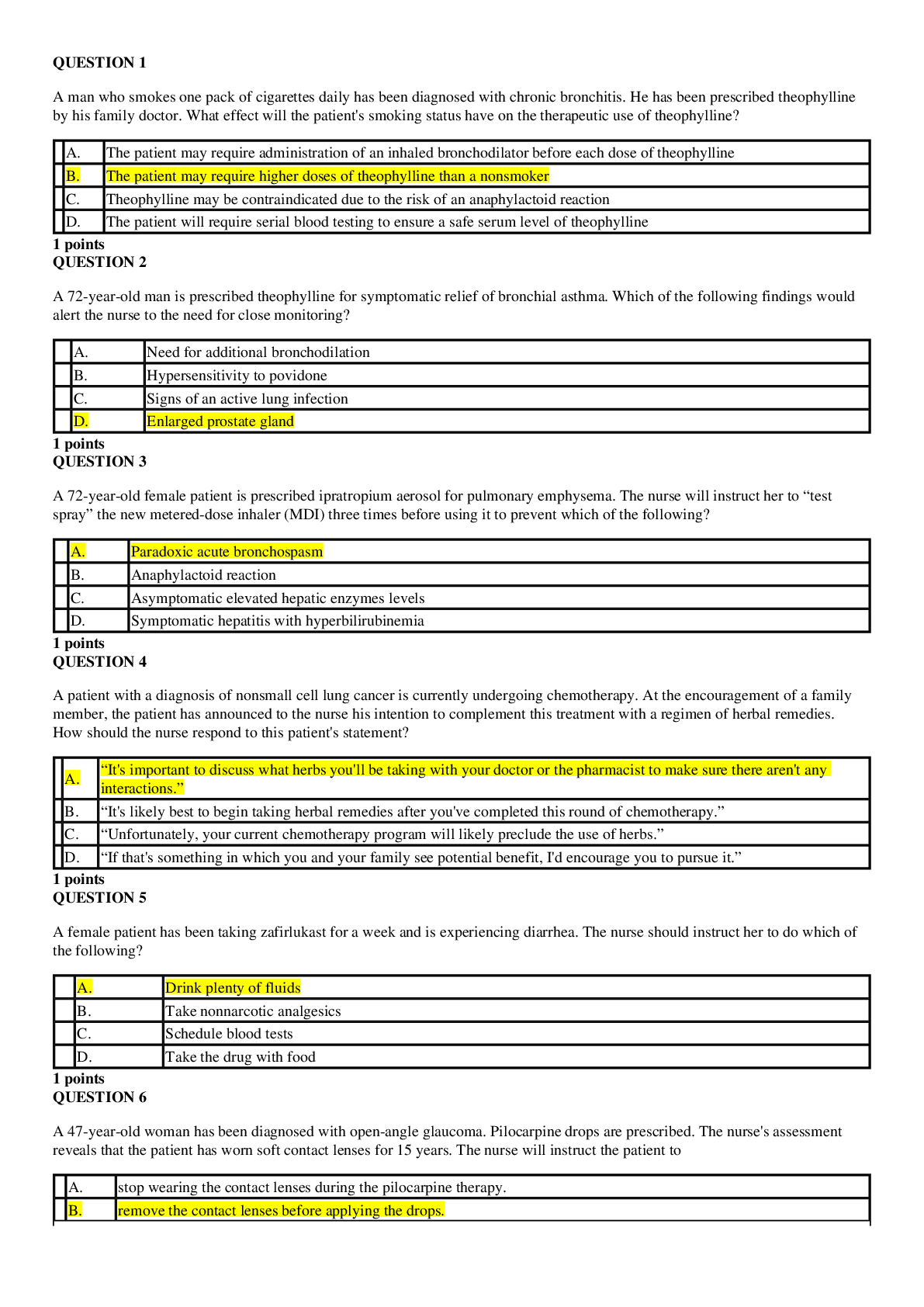
1. A man who smokes one pack of cigarettes daily has been diagnosed with chronic bronchitis. He has been prescribed theophylline by his family doctor. What effect will the patient's smoking status have on the
...
QUESTION 1
1. A man who smokes one pack of cigarettes daily has been diagnosed with chronic bronchitis. He has been prescribed theophylline by his family doctor. What effect will the patient's smoking status have on the therapeutic use of theophylline?
A. The patient may require administration of an inhaled bronchodilator before each dose of theophylline
B. The patient may require higher doses of theophylline than a nonsmoker
C. Theophylline may be contraindicated due to the risk of an anaphylactoid reaction
D. The patient will require serial blood testing to ensure a safe serum level of theophylline
1 points
QUESTION 2
1. A 72-year-old man is prescribed theophylline for symptomatic relief of bronchial asthma. Which of the following findings would alert the nurse to the need for close monitoring?
A. Need for additional bronchodilation
B. Hypersensitivity to povidone
C. Signs of an active lung infection
D. Enlarged prostate gland
1 points
QUESTION 3
1. A 72-year-old female patient is prescribed ipratropium aerosol for pulmonary emphysema. The nurse will instruct her to “test spray” the new metered-dose inhaler (MDI) three times before using it to prevent which of the following?
A. Paradoxic acute bronchospasm
B. Anaphylactoid reaction
C. Asymptomatic elevated hepatic enzymes levels
D. Symptomatic hepatitis with hyperbilirubinemia
1 points
QUESTION 4
1. A patient with a diagnosis of nonsmall cell lung cancer is currently undergoing chemotherapy. At the encouragement of a family member, the patient has announced to the nurse his intention to complement this treatment with a regimen of herbal remedies. How should the nurse respond to this patient's statement?
A. “It's important to discuss what herbs you'll be taking with your doctor or the pharmacist to make sure there aren't any interactions.”
B. “It's likely best to begin taking herbal remedies after you've completed this round of chemotherapy.”
C. “Unfortunately, your current chemotherapy program will likely preclude the use of herbs.”
D. “If that's something in which you and your family see potential benefit, I'd encourage you to pursue it.”
1 points
QUESTION 5
1. A female patient has been taking zafirlukast for a week and is experiencing diarrhea. The nurse should instruct her to do which of the following?
A. Drink plenty of fluids
B. Take nonnarcotic analgesics
C. Schedule blood tests
D. Take the drug with food
1 points
QUESTION 6
1. A 47-year-old woman has been diagnosed with open-angle glaucoma. Pilocarpine drops are prescribed. The nurse's assessment reveals that the patient has worn soft contact lenses for 15 years. The nurse will instruct the patient to
A. stop wearing the contact lenses during the pilocarpine therapy.
B. remove the contact lenses before applying the drops.
C. apply the drops directly on the contact lenses.
D. apply the contact lenses and wait 5 minutes before applying the drops.
1 points
QUESTION 7
1. A nurse is caring for a female patient who has developed atelectasis because of thick mucus secretions. The nurse is monitoring IV administration of acetylcysteine (Mucomyst) and notices that the patient's face is flushed. The appropriate nursing action would be to
A. remove any residual drug from the patient's face.
B. slow the administration of acetylcysteine and administer diphenhydramine if ordered.
C. dilute the acetylcysteine solution.
D. stop the administration of acetylcysteine.
1 points
QUESTION 8
1. Which of the following will a nurse inform the patient is one of the most common adverse effects of guaifenesin (Robitussin)?
A. Urinary retention
B. Gastrointestinal distress
C. Increased blood pressure
D. Increased blood glucose
1 points
QUESTION 9
1. A male patient is to begin treatment for pneumonia with an albuterol (Ventolin) inhaler. The nurse will advise the patient that he will most likely experience which of the following common adverse effects of the drug?
A. Dyspepsia
B. Muscle cramps
C. Throat irritation
D. Headache
1 points
QUESTION 10
1. A 54-year-old male patient with small-cell lung cancer is receiving etoposide. The nurse will carefully monitor for which of the following?
A. Hypoglycemia
B. Hypertension
C. Hypotension
D. Tachycardia
1 points
QUESTION 11
1. A nurse is providing patient education to a 42-year-old man who has been prescribed dextromethorphan (Robitussin). The patient is a crane operator for a local construction company. The nurse's assessment reveals that the patient is a smoker and has diabetes. The most important safety consideration while the nurse is designing a plan of care for this patient would be the fact that he is
A. a smoker.
B. 42 years of age.
C. a diabetic.
D. a crane operator.
1 points
QUESTION 12
1. A 57-year-old male patient who has been prescribed doxorubicin for small-cell lung cancer is advised by the nurse to avoid taking aspirin or drugs that contain aspirin because it may
A. cause extravasation injury.
B. promote bleeding.
C. cause acute nausea and vomiting.
D. cause a radiation recall reaction.
1 points
QUESTION 13
1. A high school student was diagnosed with asthma when he was in elementary school and has become accustomed to carrying and using his “puffers”. In recent months, he has become more involved in sports and has developed a habit of administering albuterol up to 10 times daily. The nurse should teach the student that overuse of albuterol can lead to
A. permanent liver damage.
B. rebound bronchoconstriction.
C. community-acquired pneumonia.
D. severe anticholinergic effects.
1 points
QUESTION 14
1. The lower respiratory system utilizes a number of different mechanisms that confer protection and maintain homeostasis. Which of the following physiological processes protects the lower respiratory system?
A. Goblet cells throughout the lower airways produce phagocytes that trap particles and microorganisms.
B. The carina, where the trachea bifurcates into two bronchi, closes off the lower airway in response to noxious stimuli.
C. Cilia sweep foreign material and mucus upward toward the trachea and larynx where they can then be swallowed.
D. The alveoli produce positive pressure in order to expel particles that have been inhaled.
1 points
QUESTION 15
1. The parents of a 7-year-old boy who has just been diagnosed with allergic asthma are being taught about their son's medication regimen by the nurse. The nurse is currently teaching the parent's about the appropriate use of a “rescue drug” for acute exacerbations of their son's asthma. What drug should the nurse suggests the parents to use in these situations?
A. Theophylline
B. Acetylcysteine
C. Beclomethasone
D. Albuterol
1 points
QUESTION 16
1. A female patient has been taking prednisone for her asthma for 1 month. The nurse will teach her to gradually decrease her dose of prednisone to avoid
A. adrenal insufficiency.
B. gastrointestinal problems.
C. menstrual irregularities.
D. hypokalemia.
1 points
QUESTION 17
1. A nurse is providing discharge planning for a 45-year-old woman who has a prescription for oral albuterol. The nurse will question the patient about her intake of which of the following?
A. Alcohol
B. Salt
C. Coffee
D. Vitamin C
1 points
QUESTION 18
1. Children age 6 to 11 are recommended to start with what dosage of Allegra?
A. 30 mg twice a day
B. 65 mg twice a day
C. 120 mg twice a day
D. 240 mg once a day
1 points
QUESTION 19
1. A nurse is providing education to a 56-year-old man who is admitted to the emergency department with an acute asthma attack. The nurse's initial assessment reveals that the patient has a history of pneumonia, drinks large quantities of coffee, and eats a high-calorie diet. Albuterol is prescribed for him. The important consideration when the nurse is preparing a teaching plan will be that the patient
A. is a 56-year-old man.
B. prefers a high-calorie diet.
C. has a high coffee intake.
D. has a history of pneumonia.
1 points
QUESTION 20
1. A college student has presented the campus medical clinic complaining of cold symptoms that he has been experiencing for the past 2 weeks. He tells the nurse that he has been taking OTC decongestants twice daily since the onset of the cold. What teaching point should the nurse provide to this student?
A. “Over-the-counter decongestants don't normally work; you'll likely need to get a prescription for something more effective.”
B. “It's best to take small doses of decongestants several times daily rather than two larger doses each day.”
C. “You might find yourself more congested than ever as your body compensates for your use of these drugs.”
D. “You can probably expect to get relief within the next few days or a week at the longest.”
1 points
QUESTION 21
1. A female patient calls the clinic and reports that since she has been taking dextromethorphan (Robitussin), she has been extremely drowsy and dizzy. The nurse will question the patient about which of the following?
A. The amount of water she drinks every day
B. The amount of grapefruit or orange juice she has during the day
C. The number of cups of coffee she has during the day
D. The amount of tea or soft drinks she has during the day
1 points
QUESTION 22
1. A 24-year-old factory worker has been prescribed guaifenesin for the first time. Which of the following will be a priority assessment by the nurse before the patient's first dose?
A. The amount of fatty foods eaten daily
B. The amount of salt intake
C. The amount of alcohol consumption
D. The number of cigarettes smoked per day
1 points
QUESTION 23
1. A woman has a long history of seasonal allergies that are typically accompanied by rhinorrhea, red eyes, and frequent sneezing. Sneezes are a result of
A. elevated CO2 levels that are detected by chemoreceptors in the large vessels.
B. a reflex that is caused when irritants come into contact with cilia.
C. stimulation of goblet cells and mast cells by the presence of microorganisms.
D. a CNS reflex that is initiated by receptors in the nasal cavities.
1 points
QUESTION 24
1. After a recent history of shortness of breath that has become increasingly severe, a woman has been prescribed ipratropium by MDI while she undergoes a diagnostic workup. What patient teaching should the nurse provide to this patient?
A. “Make sure that you take this at the scheduled times, regardless of whether you feel short of breath.”
B. “It's important that you perform deep breathing exercises before and after taking ipratropium.”
C. “You should think of this as an 'emergency drug', and it should only be used when you experience symptoms.”
D. “Most people find that ipratropium cures their lung disease within a few months.”
1 points
QUESTION 25
1. A patient with bronchial asthma is prescribed a sustained-release preparation of theophylline. To help minimize the adverse effects of the drug, which of the following should the nurse suggest?
A. Take it with foods containing xanthines, such as caffeine
B. Increase the drug dosage up to 50%
C. Take it on an empty stomach, 1 hour before or 2 hours after meals
D. Take it with a meal
1 points
QUESTION 26
1. A 68-year-old man complains of a chronic, nonproductive cough. He states that he has to have relief, that he has been coughing every 2 to 3 minutes, and he is worn out. Dextromethorphan is prescribed for him. Before he leaves the clinic he asks how long it will take for the medicine to work. The nurse will advise him that he should experience therapeutic effects in
A. 60 minutes.
B. 10 minutes.
C. 15 to 30 minutes.
D. 5 minutes.
1 points
QUESTION 27
1. A patient is being treated for respiratory infection. He is a recovering alcoholic and has impaired liver function. The nurse will instruct the patient to be especially cautious when taking
A. a syrup.
B. an elixir.
C. a tablet.
D. a troche.
1 points
QUESTION 28
1. A female patient, age 36, is prescribed inhaled corticosteroid (ICS) for daily use. Which of the following adverse effects should the nurse closely monitor for in this patient?
A. Hypotension
B. Oropharyngeal Candida albicans infection
C. Suppression of the hypothalamic-pituitary-adrenal axis
D. Delayed growth
1 points
QUESTION 29
1. A 70-year-old woman has a complex medical and a current drug regimen that includes calcium and vitamin D supplements for osteoporosis, metformin (Glucophage) for type 2 diabetes, phenelzine (Nardil) for depression, and metoprolol (Lopressor) and furosemide (Lasix) for hypertension. The woman is requesting dextromethorphan for the treatment of a recurrent cough. What component of her drug regimen contraindicates the use of dextromethorphan?
A. Phenelzine (Nardil)
B. Calcium supplements
C. Metoprolol (Lopressor)
D. Metformin (Glucophage)
1 points
QUESTION 30
1. A 25-year-old woman comes to the clinic because of a chronic, nonproductive cough. Assessment reveals that she has a history of asthma and dextromethorphan, (Robitussin) is prescribed for her. The nurse will question this order because
A. persistent coughing may develop.
B. respiratory secretions may be thickened.
C. secretions may be retained.
D. serotonin syndrome may result.
1 points
QUESTION 31
1. When completing this quiz, did you comply with Walden University’s Code of Conduct including the expectations for academic integrity?
Yes
No
0 points
[Show More]


_removed.png)