ATI Care for Children Practice A 2019.
Revised questions with rationale
answers.
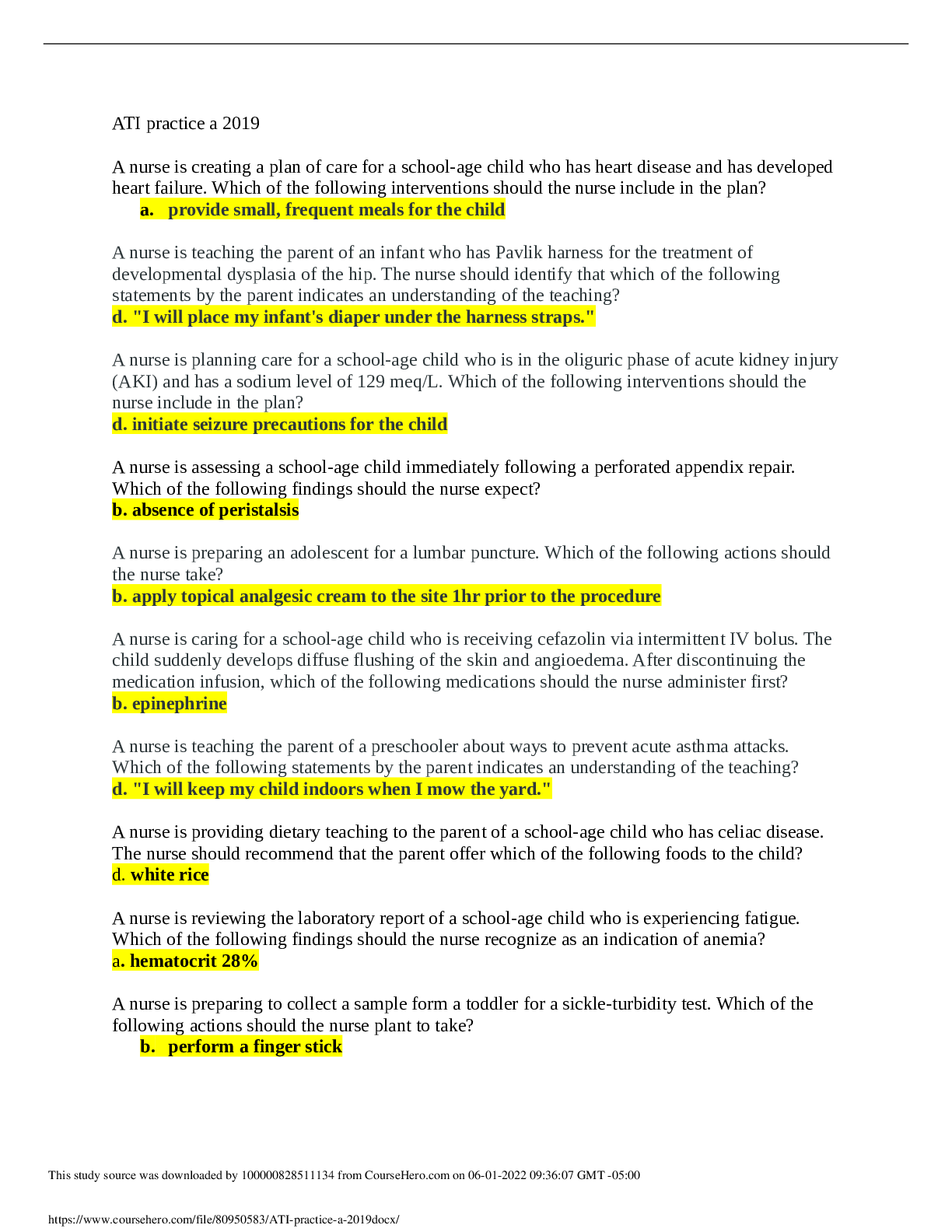
A nurse is caring for a school-age child who is receiving cefazolin via intermittent IV bolus. This child
suddenly develops diffuse flu
...
ATI Care for Children Practice A 2019.
Revised questions with rationale
answers.
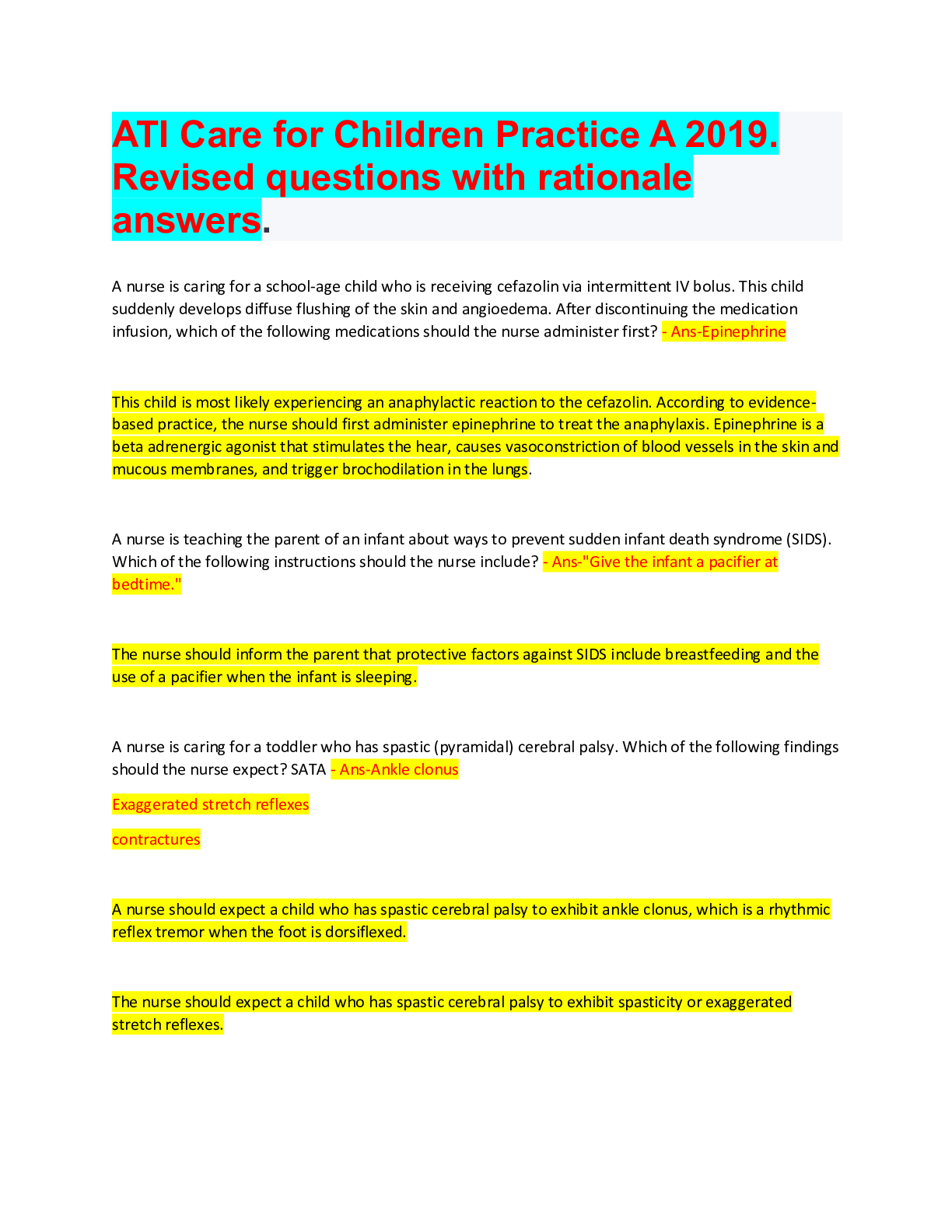
A nurse is caring for a school-age child who is receiving cefazolin via intermittent IV bolus. This child
suddenly develops diffuse flushing of the skin and angioedema. After discontinuing the medication
infusion, which of the following medications should the nurse administer first? - Ans-Epinephrine
This child is most likely experiencing an anaphylactic reaction to the cefazolin. According to evidencebased practice, the nurse should first administer epinephrine to treat the anaphylaxis. Epinephrine is a
beta adrenergic agonist that stimulates the hear, causes vasoconstriction of blood vessels in the skin and
mucous membranes, and trigger brochodilation in the lungs.
A nurse is teaching the parent of an infant about ways to prevent sudden infant death syndrome (SIDS).
Which of the following instructions should the nurse include? - Ans-"Give the infant a pacifier at
bedtime."
The nurse should inform the parent that protective factors against SIDS include breastfeeding and the
use of a pacifier when the infant is sleeping.
A nurse is caring for a toddler who has spastic (pyramidal) cerebral palsy. Which of the following findings
should the nurse expect? SATA - Ans-Ankle clonus
Exaggerated stretch reflexes
contractures
A nurse should expect a child who has spastic cerebral palsy to exhibit ankle clonus, which is a rhythmic
reflex tremor when the foot is dorsiflexed.
The nurse should expect a child who has spastic cerebral palsy to exhibit spasticity or exaggerated
stretch reflexes.
The nurse should expect a child who has spastic cerebral palsy to exhibit contractures due to the
tightening of the muscles
A nurse is providing discharge teaching to the parent of a child who is 1 week postoperative following a
cleft palate repair. For which of the following members of the inter professional team should the nurse
initiate a referral? - Ans-Speech therapist
The nurse should initiate a referral for a speech therapist who is postoperative following a cleft palate
repair. A child who has a cleft palate will require speech therapy immediately following the repair to
support speech development and future articulation.
A nurse is creating a plan of care for an infant who has an epidural hematoma from a head injury. Which
of the following interventions should the nurse include in the plan? - Ans-Implement seizure precautions
for the infant.
An infant who has an epidural hematoma is at great risk for seizure activity. Therefore, the nurse should
implement seizure precautions for the child.
A nurse is preparing an adolescent for a lumbar puncture. Which of the following actions should the
nurse take? - Ans-Apply topical analgesic cream to the site 1 hr prior to the procedure.
The nurse should apply a topical analgesic to the lumbar site 1 hr prior to the procedure to decrease the
adolescent's pain while the lumbar needle is inserted.
A nurse is providing teaching to the parent of a school-age child who has a new prescription for oral
nystatin for the treatment of oral candidiasis. Which of the following instructions should the nurse
include? - Ans-"Shake the medication prior to administration."
The nurse should instruct the parent to shake the medication prior to administration to disperse the
medication evenly within the suspension.
A nurse in an ED is performing a physical assessment on a 2 week old male newborn. Which of the
following findings is the priority for the nurse to report to the provider? - Ans-Substernal retractions
When using the ABC approach to client care, the nurse should determine that the priority finding to
report to the provider is substernal retractions. This finding indicates the newborn is experiencing
increased resp effort, which could quickly progress to resp failure.
A nurse if receiving change of shift report for four children. Which of the following children should the
nurse see first? - Ans-A school age child who has sickle cell anemia and reports decreased vision in the
left eye
When using the urgent vs. non urgent approach to client care, the nurse should determine the priority
finding is a report of decreased vision in the left eye. This finding indicates that he child is experiencing a
vaso-occlusive crisis and should be reported to the provider immediately. Therefore, the nurse should
see this child first.
A nurse is assessing a school age child who has meningitis. Which of the following findings is the priority
for the nurse to report to the provider? - Ans-Petechiae on the lower extremities
The presence of a petechial of purpuric rash on a child who is ill can indicate the presence of
minigococcemia. This type of rash indicates the greatest risk of serious rapid complications from sepsis
and should be reported immediately to the provider.
A nurse is assessing a 3 year old toddler at a well child visit. Which of the following manifestations
should the nurse report to the provider? - Ans-The nurse should identify that a resp rate of 45/min is
above the expected reference rage of 20-25/min for a 3 year old toddler and can indicate resp
dysfunction and acute resp distress. Therefore, the nurse should report this finding to the provider
A nurse is reviewing the lab report of a school age child who is experiencing fatigue. Which of the
following findings should the nurse recognize as an indication of anemia? - Ans-Hematocrit 28%
The nurse should recognize that this hematocrit level is below the expected reference range of 32-44%
for a school age child. This child can exhibit fatigue, lightheadedness, tachycardia, dyspnea, and pallor
due to the decreased oxygen carrying capacity.
A nurse is planning care for a school-age child who is in the oliguric phase of acute kidney injury (AKI)
and has a sodium level of 129 mEq/L. Which of the following interventions should the nurse include in
the plan? - Ans-Initiate seizure precautions for the child.
A sodium level of 129mEq/L indicates hyponatremia and places the child at risk for neurological deficits
and seizure activity. The nurse should complete a neurolgic assessment and implement seizure
precautions to maintain the child's safety,
A nurse is assessing the vital signs of a 10 year old child following a burn injury. The nurse should identify
that which of the following findings is an indication of early septic shock? - Ans-Temperature 39.1 C
(102.4 F)
The nurse should identify that a temp of 39.1 C is above the expected reference rage of 37-37.5 C (98.6-
99.5 F) for a 10 year old child. The nurse should expect a child who has early septic should to have a
fever a chills.
A nurse is caring for an infant who has respiratory syncytial virus (RSV). Which of the following actions
should the nurse implement for infection control? - Ans-Have a designated stethoscope in the infant's
room.
The nurse should initiate droplet precautions for an infant who has RSV because the virus is spread by
direct contact with resp secretions. Therefore, designated equipment, such as a blood pressure cuff and
a stethoscope, should be places in the infant's room.
A nurse is caring for a 15 year old client following a head injury. Which of the following findings should
the nurse identify as an indication that the child is developing syndrome of inappropriate antidiurectic
hormone secretion (SIADH)? - Ans-Mental Confusion
A child who has a head injury can develop SIADH
[Show More]