• Question 1
0 out of 0 points
Gas exchange occurs in which of the respiratory system's structures?
Selected
Answer: Trache a
Correct
Answer: Alveoli
Response Feedback:
The alveoli allow air to come in
...
• Question 1
0 out of 0 points
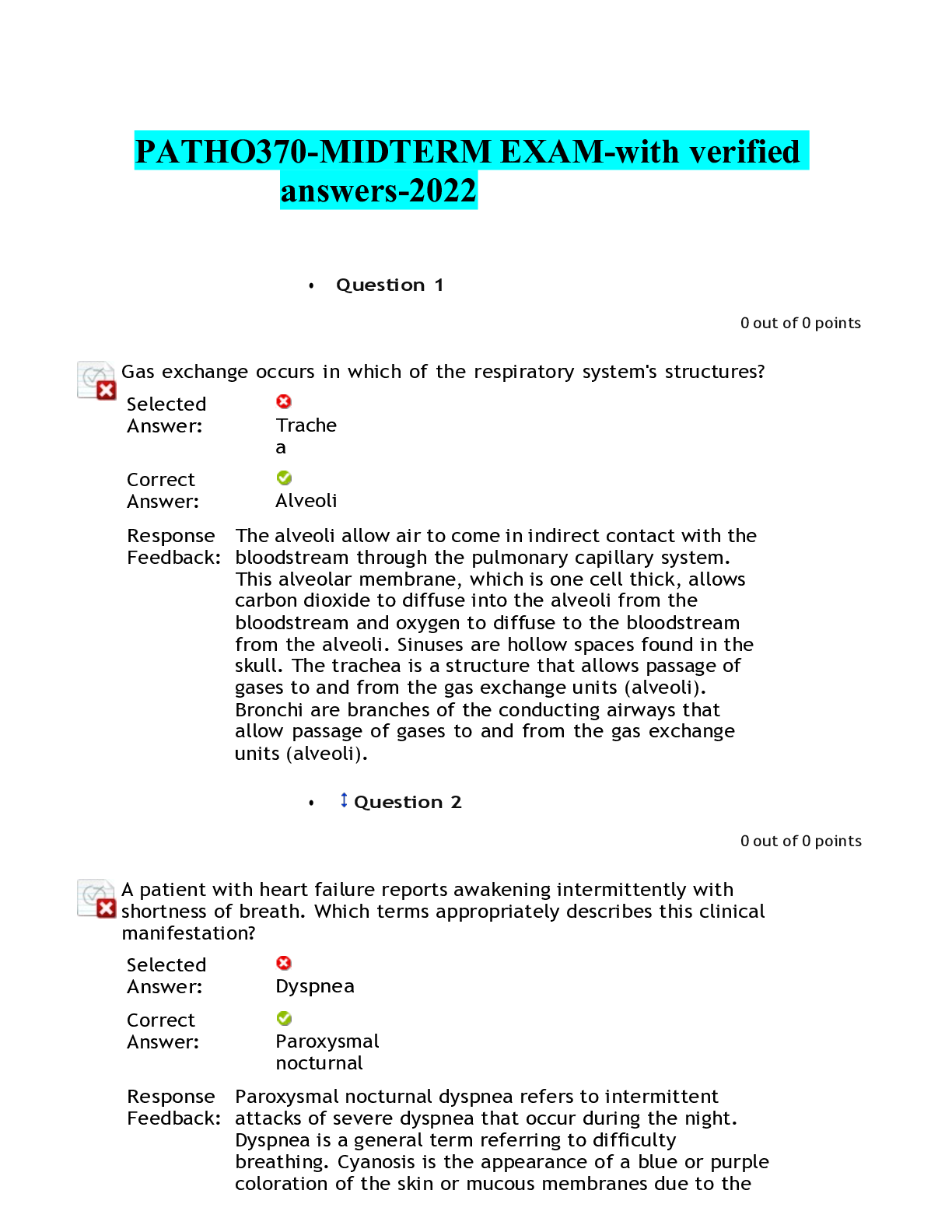
Gas exchange occurs in which of the respiratory system's structures?
Selected
Answer: Trache a
Correct
Answer: Alveoli
Response Feedback:
The alveoli allow air to come in indirect contact with the bloodstream through the pulmonary capillary system.
This alveolar membrane, which is one cell thick, allows carbon dioxide to diffuse into the alveoli from the bloodstream and oxygen to diffuse to the bloodstream from the alveoli. Sinuses are hollow spaces found in the skull. The trachea is a structure that allows passage of gases to and from the gas exchange units (alveoli).
Bronchi are branches of the conducting airways that allow passage of gases to and from the gas exchange units (alveoli).
• Question 2
0 out of 0 points
A patient with heart failure reports awakening intermittently with shortness of breath. Which terms appropriately describes this clinical manifestation?
Selected
Answer: Dyspnea
Correct
Answer: Paroxysmal nocturnal
Response Feedback:
Paroxysmal nocturnal dyspnea refers to intermittent attacks of severe dyspnea that occur during the night. Dyspnea is a general term referring to difficulty breathing. Cyanosis is the appearance of a blue or purple coloration of the skin or mucous membranes due to the
tissues near the skin surface being low on oxygen. Bradypnea describes abnormal slowness of breathing.
• Question 3
0 out of 0 points
What factor causes a congenital heart disease to produce cyanosis?
Selected
Answer: Left-to-right shunting of
blood
Correct
Answer: Right-to-left shunting of
blood
Response Feedback:
Disorders that result in right-to-left shunting cause cyanosis. A left-to-right shunt occurs when oxygenated blood from the left side of the heart or aorta flows back into the right side to be recirculated through the lungs. The blood reaching the systemic circulation is oxygenated and the infant is not cyanotic (acyanotic defect). However, the right side of the heart has an increased workload because of the extra shunt blood. In time, the overload of the right side of the heart can result in right ventricular hypertrophy and high right-sided heart pressures. Large ventricular septal defects may be apparent at birth because of rapidly developing right- sided heart failure and a loud systolic murmur. The majority of atrial septal defects occur at the location of the foramen ovale. The abnormal septal opening may be of variable size. Small defects (1 cm) are well tolerated.
Even larger atrial septal defects may be asymptomatic for many years as long as the shunt flow is left to right and therefore acyanotic.
CONTINUED...........
[Show More]