LIFEGUARDING PRACTICE TEST. All
questions & answers. Graded 2022/2023.
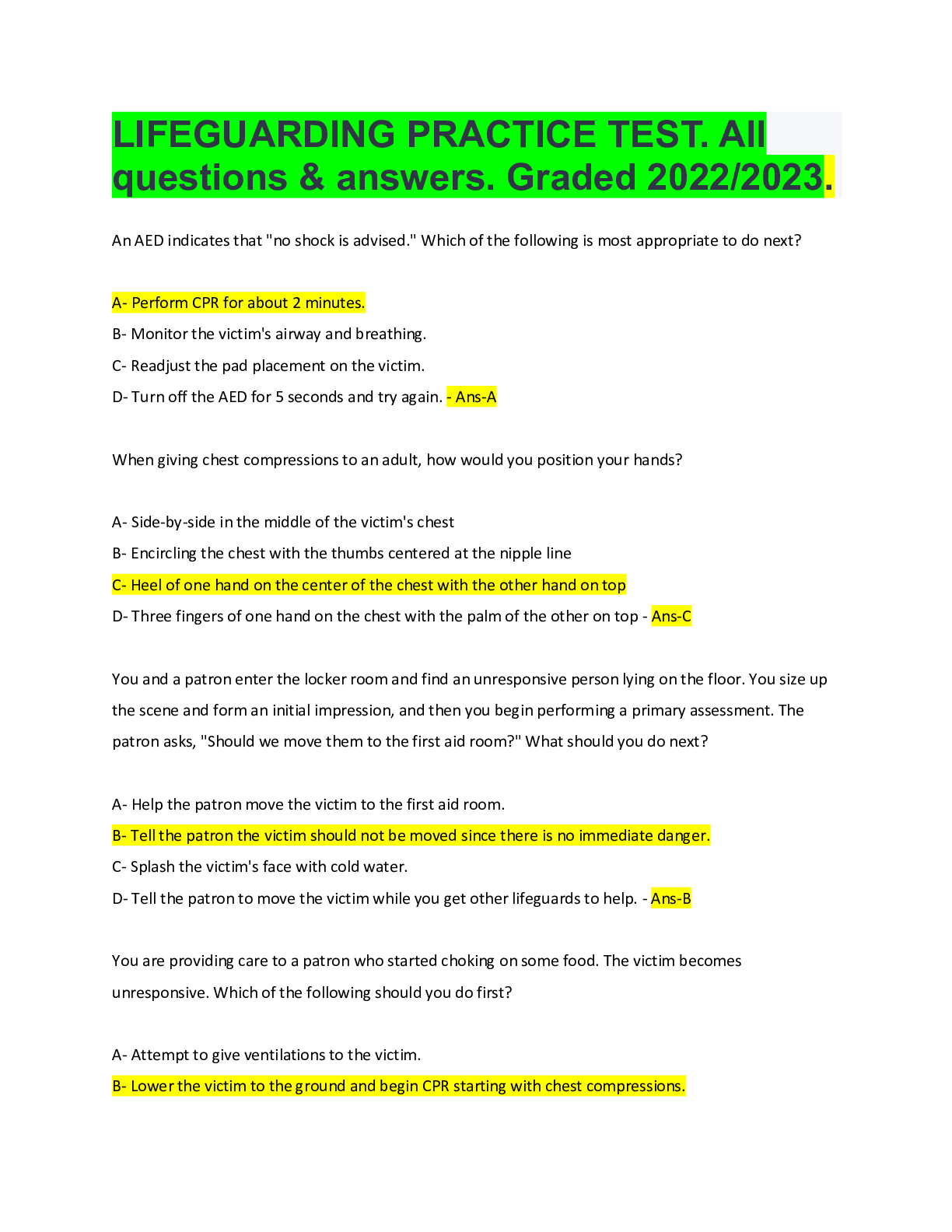
An AED indicates that "no shock is advised." Which of the following is most appropriate to do next?
A- Perform CPR for about 2 minutes.
B- Monito
...
LIFEGUARDING PRACTICE TEST. All
questions & answers. Graded 2022/2023.
An AED indicates that "no shock is advised." Which of the following is most appropriate to do next?
A- Perform CPR for about 2 minutes.
B- Monitor the victim's airway and breathing.
C- Readjust the pad placement on the victim.
D- Turn off the AED for 5 seconds and try again. - Ans-A
When giving chest compressions to an adult, how would you position your hands?
A- Side-by-side in the middle of the victim's chest
B- Encircling the chest with the thumbs centered at the nipple line
C- Heel of one hand on the center of the chest with the other hand on top
D- Three fingers of one hand on the chest with the palm of the other on top - Ans-C
You and a patron enter the locker room and find an unresponsive person lying on the floor. You size up
the scene and form an initial impression, and then you begin performing a primary assessment. The
patron asks, "Should we move them to the first aid room?" What should you do next?
A- Help the patron move the victim to the first aid room.
B- Tell the patron the victim should not be moved since there is no immediate danger.
C- Splash the victim's face with cold water.
D- Tell the patron to move the victim while you get other lifeguards to help. - Ans-B
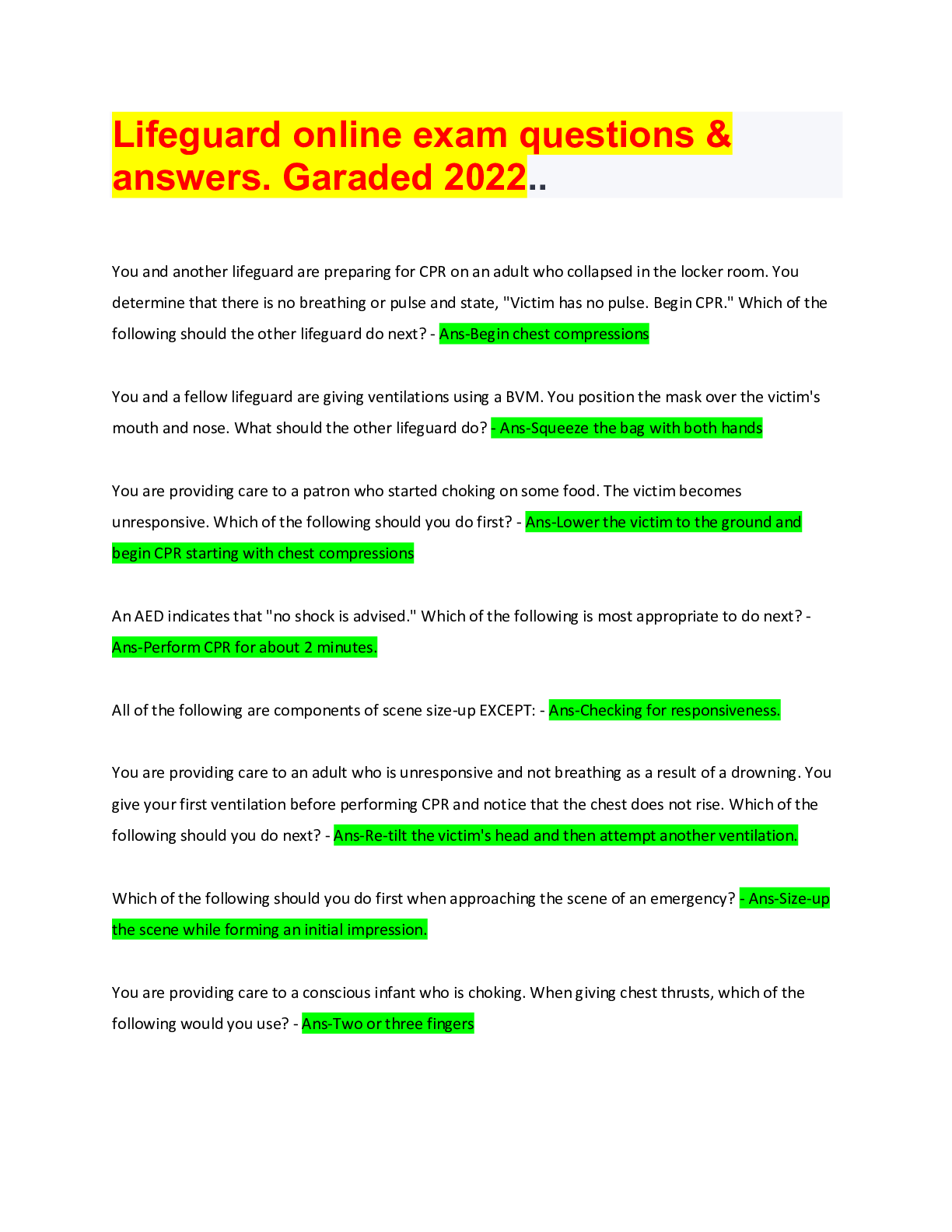
You are providing care to a patron who started choking on some food. The victim becomes
unresponsive. Which of the following should you do first?
A- Attempt to give ventilations to the victim.
B- Lower the victim to the ground and begin CPR starting with chest compressions.C- Lower the victim to the ground and open their airway.
D- Look inside the victim's mouth and use your fingers to remove the obstruction. - Ans-B
An injured patron is responsive and bleeding. After summoning EMS personnel, obtaining consent and
putting on disposable gloves, what is your next care step?
A- Treat the victim for shock by lying the victim down.
B- Elevate the wound if you can do so without causing further pain.
C- Press firmly against the wound with a sterile dressing and bandage.
D- Let the wound bleed until it stops on its own. - Ans-C
You arrive on a scene where someone seems to be hurt. During the primary assessment, you should
check for all of the following EXCEPT:
A- Swelling.
B- Bleeding.
C- Breathing.
D- Consciousness. - Ans-A
You are providing care to a conscious infant who is choking. When giving chest thrusts, which of the
following would you use?
A- Fist of the hand
B- Two or three fingers
C- Heel of the hand
D- Two hands - Ans-B
Based on which of the following signs and symptoms would you determine that a victim is experiencing
respiratory distress?
A- Complaints of feeling "really thirsty"
B- Sneezing with watery eyesC- Gasping for breath
D- Yellowish skin - Ans-C
You and another lifeguard are preparing for CPR on an adult who collapsed in the locker room. You
determine that there is no breathing or pulse and state, "Victim has no pulse. Begin CPR." Which of the
following should the other lifeguard do next?
A- Check for breathing.
B- Give 2 ventilations.
C- Begin chest compressions.
D- Open the airway. - Ans-C
[Show More]