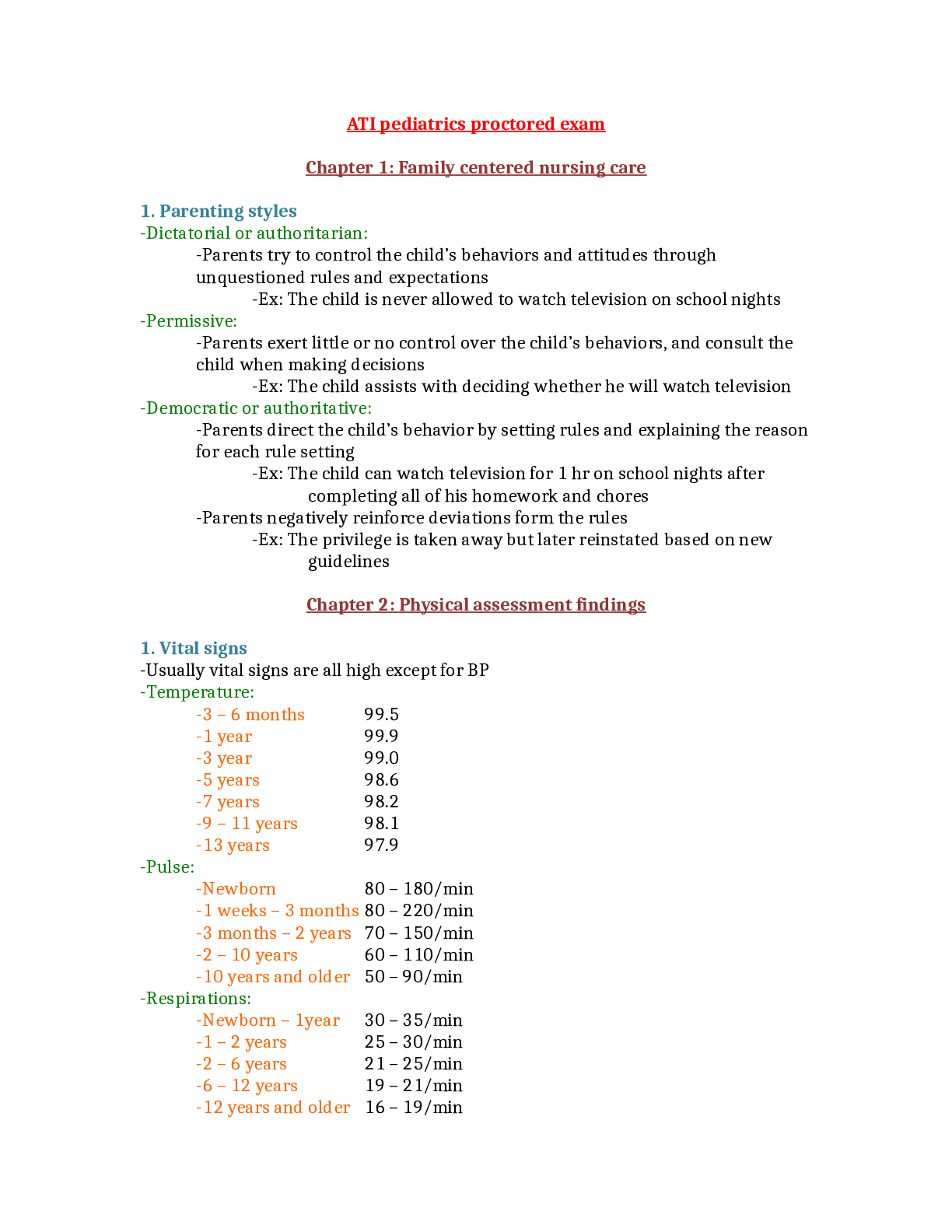
Initial Assessment
● Preparation and Triage
○ Use universal precautions and don PPE
○ Consider any possible patient exposure to hazardous material that puts the trauma team at risk ○ Safe
practice, safe care
○ Ensur
...
Initial Assessment
● Preparation and Triage
○ Use universal precautions and don PPE
○ Consider any possible patient exposure to hazardous material that puts the trauma team at risk ○ Safe
practice, safe care
○ Ensure resuscitation equipment is readily available
● Across the room observation to identify any uncontrolled external hemorrhage
○ Need to reprioritize to Circulation and Control of Hemorrhage
○ Uncontrolled hemorrhage is the major cause of preventable death in trauma patients
● Primary Survey - Inspect, Auscultate, Palpate
○ A: Airway and alertness with cervical spine stabilization
■ AVPU (Alert/verbal stimuli/painful stimuli/unresponsive)
■ Jaw-thrust maneuver to open the airway and assess for obstruction
● Tongue obstruction
● Loose teeth, foreign objects
● Blood, vomitus, secretions
● Edema
■ Listen for obstructive airway sounds (snoring, gurgling, stridor)
■ Feel for subcutaneous emphysema or deformities
■ Definitive Airway devices = ET tube
● Assess for proper placement (ETCO2, bilat breath sounds, absence of gurgling over the
epigastrium)
■ Suction the airway if needed, then reassess
○ B: Breathing and ventilation
■ Are they breathing? How well are they breathing? How long can they keep it up?
■ Spontaneous breathing? Symmetrical rise and fall?
■ Depth, pattern, and rate
■ Skin color
■ Breath sounds
■ Palpate bony structures for possible rib fractures, subcutaneous emphysema, soft tissue injury ■
Open the airway if needed
● Use oral airway adjunct, assist ventilations, then prepare for definitive airway
○ C: Circulation and Control of Hemorrhage
■ Any signs of uncontrolled external bleeding?
● Apply direct pressure or use a tourniquet
■ Skin color, temp, and moisture?
■ Listen to heart and lung sounds
■ Palpate central pulses for rate, rhythm, and strength
■ 2 large-bore IVs
● IO if needed
■ Initiate Warmed isotonic crystalloid solution infusion at a controlled rate
● Consider balanced resuscitation needs
● Rapid infusion protocols
■ Component Therapy = replacing patient loss by administering RBCs, plasma, and platelets = balanced
approach
● Suggested for fluid resuscitation instead of standard approach (large volumes of IV fluids)
○ D: Disability (Neuro status)
■ GCS (not accurate if patient is intubated) and trends
■ Assess pupils
■ Need for CT of head and cervical spine?
○ E: Exposure & Environment
■ Remove all clothing
■ Inspect for any uncontrolled bleeding or any obvious injuries
■ Keep the patient warm
● Blankets, fluids, room temp, O2
● Aggressive measures are to be taken to prevent loss of body heat
● Hypothermia + hypotension + acidosis = TRAUMA TRIAD OF DEATH
○ F: Full set of VS and Family presence
■ Monitor ef ectiveness of resuscitation ef orts and trend VS
[Show More]











![Preview of Leadership ATI Study Guide 149 Terms [A+ GUIDE]](https://scholarfriends.com/storage/Leadership ATI Study Guide.png)